Backyard Fire Pit Ideas Landscaping: Layouts, Surfaces & Planting Guide
A fire pit is more than a fire ring in the grass. Discover how professional landscape designers blend noncombustible ground planes, ergonomic seating radiuses, fire-safe plantings, Massachusetts safety codes, and drainage physics into a cohesive outdoor living retreat.
Successful backyard fire pit landscaping requires far more than dropping a metal bowl onto your lawn. True landscape integration harmonizes eight core layers: (1) an authoritative 25-foot structural setback for wood burning under Massachusetts fire codes, (2) a stable, noncombustible ground plane (compacted pea gravel, pavers, or bluestone), (3) a minimum patio diameter of 14 to 18 feet ensuring 7 to 8 feet of radius from the fire center, (4) unobstructed 3-foot perimeter circulation behind chairs, (5) fire-safe, non-resinous perennial plantings set back at least 6 to 8 feet, (6) integrated low-voltage lighting for nighttime pathway safety, (7) windbreak and privacy screening outside the heat radius, and (8) positive slope drainage preventing pooling water beneath footings.
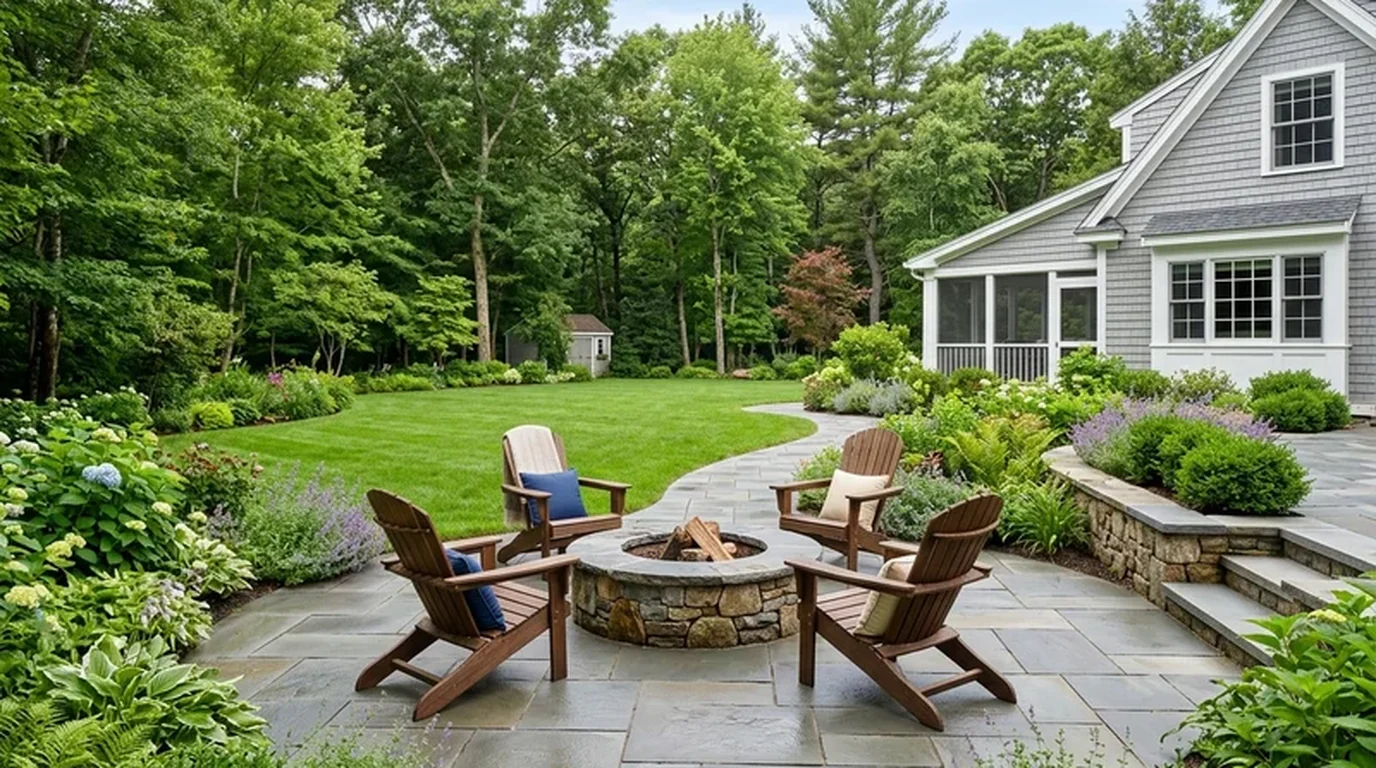
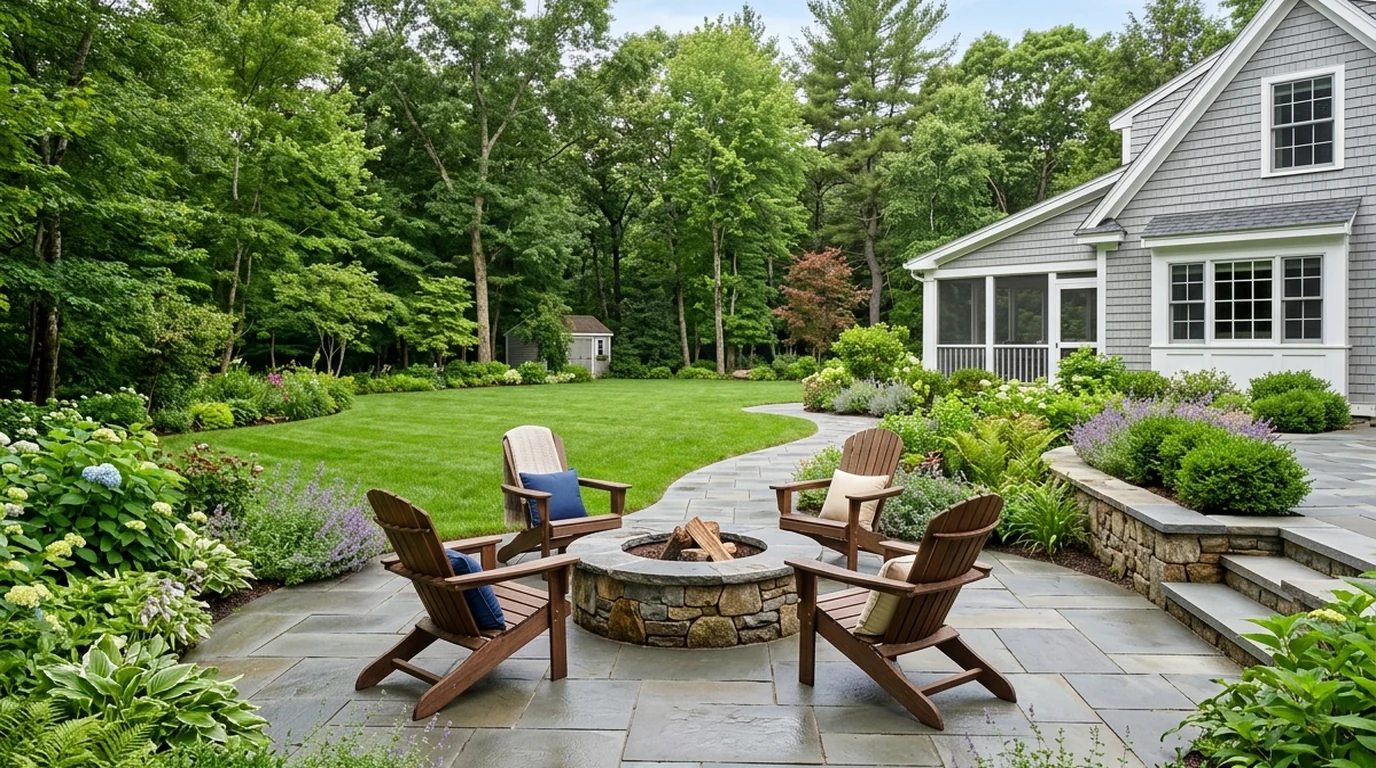
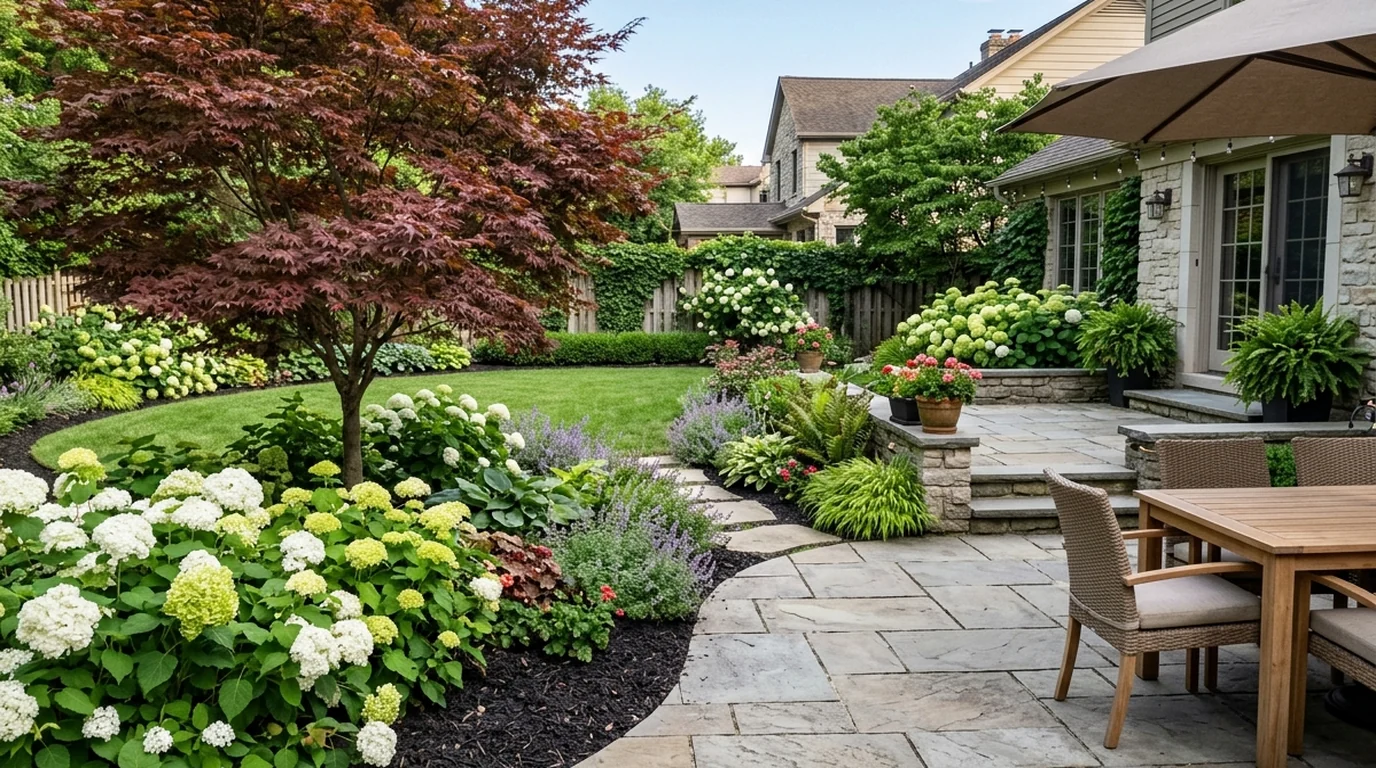
Integrated Outdoor Hearth: A complete fire pit landscape balances a durable noncombustible floor, generous seating clearances, ambient pathway lighting, and lush perimeter plantings outside the heat zone.
When homeowners search for backyard fire pit ideas landscaping, they are frequently bombarded with glossy photo galleries showcasing fire bowls with zero explanation of how the surrounding space actually works. Where do people walk when sparks fly? How do you keep chairs from sinking into soggy spring turf? What plants survive the heat, and why do town fire marshals shut down fire pits built too close to vinyl siding?
Whether you are planning an economical weekend pea-gravel circle or engineering a permanent masonry seat-wall terrace, this guide walks you through the spatial geometry, ground surface physics, horticultural considerations, and Massachusetts regulatory guidelines necessary to build a safe, durable backyard destination.
Decision Matrix
Fire Pit Landscape Typologies Compared
Evaluate the six dominant fire pit landscape styles across spatial footprint, surface material, seating ergonomics, typical budget, and ongoing maintenance.
Landscape Style
Footprint / Space
Ground Surface
Primary Seating
Est. Cost Range
Maintenance
Best Yard Application
Rustic Pea Gravel Circle
14–16 ft dia (160–200 sq ft)
Compacted 3/8″ pea gravel / crushed stone
Movable classic Adirondack chairs
$1,200 – $3,500
Low-Moderate (periodic raking)
Budget-conscious yards, informal wooded settings
Interlocking Paver Patio
16–20 ft dia (200–320 sq ft)
ASTM C936 concrete pavers with soldier border
Deep outdoor club chairs / loveseats
$4,500 – $9,500
Low (sweeping, joint sand every 3 yrs)
Suburban family yards, high-traffic entertainment
Natural Bluestone Hearth
18–22 ft dia (250–380 sq ft)
Thermal bluestone or native fieldstone
Granite boulder benches & teak chairs
$7,000 – $16,000
Very Low (hosing, seasonal leaf clearing)
Historic New England homes, high-end estates
Curved Masonry Seat Wall
16–20 ft dia (200–320 sq ft)
Pavers or bluestone with 18″ stone bench wall
Integrated stone seat wall with capstone
$6,500 – $14,000
Very Low (permanent masonry structure)
Hosting large groups, windy or exposed lots
Modern Linear Gas Terrace
14–18 ft rectilinear (200–300 sq ft)
Large-format architectural concrete slabs
Low-profile sectional & lounge chairs
$8,500 – $18,000
Ultra-Low (no ash, instant electronic switch)
Contemporary homes, compact patio extensions
Terraced Hillside Enclave
16–22 ft cut terrace (250–400 sq ft)
Segmental block retaining wall & crushed stone
Integrated terraced steps & lounge seating
$9,000 – $22,000
Low (engineered retaining wall drainage)
Sloped lots, walk-out basements, hilly terrain
*Cost ranges reflect typical 2026 Essex County, MA contractor installations including base excavation and materials.Explore Essex County cost benchmarks
12 Design Frameworks
12 Backyard Fire Pit Landscaping Ideas & Layouts
Explore detailed design blueprints covering surface mechanics, ergonomic clearances, planting choices, and common mistakes for every yard style.
1. The Rustic Pea Gravel Circle with Heavy Steel Fire Ring
Crushed stone and 3/8-inch rounded pea gravel create one of the most cost-effective, naturally permeable, and charming fire pit ground surfaces available. Instead of building expensive concrete footings, you excavate a 16-foot circular bowl, install commercial-grade nonwoven geotextile fabric, anchor rigid steel or cobblestone edging, and pack a 3-inch layer of washed crushed aggregate.
Permeable Ground Plane: Pea gravel naturally drains heavy rainfall, prevents standing puddles, and pairs effortlessly with classic wood Adirondack chairs.
Diameter14–16 Feet
Surface Depth3″ Stone / Fabric
Est. Material$800 – $1,800
Pro Install$2,200 – $3,500
How to Execute: Outline a 16-foot circle with marking paint. Excavate 4 inches of topsoil, maintaining a level subgrade. Place heavy-duty steel or aluminum landscape edging anchored with 12-inch spiral steel spikes. Lay 4-ounce non-woven geotextile fabric to stop weeds without trapping moisture. Spread 2 inches of 3/4-inch crushed stone as a stabilizing base, topped with 1.5 inches of washed pea gravel. Set a heavy 10-gauge corten steel fire ring directly in the center on top of two dry-stacked layers of solid concrete masonry units.
Watch-Out for Chair Legs: Pure round pea gravel shifts under chair legs. To prevent chairs from sinking, use pea stone with angular crushed stone dust or embed flat bluestone stepping stones directly under each chair’s contact points.
Concept #2 · High Durability & Family EntertainmentSuburban Backyards / Outdoor Dining
2. Circular Concrete Paver Fire Pit Patio with Soldier Course
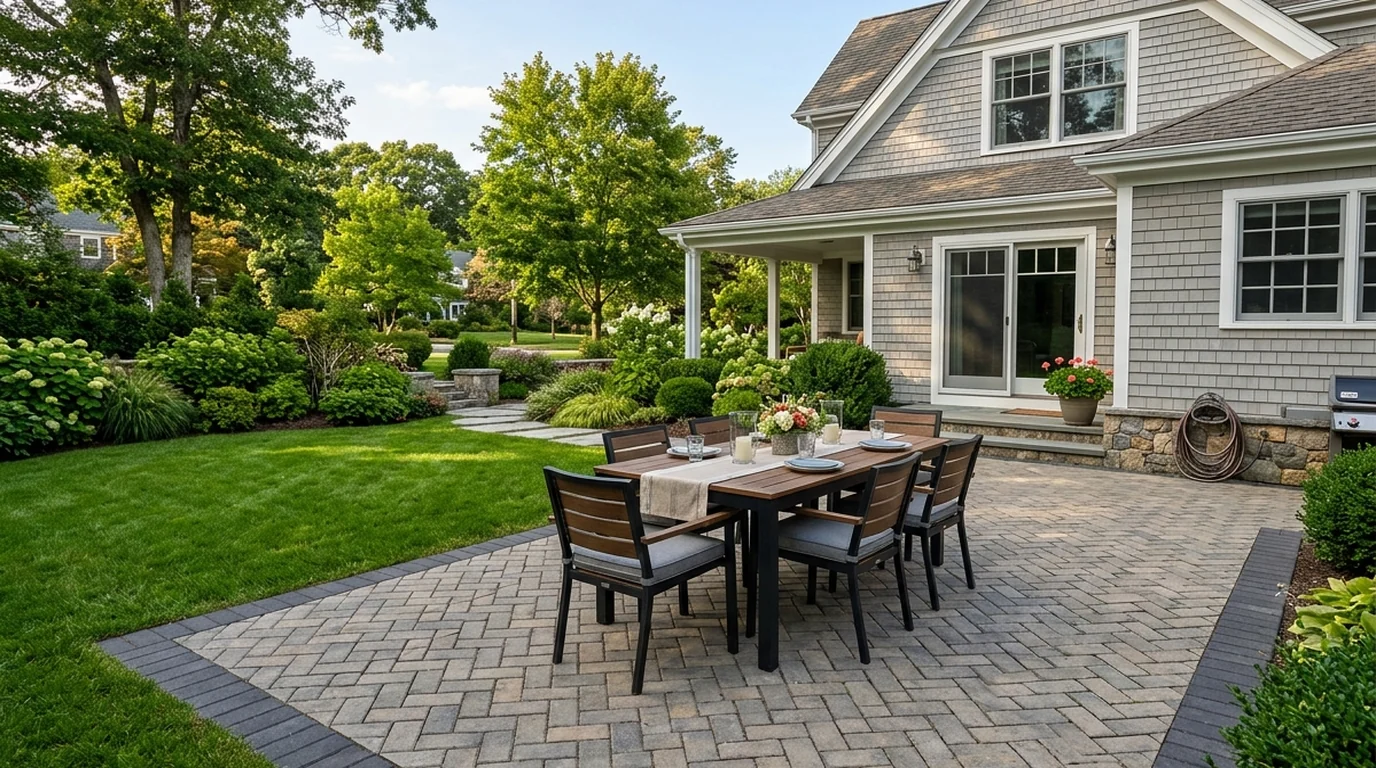
Interlocking concrete pavers offer unbeatable structural stability, uniform sliding for heavy patio furniture, and exceptional resilience against New England freeze-thaw cycles. By framing the perimeter with a darker contrasting soldier-course border, the fire pit area reads as a dedicated architectural outdoor room rather than an afterthought.
Architectural Integration: Circular concrete paver field framed by a charcoal soldier-course border creates crisp separation between patio hardscape and turf.
Patio Diameter18–20 Feet
Base Requirement6″ Dense Crushed Stone
Fire Pit CopingBullnose Concrete Caps
Typical Installed Cost$5,500 – $9,800
How to Execute: Excavate 9 to 10 inches below finished grade to allow for a 6-inch compacted crushed aggregate base (Massachusetts dense-grade gravel), 1 inch of screeded concrete sand (ASTM C33), and 2-3/8-inch interlocking pavers conforming to ASTM C936. Construct the fire pit ring using high-density concrete wall blocks with fire-rated refractory interior liner or a protective steel drop-in ring. Fill paver joints with polymeric sand activated with fine water mist to lock the surface against ant hills and weeds.
Chair Clearance Rule: Allow at least 48 inches of smooth paver field between the fire pit wall and the outer edge of your chairs so guests can scoot backward when flames flare up without tipping onto grass.
Concept #3 · Classic New England CharacterTraditional Homes / Naturalistic Landscapes
Nothing captures the authentic heritage of the North Shore and Essex County quite like native fieldstone and New York/Pennsylvania bluestone. Thermal-treated or irregular flagstone creates an organic, timeless patio surface that feels like an organic extension of Massachusetts woodlands. Natural stone stores daytime solar heat and gently radiates warmth as evening temperatures drop.
New England Stonework: Irregular thermal bluestone flagstones and hand-chiseled fieldstone coping create an organic outdoor hearth with zero artificial sheen.
Stone TypeThermal Bluestone / Granite
Fire Pit WallDry-Stack Fieldstone
Joint FillingPolymeric Stone Dust
Typical Installed Cost$8,000 – $16,000
How to Execute: Dry-lay 1.5-to-2-inch thick irregular bluestone over a 6-inch crushed gravel bed topped with open-graded stone dust or bedding sand. The fire pit itself is built from split native granite or fieldstone backed with ASTM C64 firebrick and high-temperature refractory mortar. Avoid using porous river rocks or soft shale inside the burn chamber, as trapped water vapor inside porous stones can boil and cause rocks to violently crack or pop under high heat.
Avoid Wet-Mortared Slabs on Bare Dirt: In freeze-thaw zones like Peabody, setting flagstones in thin wet mortar directly on ground soil will cause severe frost heave cracking within 2 to 3 winters. Either build a 48-inch frost footing or dry-lay the stones on a flexible aggregate foundation.
Concept #4 · Permanent Entertainment & Space EfficiencyFamily Entertaining / Windy Lots
4. The Semicircular Masonry Seat Wall Fire Pit Enclave
If your yard experiences strong evening gusts or you regularly host large gatherings of 8 to 15 people, moving individual lawn chairs back and forth quickly becomes tedious. A built-in curved masonry seat wall (18 to 20 inches tall) provides permanent seating, blocks prevailing breezes, and anchors the fire pit with substantial architectural presence.
Built-In Permanence: A radius seat wall topped with smooth bluestone coping doubles seating capacity without cluttering the patio surface with loose furniture.
Wall Height18–20 Inches
Cap Depth12–14 Inches
Seating Capacity10–14 Adults
Typical Installed Cost$6,500 – $13,500
How to Execute: Locate the seat wall on the windward side of your fire feature so it acts as an ergonomic wind baffle. Construct the wall using segmental retaining wall units or reinforced concrete masonry units with stone veneer. Top the wall with 14-inch deep thermal bluestone or bullnose cast caps that overhang 1.5 inches to provide a comfortable drip edge and leg clearance. Maintain a distance of 6 to 7 feet from the center of the fire ring to the inner curve of the seat wall so seated guests stay comfortably warm without singeing their shins.
Ergonomic Comfort: Add weatherproof custom outdoor cushions or throw pillows during social gatherings. In winter, natural stone retains cold, so wood or cushion toppers make the seating comfortable year-round.
5. Modern Rectilinear Linear Gas Fire Pit with Architectural Slabs
For contemporary homes or homeowners who dread smoke blowing into eyes and clothes, a plumbed natural gas or enclosed propane linear fire pit provides sleek minimalist aesthetics. Large-format architectural concrete slabs (24x24 or 24x36 inches) create an expansive, low-joint terrace that visually connects modern indoor living rooms to the outdoor landscape.
Contemporary Precision: Linear gas burners with black lava rock or fire glass deliver instant warmth and zero ash cleanup on a sleek architectural paver floor.
Fuel SourcePlumbed Gas / Propane
Burner Rating60,000 – 120,000 BTU
Setback Req.10–15 Ft (Check Specs)
Typical Installed Cost$8,500 – $18,000
How to Execute: Run a dedicated 1-inch underground polyethylene gas line from your meter at a minimum depth of 18 inches per Massachusetts plumbing code, verified by a call to Dig Safe 811. Install an electronic spark ignition valve inside a stainless steel drop-in pan filled with black lava rock or tumbled ceramic river stones. Pair with large-format porcelain or smooth wet-cast concrete pavers laid with tight 3/16-inch joints.
Plumbing & Permitting Mandate: In Peabody and throughout Massachusetts, all plumbed gas lines must be installed and tested by a licensed Massachusetts master gas fitter and inspected by the local municipal building department before burial.
Living on a 1/4-acre suburban lot or compact urban parcel doesn't mean sacrificing outdoor fire pit enjoyment. By tucking the fire feature into a designated rear corner and using a quarter-circle or angled footprint, you maximize lawn conservation while adhering to safety clearances.
Small-Yard Corner Layout: Angled bluestone patio maximizes seating geometry without cannibalizing valuable open turf for children or pets.
Patio Footprint12 x 12 Ft (144 sq ft)
Fire Pit Diameter28–32 Inches
Seating ChoiceLow-Profile Folding Chairs
Typical Installed Cost$3,200 – $6,200
How to Execute: Select a smokeless double-walled stainless steel fire bowl (e.g., Solo Stove or Breeo) that drastically cuts embers and eye-stinging smoke. Border the corner with vertical columnar evergreen shrubs like 'Emerald Green' arborvitae set 8 feet back to create privacy from neighboring bedroom windows without creating a fire hazard. Use light-colored pavers or thermal bluestone to make the compact corner feel open and airy.
Property Line Awareness: Always check your city’s property line setback rules. Even if single-family fire pits require 25 feet from your house, local zoning may also require setbacks from a neighbor’s wooden property line fence.
7. Terraced Hillside Fire Pit Cut into a Sloped Backyard
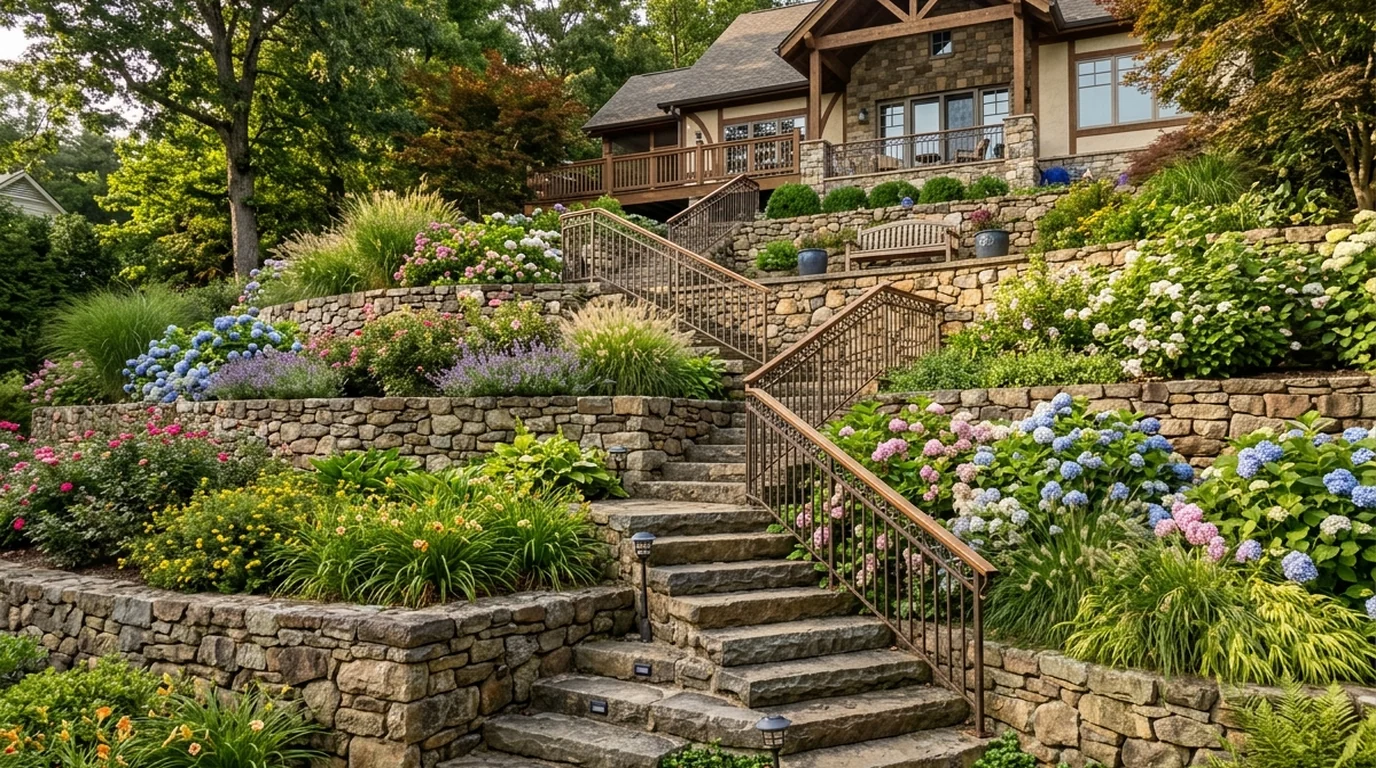
Many properties in Peabody, Lynnfield, and Danvers sit on rolling glacial till and granite ledges, leaving sloping backyards that feel unusable. By cutting a level terrace into the slope supported by a segmental block or natural boulder retaining wall, you transform wasted hillside into a secluded, sunken amphitheater.
Slope Transformation: A curved segmental retaining wall cuts into the hillside, creating a wind-sheltered level patio with built-in stone steps.
Wall TypeSegmental Retaining Wall
Cut Depth2–4 Feet Below Grade
Drainage SystemPerforated Pipe & 3/4″ Stone
Typical Installed Cost$9,500 – $22,000
How to Execute: Excavate the hillside using a mini-excavator. Install a compacted crushed aggregate leveling pad and build a retaining wall behind the patio to hold back earth pressure. Crucially, install a 4-inch perforated PVC drain pipe embedded in clean 3/4-inch crushed stone behind the wall to route subterranean hillside runoff safely around the patio rather than flooding the fire pit bowl.
Massachusetts 780 CMR Permitting: Under the Massachusetts State Building Code (780 CMR), retaining walls exceeding 4 feet of unbalanced fill height require an engineered design stamped by a Massachusetts Professional Engineer (PE) and a municipal building permit.
8. Garden-Immersed Fire Pit with Perennial Drifts & Ornamental Grasses
If an expanse of bare stone feels too harsh and sterile, integrate the fire pit directly into lush garden borders. Layering hardy, heat-tolerant native perennials, flowering shrubs, and tactile ornamental grasses around the perimeter softens the masonry edges and immerses seated guests in texture, fragrance, and bird-friendly foliage.
Softened Hardscape: Feathery ornamental grasses and native flowering perennials buffer the patio perimeter, creating seasonal interest from spring blooms to winter snow silhouettes.
Planting Buffer6–8 Ft Minimum From Fire
Top GrassesLittle Bluestem, Switchgrass
Top PerennialsConeflower, Catmint, Sedum
Typical Installed Cost$4,800 – $9,200
How to Execute: Keep a 6-foot wide noncombustible stone or gravel apron immediately surrounding the fire feature. In the 6-to-12-foot perimeter planting band, group drought- and heat-resistant perennials in drifts of three to five: purple coneflower (Echinacea purpurea), 'Walker's Low' catmint (Nepeta), black-eyed Susan (Rudbeckia fulgida), and autumn stonecrop (Hylotelephium 'Autumn Joy'). Incorporate feathery switchgrass (Panicum virgatum) at the outer boundary for rustling wind movement.
Bark Mulch Fire Safety: Keep organic wood mulch at least 4 to 5 feet away from open wood fire rings. Dry shredded bark mulch can smolder if hit by stray embers on windy nights. Use river gravel or slate chips as the transitional mulch directly beside the patio.
Concept #9 · Circulation & Landscape FlowConnection to Main House / Turf Protection
9. Stepping Stone & Bluestone Connector Pathway to the Fire Pit
A major landscape failure occurs when homeowners place a gorgeous fire pit 50 feet away in the yard with no connecting walkway. Guests carrying firewood, blankets, and drinks trample a muddy trench through the grass, tracking dirt into the home. An intentional stepping stone or paver walkway establishes clear circulation and creates an inviting journey across the landscape.
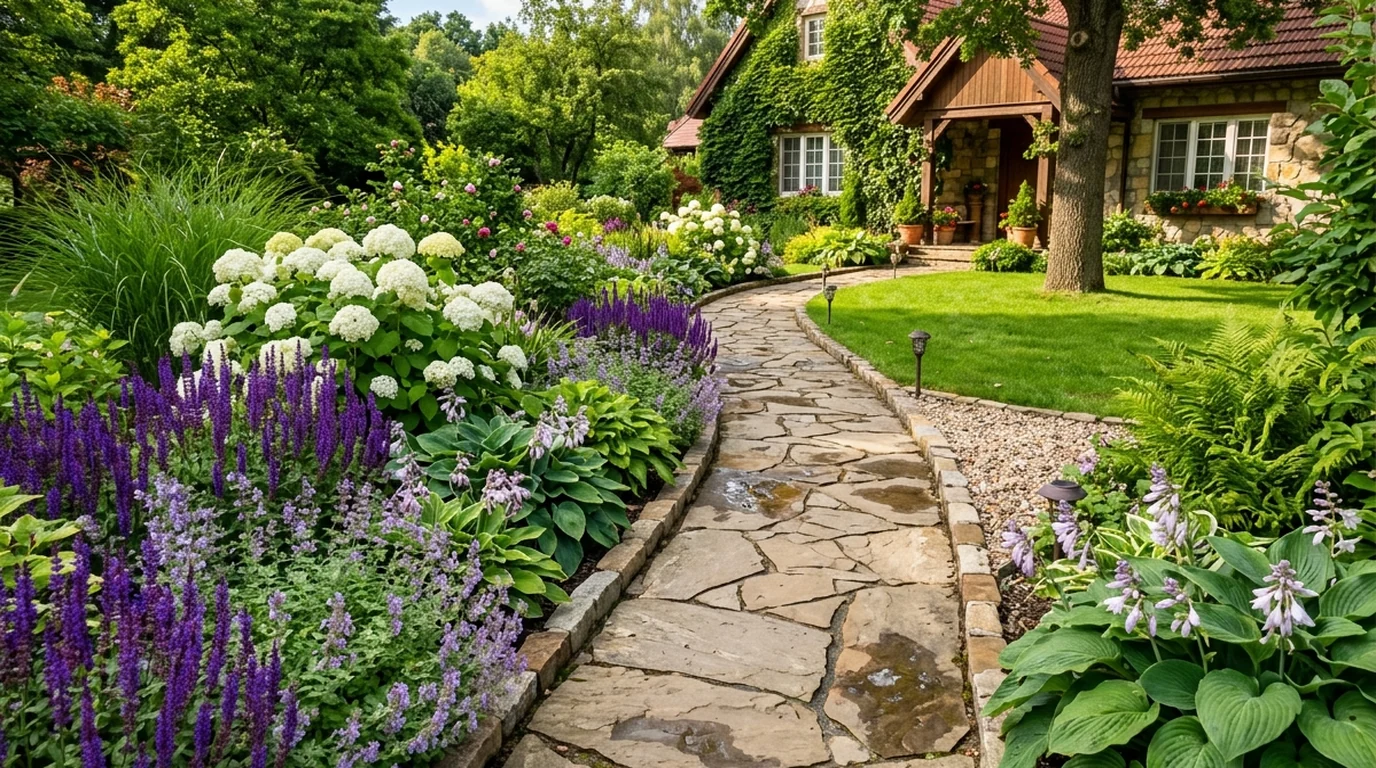
Inviting Circulation: Natural bluestone stepping stones set into turf or gravel invite evening travel while shielding wet spring grass from compaction.
Walkway Width36–48 Inches
Step Spacing24″ Center-to-Center
MaterialBluestone Slabs / River Rock
Typical Installed Cost$1,800 – $4,500
How to Execute: Design the pathway to follow a gentle organic curve rather than an aggressive straight line, guiding the eye toward the fire destination. Lay thermal-cleft bluestone or granite stepping stones spaced roughly 24 to 26 inches from center to center to match a comfortable human stride. Dig stones flush with the lawn mower grade so maintenance crews can mow directly over them without scalping blades.
Lighting the Path: Place subtle, downward-shielded LED path lights along the walkway at 10-to-12-foot intervals to guide nighttime walking without blinding seated fire pit guests.
10. Living Evergreen Privacy Screening & Wind Baffles
Nothing ruins an evening around the fire faster than howling wind that blows smoke into your face or the feeling of being on display to neighboring two-story bedroom windows. A layered living privacy hedge provides acoustic dampening, acts as a natural wind baffle, and creates a cozy sense of outdoor enclosure.
Natural Enclosure: Dense evergreen screening blocks biting northwest winter winds while shielding evening conversation from neighboring property lines.
How to Execute: Position evergreen plantings along the prevailing northwest wind corridor. In Massachusetts, choose hardy 'Techny' arborvitae (Thuja occidentalis) or upright Japanese yew (Taxus cuspidata) set back at least 10 feet from the fire ring. In front of the evergreens, stagger flowering deciduous shrubs like panicle hydrangeas or arrowwood viburnum (Viburnum dentatum) to create a multi-tiered natural border that looks stunning across all four seasons.
Radiant Heat Damage: Evergreens subjected to intense convective heat will rapidly brown out on the fireward side, losing needles permanently. Never plant dense hedges closer than 10 feet to a wood fire pit.
Concept #11 · Year-Round Resilience & Cold ClimateFour-Season Massachusetts Living / Fall & Winter Fires
11. Four-Season New England Fire Pit with Embedded Granite Boulders
In New England, prime fire pit season isn't midsummer—it's crisp October autumn evenings and snowy winter afternoons. Designing a fire pit for four-season longevity means engineering against deep ground freezes, incorporating weathered native granite boulders as thermal heat sinks, and providing sheltered firewood storage.
Year-Round Endurance: Weathered Massachusetts granite boulders anchor the landscape, soaking up fireplace heat and resisting heavy winter snow loads without damage.
Frost Depth Spec6–8″ Open Aggregate Base
Feature StoneNative Glacial Granite
Firewood NookCovered Masonry Alcove
Typical Installed Cost$7,500 – $15,000
How to Execute: Excavate the sub-base deep enough to install 8 inches of compacted crushed stone that prevents frost heave. Position large 500-to-1,000-pound native granite boulders around the outer patio ring as natural sculpture and auxiliary benches. Build a low dry-stacked stone firewood storage alcove 15 feet away under a roofed shelter so dry hardwood (sugar maple, red oak) is always within reach when winter snow falls.
Snow Removal Plan: Design the patio surface flush with the surrounding grade so you can shovel or snow-blow a clear path from the back porch directly to the fire circle without catching shovel edges on raised stone rims.
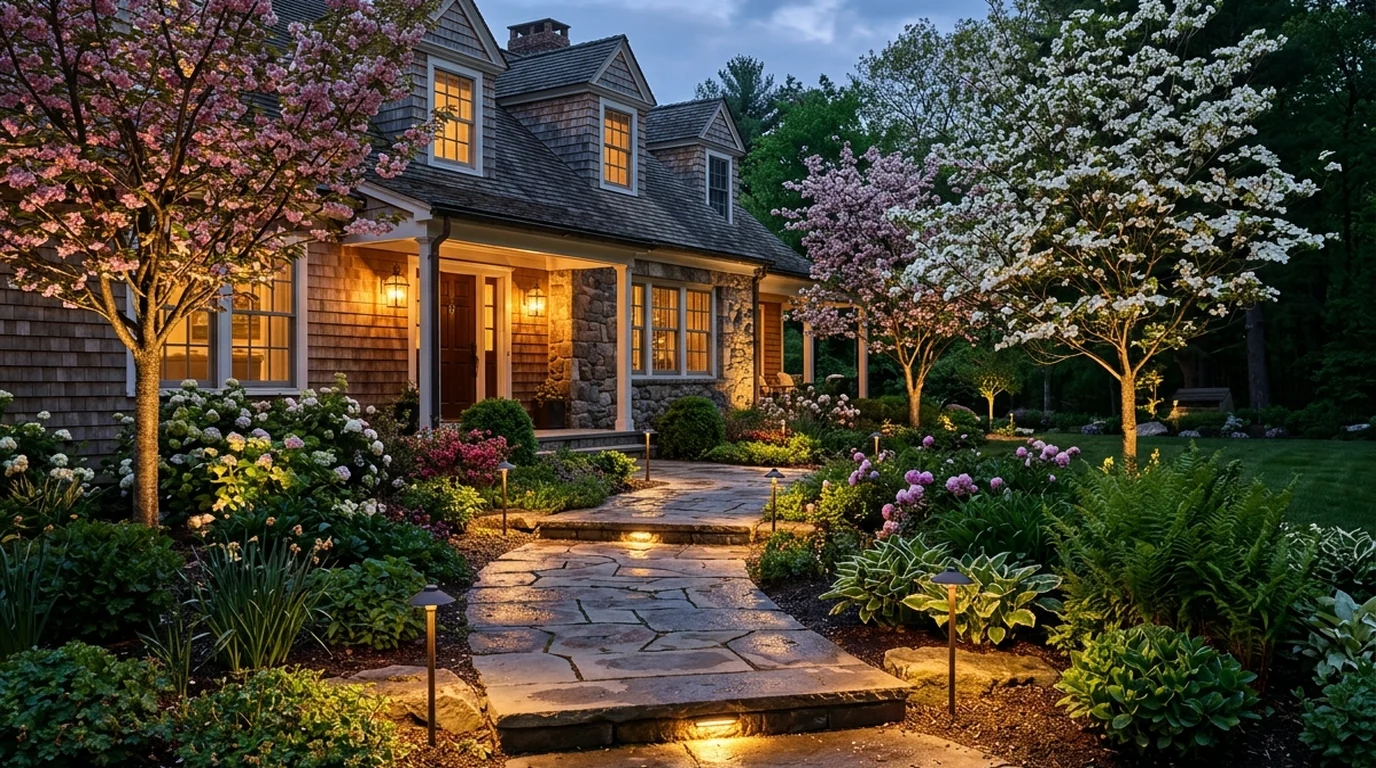
When the fire burns down to glowing embers, navigating pitch-black stone steps and dark patio edges is a serious trip hazard. However, harsh overhead floodlights destroy the intimate mood of a campfire. The solution is professional low-voltage LED landscape lighting: subtle undercap recessed fixtures beneath seat walls, soft downlights in surrounding tree canopies, and glare-shielded path lights.
Subtle Illumination: Warm 2700K low-voltage LED fixtures tucked under seat wall caps illuminate walkways and patio boundaries without overwhelming the campfire glow.
Color TempWarm 2700K LED
Fixture TypesUndercap Hardscape & Path
Power System12V Multi-Tap Transformer
Typical Installed Cost$2,200 – $4,800
How to Execute: Run 12-gauge direct-burial low-voltage wire inside PVC conduit underneath the patio base during initial excavation before laying pavers. Embed brass undercap light fixtures directly beneath bluestone wall caps to cast an indirect golden wash across the patio floor. Mount small spotlights high in adjacent oak or maple tree branches to simulate gentle moonlight across the lawn. Put the system on an astronomical timer or smartphone app so it dims automatically late at night.
Avoid Glare: Always ensure light sources are shielded so the fixture bulb is never visible from a seated position. All light should be cast downward onto walking surfaces.
Material Science
Ground Surfaces Around a Fire Pit: Pros, Cons & Physics
Detailed comparison of how gravel, interlocking pavers, bluestone flagstones, poured concrete, and grass perform under heat, traffic, and freeze-thaw cycles.
Choosing the right ground plane material is the single most critical structural decision in backyard fire pit landscaping. A poor choice leads to sinking chairs, cracked slabs, weed infestations, or hazardous slipping. Here is how the top materials compare:
Interlocking Concrete Pavers (ASTM C936)
Pros: High compressive strength (8,000+ psi), exceptional freeze-thaw flexibility, uniform flat plane for sliding chairs, easily repaired.
Cons: Shifts under narrow chair legs; gravel migrates into nearby lawn; leaves and pine needles are difficult to rake out.
Verdict: Best for budget-conscious homeowners, wooded lots, or rustic camp-style gathering spots.
Natural Bluestone / Flagstone
Pros: Unmatched natural beauty; timeless New England aesthetic; retains solar heat into evening; naturally slip-resistant cleft texture.
Cons: Premium pricing ($25–$45/sq ft installed); irregular slabs require skilled stone mason sorting; wet mortared joints can crack if base moves.
Verdict: Ideal for luxury properties, historic architecture, and natural woodland clearings.
Why Bare Lawn & Poured Concrete Fail
Bare Lawn Failure: Convective heat scorches grass roots within hours; chair legs chew turf into mud during spring thaw; fire embers burn brown scars.
Poured Concrete Cracking: Intense heat differentials between the fire pit center and outer edge cause rigid concrete slabs to crack along stress lines.
Verdict: Avoid building fire pits directly on bare turf or unshielded thin poured concrete slabs.
Horticultural Architecture
Fire-Safe & Resilient Planting Design for Massachusetts (Zone 6b)
How to design multi-layered planting zones around a fire pit that withstand radiant heat, embers, and wind while complying with state invasive plant bans.
Plants soften hard stone boundaries, provide wildlife habitat, and create seasonal beauty. However, planting too close to a fire pit can dry foliage out, introduce flammable oils, or suffocate root zones. Professional landscape designers organize planting around fire pits into three concentric zones:
The 3 Concentric Fire Pit Planting Zones:
Zone 1: 0–6 FeetNoncombustible Buffer
Strictly stone pavers, gravel, or decomposed granite. Zero combustible plants, turf, or organic wood mulch within direct spark drop range.
Zone 2: 6–12 FeetHeat-Tolerant Perennials
Low-profile native perennials and compact shrubs with high leaf moisture content, deep root resilience, and low volatile sap or oil content.
Zone 3: 12+ FeetWindbreak & Privacy
Dense evergreen hedges, ornamental trees, and taller backdrop shrubs positioned outside direct convective heat to block wind and create privacy.
Recommended Plant Selections for Peabody & North Shore Gardens
Plant Name
Type
Height / Spread
Fire-Safe Characteristic
Seasonal Interest
Catmint (Nepeta 'Walker's Low')
Perennial
2–3 ft / 3 ft
High moisture content, compact growth
Long lavender bloom May–September
Purple Coneflower (Echinacea)
Native Perennial
2–3 ft / 2 ft
Deep taproot, drought & heat resilience
Purple petals, winter seed heads for birds
Stonecrop (Sedum 'Autumn Joy')
Succulent Perennial
1.5–2 ft / 2 ft
Fleshy water-storing leaves, ember resistant
Pink to rusty red late summer/autumn bloom
Inkberry Holly (Ilex glabra)
Native Evergreen Shrub
4–6 ft / 4–6 ft
Non-resinous leaves, native cold hardiness
Glossy green leaves through winter snow
Little Bluestem (Schizachyrium)
Native Ornamental Grass
2–3 ft / 1.5 ft
Plant in Zone 3 (8+ ft back); windbreak
Blue-green summer foliage, bronze fall color
Plants to Strictly Avoid Near Fire Features in Massachusetts:
Highly Flammable Resinous Conifers: Junipers (Juniperus), arborvitae placed too close (<8 ft), and dwarf pines contain volatile terpene oils that ignite rapidly if hit by embers.
Massachusetts Prohibited Invasive Plants: Never plant Japanese barberry (Berberis thunbergii) or burning bush (Euonymus alatus). Both are legally banned for sale, transport, and propagation in Massachusetts by the Massachusetts Department of Agricultural Resources (MDAR) due to severe forest ecological destruction.
Overhanging Deciduous Trees: Any oak, pine, or birch tree branch hanging lower than 15 feet directly above the fire pit is an extreme fire hazard that violates local fire safety codes.
Fuel Selection
Wood vs Natural Gas vs Propane: Landscape & Infrastructure Impact
How your choice of fuel dictates structural setbacks, underground trenching, firewood storage, and municipal approvals.
Wood-Burning
Authentic Campfire Flame
Provides authentic crackling sounds, wood aroma, and high radiant BTUs. Ideal for large yards and chilly New England autumns.
Ash Management: Regular shoveling into metal ash bucket
Operating Cost: $300–$600/cord seasoned hardwood
Best For: Traditionalists with 1/3+ acre lots
Plumbed Natural Gas
Instant, Smoke-Free Luxury
Instant electronic ignition with continuous fuel and zero smoke. Perfect for patios attached closer to the house or modern linear designs.
Clearance Setback: 10–15 ft (per manufacturer listing)
Infrastructure: 18″ deep underground gas line trench
Ash Management: Zero ash, zero soot, lava rock/glass
Operating Cost: Very low ($0.50–$1.50/hour on utility gas)
Best For: Patios close to house & busy families
Propane Tank Unit
Flexible, Portable Solution
Clean-burning flame powered by an enclosed 20 lb propane tank. Ideal for budget retrofits where running underground gas lines is cost-prohibitive.
Clearance Setback: 10–15 ft from combustible walls
Infrastructure: Integrated tank enclosure table
Ash Management: Zero ash, simple wipe down
Operating Cost: $20–$25 per 20 lb tank exchange (8–12 hrs)
Best For: Existing patios & small urban yards
Safety & Legal Compliance
Peabody & Massachusetts Fire Codes: What Homeowners Must Know
Review state fire safety codes (527 CMR 1.00), open burning distinctions (310 CMR 7.07), Dig Safe 811 rules, and smoke nuisance bylaws.
Before investing thousands of dollars into a hardscaped fire pit patio, understanding state and municipal fire safety requirements is essential. Violating setbacks can result in fines, mandatory removal orders, or voided homeowner insurance claims in the event of an accidental fire.
Massachusetts 527 CMR 1.00 & DFS Guidelines
25-Foot Setback Rule: Open-flame wood recreational fires must be located at least 25 feet away from any structure or combustible material (NFPA 1, Section 10.10.4.3).
Size Limits: Fires must be contained within a pit or ring with a maximum fuel pile diameter of 3 feet and maximum flame height of 2 feet.
Clean Fuel Mandate: Only clean, seasoned firewood or charcoal is permitted. Burning leaves, brush, construction lumber, painted/treated wood, or trash is strictly prohibited.
Constant Supervision: An adult must attend the fire at all times with a charged garden hose, 4-A rated fire extinguisher, or water bucket immediately on hand.
Peabody Fire Department & Municipal Nuisance Rules
Nuisance Smoke Complaints: Under Massachusetts air pollution laws (M.G.L. c. 111, § 142A–142D) and Peabody Fire Dept policy, if smoke from your fire pit enters neighboring open windows or creates a breathing hazard, officers have legal authority to order immediate extinguishment.
Recreational Fire vs Open Burning: Massachusetts MassDEP seasonal open burning (Jan 15 – May 1 under 310 CMR 7.07) requires a permit for brush disposal. Recreational fire pits do not require an open burning permit, but must adhere strictly to clean wood recreation guidelines.
Dig Safe (811): Under M.G.L. c. 82, § 40, you or your contractor must call Dig Safe at 811 at least 72 hours before any excavation to locate buried electric, cable, water, and natural gas lines.
When to Hire a Professional Hardscape Contractor:
While setting a portable steel fire bowl on gravel is a realistic weekend DIY project, professional installation is strongly recommended whenever your project involves: (1) excavating into sloped terrain requiring structural retaining walls, (2) cutting and compacting large paver or natural bluestone patios exceeding 200 square feet, (3) plumbing underground natural gas lines, or (4) installing frost-resilient masonry seat walls. Experienced North Shore contractors guarantee proper sub-base compaction, laser-graded drainage slopes, and full compliance with municipal building codes.
Frequently Asked Questions
Common Questions About Backyard Fire Pit Landscaping
Clear, authoritative answers to the most common homeowner questions about fire pit clearances, surfaces, plantings, and local codes.
Answers
Frequently asked questions
7 questions
01
How much space do you need around a backyard fire pit?
A comfortable, functional fire pit patio requires a minimum diameter of 14 to 18 feet (approximately 150 to 250 square feet). With a typical fire pit measuring 3 to 4 feet across, you need at least 2.5 to 3 feet of legroom between the outer fire pit coping and seating, 3 feet of depth for Adirondack or club chairs, and an additional 2.5 to 3 feet of unobstructed walking circulation behind the chairs so guests can safely enter and exit without stepping into planting beds or tripping over embers.
What is the best ground surface under and around a fire pit?
The best ground surfaces are noncombustible, stable materials such as interlocking concrete pavers (ASTM C936), dry-laid thermal bluestone flagstones, or compacted 3/8-inch pea gravel over a crushed stone base. Poured concrete is susceptible to cracking from intense localized heat and winter freeze-thaw cycles. Natural grass or wood mulch should never be placed directly under or within 5 feet of a wood fire pit, as radiant heat dries grass into kindling, ember sparks ignite mulch, and heavy foot traffic turns damp turf into mud.
What are the Massachusetts fire pit distance rules and regulations?
Under the Massachusetts Comprehensive Fire Safety Code (527 CMR 1.00, incorporating NFPA 1 Section 10.10) and Massachusetts Department of Fire Services guidelines, open-flame wood-burning recreational fire pits must be placed at least 25 feet away from any combustible structure—including houses, wooden or composite decks, sheds, garages, vinyl fencing, and overhanging tree branches. Manufactured portable gas or propane fire bowls typically require 10 to 15 feet of clearance based on their manufacturer listing. Local municipal bylaws enforce nuisance smoke restrictions, requiring fires to be extinguished if smoke drifts into neighbors' homes.
04
Can you put a fire pit directly on a grass lawn?
Placing a fire pit directly on grass is a common beginner mistake that causes lawn failure. Radiant downward heat kills the root zone of cool-season turf grasses (Kentucky bluegrass, fescues), leaving scorched dead bare earth. Furthermore, chairs constantly scuff turf roots, and fallen sparks cause scorch spots. If constructing on an existing lawn, excavate 4 to 6 inches, install a permeable geotextile fabric, and bed the fire pit area in compacted crushed stone and pea gravel or pavers.
Which plants are safe to grow near an outdoor fire pit?
Landscape plantings near a fire pit should have high foliage moisture content, low volatile sap or oil levels, and compact growth habits. In Massachusetts (USDA Zone 6b), excellent selections placed at least 6 to 8 feet from the fire feature include catmint (Nepeta), purple coneflower (Echinacea purpurea), sedum ('Autumn Joy'), inkberry holly (Ilex glabra), and boxwood. Avoid resinous evergreens with high terpene content (such as junipers or pines) within direct ember reach, and never plant Massachusetts-prohibited invasive species like Japanese barberry or burning bush.
Is a gas or wood-burning fire pit better for backyard landscaping?
Wood-burning fire pits provide authentic crackling sound, wood aroma, and high thermal heat output, but require 25-foot structure setbacks, dedicated dry firewood storage, and ongoing ash cleanout. Plumbed natural gas or propane fire pits offer instant on/off convenience, zero spark hazards, clean air with no drifting smoke, and lower clearance setbacks (frequently 10–15 feet), making them superior for smaller suburban yards or integrated patio living spaces. However, gas fire pits require underground trenching, Dig Safe 811 verification, and licensed Massachusetts gas fitter hookup.
07
How much does it cost to landscape a backyard fire pit area?
Costs range from $1,200 to $3,500 for a DIY or simple contractor-installed pea gravel fire pit ring with steel liner and stepping stones. A professionally installed interlocking concrete paver fire pit patio (250–350 sq ft) with built-in masonry ring typically costs $5,500 to $11,000. Luxury outdoor living spaces featuring curved natural stone seat walls, bluestone flagstones, low-voltage landscape lighting, and perimeter planting beds range from $12,000 to $25,000+ depending on grading, excavation, and utility runs.
Regulatory citations: Massachusetts Comprehensive Fire Safety Code (527 CMR 1.00), NFPA 1 Fire Code Section 10.10, Massachusetts Department of Fire Services (DFS), Massachusetts Department of Environmental Protection (310 CMR 7.07), Massachusetts Building Code (780 CMR), and ASTM C936 concrete paver specifications.
Updated:
Ready to Design Your Backyard Fire Pit Retreat?
Connect with screened, independent hardscaping and landscape contractors in Peabody and Essex County for free, no-obligation on-site estimates on fire pits, patios, and custom stonework.