Peabody • Essex County
Landscaping Costs in Peabody, MA
Published ranges
What Peabody landscaping projects typically cost
These four figures are the published planning ranges for the Peabody market: general landscaping runs $4–$12 per square foot, small jobs run $50–$100 per hour, a full design-and-install project runs $3,000–$15,000, and ongoing maintenance runs $100–$200 per month. Treat every figure as a starting point for a conversation, not a quote.
| Category | Published range | What it covers |
|---|---|---|
| General landscaping | $4 – $12 / sq ft | Spans planting-only work up through mixed hardscape and softscape projects |
| Small jobs, hourly | $50 – $100 / hr | Cleanups, planting, minor repairs and punch-list items |
| Design + install project | $3,000 – $15,000 | Planting plan plus hardscape or lawn work on a typical residential lot |
| Ongoing maintenance | $100 – $200 / month | Seasonal mowing, edging and bed-care programs |
Cost ranges are attributed to HomeGuide's published Peabody landscaping cost page and represent typical market ranges, not a quote for any specific property. Get a written estimate from the professional you're connected with before agreeing to any work.
What moves the price
Why two similar-looking jobs can cost differently
Access, depth, ground conditions, material choice, drainage, permits and hauling distance are the seven factors that most often explain why one Peabody project lands near the bottom of a published range and a similar-looking one lands near the top.
Two backyards can look nearly identical from the street and still price very differently once a crew gets equipment and material into them. The table below walks through the factors that most commonly explain the spread.
| Factor | Effect on price | Why |
|---|---|---|
| Access to the work area | Raises price on tight lots | Backyards reached only through a narrow side yard need hand-carried material and more labor hours than a driveway-adjacent job |
| Excavation depth | Raises price with depth | Frost-depth footings, deeper wall bases and drainage trenches all add equipment time and spoil removal |
| Ledge and cobbles | Can raise price sharply | Essex County glacial till commonly runs 5–35% rock fragments; hitting shallow ledge can force hand work or a plan change mid-project |
| Material choice | Wide range top to bottom | Poured concrete and basic block sit lower; natural stone, mortared work and premium pavers sit higher |
| Drainage requirements | Moderate to significant increase | French drains, dry wells and wall drainage systems add pipe, stone, fabric and labor beyond the visible finished surface |
| Permits | Adds cost and lead time | Retaining walls over four feet and other regulated work require a Peabody Inspectional Services permit and inspection scheduling |
| Site distance and disposal | Small to moderate increase | Trucking material in and spoil or debris out costs more the farther a crew has to haul it |
Hardscape vs. planting
Why hardscape costs more than planting
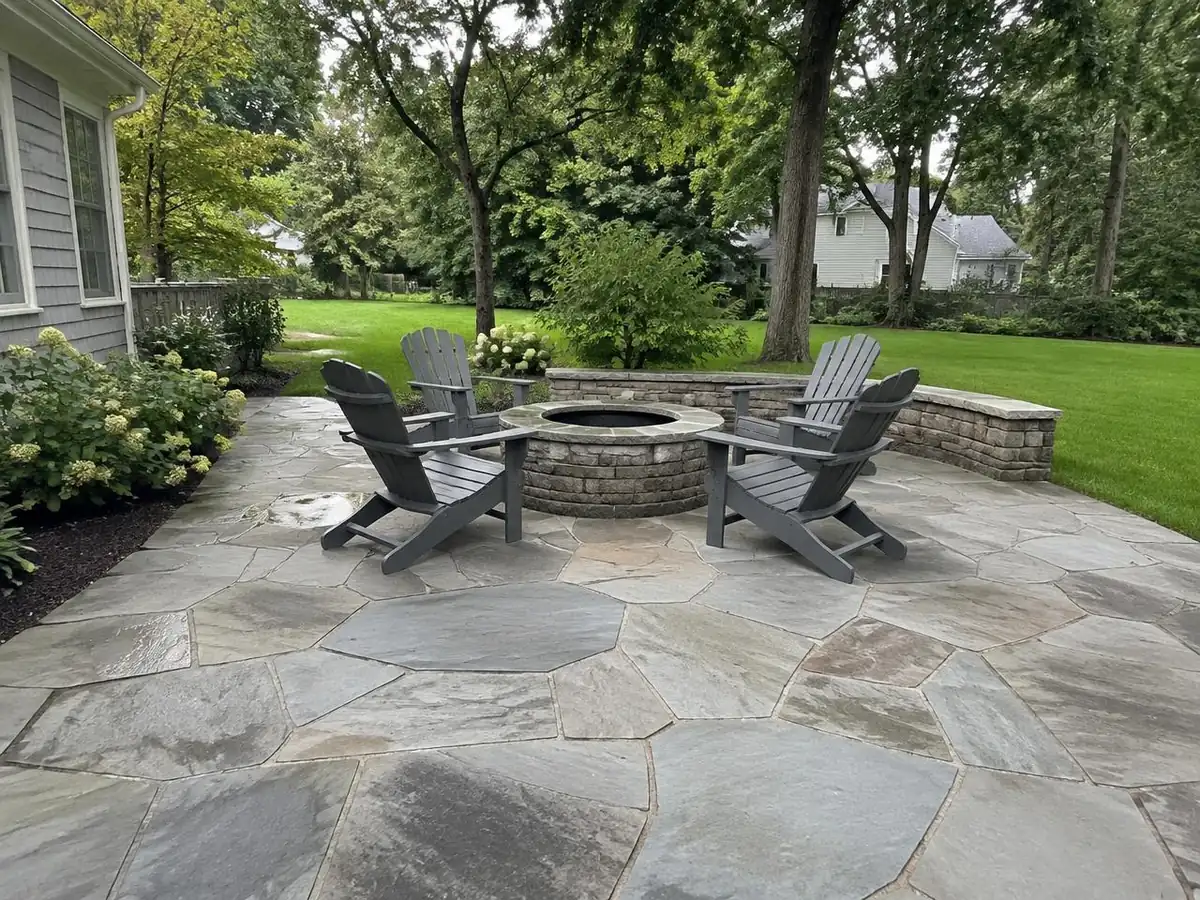
Hardscape work needs excavation, a compacted base and drainage before the visible surface goes down, while planting mostly adds material and labor at the surface. That hidden prep is why a patio or wall usually sits higher in the published range than a planting bed of similar size.
A paver patio or a retaining wall carries real structural requirements: excavation to a stable depth, compacted gravel base, drainage stone, sometimes a perforated pipe with an outlet, and edge restraint or a footing to keep the finished surface from moving through New England's freeze–thaw cycles. None of that work is visible once the project is finished, but it is most of the labor and material cost.
A planting bed or a lawn renovation, by comparison, mainly needs soil preparation, plant or sod material, and labor to install it. There is far less structural work underneath, so the same square footage of planting generally costs less than the same square footage of hardscape. The table above shows where each service tends to land as a result.
By service
Where each service typically sits in the range
Within the published $4–$12 per square foot and $3,000–$15,000 project ranges, retaining walls and hardscape tend to sit toward the upper end, lawn care and cleanups sit toward the lower end, and design, sod and drainage fall in the middle — based on how much excavation and drainage each service typically requires.
| Service | Typical band | Why it lands there |
|---|---|---|
| Patios & hardscaping | Middle to upper end | Excavation, base and drainage put most hardscape projects above simple planting work |
| Retaining walls | Upper end | Footings, drainage stone, geogrid on taller walls and possible permitting push cost toward the top of the range |
| Landscape design | Lower to middle end | A planting plan alone costs less than a plan paired with installation |
| Sod installation | Lower to middle end | Grading and loam delivery matter more here than heavy excavation |
| Lawn care & mowing | Lower end, recurring | Billed as a monthly program rather than a one-time project cost |
| Yard drainage | Middle end | Cost tracks pipe run length and whether a dry well or catch basin is added |
| Spring & fall cleanup | Lower end | Priced hourly or per visit rather than as a design-and-install project |
Comparing quotes
How to compare landscaping quotes fairly
Compare the scope line by line rather than the bottom-line number alone: base depth, drainage provisions, material grade, cleanup and payment terms. A lower quote that skips drainage or a proper base is usually a different, cheaper project, not a better deal on the same one.
What a written scope should include
- The exact work area and dimensions, ideally with a rough sketch
- Materials named by product or grade, not just "pavers" or "stone"
- Base depth and drainage details for any hardscape or wall
- Who pulls a permit, if the project needs one, and who pays the fee
- A start window and a rough completion estimate
- Payment schedule, including the deposit amount and what triggers it
- Cleanup and disposal responsibility
Deposit and payment norms
A modest deposit to reserve materials and a crew slot is standard practice for landscaping projects of meaningful size, with the remaining balance due on completion or split across agreed milestones for larger jobs. Payment terms and deposit amounts are set by the independent professional you work with — get them in writing before paying anything, and be cautious of a request for full payment up front.
Home value
Does landscaping affect home value?
Landscaping is commonly cited in industry sources as affecting home value by roughly 5 to 20 percent, though the figure is a broad, widely repeated estimate rather than an appraisal for any specific property. Functional work — solid walls, working drainage, a usable patio — tends to hold that value better than decorative planting alone.
Treat the 5–20% figure as a directional planning number, not a guarantee. It moves with the local market, the condition of the rest of the house, and whether the work solves an actual problem — a wet yard, a failing wall, an unusable slope — versus adding decoration on top of an otherwise unfinished landscape.
Answers
Landscaping cost FAQs
01How much does landscaping cost per square foot in Peabody?
Published data for the Peabody market puts general landscaping at roughly $4 to $12 per square foot. Where a project lands in that range depends mainly on whether it is planting and grading or full hardscape construction.
02What is the hourly rate for small landscaping jobs?
Small jobs such as cleanups, planting and minor repairs are commonly billed at $50 to $100 per hour in this market. Multi-day jobs are usually quoted as a flat project price instead.
03How much does a full design-and-install project cost?
A planting plan combined with hardscape or lawn installation on a typical residential lot is published at roughly $3,000 to $15,000. Lot size, material choice and how much excavation is required drive where a given project sits.
04What does monthly lawn maintenance cost?
Ongoing seasonal maintenance programs — mowing, edging and bed care — are published at roughly $100 to $200 per month. Programs that add fertilization or irrigation checks typically sit toward the higher end.
05Why does hardscape cost more than planting?
Hardscape requires excavation, a compacted base, drainage stone and sometimes a permit, all before a single paver or block goes down. Planting mainly adds material and labor at the surface, with far less prep underneath it.
06How do I compare two landscaping quotes fairly?
Compare the scope line by line, not just the bottom number: base depth, drainage provisions, material grade, cleanup and warranty terms. A lower number that skips base prep or drainage is usually not the better deal over time.
07What should a written landscaping scope include?
A clear scope lists the exact work area, materials and their grade or brand, base and drainage details, a start and estimated completion window, payment schedule, and who handles permits if any are required.
08Is a deposit normal for landscaping work?
A modest deposit to schedule materials and crew time is standard practice in this trade, with the balance due on completion or at agreed milestones. Get the deposit amount and schedule in writing before paying anything.
For general questions beyond cost, see the full Peabody landscaping FAQ page.
Get a real quote for your project
Call to describe your yard and get connected with an independent local landscaping professional who can give you an actual estimate.
Get connected with an independent local landscaping professional. Calls go to (877) 537-6896.