Interactive Yard Material Estimator • Peabody & North Shore, MA
Landscaping Yard Calculator
To find the total cubic yards needed for any rectangular garden bed, lawn, or patio excavation, multiply Length (ft) × Width (ft) × Depth (in) ÷ 324. One cubic yard contains 27 cubic feet. Dividing 27 cubic feet by 12 inches equals 324. For circular beds, multiply π × (Radius in feet)² × Depth in inches ÷ 324. Always factor in a 10% to 15% settling and compaction buffer for loose soil, crushed stone base, or shredded bark mulch.
Calculate Your Yard Material Requirements
Add multiple zones (e.g. front garden bed, patio base, lawn topdressing), customize dimensions, and see real-time volume in cubic yards, retail bag counts, estimated weight in tons, and delivery budget ranges.
Cubic Yard & Material Coverage Calculator
Calculate exact cubic yards, weight in tons, and bag equivalents for mulch, soil, gravel, and stone in Peabody and Essex County.
Compaction & Settling Buffer
Bulk mulch and soil settle 10% after rain, while gravel compacts when tamped.
2" for freshening existing beds, 3" for new garden installations
Surface Area: 250 sq. ft.
Estimated Materials Required
2.55
Exact volume with +10% buffer
250 sq ft
Total depth volume: 69 cu. ft.
1.1 Tons
Approximately 2,292 lbs
$114 – $156
Bulk materials in Peabody area
Buying Bags vs. Ordering Bulk Delivery
Bagged Retail Equivalent:
- • Main Area (e.g., Front Garden Bed): ~35 bags (2 cu. ft. bags)
⚠️ Over 2.5 cubic yards (~35+ bags), bulk delivery is typically 40% to 60% cheaper and saves hours of heavy lifting.
Bulk Delivery & Truck Loads:
• Standard 1/2-ton pickup truck bed: holds approximately 1.0 to 1.5 yards of mulch, but only 0.5 to 0.75 yards of topsoil or gravel before exceeding vehicle gross weight ratings.
• Commercial dump truck / tri-axle: single delivery carries up to 10 to 18 cubic yards directly to your Peabody driveway.
Need Help Grading, Preparing Beds, or Spreading Materials?
Connect with independent local Peabody landscaping professionals for delivery and installation.
Step-by-Step Instructions
How to Calculate Landscaping Yardage Accurately
Measure Dimensions in Feet
Measure the perimeter of each distinct planting zone or hardscape area with a 100-foot measuring tape or measuring wheel. Break irregular curves into smaller rectangles or circles for precise square footage summation.
Select Your Required Depth
Determine depth in inches according to your project type: 2 to 3 inches for bark mulch, 4 to 6 inches for lawn topsoil, 1 inch for paver sand, and 4 to 8 inches for crushed stone aggregate base under outdoor flatwork.
Apply Compaction & Settling Buffer
Add 10% to 15% extra volume to account for natural soil compression, plate compaction of subbase gravel, and uneven subgrade terrain across rocky North Shore property lines.
Worked Calculation Example: Mulching a Peabody Garden Bed
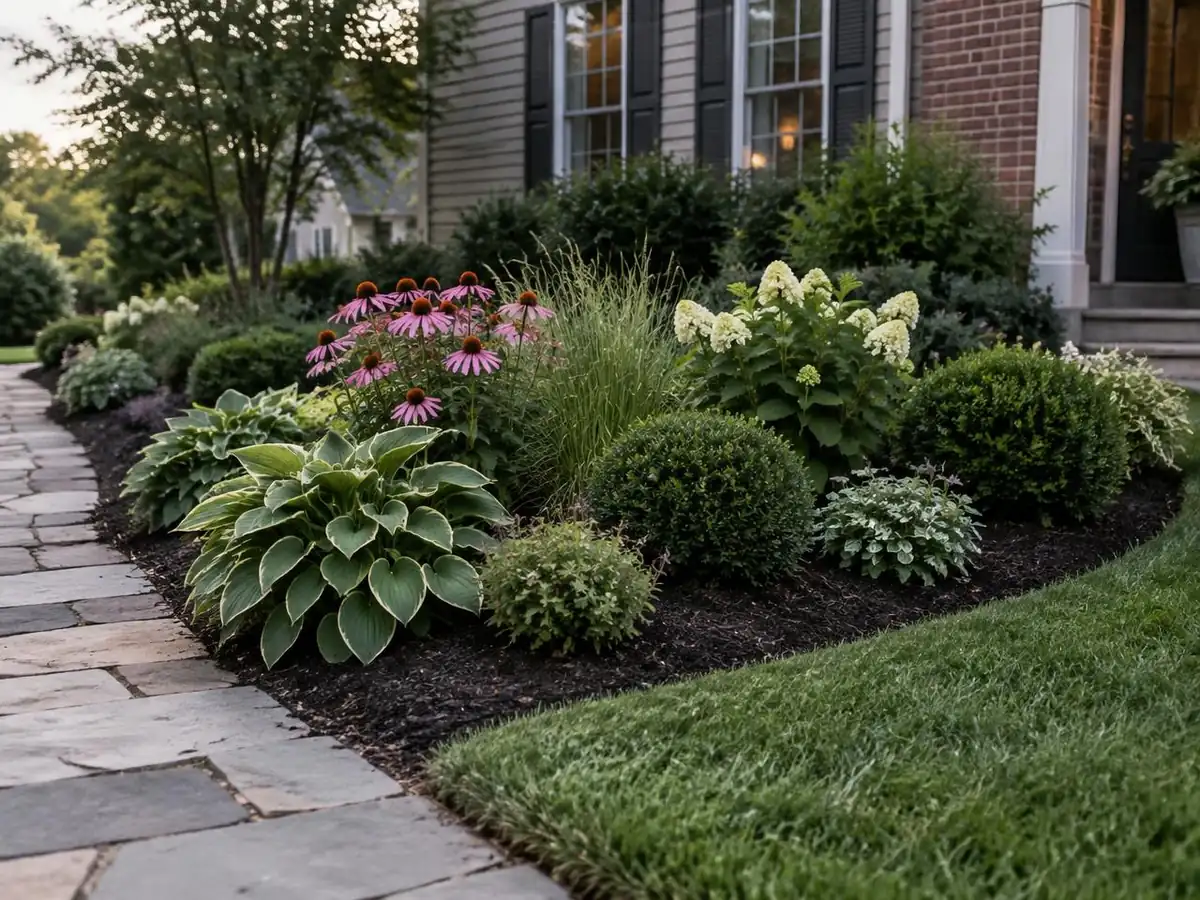
Let's calculate the material requirement for a foundation garden bed along a ranch home measuring 40 feet long by 6 feet wide, mulched at a recommended depth of 3 inches:
Application Depths
Recommended Landscaping Material Depths
| Material / Application Layer | Recommended Depth | Purpose & Best Practices |
|---|---|---|
| Shredded Bark Mulch (Hemlock, Pine, Black) | 2 – 3 Inches | Apply 2 inches when topdressing existing garden beds; apply 3 inches for newly established plantings to conserve soil moisture and suppress annual weeds. Keep mulch 2–3 inches away from tree trunk flares. |
| Screened Loam / Sandy Topsoil (Turf & Sod) | 4 – 6 Inches | Recommended minimum 4 inches of weed-free screened loam over native till for lawn seeding or sod establishment to ensure deep, drought-resilient root penetration. |
| Organic Leaf Compost / Soil Amendment | 1 – 2 Inches | Spread 1/4 to 1/2 inch for seasonal lawn topdressing (aeration overseeding), or till 2 inches into heavy clay or depleted topsoil before planting perennial flower beds. |
| Crushed Stone / Drainage Gravel (3/4″) | 3 – 4 Inches | Standard depth for French drain trench surrounds, foundation drip lines, window well sumps, and decorative utility shed gravel pads. |
| Paver Bedding Sand (Concrete / Mason Sand) | Strictly 1.0 Inch | According to ICPI guidelines, screeded bedding sand must be maintained at a uniform 1 inch uncompacted depth over a prepared crushed stone base. Never exceed 1.5 inches to prevent rutting. |
| Dense Grade Aggregate Subbase (Crushed Stone) | 4 – 10 Inches | 4 to 6 inches compacted depth for pedestrian walkways and backyard patios; 8 to 12 inches for vehicular paver driveways to resist New England winter frost heaves. |
Depths compiled from UMass Amherst Extension Landscape & Nursery Guidelines and the Interlocking Concrete Pavement Institute (ICPI) residential construction standards.
Purchasing Strategy
Bulk Delivery vs. Bagged Retail Materials: Cost & Weight Comparison
| Project Scope / Volume | Recommendation | Cost, Transport & Labor Considerations |
|---|---|---|
| Small Garden Touch-Up (Under 1.5 Yards / < 20 Bags) | Bagged Material Preferred | Easy to transport in an SUV or trunk; no minimum bulk delivery fee; store bags cleanly on the lawn until ready to spread. |
| Medium Yard Project (1.5 to 3.0 Yards / 20–40 Bags) | Borderline / Choice | Bulk delivery saves physical labor and bag disposal; bagged material may still suit properties with narrow backyard access where a dump truck cannot reach. |
| Full Yard Renovation (3.0+ Cubic Yards / 40+ Bags) | Bulk Delivery Highly Recommended | Bulk pricing typically yields 40% to 60% savings per yard. A single dump truck drop delivers the entire volume onto a driveway tarp in minutes. |
| Crushed Stone & Paver Base (Any Project > 1 Yard) | Bulk Delivery Strongly Recommended | One cubic yard of stone weighs ~2,800 lbs (over 55 fifty-pound bags). Transporting and hand-loading 50-lb bags quickly exceeds vehicle capacities and causes fatigue. |
Pricing benchmarks based on Essex County, MA bulk landscape supply depots and regional retail home center bagged inventory pricing.
Vehicle Payload Weight Warnings
A standard half-ton pickup truck (e.g. Ford F-150, Chevy 1500) has a maximum bed payload typically between 1,400 and 2,000 lbs. While a half-ton truck can safely haul 1.5 to 2.0 cubic yards of lightweight dry mulch (~1,600 lbs), loading just 1 cubic yard of wet loam (~2,500 lbs) or crushed stone (~2,850 lbs) will dangerously overload the suspension and brakes. Bulk delivery by commercial dump truck is strongly advised for dense aggregates.
Driveway Preparation for Dump Trucks
Bulk delivery dump trucks require an unobstructed drop zone at least 10 feet wide with 14+ feet of vertical clearance away from overhead power lines and mature tree limbs. Always lay a heavy duty polyethylene tarp (at least 15×20 ft) across the driveway surface before the truck arrives to prevent asphalt staining, ease shovel cleanup, and protect paver joints.
Peabody & North Shore Soil & Geological Considerations
When calculating loam, compost, and gravel requirements in Peabody, Danvers, Salem, and surrounding Essex County municipalities, native soil conditions play a decisive role in compaction and drainage:
- Glacial Till & Dense Paxton Subsoils: Much of inland Peabody and Lynnfield sits on glacial till with high boulder density and compacted substrata. When renovating turf over till, spreading at least 4 to 6 inches of screened sandy loam is necessary to create a healthy root zone and prevent seasonal drought stress.
- Winter Frost Heave Resistance: Massachusetts Department of Transportation standards for frost penetration in Essex County reach 36 to 48 inches. While landscape flatwork does not extend to full frost depth, patios and walkways require a minimum of 6 to 8 inches of compacted dense-graded crushed stone over geotextile fabric to prevent differential winter heave.
- Coastal Sandy Loams vs. Clay Lowlands: Properties closer to Salem Harbor or low-lying sections along the North River corridor often suffer from high water tables. These areas require free-draining 3/4-inch crushed washed stone around foundations rather than fine loam backfills that hold stagnant moisture.
Need Help Sourcing, Delivering, or Installing Materials?
Calculating cubic yardage is the first step. If your project involves heavy machine excavation, grading, skid steer material spreading, or ordering multiple truckloads of screened loam and crushed stone, independent landscape professionals in our referral network can help.
Frequently Asked Questions
Landscaping Yard Calculation FAQs
Answers
Frequently asked questions
01How many cubic feet are in one cubic yard of landscaping material?
There are exactly 27 cubic feet in one cubic yard (a 3 ft by 3 ft by 3 ft cube). Because material depth is normally measured in inches and area in square feet, the direct conversion formula is: Square Footage multiplied by Depth in inches, divided by 324.
02How many bags of mulch or topsoil equal one cubic yard?
Standard retail mulch is sold in 2.0-cubic-foot bags, requiring 13.5 bags (round up to 14 bags) to equal 1 cubic yard. Retail topsoil and compost are commonly sold in 0.75-cubic-foot bags (~40 lbs) or 1.0-cubic-foot bags, requiring 36 bags (of 0.75 cu ft) or 27 bags (of 1.0 cu ft) to equal 1 cubic yard.
03When is bulk delivery cheaper than buying bagged material in Peabody?
Bulk delivery is generally significantly cheaper whenever your project requires 2.5 cubic yards or more. In the Peabody and North Shore area, bulk shredded mulch typically runs $38 to $52 per cubic yard compared to $65 to $95 equivalent when purchasing individual 2-cu-ft bags at retail garden centers, plus bulk delivery eliminates loading and hauling dozens of heavy bags.
04How much does a cubic yard of topsoil, gravel, or mulch weigh?
Material weight varies dramatically by moisture and density: dry shredded bark mulch weighs 600 to 1,000 lbs per cubic yard; screened loam/topsoil weighs 2,200 to 2,700 lbs (over 1 ton); and crushed stone, dense-graded base, or gravel weighs 2,600 to 3,200 lbs (~1.3 to 1.6 tons). Homeowners hauling materials in personal pickup trucks must check their vehicle payload capacity before loading dense soil or stone.
05Why should I add a 10% to 15% settling or compaction buffer to my calculation?
Loose materials settle and compress after delivery and spreading. Screened topsoil compacts 10% to 15% when raked and rolled, shredded bark mulch settles 10% over the first few rainfalls, and subbase gravel compacts up to 20% under plate compactor passes. Adding a buffer prevents running short of material mid-installation.
06Can a heavy bulk delivery dump truck damage my residential driveway in Peabody?
Yes. Tri-axle dump trucks carrying 10 to 18 tons of gravel or wet topsoil can crack standard residential asphalt edges or decorative paver driveways. Reputable local suppliers recommend laying thick plywood sheets where truck tires make contact or placing heavy polyethylene tarps over the designated drop zone near the garage or apron.
Connect with Local Landscaping & Excavation Pros
Whether you need 5 yards of mulch delivered, a backyard graded with fresh screened loam, or a new paver patio installed, call our request line or submit your project details online.
Connect with independent local landscaping professionals across Peabody and the North Shore. Calls go to (877) 537-6896.