How Much Mulch Do You Need?
Mulch volume is calculated by multiplying your total planting bed area (in square feet) by your target mulch depth (in inches) and dividing by 324 to get cubic yards. One cubic yard covers approximately 108 square feet at 3 inches deep (or 162 square feet at 2 inches deep) and equals 13.5 standard 2-cubic-foot bags. For annual spring refreshes over existing mulch, subtract remaining mulch depth so you only purchase the necessary top-up layer.
Mulch Coverage per Cubic Yard & Bag Conversions
Square Foot Coverage per 1 Cubic Yard (27 cu. ft.)
| Mulch Depth | Square Feet Covered | Typical Landscape Use |
|---|---|---|
| 1 inch | 324 sq. ft. | Annual top-up over existing mulch |
| 2 inches | 162 sq. ft. | Herbaceous perennial beds (UMass) |
| 3 inches | 108 sq. ft. | New shrub borders & weed barrier |
| 4 inches | 81 sq. ft. | Play areas & garden pathways |
Formula: Coverage = 324 ÷ depth in inches. Figures represent mathematical volumes before natural settling.
Retail Bags Required per 1 Cubic Yard
| Bag Volume | Bags per Yard | Purchase Count |
|---|---|---|
| 1.0 cu. ft. | 27.0 bags | 27 full bags |
| 1.5 cu. ft. | 18.0 bags | 18 full bags |
| 2.0 cu. ft. (Standard) | 13.5 bags | 14 full bags |
| 3.0 cu. ft. (Large) | 9.0 bags | 9 full bags |
Formula: Bags = 27 ÷ bag volume in cu. ft. Always round up to the next whole bag because retail garden centers do not sell partial bags.
How to Measure Multiple & Irregular Landscape Beds
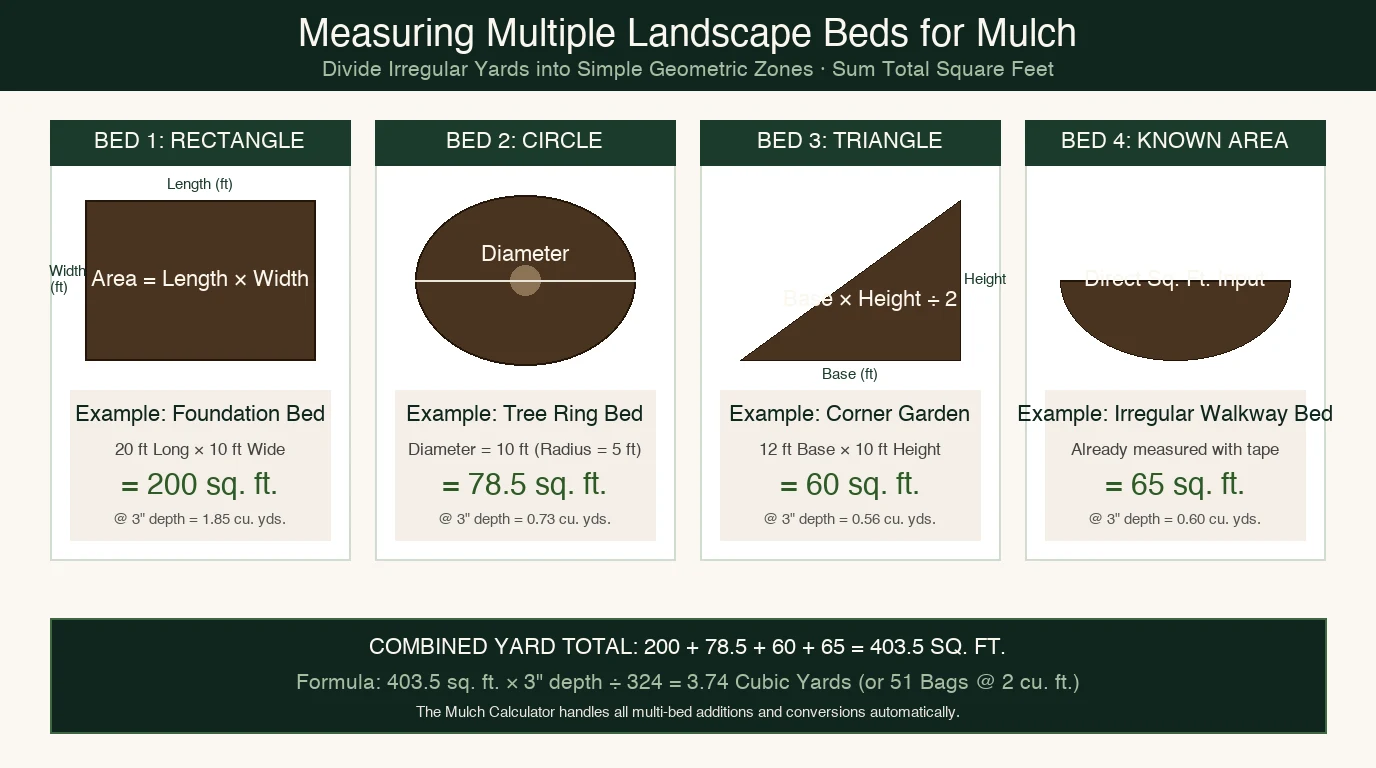
To measure curved or irregular garden beds without complex calculus, subdivide your property into simple shapes and measure each with a 50-foot contractor tape measure:
1. Rectangles & Linear Beds
Ideal for foundation borders, driveway edges, and fence line plantings.
Example: A 25-ft foundation bed that is 6 ft deep = 150 sq. ft.
2. Circular Tree Rings & Islands
Ideal for freestanding tree mulch rings, center-lawn fountain beds, or round shrubs.
Example: An 8-ft diameter tree ring = 3.1415 × 4² = 50.3 sq. ft.
3. Triangular Corner Beds
Ideal for property corners, driveway entry wedges, or patio corner accents.
Example: A corner bed with a 14-ft base along the fence and 10-ft height = (14 × 10) ÷ 2 = 70 sq. ft.
4. Curving Freeform Perennial Beds
For serpentine borders, measure the total centerline length, measure width at three representative spots (narrowest, middle, widest), and average the widths.
Example: A 40-ft serpentine bed with widths of 4, 7, and 5 ft (avg 5.3 ft) = 40 × 5.3 = 212 sq. ft.
Once you measure each zone, click "+ Add Another Bed" in the calculator above. The tool automatically adds your areas, converts the sum to cubic yards, and calculates both bulk scoop and bagged requirements. Pair your measured beds with spade-cut trench or stone edging to prevent mulch washouts during heavy New England rainstorms.
How Deep Should Mulch Be? (UMass Amherst Extension Standards)
According to the UMass Amherst Center for Agriculture, Food and the Environment (Landscape & Nursery Extension), organic mulch provides tremendous benefits to New England soils: it moderates soil temperatures against rapid summer baking and winter freeze-thaw cycles, suppresses weed seed germination, and retains critical moisture in rocky glacial till. However, depth and placement must be tailored to plant type:
Target Depth by Landscape Application:
- Perennial Flower Beds (2 to 3 Inches): Herbaceous perennials have shallow root crowns. Applying 2 to 3 inches of fine shredded bark cools soil without burying vegetative crowns. Applying more than 3 inches can cause crown rot and stunt tender shoots.
- Woody Shrubs & Landscape Trees (3 to 4 Inches Maximum): Coarser wood chips or shredded bark should never exceed 4 inches. Taper mulch gradually down to ground level as you approach the trunk.
- Walking Paths & Play Areas (3 to 4 Inches): Deeper coverage is acceptable on non-planted walkways where weed suppression and foot-traffic cushioning are the primary goals.
- Vegetable Gardens (1 to 2 Inches): Use clean straw, shredded leaves, or composted mulch rather than heavy dyed bark, which can deplete surface nitrogen during decomposition.
Warning: Stop "Volcano Mulching" Around Trees
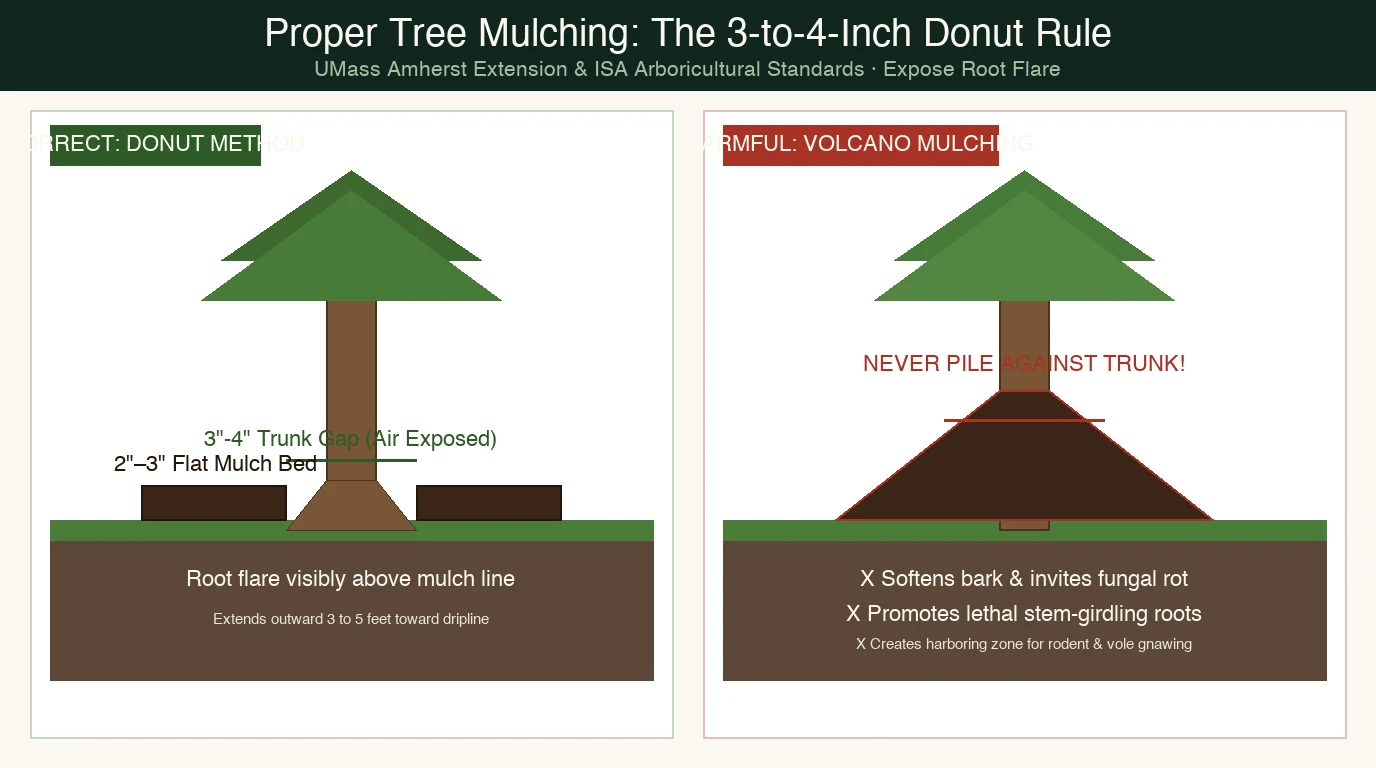
Piling mulch high into a steep cone against the trunk—commonly known as a "mulch volcano"—is one of the leading causes of premature landscape tree death in suburban New England. Tree bark evolved to be exposed to air and sunlight. When damp mulch is held continuously against living trunk tissue, it:
- Softens trunk bark: Creates entry wounds for opportunistic wood-decaying fungi and boring insects.
- Promotes stem-girdling roots: Feeder roots grow upward into the warm, damp mulch pile, circle the trunk, and eventually choke off the tree’s vascular sap flow as the trunk caliper expands.
- Creates rodent harboring zones: Voles and mice tunnel through deep mulch mounds during winter snowfall and chew protective bark off the trunk base.
The Rule: Never allow mulch to touch the trunk. Maintain a visible 3-to-4-inch air gap so the tree’s natural root flare remains exposed.
Adding Mulch Over Existing Mulch: The Top-Up Assessment
A common homeowner mistake during spring yard cleanup is ordering a full 3 inches of mulch every single year. Over 3 to 4 seasons, this creates a 6-to-8-inch suffocating mat that repels irrigation water and starves perennial roots of oxygen.
Stick a trowel or ruler into your bed at several spots. If you still have 1.5 to 2 inches of intact mulch, you only need a 1-inch top-up to restore color and weed protection.
Over winter, shredded bark forms a compacted crust or develops harmless white saprophytic fungal mats. Cultivate the surface with a hand cultivator or bow rake before adding fresh material.
In our calculator above, set your desired depth to 3" and your existing depth to 1" or 1.5". The tool calculates only the net volume needed, saving you hundreds of dollars and protecting your plants.
For complete spring bed preparation steps—including clearing winter deadfall, cutting back ornamental grasses, and edging—consult our guide to seasonal spring cleanup services in Essex County.
Bulk Mulch vs. Bagged Mulch: Price & Handling Realities
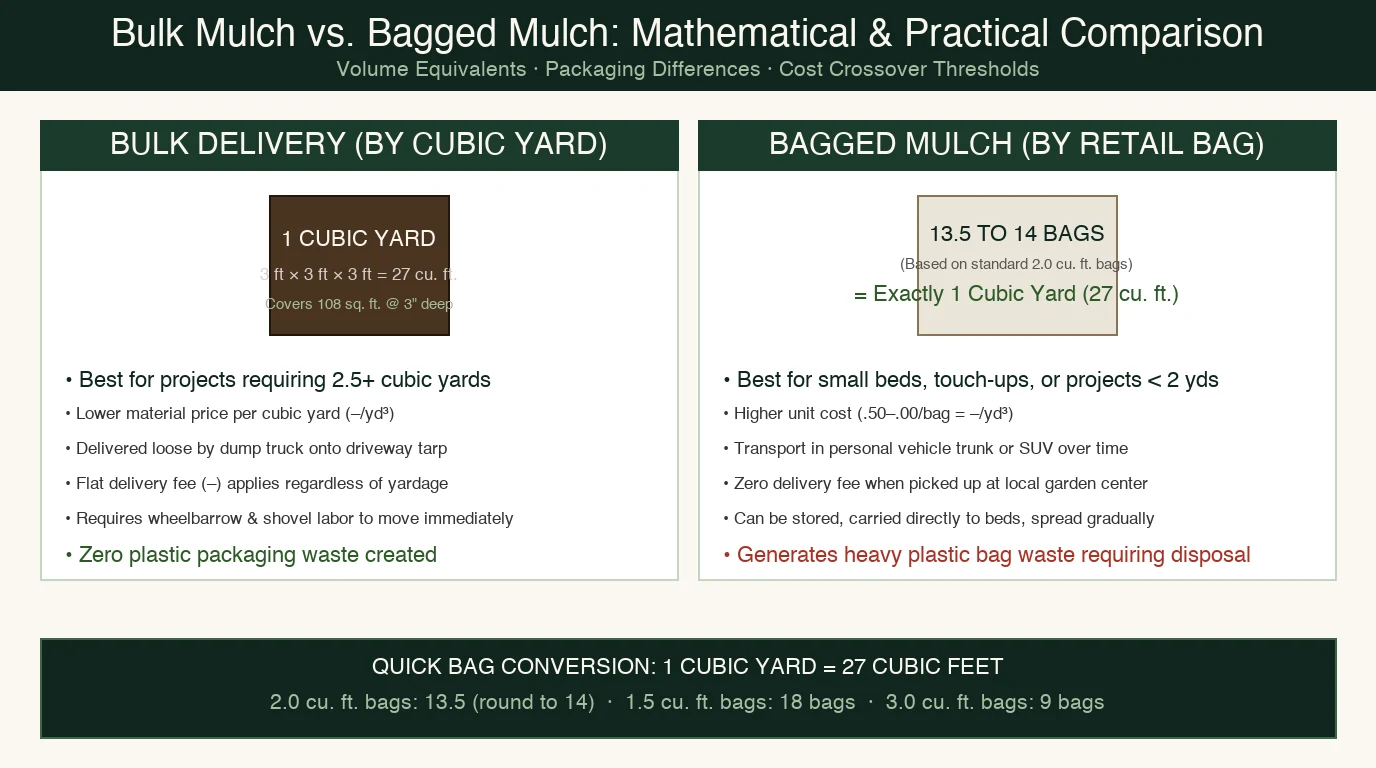
Neither bulk nor bagged mulch is universally "better." The right choice depends primarily on your project volume, property access, and physical handling preferences:
When Bulk Delivery Makes Sense:
Projects > 2.5 Yards- Lower Material Cost: Bulk hemlock, dark pine, or black mulch runs $35 to $55 per cubic yard, compared to $49 to $84 per equivalent yard in retail bags.
- Single Drop-Off: Dump trucks deposit material directly onto a heavy polyethylene tarp on your driveway, ready for wheelbarrow loading.
- Zero Plastic Waste: Spreading 40 plastic bags generates a massive pile of unrecyclable plastic sheeting that fills municipal trash barrels.
- Delivery Fee Factor: North Shore landscape suppliers charge a flat delivery fee ($40 to $75) regardless of yardage. Once you order 3+ yards, this fee is easily offset by the per-yard material savings.
When Retail Bags Make Sense:
Projects < 2 Yards- No Delivery Minimums: If you only need 8 bags (about 0.6 cubic yards) for a small front walkway bed, buying bags at a local garden center avoids paying a $50 delivery charge.
- Work at Your Own Pace: Bags can sit neatly on a pallet or garage floor for weeks. A bulk mulch pile must be moved off your driveway promptly before it stains asphalt or gets rained on.
- Tight Backyard Access: If your yard lacks wide gate clearance for a wheelbarrow, carrying individual 35-pound bags directly to rear garden beds is much easier.
- Easy Vehicle Transport: A standard SUV or crossover can comfortably hold 8 to 12 bags in the cargo area with the rear seats folded down.
Review full regional pricing guidelines in our Peabody landscaping cost guide, or use our general landscaping yard calculator if you also need to estimate screened loam, crushed stone, or paver bedding sand.
Mulch Planning for Peabody & New England Landscapes
Residential soils across Peabody, Salem, Danvers, and Lynnfield predominantly consist of stony glacial till—such as Paxton and Essex fine sandy loams—frequently underlain by shallow granite bedrock. Implementing proper mulching practices provides specific agronomic benefits in this microclimate:
Spring Timing: Wait for Soil Warm-Up
Do not apply fresh mulch during the first warm weekend in late March or early April. Mulch acts as an insulating blanket. Spreading a thick layer over frozen or cold soil traps winter chill, delaying spring root awakening and slowing perennial emergence. Wait until late April through mid-May when soil temperatures reach 50°F to 55°F.
Building Organic Matter in Glacial Till
Unlike dyed recycled wood pallets, premium aged hemlock and dark pine bark mulches naturally break down into humus over 12 to 18 months. In rocky Essex County soils, this slow decomposition adds vital carbon, increases microbial activity, and improves soil moisture-holding capacity during humid July droughts.
Storm Runoff & Slope Washouts
Peabody properties along steep slopes or rocky contours experience intense runoff during coastal nor'easters. Light shredded mulch can wash into storm drains if beds lack physical containment. Always spade-cut a 3-to-4-inch vertical trench edge or install natural stone borders before mulching sloped front yards.
Protecting Small Front Yard Trees
When planting compact ornamental trees—such as Serviceberry, Kousa Dogwood, or Paperbark Maple—maintain a broad 4-foot mulch circle around the tree. This keeps lawn mowers and string trimmers away from tender trunk bark while conserving water over shallow roots. Consult our guide to small trees for front yards for detailed species placement rules.
5 Common Mulch Calculation & Spreading Mistakes
1. Forgetting to convert inches to feet
Calculating 200 sq. ft. × 3 inches as 600 cu. ft. leads to ordering 22 cubic yards instead of 1.85 cubic yards! You must divide inches by 12 (3 ÷ 12 = 0.25 ft) or use the shortcut formula: (Area × Depth) ÷ 324.
2. Assuming every retail bag holds 2.0 cubic feet
While 2.0 cu. ft. is common, many premium bark varieties and organic composts are packaged in 1.5 cu. ft. or 1.0 cu. ft. bags. If you need 50 cubic feet and purchase 1.5 cu. ft. bags assuming they are 2.0 cu. ft., you will run short by 9 full bags.
3. Failing to measure existing mulch depth before ordering
Ordering a full 3 inches of mulch for a yard that already has 2 inches of weathered mulch will result in twice as much material as you need and risks suffocating your perennial root systems.
4. Neglecting supplier delivery minimums and drop zones
Most bulk landscape yards require a 2-to-3-yard minimum for delivery and dump exclusively on paved or gravel surfaces. Check overhead tree branches and power lines above your driveway drop zone before scheduling a dump truck.
5. Piling mulch against wood siding and foundations
Keep organic wood mulch at least 6 inches below wood siding and exterior sill plates. Mulch piled against wood structures creates a moist bridge that attracts carpenter ants, termites, and fungal wood rot.
Answers
Frequently Asked Questions About Mulch Calculations
01How much mulch do I need for my garden beds?
To calculate mulch, multiply your total bed area (length in feet × width in feet) by your desired depth in inches, then divide by 324 to get cubic yards. For example, a 200-square-foot garden bed mulched at 3 inches deep requires (200 × 3) ÷ 324 = 1.85 cubic yards of mulch (or 50 cubic feet). If purchasing 2-cubic-foot bags, you will need exactly 25 bags.
02How many square feet does 1 cubic yard of mulch cover?
One cubic yard of mulch (27 cubic feet) covers exactly 324 square feet at 1 inch deep, 162 square feet at 2 inches deep, 108 square feet at 3 inches deep, and 81 square feet at 4 inches deep. Because most New England perennial beds require a 2-to-3-inch layer, a safe rule of thumb is that 1 cubic yard covers roughly 100 to 110 square feet of planting bed.
03How many bags of mulch equal one cubic yard?
One cubic yard contains 27 cubic feet. If using standard retail 2.0-cubic-foot bags, exactly 13.5 bags equal 1 cubic yard (always purchase 14 bags to avoid running short). For smaller 1.5-cubic-foot bags, you need 18 bags per yard; for large 3.0-cubic-foot bags, you need 9 bags per yard.
04How deep should mulch be in a landscape bed?
According to UMass Amherst Extension and International Society of Arboriculture (ISA) guidelines, organic mulch should be maintained at a depth of 2 to 3 inches for herbaceous perennial beds, and 3 to 4 inches maximum for woody trees and shrubs. Applying mulch deeper than 4 inches suffocates plant roots, repels rain, and promotes fungal rot.
05Should I remove old mulch before adding new mulch?
You generally do not need to haul away old organic mulch if it has broken down into crumbly dark compost. However, you must measure the remaining depth first: if 1 to 2 inches of mulch still remains, you only need a 1-to-2-inch top-up rather than a full 3-inch layer. Rake and loosen compacted or crusted existing mulch before top-dressing so water can penetrate to plant roots.
06Is bulk mulch cheaper than buying bags?
Bulk mulch is generally significantly more economical whenever you need 2.5 to 3 cubic yards or more. Bulk shredded bark typically costs $35 to $55 per cubic yard (plus a $40 to $75 delivery fee), whereas buying 14 bags (1 yard equivalent) at retail prices of $3.50 to $6.00 per bag costs $49 to $84 per yard. For small jobs under 2 yards, bags are often cheaper and more convenient because they eliminate truck delivery charges.
07What is volcano mulching and why is it harmful?
Volcano mulching is the practice of mounding mulch into a steep cone piled directly against tree trunks. UMass Extension cautions that volcano mulching keeps tree bark constantly moist, causing bark rot, fungal cankers, rodent gnawing, and stem-girdling roots that can strangle mature trees. Always keep mulch 3 to 4 inches away from trunks and root flares in a flat 'donut' shape.
Horticultural Reference & Disclosure: Mulch application depths and tree root flare guidelines cite the University of Massachusetts Amherst Center for Agriculture, Food and the Environment (Landscape, Nursery and Urban Forestry Program) and the International Society of Arboriculture (ISA) Best Management Practices. Material volume calculations are based on standard mathematical geometric formulas (27 cubic feet per cubic yard). LandscapingPeabodyMA.com is a free educational and referral directory connecting Massachusetts homeowners with independent local contractors; service pricing and availability vary by independent provider.