Interactive Arborist Cost Estimator • 2026 Industry Benchmarks
Tree Trimming Cost Calculator
Tree Height & Service Scope
Select the visual height band and primary maintenance outcome.
Step 2: Site Access, Nearby Structures & Hazards
Site friction drives crew hours and specialized rigging requirements.
HomeGuide 2026 reports complete branch haul-away adds $75 to $250 depending on canopy volume.
$875
(Expected Planning Midpoint)Planning Range: $525 – $1,200
How Much Does Tree Trimming Cost in 2026?
Tree trimming costs an average of $650 per mature residential tree, with most standard jobs ranging from $400 to $900 according to 2026 national cost data. Small trees under 30 feet cost $250 to $700, medium trees (30 to 60 feet) range from $600 to $1,200, and large trees over 60 feet cost $1,000 to $2,500+. Individual overhanging branch removal costs $75 to $250 (average $150), subject to contractor trip minimums ($100–$300). Key pricing drivers include working height, proximity to roofs or power lines, machine access, and brush haul-away.
Visual Cost Dynamics
Understanding Tree Trimming Labor, Geometry & Equipment Scaling
Tree Height vs. Equipment & Labor Complexity (2026 National Benchmarks)
Why mature tree trimming costs scale non-linearly due to aerial bucket trucks, specialized rigging, and climber safety standards.
Typically handled with ground-based pole saws or light aerial lifts with minimal property rigging.
Standard mature suburban trees. Requires controlled lowering of limbs to protect lawns, roofs, and fences.
Legacy oaks and pines requiring advanced friction brake rigging and commercial chipper transport.
Single Branch Removal vs. Whole-Tree Trimming vs. Complete Tree Removal
Understanding why distinct pricing models apply depending on the arboricultural objective.
Cutting 1 to 3 isolated hazard branches overhanging a driveway or scraping a gutter. Quick aerial work subject to a $100–$150 minimum trip charge.
The tree remains standing. Crown thinning, deadwood removal, structural balance, and canopy elevation to promote long-term tree health.
Entire tree is felled, trunk sectioned, wood hauled away, and the stump ground below grade. Felling poses higher structural liability.
How Site Obstacles & Access Shift Tree Trimming Costs
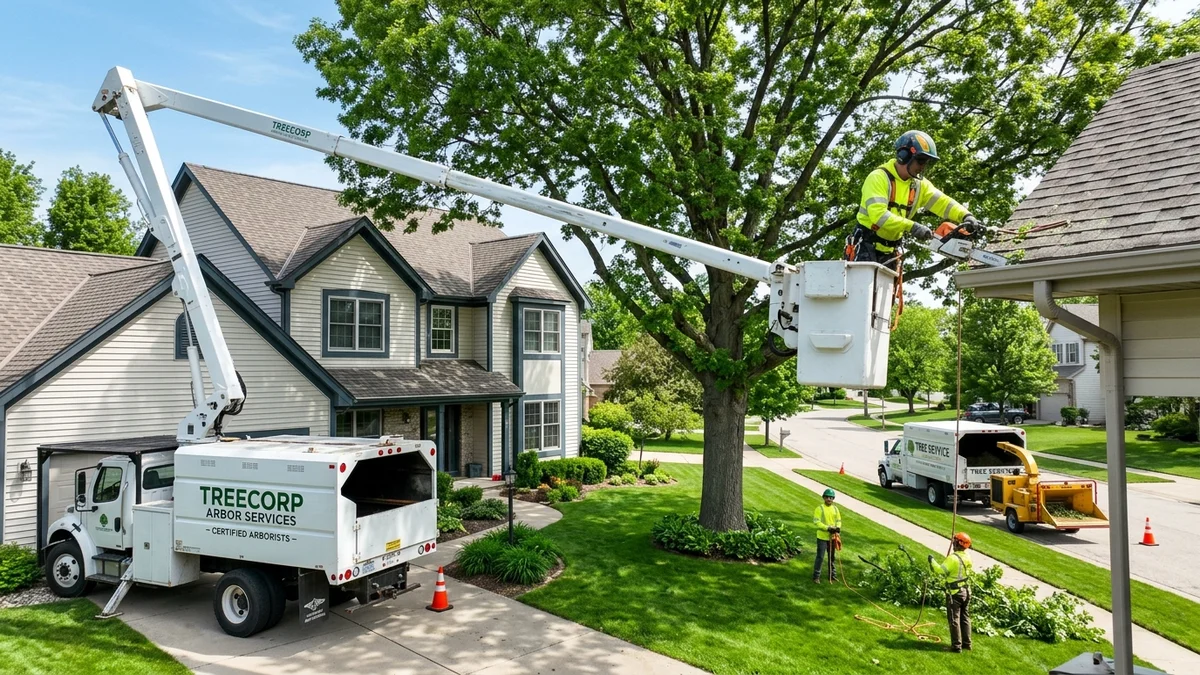
Two identical 45-foot maple trees receive completely different quotes depending on equipment staging and drop-zone clearance.
- Commercial bucket truck backs straight onto wide driveway
- Free ground drop zone onto open turf with zero structures below
- Direct chipper staging; brush fed immediately into machine
- Total crew time: 1.5 hours
- 36-inch gate prevents bucket truck entry; requires manual climber
- Limbs overhang asphalt shingle roof and glass sunroom
- Rope rigging and friction brake required to lower each branch
- Heavy branches hand-carried through narrow side gate
- Total crew time: 4.0 hours
Programmatic Cost Tables
Tree Trimming Cost Benchmarks by Height, Scope & Site Obstacles
Table 1: Tree Trimming Cost by Height Tier & Canopy Spread
| Height Tier | Canopy Spread | Typical Species Examples | Primary Equipment | Expected Cost Range |
|---|---|---|---|---|
| Under 15 ft (Dwarf / Ornamental) | < 15 ft | Japanese Maple, Dwarf Alberta Spruce, Lilac, Flowering Dogwood | Hand bypass pruners, loppers, telescoping hand pole saws | $100 – $300 |
| 15 – 30 ft (Small Tree) | 15 – 25 ft | Crabapple, Flowering Pear, Redbud, Serviceberry, River Birch sapling | Gas pole pruners, tripod orchard ladder, mini trailer chipper | $250 – $700 |
| 30 – 45 ft (Medium Shade Tree) | 25 – 40 ft | Red Maple, Flowering Cherry, Sweetgum, Hornbeam, Birch | 50’ aerial bucket truck, arborist rope & saddle climbing | $450 – $950 |
| 45 – 60 ft (Large Shade Tree) | 35 – 55 ft | White Pine, Mature Ash, Norway Maple, Honey Locust | 60’ aerial lift, friction Port-a-Wrap, heavy brush chipper | $600 – $1,200 |
| 60 – 80 ft (Extra Large Hardwood) | 50 – 70 ft | Mature White Oak, Sugar Maple, Black Walnut, Norway Spruce | 75’ high-reach boom, arborist aerial rigging, mini skid steer | $1,000 – $2,100 |
| 80+ ft (Towering Mature Giant) | 60 – 90+ ft | Grand Red Oak, Sycamore, Tulip Poplar, Eastern White Pine | 100’ knuckle boom, mobile crane assist, multi-climber crew | $1,400 – $2,500+ |
*Figures represent national suburban baseline pricing for healthy, open-yard residential trees including standard brush chipping and cleanup. Sourced from 2026 HomeGuide and Angi national surveys.
Table 2: Single Branch Removal vs. Whole-Tree Trimming vs. Full Removal
| Service Scope | Typical Cost Range | National Average | Operational Scope & Details |
|---|---|---|---|
| Single Branch Removal (Isolated Limb) | $75 – $250 | $150 | One hazardous or low-hanging limb cut back to branch collar. Usually subject to contractor trip minimum ($100–$300). |
| Few Limbs (2 – 4 Branches) | $150 – $400 | $250 | Clearing roofline overhangs, driveway clearance, or broken storm limbs while preserving the rest of the canopy. |
| Several Branches (5 – 8 Branches) | $250 – $600 | $375 | Extensive deadwood clearance or clearance along a property fence line without full canopy crown thinning. |
| Whole-Tree Maintenance Pruning | $400 – $900 | $650 | Comprehensive ANSI A300 crown cleaning, deadwood removal, thinning, and weight reduction across entire crown. |
| Complete Tree Removal (Tree Felling) | $750 – $2,500+ | $1,200 | Total takedown of entire standing tree to ground grade, log bucking, and heavy timber disposal. |
Table 3: Site Obstacles & Complexity Surcharges
| Site Obstacle / Risk Factor | Cost Multiplier | Operational Rationale |
|---|---|---|
| Overhanging House, Deck, or Garage | +20% to +35% | Zero free-fall drops allowed. Every branch must be roped through friction pulleys and lowered slowly to protect roofing and gutters. |
| Narrow Gate (< 36”) / Fenced Back Yard | +15% to +25% | Aerial bucket trucks cannot enter. Arborists must manually ascend with climbing spurs or throw lines, and brush must be carried by hand. |
| Near High-Voltage Power Lines (< 10 ft) | +35% to +50% | Demands OSHA 1910.269 and ANSI Z133 certified utility line-clearance arborists and insulated fiberglass aerial equipment. |
| Significant Deadwood / Brittle Rot | +20% to +35% | Dead branches are fragile and lack tensile flexibility. Climber tie-in points are hazardous, requiring aerial lifts or crane picks. |
| Storm Damaged / Hanging Split Limbs | +25% to +50% | Boughs under violent tension can kick back or barber-chair upon cutting. Requires complex rigging and extra spotters. |
| Debris Haul-Away & Disposal | +$75 to +$250 | Covers brush chipper operation, chip truck transport, and commercial municipal green-waste tipping fees. |
1. Tree Trimming vs. Tree Pruning: What is the Difference?
In common homeowner language, "tree trimming" and "tree pruning" are often used as synonyms. In professional arboriculture, however, they represent two distinctly different disciplines with separate labor methodologies, tooling, and pricing structures:
Tree Trimming (Aesthetic & Clearance)
Trimming focuses primarily on external aesthetics, boundary maintenance, and physical clearances. Typical tasks include shearing hedges, trimming branches encroaching on utility wires, clearing sightlines along sidewalks and driveways, and cutting back limbs brushing against roofs or siding.
Tree Pruning (Horticultural Health & ANSI A300)
Pruning is a biological science designed to protect tree health and structural longevity according to ANSI A300 standards. Certified arborists evaluate the entire tree crown to perform:
- Crown Cleaning: Removing dead, dying, diseased, or weakly attached branches.
- Crown Thinning: Selectively removing interior branches to increase light penetration and reduce wind resistance during gale storms.
- Crown Raising: Removing lower branches to provide head clearance for pedestrians and vehicles.
- Crown Reduction: Reducing canopy height or spread while maintaining structural branch architecture (never topping).
2. The Physics of Height: Why Tall Trees Cost Dramatically More
A 75-foot mature oak tree does not cost twice as much to prune as a 35-foot flowering cherry—it often costs three to four times as much. Understanding the physical and operational realities explains why pricing scales non-linearly with canopy height:
- Aerial Equipment Overhead: While a small ornamental tree can be pruned from the ground using telescoping pole saws and tripod ladders, trees over 45 feet require heavy capital machinery: 60-to-100-foot insulated aerial bucket trucks or articulated spider lifts costing $180,000 to $300,000.
- Climbing Fatigue & Rigging Physics: In backyards where heavy trucks cannot enter, certified production climbers must ascend the tree using climbing ropes and spurs. Climbing and operating a chainsaw 65 feet in the air is physically grueling, requiring rotations between certified arborists and extensive ground safety support.
- Wind Sway & Kinetic Risk: At 70 feet above ground level, wind gusts cause significant canopy sway. Severed branches possess massive kinetic energy that can whip erratically if not properly snubbed with arborist rigging blocks and friction bollards.
- Workers' Compensation Premiums: Tree trimming at heights is classified among the highest-risk occupations in the nation. Workers' comp insurance for aerial tree workers routinely costs 25% to 45% of payroll, a mandatory overhead cost embedded in legitimate arborist bids.
3. Single Branch Removal vs. Whole-Tree Pruning: The Contractor Minimum Fee
Homeowners frequently ask: "If a single branch removal costs $75 to $250, why did a company quote me $300 to cut down just one branch?"
The answer lies in contractor mobilization overhead. A professional tree care company does not send a lone handyman in a sedan. A standard tree service dispatch involves:
1. Driving a 26,000-lb commercial bucket truck and 12-inch brush chipper through traffic.
2. Paying the hourly wages and hazard benefits of a 2- to 3-man certified crew.
3. Setting up safety traffic cones, establishing safe drop perimeter zones, and staging rigging gear.
4. Commercial general liability and heavy equipment insurance coverage for the duration of the visit.
Pro-Tip for Maximum Savings: If you have an overhanging branch requiring professional attention, walk your entire yard before calling. Bundling several trees or pruning 3 to 5 limbs across multiple trees during the same visit amortizes the mobilization cost and drops the cost per branch dramatically.
4. Roofline Proximity & Precision Sectional Rigging
When a large tree stands in an open meadow, pruning is rapid: the crew cuts limbs and allows them to free-fall directly to the turf. In suburban residential settings, however, heavy canopy limbs frequently hang directly over architectural shingles, gutter lines, glass skylights, or stone patios.
In these proximity zones, free-falling wood is forbidden. Arborists must execute controlled negative rigging:
- Bull Ropes & Pulleys: A high-strength arborist bull rope is anchored above the cut branch through an impact block. The limb is hitched with a timber knot, and a tag line is attached to guide its swing.
- Ground Friction Bollards (Port-a-Wrap): A ground technician wraps the rope around a steel friction bollard mounted to the trunk. When the aerial worker severs the limb, the ground worker snubs the line, catching the multi-hundred-pound branch mid-air before it can contact the roof, and lowers it gently to the lawn.
- Labor Multiplier: Rigging each limb requires 10 to 20 minutes of rigging and lowering compared to 30 seconds for a free drop. This directly drives the 20% to 35% proximity surcharge seen in professional estimates.
5. High-Voltage Power Lines: Electrical Clearance & Utility Programs
Tree trimming near overhead electrical infrastructure presents extreme life-safety risks. Green living tree limbs are filled with conductive sap and water; touching or getting within the arc distance of an uninsulated power line can cause fatal electrocution.
Mandatory Legal Protocols:
Primary Distribution Lines (High-Voltage 7,200V+): Under federal OSHA 1910.269 and ANSI Z133 safety mandates, standard residential tree care workers and homeowners are legally prohibited from working within 10 feet of high-voltage transmission lines. Only specially certified Utility Line-Clearance Arborists with dielectric-tested fiberglass boom trucks are authorized to operate in this clearance zone.
Utility Provider Pruning (Free of Charge): If a tree branch is growing into, touching, or threatening primary electric wires on your street, contact your local electric utility immediately. Most electric companies maintain routine vegetation management programs and will prune or fell the hazardous limb at zero cost to you to safeguard the electrical grid.
6. Debris Management: Chipping, Hauling, or On-Site Recycling
A mature shade tree can generate several cubic yards of compressed foliage and dense branches. Managing this waste represents a substantial portion of contractor operating expenses:
Complete Haul-Away (+$75 – $250)
The crew chips all brush into their commercial dump truck, rakes your lawn clean, blows off driveways and roofs, and pays municipal tipping fees to unload green waste.
Keep Woodchips (Free Mulch)
Request that the crew chip the brush and dump the organic woodchips on your property. Fresh arborist woodchips make excellent long-term weed suppressant and moisture retention for landscape beds.
Firewood Bucking (Save $50 – $100)
Ask the crew to buck thick limbs (over 4 inches in diameter) into 16-inch fireplace rounds and leave them neatly stacked on-site. This reduces truck payload and dump fees.
7. How to Evaluate Tree Contractor Quotes & Spot Unlicensed Handymen
Tree care is notorious for unlicensed, uninsured contractors operating out of pickup trucks. While their prices may look tempting, an uninsured worker injured on your property or a severed limb crushing your roof can trigger devastating financial and legal liabilities.
Related Arborist & Yard Care Resources
Explore our comprehensive suite of arborist tools, tree care guides, and yard planning calculators:
Common Questions
Frequently Asked Questions About Tree Trimming Costs
Answers
Frequently asked questions
01How much does tree trimming cost on average in 2026?
Nationwide, the average cost to trim a mature residential tree is approximately $650, with most homeowners spending between $400 and $900 per tree according to HomeGuide and Angi national cost surveys. Small trees under 30 feet cost $250 to $700, medium trees (30 to 60 feet) cost $600 to $1,200, and large mature hardwoods over 60 feet range from $1,000 to $2,500 or more depending on equipment access and canopy spread.
02How much does it cost to trim a single large tree branch?
Trimming a single large overhanging tree branch typically costs $75 to $250, with a national average of approximately $150. However, most professional tree care services carry a minimum trip charge or job floor of $100 to $300 to cover truck mobilization, crew travel, and insurance overhead. Pruning 2 to 3 branches during the same visit is generally far more cost-effective per cut.
03What is the difference between tree trimming and tree pruning?
While often used interchangeably, tree trimming primarily refers to aesthetic shaping and clearance pruning (e.g. cutting back branches touching gutters or clearing sightlines). Tree pruning refers to horticultural crown maintenance adhering to ANSI A300 standards—such as crown thinning, removing diseased or crossing branches, and structural crown reduction to foster long-term arboricultural health.
04Why are 60- to 80-foot trees so expensive to trim?
Towering trees over 60 feet require heavy specialized equipment (such as a 75-foot aerial bucket truck or 40-ton crane) and advanced high-climbing arborist techniques with friction ropes. Working at extreme canopy heights increases fall hazards, demands specialized high-hazard workers' compensation insurance, and requires meticulous lowering of heavy boughs to avoid damaging roofs or lawns below.
05How often should mature residential trees be trimmed or pruned?
Most mature deciduous shade trees (oaks, maples, elms) benefit from professional pruning every 3 to 5 years. Fast-growing trees or ornamental fruit varieties may require light pruning every 1 to 2 years. Evergreen conifers (pines, spruces, firs) rarely require routine pruning other than removing lower dead branches or storm-damaged limbs.
06How much extra does it cost if a tree overhangs a house, deck, or patio?
Limbs overhanging structures typically add a 20% to 35% complexity surcharge. Arborists cannot allow cut limbs to free-fall onto roofs or decks. Every heavy limb must be tied off with arborist bull ropes, rigged through canopy pulleys, and lowered slowly using a ground friction brake (such as a Port-a-Wrap), which doubles crew labor time per branch.
07Who is legally and financially responsible for trimming branches overhanging a property line?
Under standard U.S. common law, a property owner has the legal right to trim branches and roots that encroach across their boundary line up to the exact property line, at their own expense. However, you cannot trespass onto the neighbor's land without permission, nor can you prune the tree in a negligent manner that compromises its health, causes it to die, or creates a collapse hazard.
08What should I do if tree branches are touching electrical power lines?
Never attempt to trim branches near power lines yourself, and never hire an uncertified handyman. Under federal OSHA 1910.269 and ANSI Z133 regulations, only certified utility line-clearance arborists may work within 10 feet of high-voltage transmission lines. Contact your electric utility company immediately; in most jurisdictions, utility providers will prune line-encroaching branches at zero cost to the homeowner to prevent grid outages.
09Does homeowners insurance cover tree trimming?
Standard homeowners insurance policies do not cover routine or preventative tree trimming, as tree maintenance is considered the property owner's ongoing responsibility. Insurance only steps in if an unpreventable storm or peril causes an otherwise healthy tree or limb to fall and inflict physical damage on a covered dwelling or insured structure.
10Can I save money by keeping the wood chips and cut branches on-site?
Yes. Declining debris haul-away typically saves $75 to $200 on your overall invoice. If you have open garden beds, you can request that the crew leave the chipped brush behind for free landscape mulch. If you have a fireplace or wood stove, you can ask the crew to buck thick branches into 16-inch to 18-inch firewood rounds and stack them on your property.
11Why do tree companies have a minimum trip fee or job minimum?
Deploying a licensed tree service involves significant fixed mobilization costs: dispatching a 3-man crew, fueling a $200,000 aerial bucket truck and wood chipper, paying high-hazard workers' compensation insurance, and driving to your property. To cover this base overhead, most professional outfits enforce a minimum service charge of $100 to $300 regardless of job size.
12How do I know if an arborist quote is fair or overpriced?
A fair residential tree trimming quote in 2026 generally falls between $350 and $900 per mature tree depending on height, canopy density, and obstacle proximity. If a bid exceeds $1,500 per tree without specialized crane rigging, severe structural obstacles, or hazardous rot, request an itemized breakdown. Always obtain 2 to 3 written bids from ISA Certified Arborists with verified certificates of insurance.
Need Expert Tree Care or Landscape Renovation in Essex County?
For tree pruning, hazardous limb clearance, tree planting, or comprehensive yard rejuvenation, connect with verified local North Shore landscaping professionals.
Get connected with an independent local landscaping professional. Calls go to (877) 537-6896.