Tree Removal Due to Storm Damage: What Homeowners Should Know
When severe wind, ice, or torrential rain damages or fells a mature tree, immediate safety takes precedence over cleanup. Understand what constitutes an emergency hazard, how insurance coverage applies, when a damaged tree can be saved, and how to verify professional quotes.
If a storm-damaged tree or branch is affecting electrical lines, a building, a roadway, or an area people must use, keep clear of the affected area and contact the appropriate electric utility, municipal emergency authority, or qualified tree professional immediately. Storm-damaged wood, partially failed root plates, and suspended branches are under extreme physical tension and can shift, roll, or snap unexpectedly without warning.
Direct Answer: What Happens When a Tree Suffers Storm Damage?
Storm damage does not automatically mean a tree must be removed, but uprooting, major trunk failure, extensive crown damage, unstable broken limbs, or contact with structures and utilities can require urgent professional assessment. Avoid approaching unstable trees or electrical-line damage. A qualified arborist/tree professional can determine whether the tree can reasonably be retained, requires pruning, or needs full removal and can document the scope for estimates or insurance.

What Should You Do When a Tree Is Damaged by a Storm?
In the immediate wake of a severe nor'easter, hurricane, high-wind derecho, or heavy ice storm, the yard is a dynamic hazard zone. Trees and large branches that look stable may be held in place only by splintered twigs, friction, or underlying tension.
Before picking up a phone or calling tree services, systematically identify which category describes your situation:
Storm-Damaged Tree Decision Flowchart
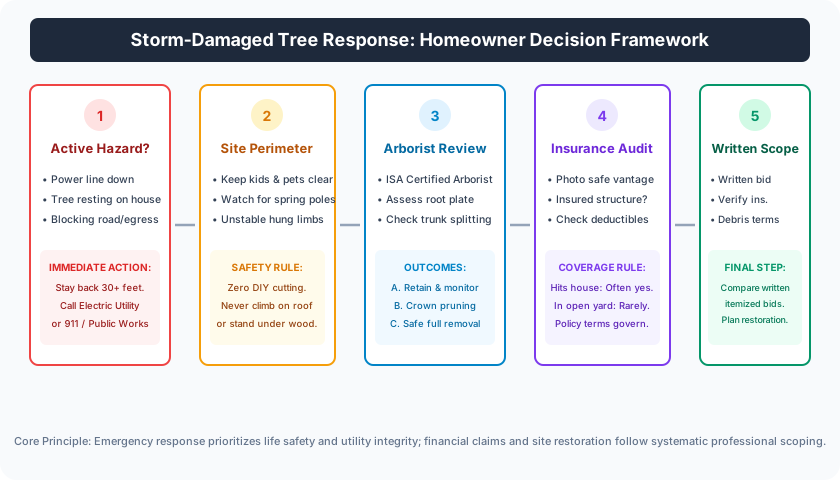
Guidance synthesized from OSHA Tree Care Safety Guidelines & Penn State Extension Post-Storm Management.
| Situation Scenario | Primary Safety Concern | Who to Contact | Response Priority | Insurance Potential | Next Step |
|---|---|---|---|---|---|
| Tree or large limb in contact with power lines | Fatal electrocution hazard; arcing wire fire; energized ground conductors. | Electric Utility Emergency Line & 911 (Keep 30+ feet clear) | Critical Emergency | Utility handles line clearance. Homeowner claim applies only if private property sustained structural damage. | Safety First: Clear Area & Call Utility |
| Tree or heavy branch resting on house or attached garage | Structural roof collapse; punctured rafters; rainwater infiltration; shifting loads. | Qualified Tree Professional (Crane/Rigging) & Homeowners Insurer | Critical Emergency | Generally covered under standard dwelling coverage, subject to policy deductible and tree removal sub-caps. | Tree Removal Cost Calculator |
| Tree resting on detached shed, boundary fence, or deck | Secondary structure failure; tensioned wood; compromised property security. | Professional Tree Service with Liability & Workers' Comp Insurance | Urgent Response | Often covered under 'Other Structures' (Coverage B), usually with sub-limits (e.g. $500–$1,000 for tree removal). | Tree Removal Cost Calculator |
| Tree blocking primary driveway or essential household access | Emergency vehicle entrapment; blocked egress for residents or medical mobility. | Professional Tree Service or Municipal Public Works (if blocking public road) | Urgent Response | Many policies cover tree removal if it blocks a driveway or wheelchair ramp, even if no building was struck. | Tree Removal Cost Calculator |
| Broken or hung branches suspended in upper canopy ('widow-makers') | Unpredictable falling weight without warning during subsequent breezes or rains. | ISA Certified Arborist equipped for aerial work / bucket truck | Urgent Response | Generally not covered unless the falling branch damages an insured structure. Considered preventative arborist maintenance. | Tree Trimming Cost Calculator |
| Standing mature tree newly leaning or showing ground heaving | Root plate rupture; catastrophic failure imminent in subsequent weather. | ISA Certified Arborist (Tree Risk Assessment Qualified - TRAQ) | Prompt Assessment | Insurers do not pay for preventative removal of leaning trees before they fall and strike a covered structure. | Tree Removal Cost Calculator |
| Standing tree with storm damage to outer crown or lost branches | Asymmetrical weight distribution; secondary decay; potential crown recovery. | ISA Certified Arborist for crown restoration assessment | Prompt Assessment | Not covered by insurance; ongoing landscape tree preservation investment. | Tree Trimming Cost Calculator |
| Tree fallen completely in open yard / turf without hitting structures | Turf suffocation; blocked lawn maintenance; aesthetic yard impact. | Standard Professional Tree Service or Landscape Cleanup Contractor | Non-Emergency Cleanup | Generally NOT covered by standard homeowners insurance (no insured structure damaged; out-of-pocket homeowner cost). | Tree Removal Cost Calculator |
Does Storm Damage Mean the Tree Must Be Removed?
In the immediate shock following a storm, many property owners assume that because a tree looks ragged, stripped of leaves, or missing several large limbs, it is "dead" and must be cut to the ground.
Penn State Extension explicitly warns that post-storm panic frequently leads to unnecessary and destructive tree work. Trees are resilient biological organisms equipped with natural defenses (known in forestry as compartmentalization). A tree that lost 30% of its outer canopy can often seal its pruning wounds, generate new vegetative foliage, and remain structurally sound and aesthetically pleasing for decades.
Many commercial tree websites publish an arbitrary rule claiming that if 50% of a tree's crown is damaged, it must automatically be condemned. Certified arborists reject this as an oversimplification. Whether a tree can recover depends on multiple biological variables:
- Tree Species: Fast-growing, decay-prone species (like silver maple or willow) struggle with major breaks, whereas strong hardwoods (like white oak, sugar maple, or hickory) have outstanding compartmentalization capabilities.
- Trunk Integrity: If the main central stem has not split vertically and the bark remains attached to the trunk collar, structural stability remains intact.
- Root Plate Anchor: If the ground around the tree is flat and undisturbed, the anchoring root plate is sound.
- Target Zone: A tree located in an open back field poses vastly lower target risk than the identical tree towering over a bedroom.
Save vs. Remove Decision Matrix
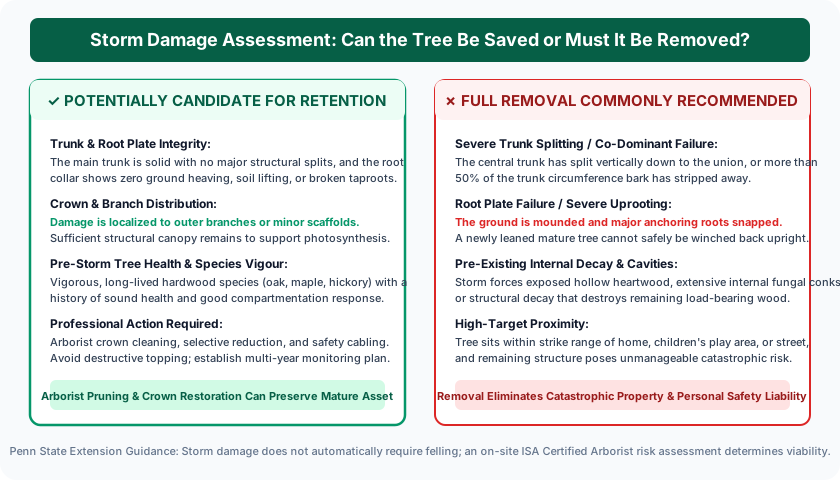
Source: Penn State Extension (Department of Ecosystem Science and Management) & International Society of Arboriculture (ISA).
Critical Warning: Never Allow "Tree Topping" After Storms
Unscrupulous or untrained contractors frequently advise homeowners to "top" a storm-damaged tree—lopping off all major canopy limbs down to blunt stubs under the promise of making the tree "wind-resistant."
Topping is the most destructive practice in arboriculture. Cutting main limbs creates massive flat wounds that cannot seal, allowing wood-decay fungi to penetrate deep into the heartwood. In response to stress, the tree sends out dozens of rapid, weakly anchored "water sprouts" from the edges of the cut. Within 3 to 5 years, these weakly attached sprouts grow heavy and break off in moderate breezes, turning the tree into a severe hazard. Insist on ANSI A300 crown-reduction pruning by an ISA Certified Arborist.
Who Should Evaluate a Storm-Damaged Tree?
ISA Certified Arborist
Credentialed by the International Society of Arboriculture (ISA). Possesses verified education, passing scores on comprehensive arboricultural exams, and adherence to professional codes of ethics. Look for specialists holding the TRAQ (Tree Risk Assessment Qualification) credential for evaluating structural hazards.
Utility Line-Clearance Crew
Specifically certified under OSHA 1910.269 electrical-hazard standards. Employed or contracted directly by the electric utility to clear trees touching or threatening high-voltage distribution lines. Private homeowners cannot hire standard tree companies to cut near energized wires.
General Tree Service / Crane Crew
Equipped with grapple trucks, mobile cranes, and chippers for physical felling, bucking, and timber extraction. Must carry active General Liability (minimum $1M–$2M) and active Workers' Compensation. Excellent for executing cleanups once safety is established.
Specific Storm Impact Scenarios: Roofs, Wires & Lawns
What Happens When a Tree Hits a Building?
When tons of green wood rest on roof rafters, the primary danger is secondary shifting during cutting. If an untrained crew makes hasty chainsaw cuts, the sudden release of weight can cause the remaining trunk to punch through ceiling joists or destabilize the load-bearing exterior wall.
- Evacuate rooms directly beneath the strike zone immediately.
- Check basement electrical panels for arcing or water leaks.
- Call your insurance claim hotline before moving any wood.
- Professional arborists will use a crane to sling and hoist the trunk vertically off the structure.
What If the Tree Is Near an Electrical Line?
OSHA guidelines state that downed or damaged lines must be treated as energized until certified otherwise by the electric utility. Even if your home has lost power, neighborhood backfeed from home generators or automated grid switches can re-energize lines in an instant.
- Stay back at least 30 feet from the tree and all touching fences.
- Call the electric utility emergency number immediately.
- Do not allow private tree services to work until utility releases the site.
- Never touch a vehicle that is in contact with downed lines.
How Much Does Storm-Damaged Tree Removal Cost?
According to current nationwide market data compiled by Angi (July 2026), routine professional tree removal averages approximately $750, with most standard residential removals falling between $200 and $2,000+ depending on tree height and trunk diameter.
However, storm-damage tree removal frequently exceeds baseline pricing. Many commercial lead-generation websites claim that emergency tree work automatically carries a fixed "+50% or +100% emergency surcharge." In reality, tree service pricing after a storm is not driven by arbitrary percentage markups, but by concrete physical job complexity:
| Cost Driver Factor | Impact on Job Complexity & Labor | Planning Guidance |
|---|---|---|
| Tree Size & Trunk Diameter (DBH) | Larger trees (60+ feet tall, 30+ inches DBH) carry exponential weight, requiring heavy equipment, extensive rigging, and multiple truckloads of wood hauling. | Small trees under 30 feet are straightforward; massive multi-leader oaks or pines require heavy crane operations. |
| Tree Position: Standing vs. Fallen vs. Hung | A tree clean on the ground requires bucking and chipping. A tree suspended on a roof, hung up in another canopy, or partially uprooted is under unpredictable rotational tension. | Never attempt to cut suspended wood yourself; release of internal wood tension can cause violent, fatal snap-backs. |
| Structure Contact & Roof Rigging | A tree resting on a house cannot simply be felled. Arborists must use cranes or complex friction-lowering rigging to piece out wood branch by branch without further puncturing the roof. | Insurers generally cover reasonable crane extraction costs when an insured structure is directly threatened. |
| Proximity to Electrical Utility Lines | OSHA mandates that non-utility tree crews stay clear of energized power lines. The utility must de-energize lines or perform certified line clearance before private tree crews can touch the wood. | Always call the electric utility first; never pay a private contractor to work directly around active, arcing conductors. |
| Site Accessibility & Terrain | Front yard trees easily accessible by bucket trucks and grapple loaders cost less. Fenced backyards, steep slopes, or soggy storm-soaked soils requiring protective ground mats increase labor. | Ask tree services whether they use heavy turf-protection mats to avoid leaving deep ruts in saturated lawns. |
| Debris Hauling & Wood Chipping Scope | Leaving clean firewood logs on site costs less than complete chip-and-haul debris removal. Municipal green-waste disposal tip fees vary by county. | Always confirm whether debris disposal is included or if logs will simply be stacked on the curb. |
| Stump Grinding Inclusion | Storm removal quotes typically cover taking the tree down to a low stump (3–6 inches above ground). Grinding the subterranean stump and chasing surface root flares is usually billed separately. | If you plan to replant a lawn or garden, specify stump grinding to a minimum depth of 8 to 12 inches below grade. |
Need an Itemized Estimate for Tree Removal or Trimming?
Once immediate storm hazards are secured, run our interactive pricing calculators to establish a realistic baseline range based on tree height, trunk diameter, access, and stump grinding.
Does Homeowners Insurance Cover Storm Tree Removal?
Navigating insurance claims after a severe weather event is fraught with misunderstandings. Many homeowners assume that any tree felled by wind is an automatic insurance claim. In truth, standard homeowners insurance policies (such as the standard HO-3 form) draw a sharp line based on what the tree struck:
Insurance Coverage Comparison: Structure Struck vs. Open Yard
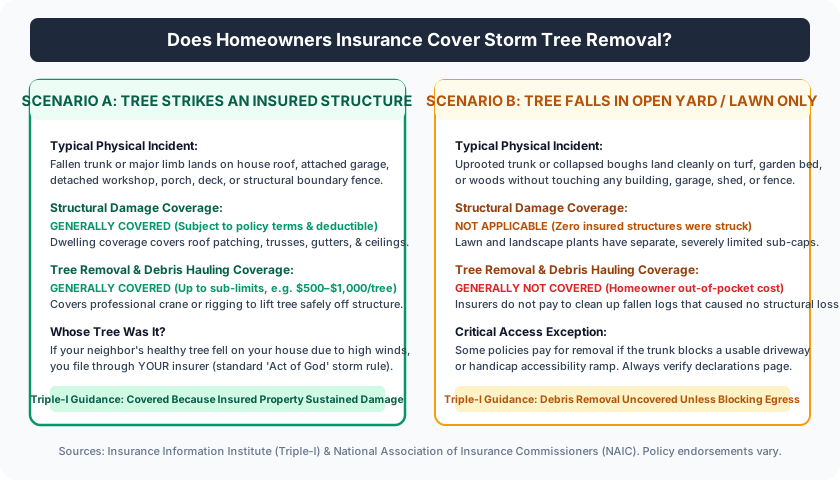
Source: Insurance Information Institute (Triple-I) & National Association of Insurance Commissioners (NAIC).
| Insurance Scenario | Physical Impact | Structural Damage | Tree Removal Coverage | Authoritative Policy Rule |
|---|---|---|---|---|
| Tree Falls on Your Home, Roof, or Attached Garage | Roof decking punctured, structural trusses damaged, interior exposed to weather. | Generally Covered (Dwelling / Coverage A) | Generally Covered (Up to policy tree limits, typically $500–$1,000+ per tree) | Insurance Information Institute (Triple-I): If a tree strikes an insured structure, the policy covers both structural repairs and necessary tree removal from the building. |
| Tree Falls in Open Yard (No Structures Damaged) | Tree lands harmlessly on lawn, garden bed, or woodland soil without touching buildings. | Not Applicable (Zero structural damage) | Generally NOT Covered (Homeowner out-of-pocket expense) | Triple-I & NAIC: When a tree falls in the yard without damaging an insured building, the homeowner is responsible for cleanup costs, unless access is blocked. |
| Tree Falls and Blocks Usable Driveway or Accessibility Ramp | Fallen trunk prevents vehicle egress to public roads or blocks handicap accessibility ramp. | Not Applicable (Unless driveway pavement sustained impact damage) | May Be Covered (Under specific additional coverage endorsements) | Many standard ISO homeowners forms include an exception reimbursing up to $500–$1,000 to remove a tree that blocks a driveway or wheelchair ramp. |
| Neighbor's Healthy Tree Falls onto Your House | A neighbor's tree is felled by high storm winds and crushes your roof or fence. | Covered by YOUR Insurer (Dwelling / Other Structures) | Covered by YOUR Insurer (Subject to your deductible and sub-caps) | Triple-I Standard Rule: Regardless of whose property the tree grew on, you file the claim with YOUR homeowners insurance company when your home is damaged. |
| Your Tree Falls onto Neighbor's House | Your tree is uprooted by storm winds and lands on a neighbor's house or garage. | Covered by NEIGHBOR'S Insurer | Covered by NEIGHBOR'S Insurer | Unless prior written notice of severe tree decay was formally established, severe weather felling is deemed an Act of God, and the neighbor files with their own carrier. |
| Tree Falls on Your Parked Vehicle in the Driveway | Tree trunk crushes vehicle hood, roof, or windshield while parked on private property. | Not Homeowners Insurance (Auto Comprehensive) | Covered under Auto Policy (Comprehensive / Other than Collision) | NAIC Guidance: Vehicles crushed by fallen trees are covered under the optional Comprehensive section of the automobile insurance policy, not home insurance. |
What If My Neighbor's Tree Fell on My Property?
This is one of the most common post-storm disputes. According to the Insurance Information Institute (Triple-I), when a neighbor's healthy tree is blown over onto your house, garage, or fence by storm winds, you file the claim through your own homeowners insurance. In the eyes of the law, severe weather is an "Act of God," and your neighbor is generally not held legally negligent for storm damage caused by a living, apparently healthy tree.
The only common exception occurs if you have documented written proof (such as a certified arborist inspection letter sent via certified mail prior to the storm) that put the neighbor on formal legal notice that their tree was dead, severely rotted, or structurally hazardous. In that scenario, your insurer may pursue subrogation against the neighbor's liability policy after paying your claim.
What Should a Storm Tree Removal Quote Include?
6-Point Written Quote Verification Checklist
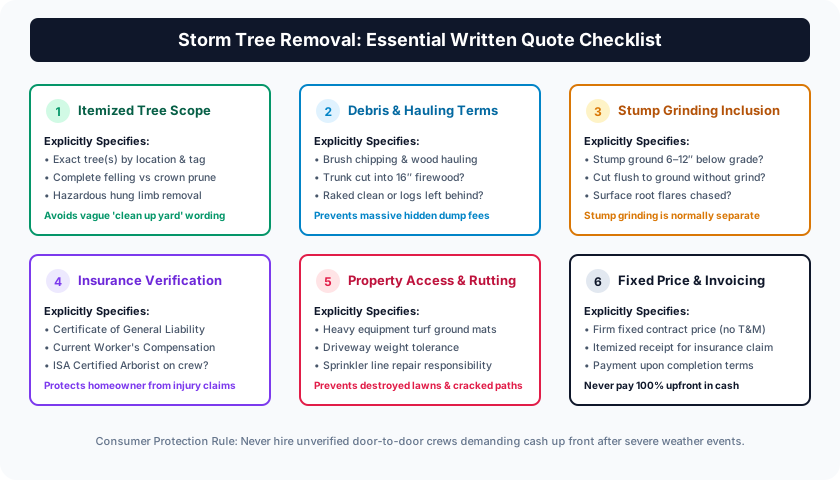
Consumer Protection Standard: Always verify contractor General Liability and Workers' Comp coverage directly with their insurance agent.
10 Common Mistakes Homeowners Make After Storm Tree Damage
Attempting DIY Chainsaw Work on Spring Poles or Suspended Limbs
Storm-damaged timber is frequently under severe internal mechanical tension (known as 'spring poles'). Cutting into a bent branch or partially pinned trunk can release stored kinetic energy violently, kicking the chainsaw back or crushing the operator. OSHA reports show spring poles cause dozens of fatal injuries annually.
Approaching Downed Power Lines or Assuming They Are Dead
Never assume a downed or tangled wire is harmless telephone cable or de-energized. Power lines can re-energize automatically through automated grid reclosers, electrifying tree limbs, wet grass, and chain-link fences up to 30 feet away.
Climbing on a Storm-Damaged Roof to Access or Cut a Tree
Homeowners frequently climb onto roofs with hand saws or chainsaws to inspect damage. A tree resting on rafters may have fractured structural trusses; stepping on the roof decking can trigger catastrophic localized collapse, or an unexpected tree shift can knock the homeowner to the ground.
Automatically Felling a Healthy Mature Tree that Suffered Minor Damage
In the emotional aftermath of a frightening storm, homeowners often panic and order complete removal of healthy trees that merely lost broken outer branches. Penn State Extension notes that many storm-damaged hardwoods possess exceptional compartmentalization capacity and can recover completely with proper arborist crown pruning.
Permitting Destructive Tree Topping Under the Guise of 'Safety Pruning'
Unqualified contractors often recommend 'topping' or severely shearing back all upper branches to make a surviving tree 'safer in the wind.' In reality, topping destroys tree architecture, creates large non-healing decay pockets, and stimulates weak, weakly attached water sprouts that fail easily in future storms.
Hiring Door-to-Door 'Storm Chasers' Demanding Upfront Cash
Transitory crews often descend on neighborhoods after severe wind or ice storms, offering cut-rate tree removal. Many lack general liability insurance and workers' compensation, meaning if an uninsured worker is injured on your property, you could face massive personal liability claims.
Assuming Homeowners Insurance Pays for Every Fallen Tree in the Yard
Many homeowners hire expensive emergency tree removal crews to clear fallen logs from their back lawn, expecting insurance reimbursement. When the claim is filed, they discover standard policies exclude fallen trees that caused zero structural damage to insured buildings.
Waiting Too Long to Mitigate Water Infiltration from Tree Roof Punctures
Homeowners sometimes wait days for an insurance adjuster to arrive before taking any action. If a tree punctured the roof and rain continues, failure to perform emergency mitigation (such as professional tarping) can lead to secondary interior mold and water damage that insurers may dispute.
Discarding Tree Debris Before Documenting Physical Damage for Insurance
Clearing away crushed gutters, shattered fence sections, or punctured roof shingles before taking photographs can complicate insurance claim adjusters' ability to verify the full scope of storm impact.
Failing to Check Municipal Street-Tree and Conservation Permit Rules
Cutting down a storm-damaged tree located on a public sidewalk strip, municipal right-of-way, or protected wetland buffer zone can result in heavy municipal fines if completed without local authority approval.
Frequently Asked Questions About Storm Tree Removal
Answers
Frequently asked questions
01Does a storm-damaged tree always have to be removed?
No. Storm damage does not automatically require complete tree removal. Penn State Extension guidance emphasizes that trees can often be saved if the main trunk has not split vertically, the root plate remains firmly anchored in the ground, and sufficient canopy remains to sustain the tree. An ISA Certified Arborist can evaluate structural integrity, prune broken limbs, and establish a recovery plan rather than felling a valuable mature tree prematurely.
02What should I do immediately if a tree or branch is touching a power line?
Stay clear and call your local electric utility emergency line immediately (or 911 if there is active sparking or fire). OSHA safety standards mandate that all downed or tangled power lines must be treated as fully energized and lethal. Never touch the tree, attempt to cut branches, or approach within 30 feet, as electrical current can flow through wet wood and ground soil. Only certified utility line-clearance arborists are authorized to work near electrical conductors.
03What should I do if a tree falls on my house or garage?
First, ensure all residents and pets evacuate the affected areas of the home immediately, especially if the impact compromised roof rafters, ceilings, or electrical wiring. From a safe distance outside, verify that no power lines are entangled. Contact your homeowners insurance carrier to initiate a claim, and call a qualified professional tree service equipped with cranes and rigging to remove the tree without causing further structural damage. Never climb onto a punctured roof to inspect or cut the wood yourself.
04Does homeowners insurance pay to remove a fallen tree after a storm?
Insurance coverage depends strictly on where the tree landed. According to the Insurance Information Institute (Triple-I), if a tree strikes your home, garage, shed, or structural fence, standard homeowners insurance generally covers both structural repairs and reasonable tree removal costs (often subject to sub-limits of $500 to $1,000 per tree). However, if the tree falls harmlessly in an open lawn or garden bed without damaging an insured structure, tree and debris removal is generally NOT covered and must be paid out-of-pocket.
05Who pays if my neighbor's tree falls on my house during a storm?
Under standard insurance rules across most US jurisdictions, you file the claim with YOUR OWN homeowners insurance company. Storm-related tree failures caused by severe wind, lightning, or ice are legally considered 'Acts of God.' Your insurance policy will cover the structural repairs and tree removal up to your coverage limits. Your insurer may only seek reimbursement (subrogation) from your neighbor if you have documented proof that the neighbor knew the tree was dead or hazardous prior to the storm and failed to address it.
06How much does storm-damaged tree removal typically cost?
National pricing benchmarks from Angi report that routine tree removal averages around $750, with common projects ranging from $200 to $2,000+. However, storm and emergency removals can cost significantly more when trees are entangled with structures, require specialized crane rentals ($200–$500+/hr), involve complex rigging to relieve internal wood tension, or require rapid after-hours response. Once immediate hazards are stabilized, use our Tree Removal Cost Calculator for a detailed project estimate.
07Is a fallen tree in the open yard considered an emergency?
No. If a tree has fallen completely onto open turf or garden beds without striking buildings, interfering with electrical lines, or blocking essential vehicle access, it is a non-emergency cleanup project. While you should keep children and pets away from splintered branches, you can take your time to collect multiple written estimates from qualified, insured tree services rather than paying premium emergency rates.
08What is a 'widow-maker' and why is it dangerous?
In arboriculture and forestry, a 'widow-maker' refers to a heavy broken limb, splintered branch, or detached tree crown that remains hung up or suspended loosely high in the canopy. These branches can drop unpredictably hours or days after a storm under the slightest breeze, posing severe, often fatal strike risks to anyone walking below. Suspended limbs require immediate professional bucket-truck or aerial rigging removal.
09Can a tree split down the middle by a storm be saved?
It depends on the depth and location of the split. If a minor co-dominant branch union has partially separated but the main structural trunk remains sound, an ISA Certified Arborist may be able to save the tree through crown reduction pruning and installing dynamic cabling or through-rod structural bracing (ANSI A300 standards). However, if a mature trunk has split vertically down to the ground or deep rot is present, complete removal is usually necessary to eliminate catastrophic failure risk.
10Should I let a tree service 'top' my storm-damaged tree to make it safer?
No. You should strictly reject any proposal to top a storm-damaged tree. Penn State Extension and the International Society of Arboriculture (ISA) warn that topping severely stresses the tree, creates massive open wounds that decay rapidly, and stimulates dense clusters of weakly anchored water sprouts. These fast-growing sprouts are far more prone to breaking and causing catastrophic failures in future storms than properly pruned natural branches.
11How can I avoid hiring an unlicensed or untrustworthy tree contractor after a storm?
Protect yourself by following five critical rules: (1) Never hire door-to-door solicitors demanding cash upfront; (2) Require an official Certificate of Insurance emailed directly from the contractor's insurance carrier showing active General Liability and Workers' Compensation; (3) Verify credentials such as ISA Certified Arborist; (4) Insist on a written contract detailing the exact tree scope, debris chipping, log hauling, and stump grinding; (5) Never pay the final bill until all work is fully completed.
12What happens if a storm-damaged tree is located on a city street or municipal strip?
If a damaged tree is located on a public sidewalk, street easement, or municipal park strip, it is generally the property and legal responsibility of the local municipal government (such as the City Public Works or Forestry Department). Private homeowners should not hire private contractors to fell or remove municipal trees without explicit written authorization from the city arborist or tree warden.
Restoring Your Landscape After Storm-Damaged Tree Removal
Once hazardous timber is safely removed and the stump is ground below grade, homeowners are left with large bare spots, churned lawn ruts, and altered sunlight conditions. Taking down a mature canopy shifts an area from deep shade to full sun, opening opportunities to rebuild your property with resilient, storm-adapted native trees, deep-rooted shrubs, and improved yard grading.
Need Professional Guidance on Storm-Damaged Trees or Site Restoration?
Connect with verified local tree services and landscape design professionals who carry active liability insurance and understand regional tree species.
Get connected with an independent local landscaping professional. Calls go to (877) 537-6896.