Meadow Garden Ideas: How to Create a Naturalistic Landscape
Transform sprawling, high-maintenance turf into a dynamic, living plant community. Learn how to combine structural native grasses with seasonal wildflowers, design intentional paths and edges, choose regionally adapted species, and manage the multi-year establishment process.
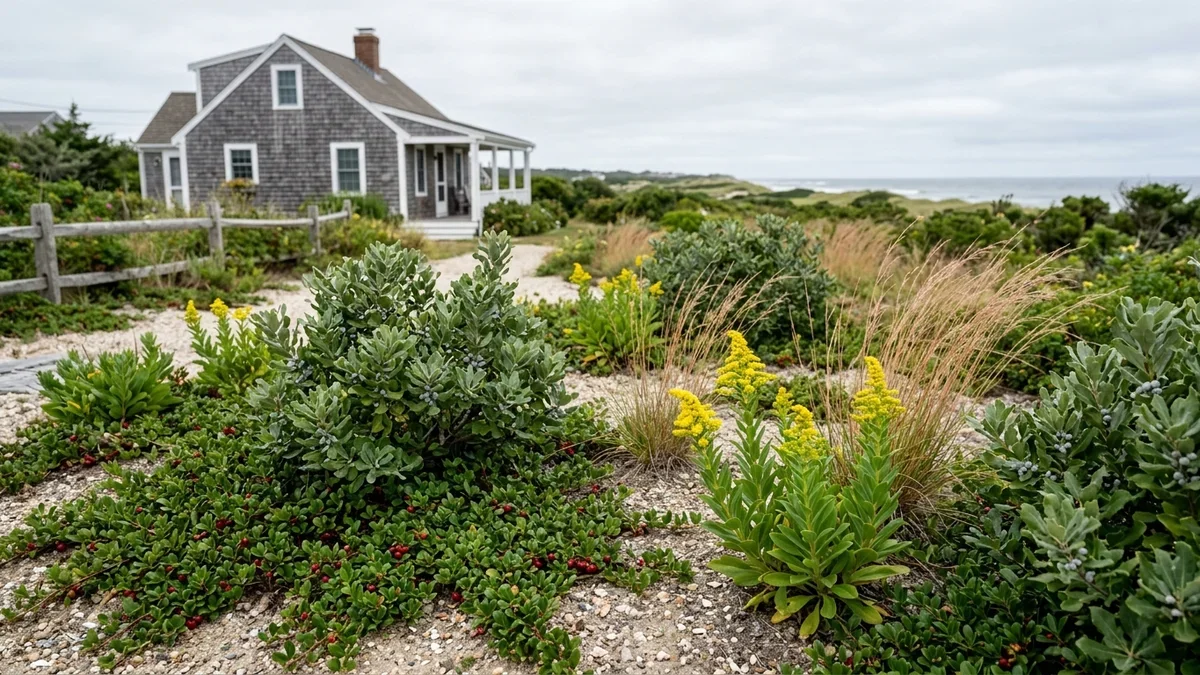
Direct Answer: What Is a Meadow Garden?
Quick Evaluation
Is a Meadow Garden Right for Your Property?
Before removing turfgrass, evaluate your site characteristics against the four ecological requirements of a sustainable residential meadow:
Sunlight Level
Ideal: 6+ hours of unobstructed sun. Partial sun (4–6 hrs) works with adapted edge sedges. Deep tree shade requires a woodland garden instead.
Soil & Moisture
Ideal: Average to lean soil. Do not over-fertilize; excess nitrogen causes aggressive weeds and weak, floppy flower stems.
Foot Traffic
Ideal: Visual viewing and wildlife strolling. Meadows cannot withstand high-impact soccer games or daily dog runs; retain a central turf lawn for active play.
Patience Horizon
Ideal: 2 to 3 years. Meadows require multi-season weed management before forming an interlocking, self-sustaining root canopy.
Ecological Reality
What Is a Meadow Garden? Plant Community vs. Bag of Seed
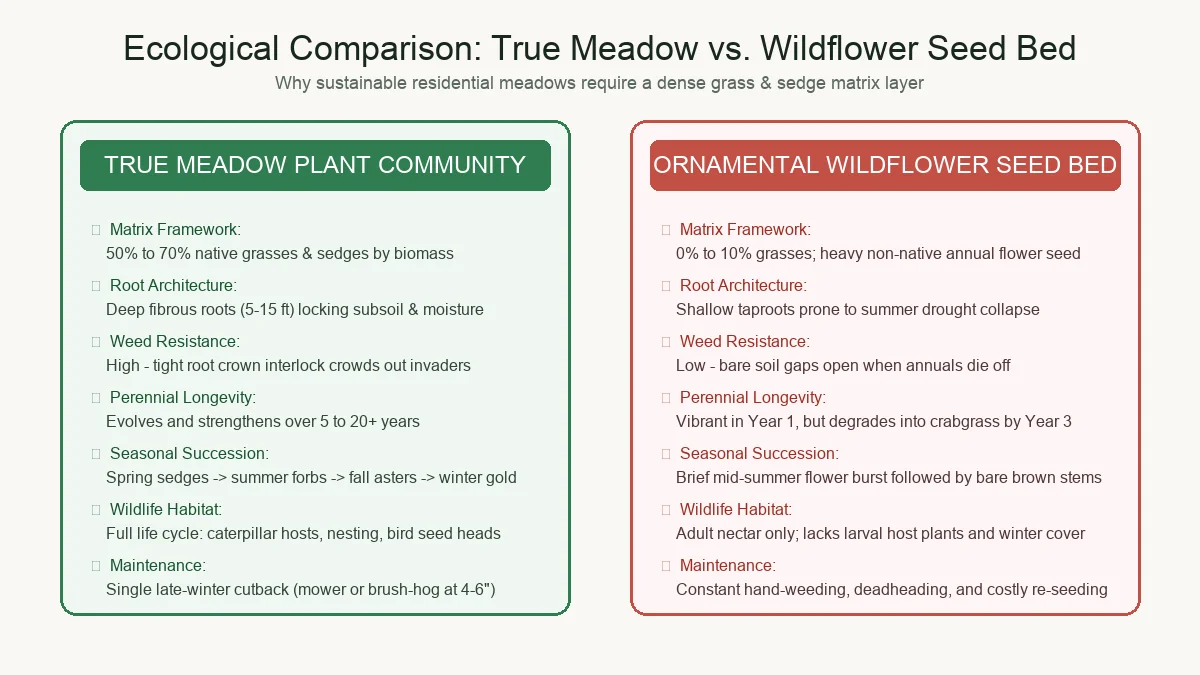
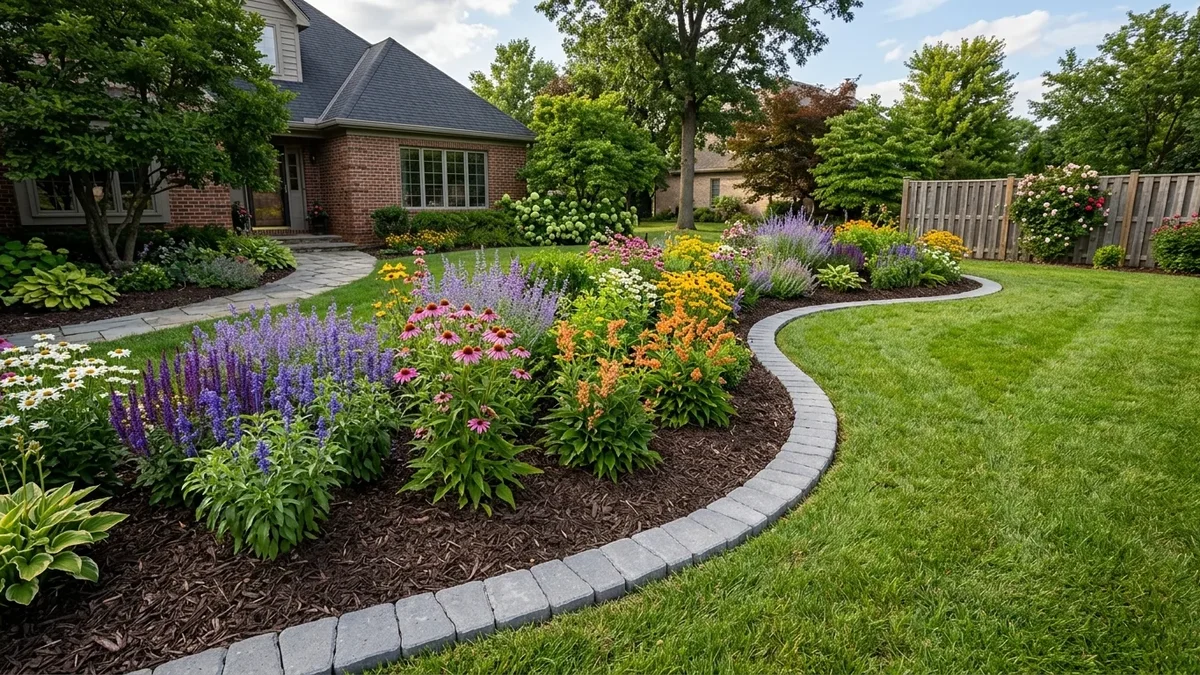
A meadow is not an ornamental flower bed with bark mulch between individual plants, nor is it a random scattering of packaged wildflower seeds. In ecology, a meadow is an interlocking, self-sustaining plant community dominated by perennial herbaceous species.
In a healthy meadow, plants grow tightly shoulder-to-shoulder. The underground root layer is as dense as the aboveground canopy. Deep fibrous root networks of native grasses and sedges intertwine with the deep taproots of flowering perennials (forbs). This dense belowground network intercepts rainwater, prevents airborne weed seeds from making contact with bare soil, and recycles organic nutrients without synthetic fertilizers.
Meadow Garden
A broad residential landscaping design term. Features a balanced mixture of native grasses, sedges, and forbs adapted to local soil and moisture conditions.
Wildflower Garden
Often composed entirely of flowers (90%+ forbs) with few or no grasses. Beautiful in early summer, but lacks the physical root structure to suppress aggressive weeds long-term.
Prairie
A distinct regional biome (predominantly the North American Midwest and Great Plains). We should not label every residential lawn conversion a “prairie” unless regionally appropriate.
Pollinator Garden
A functional habitat goal. A pollinator garden can take many forms (a formal border, raised bed, or container collection), while a meadow is an overarching landscape vegetation structure.
The “Stop Mowing and Let It Grow” Myth
Social media frequently promotes the idea that homeowners can simply stop mowing their lawn to instantly create an effortless wildflower meadow. University Extension horticulturists strongly warn against this approach.
Conventional residential turf consists of non-native cool-season grasses (Kentucky bluegrass, perennial ryegrass) bred to form dense mats. If left unmown, turfgrass turns into an unkempt 18-inch thatch that smothers desirable native wildflowers. Meanwhile, windblown seeds from invasive weeds—dandelions, thistle, burdock, garlic mustard, and aggressive tree saplings—colonize the yard. A true meadow requires removing existing turf, exhausting the soil weed bank, and installing a designed native matrix.
Structural Backbone
Why Meadows Need More Than Wildflowers: The Grass Matrix
Homeowners often fall in love with photos of wildflower meadows because of the dazzling colors of coneflowers, black-eyed Susans, and blazing stars. However, an all-flower planting is unstable. Without native bunchgrasses and sedges, residential meadows inevitably flop, succumb to weed invasions, and look bleak through winter.
Physical Scaffolding
Heavy flowerheads naturally lean after summer thunderstorms. The sturdy, upright foliage of bunchgrasses acts as a natural physical scaffold, holding tall forbs upright without the need for unsightly garden stakes.
Weed Suppression
University of Maryland Extension emphasizes that meadows composed of 50% to 70% grasses create an impenetrable fibrous root crown in the top 2 inches of soil, depriving weed seeds of sunlight and space to germinate.
Winter Architecture
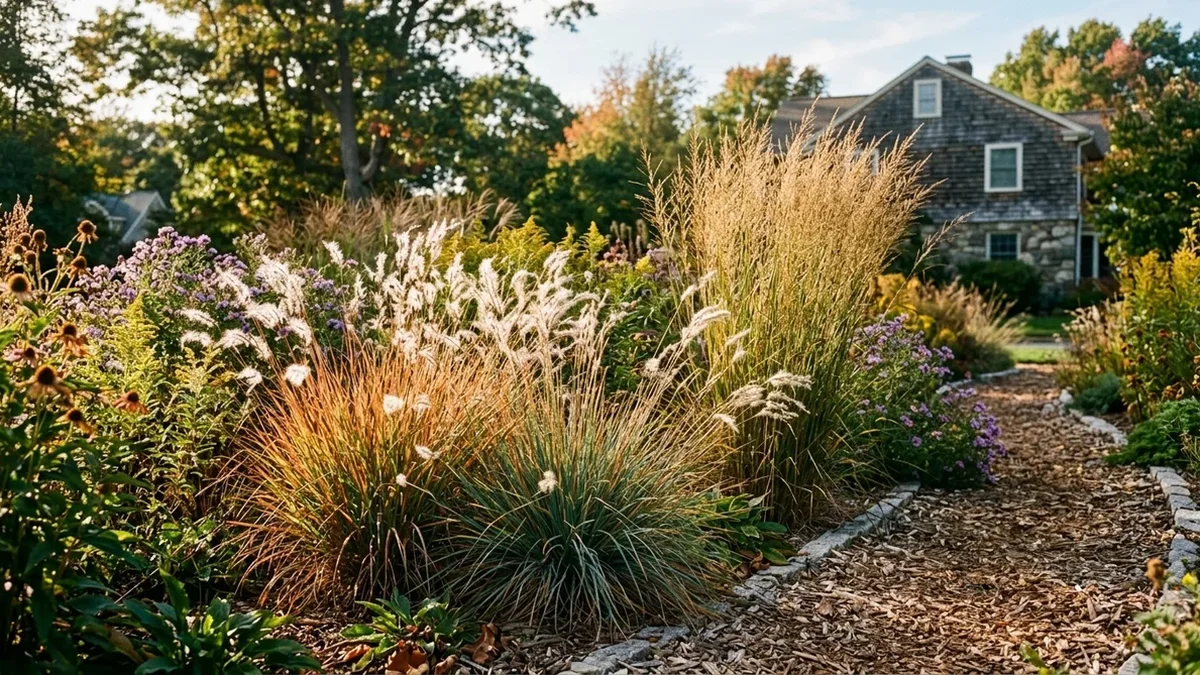
While herbaceous flower stems collapse after freezing frosts, native bunchgrasses (Little Bluestem, Prairie Dropseed) retain rich amber, russet, and copper tones that stand erect above snow blankets, providing winter movement and shelter.
Meadow Matrix & Plant Density Calculator
Calculate your grass-to-forb ratios, plant counts, drift clusters, and turf replacement metrics based on authoritative Extension standards.
Medium Yard Conversion
Recommended Specifications for 300 sq ft Meadow
300
12" on-center grid165
~4 native species135
~8 seasonal species23
5-7 plants / clusterExtension Insight: University of Maryland and Iowa State Extension emphasize planting in repeating drifts rather than scattering seeds randomly. Clumping 5 to 7 plugs of one flowering species creates prominent visual color blocks and allows bees to forage efficiently without expending excess flight energy.
Visual Inspiration & Design
16 Residential Meadow Garden Ideas for Real Yards
A successful residential meadow must balance wild ecological vitality with human living needs. Explore 16 distinct meadow design concepts tailored for small urban beds, formal front yards, expansive backyards, and difficult slopes:
Find Your Ideal Meadow Garden Concept
Filter 16 residential meadow styles by yard location, sun exposure, soil moisture, and available space.
Small Meadow Island Bed
Best For: Beginners wanting to test native plants without tearing up an entire lawn.
A standalone 150- to 250-square-foot kidney or teardrop bed set within manicured turf. Low-growing bunchgrasses anchor the core while compact coneflowers and goldenrod provide color. Surrounded by a 3-foot mown strip to signal intentional design.
Critical Watch-Out: Don't plant tall 6-foot species like big bluestem or cup plant; they will flop outward over the lawn edge.
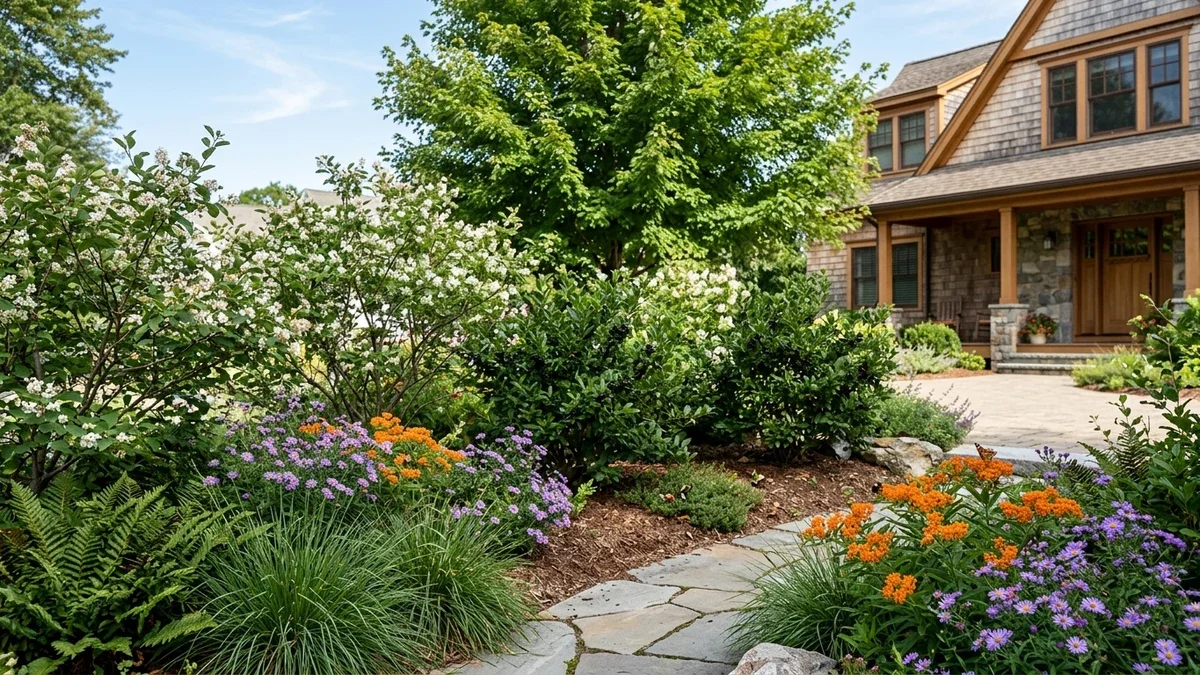
Lawn-Edge Perimeter Meadow
Best For: Homeowners looking to eliminate tedious boundary mowing while retaining play turf.
A 6- to 10-foot-wide naturalistic band lining property borders or fence lines. Blends soft ornamental grasses with seasonal perennials, creating an ecological buffer that frames the central recreational lawn.
Critical Watch-Out: Keep aggressive rhizomatous species (like Canada goldenrod) out of small borders or they will overwhelm neighboring beds.
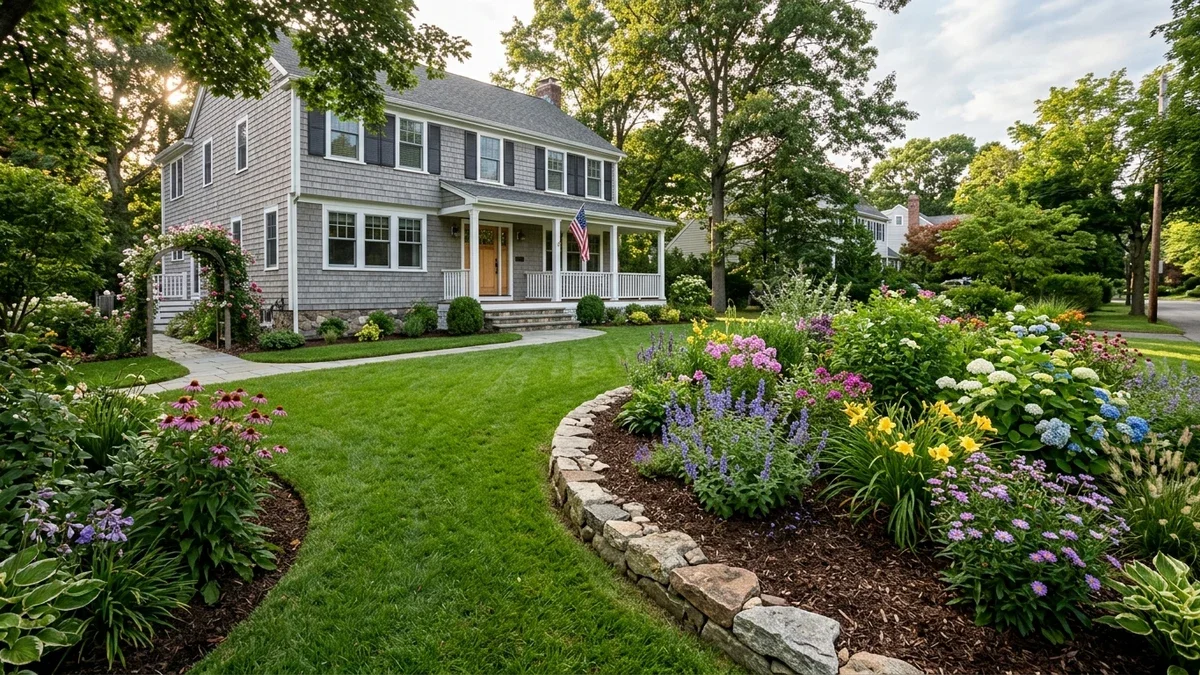
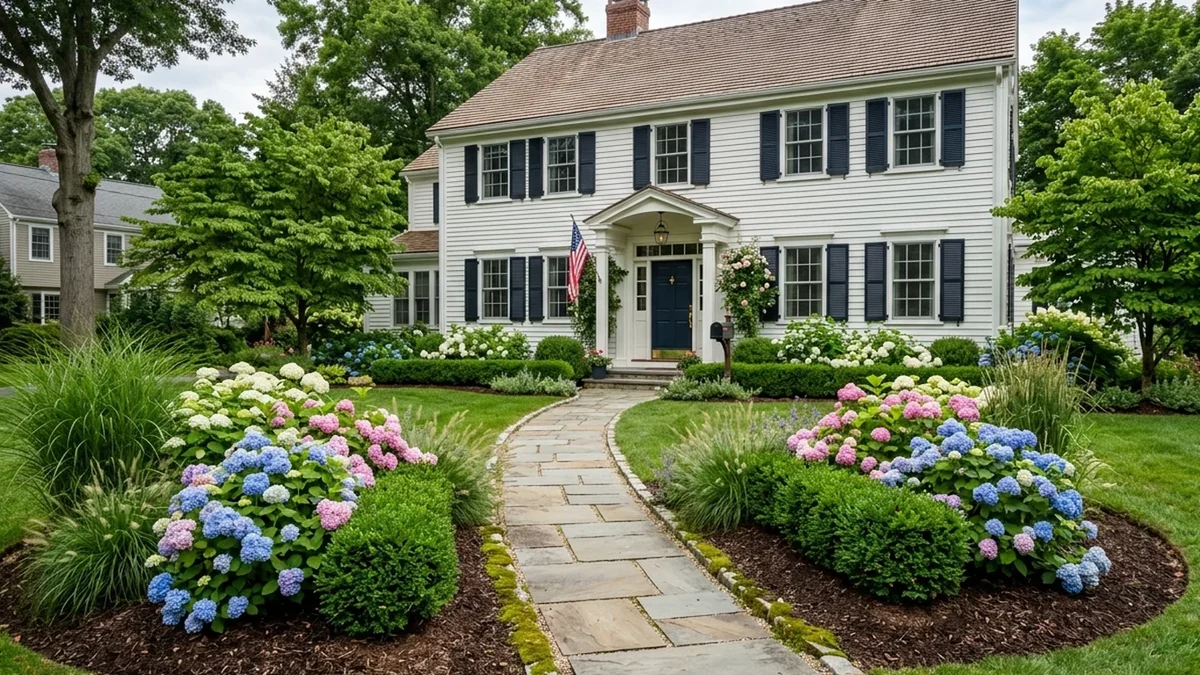
Front-Yard Designed Meadow
Best For: Front yards where curb appeal, neighbor relations, and HOA standards matter.
Features strictly controlled plant heights (under 3 feet) near public sidewalks, a pristine flagstone or concrete path to the front porch, and repeated drifts of 5 to 7 specimens of the same species to look intentional.
Critical Watch-Out: Check municipal height ordinances; keep plantings under 24 to 30 inches within 20 feet of driveway sightlines.
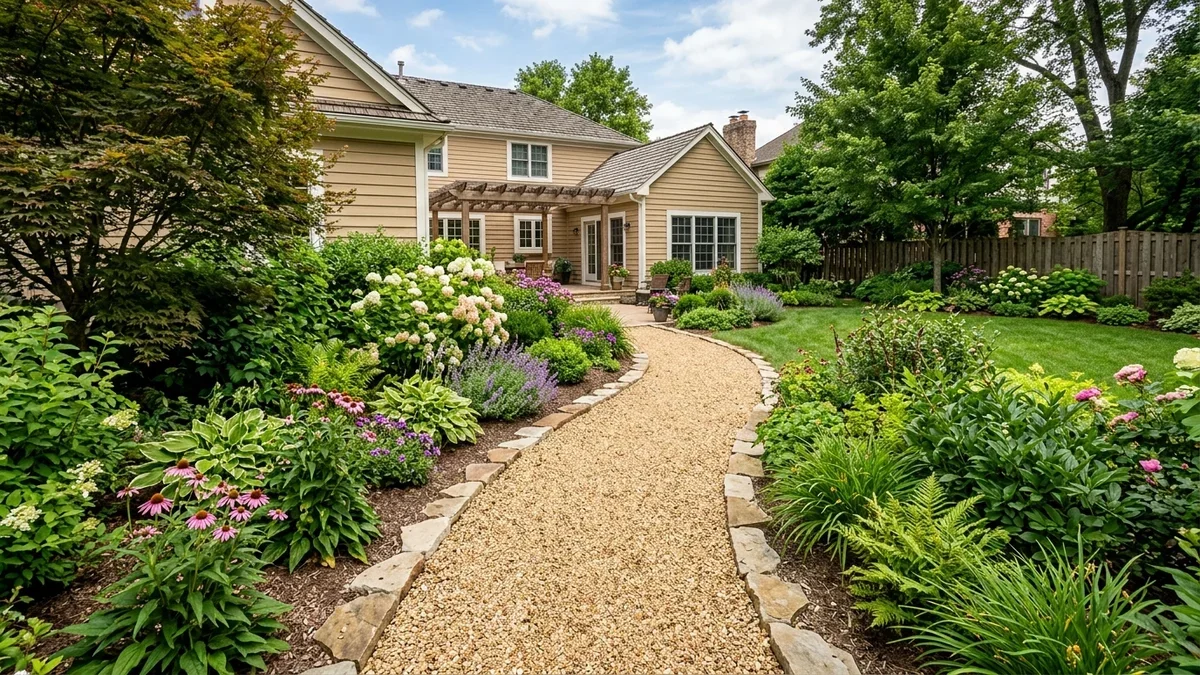
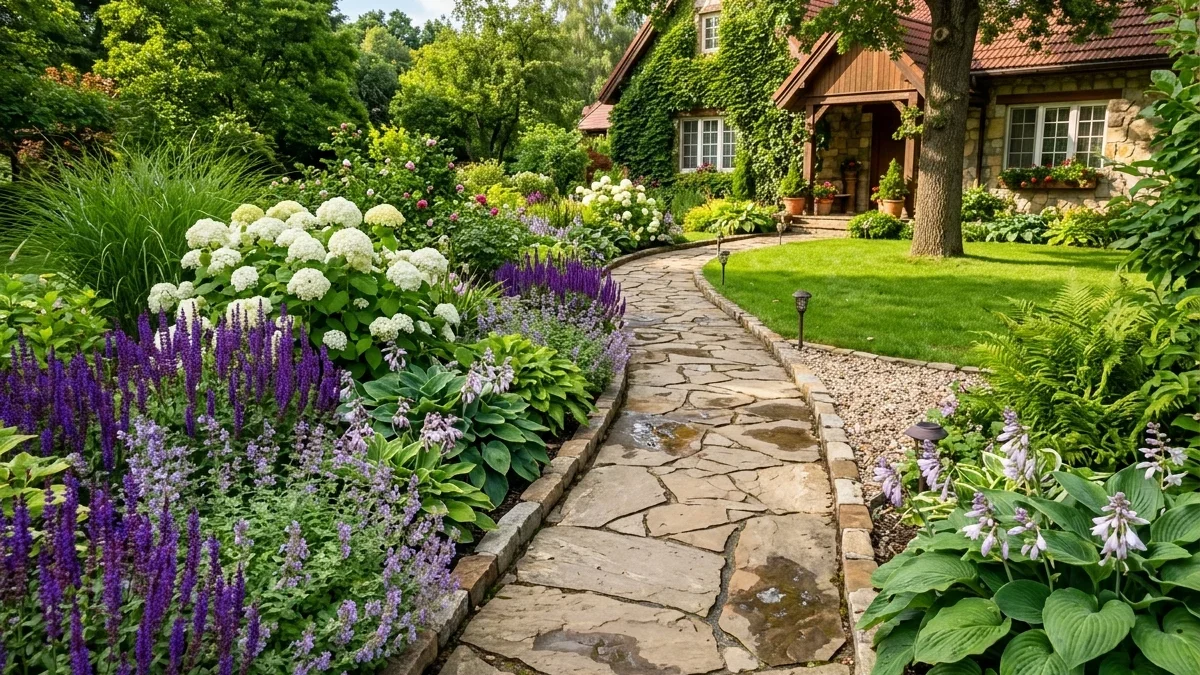
Crushed Stone Path Through Meadow
Best For: Interactive walkthroughs, butterfly watching, and sensory backyard experiences.
A 4-foot-wide permeable decomposed granite, pea gravel, or wood chip path meandering through knee-to-waist-high grasses and wildflowers. Steel edging keeps stone contained and creates a clean architectural line.
Critical Watch-Out: Ensure path is wide enough (minimum 42 inches) so dew-laden morning grasses don't soak your clothing as you stroll.
Mown Turf Circulation Lane
Best For: Suburban quarter-acre to multi-acre parcels converted from sprawling unneeded turf.
Maintain a double-width mower swath (5 to 8 feet wide) curving gently through the meadow. This gives visitors intuitive access and demonstrates to municipal inspectors that the meadow is deliberately maintained.
Critical Watch-Out: Mow the path weekly at 3 inches while leaving the adjacent meadow standing untouched until late winter.
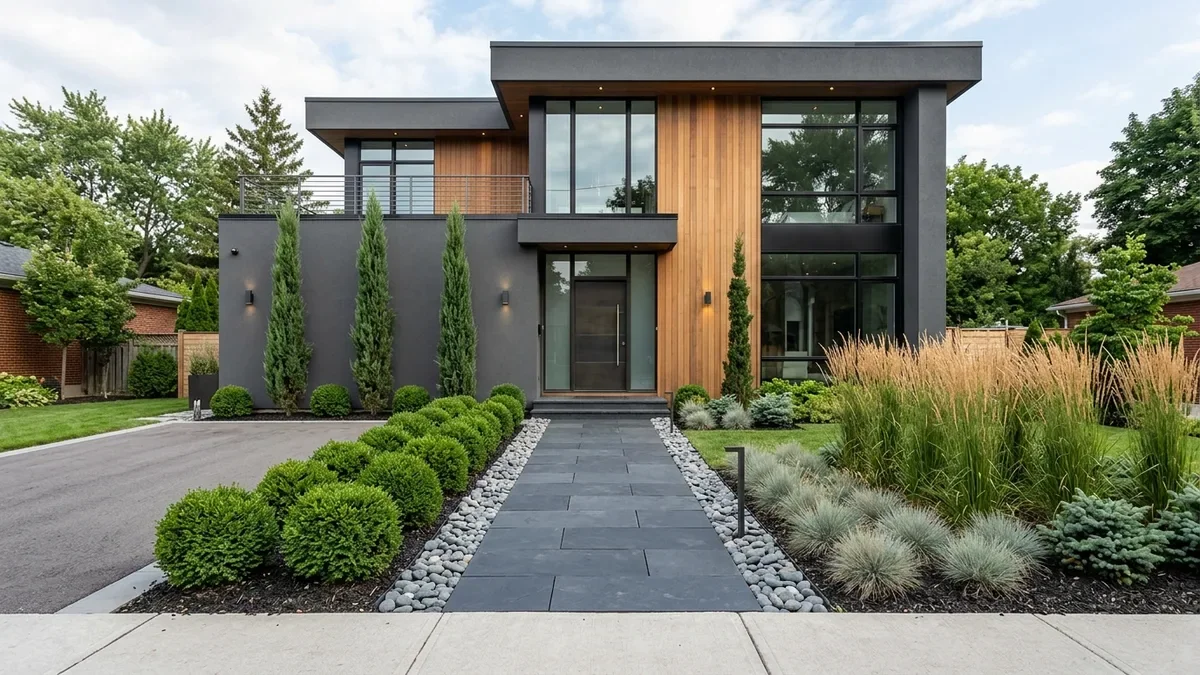
Modern Minimalist Architectural Meadow
Best For: Contemporary homes, clean architectural lines, and low-maintenance modern outdoor living.
Pairs geometric concrete paver walks and corten steel planters with large, repeating blocks of fine-textured bunchgrasses (like Prairie Dropseed or Blue Fescue) accented by solitary sculptural flowers like Echinacea or Allium.
Critical Watch-Out: Limit the palette to 4 or 5 carefully selected species; avoid random mixed seed mixes that look chaotic.
Grass-Led Matrix Meadow
Best For: Winter visual appeal, wind movement, and properties wanting the ultimate low-weed resilience.
Composed of 70% native bunchgrasses (Little Bluestem, Sideoats Grama, Prairie Dropseed) with delicate flowering forbs woven in as sparkling accents. Produces stunning copper and bronze autumn color that stands erect through snow.
Critical Watch-Out: Over-fertilization causes native grasses to grow too lush, lodge (fall flat), and lose their upright winter structure.
Flower-Rich Pollinator Meadow
Best For: Homeowners prioritizing butterflies, native solitary bees, hummingbirds, and goldfinches.
Maximizes unbroken floral succession from April through October while keeping a 40-50% bunchgrass base for caterpillar shelter. Clusters nectar plants (Monarda, Milkweed, Liatris, Asters) in 3-foot drifts so pollinators locate them easily.
Critical Watch-Out: Don't forget larval host plants; adult butterfly flowers alone will not support reproducing pollinator populations.
Dry-Site Gravel Meadow
Best For: South-facing slopes, sandy soils, gravelly terraces, and drought-prone water-restriction zones.
Planted directly into lean, sandy soil or a 2- to 3-inch gravel mulch layer. Features drought-hardy taproot forbs (Echinacea, Butterfly Weed, Blanketflower) and arid-tolerant bunchgrasses (Blue Grama, June Grass) that survive on rainfall alone once rooted.
Critical Watch-Out: Never apply rich organic compost or wood mulch in dry meadows; it holds excessive crown moisture and invites fungal rot.
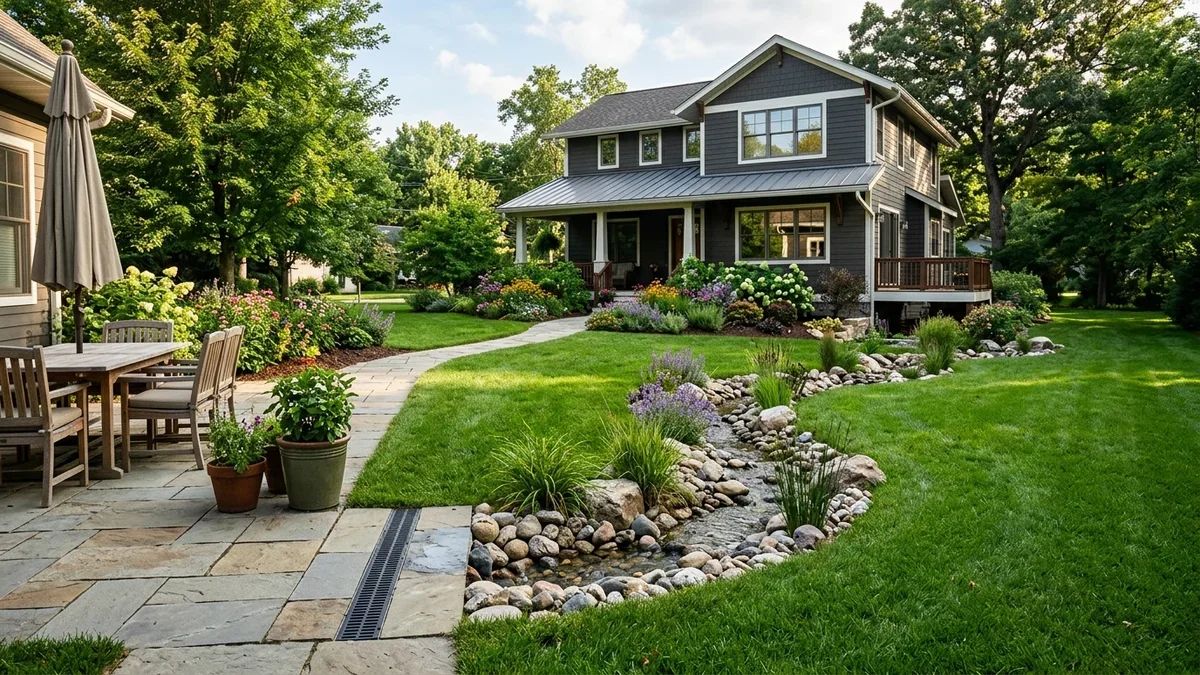
Moist Depression & Rain Garden Meadow
Best For: Natural low spots in the yard where seasonal rain pools for 12 to 24 hours.
Combines water-loving wetland sedges (Fox Sedge, Tussock Sedge) with resilient moisture forbs (Swamp Milkweed, Joe Pye Weed, Blue Flag Iris). Deep roots filter runoff and recharge the water table.
Critical Watch-Out: A moist meadow cannot resolve structural foundation water penetration; evaluate building drainage pipes and grading first.
Meadow-to-Woodland Edge Transition
Best For: Bridging open sunny lawns to mature tree lines, forested backyards, or property woodlots.
Transitions from full-sun meadow grasses into shade-tolerant sedges (Carex pensylvanica), woodland phlox, and native understory shrubs along the tree drip line. Mimics the highest biodiversity zone in eastern ecology.
Critical Watch-Out: Avoid deep mechanical rototilling under mature tree canopies; install shade sedges as small plugs between surface roots.
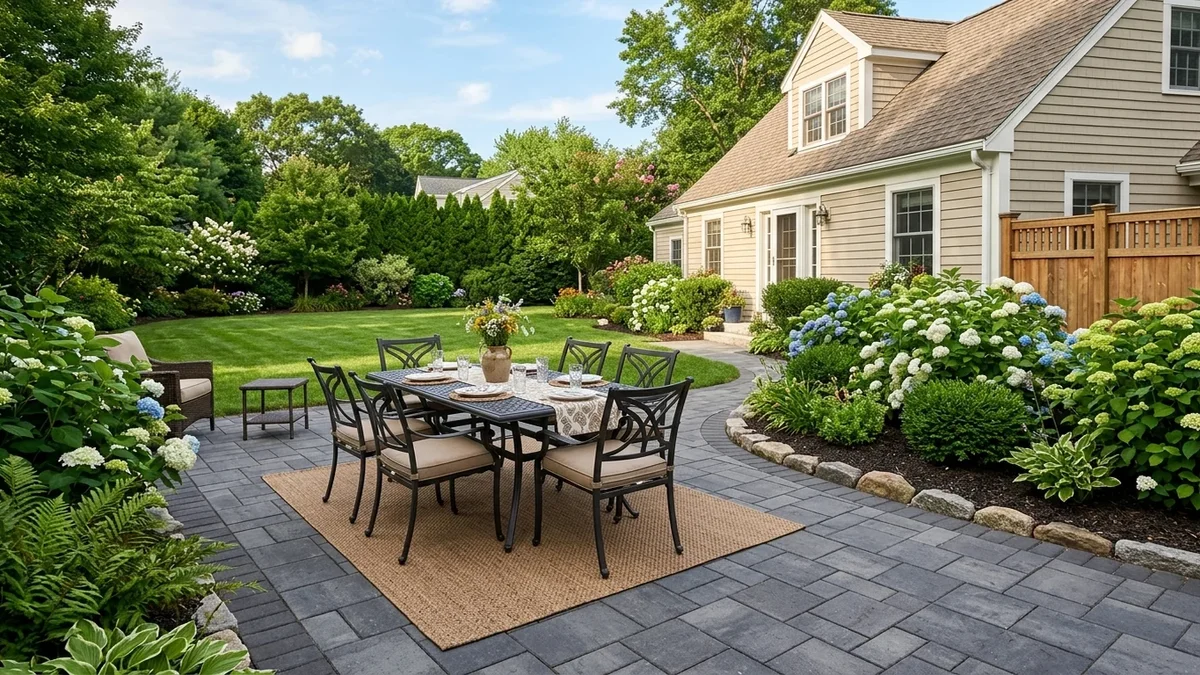
Meadow Border Wrapping a Patio
Best For: Creating an intimate, wildlife-surrounded outdoor dining or lounge area.
Wraps around patio pavers with soft, scented foliage (Wild Bergamot, Anise Hyssop) and fine grasses. Keeps plant heights low (under 2.5 ft) adjacent to dining chairs so seating feels immersed rather than encroached upon.
Critical Watch-Out: Maintain a 12-inch gravel or paver buffer between fire pits and standing dry grass to avoid late-summer fire hazards.
Ecoregional Native Meadow
Best For: Purists seeking authentic ecological restoration matched to their local county or ecoregion.
Utilizes only local ecotype seed and plugs sourced from regional native nurseries within 200 miles. Restores ancestral soil microbiology, provides specialized insect interactions, and thrives without amendments.
Critical Watch-Out: Avoid commercial 'wildflower mixes' claiming to be native; they frequently contain aggressive Eurasian annuals like Shirley poppy.
Short-Stature Meadow for Tight Spaces
Best For: Urban lots, tight side yards, and courtyards where tall grasses feel overwhelming.
Restricts all species to 12 to 24 inches maximum mature height. Employs Blue Grama, Pennsylvania Sedge, Wild Petunia, Calico Aster, and Pale Purple Coneflower. Retains full meadow ecological benefits at pocket garden scale.
Critical Watch-Out: Do not attempt to keep tall meadow plants short by shearing them in midsummer; select naturally low-growing species.
Meadow Along a Post & Rail Fence
Best For: Rustic suburban properties, country cottages, and softening long utilitarian fence lines.
Uses a two- or three-rail split cedar fence as a permanent architectural spine. Taller forbs (Ironweed, Joe Pye, Switchgrass) rise against the rails while medium grasses and forbs taper down to the lawn.
Critical Watch-Out: Leave a 12-inch clear strip beneath the fence rails for weed trimming access before plants fill in.
Driveway Border Naturalistic Ribbon
Best For: Replacing narrow, baked lawn strips between the driveway and property boundary.
A tough, heat-resilient 4- to 6-foot strip featuring salt-tolerant and drought-ready native perennials (Prairie Dropseed, Black-Eyed Susan, Goldenrod). Stands up to reflected pavement heat and winter snow piling.
Critical Watch-Out: Select salt-tolerant species in northern climates where road and driveway de-icing salts wash into roadside soil.
Continuous Interest
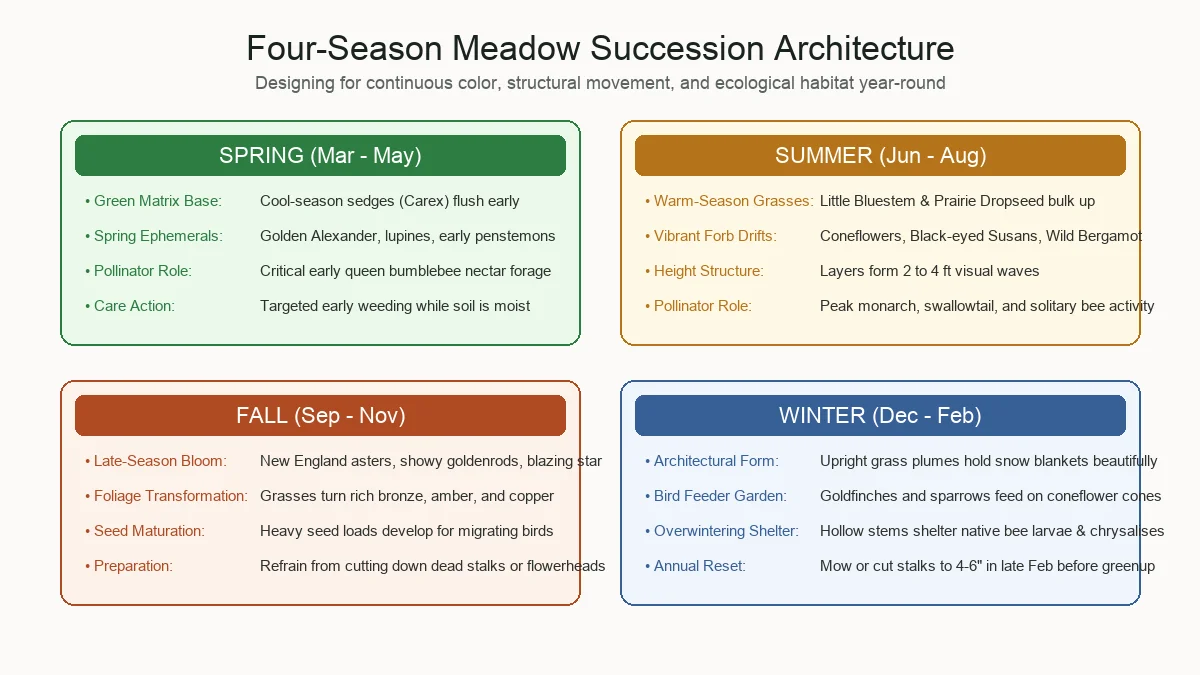
Four-Season Meadow Succession: Beyond July Photography
Amateur wildflower plantings often peak for three weeks in midsummer and look desolate for the remainder of the year. A professionally designed residential meadow relies on sequential bloom waves and persistent winter structure:
Curb Appeal & HOA Harmony
How to Make a Meadow Look Intentional, Not Abandoned
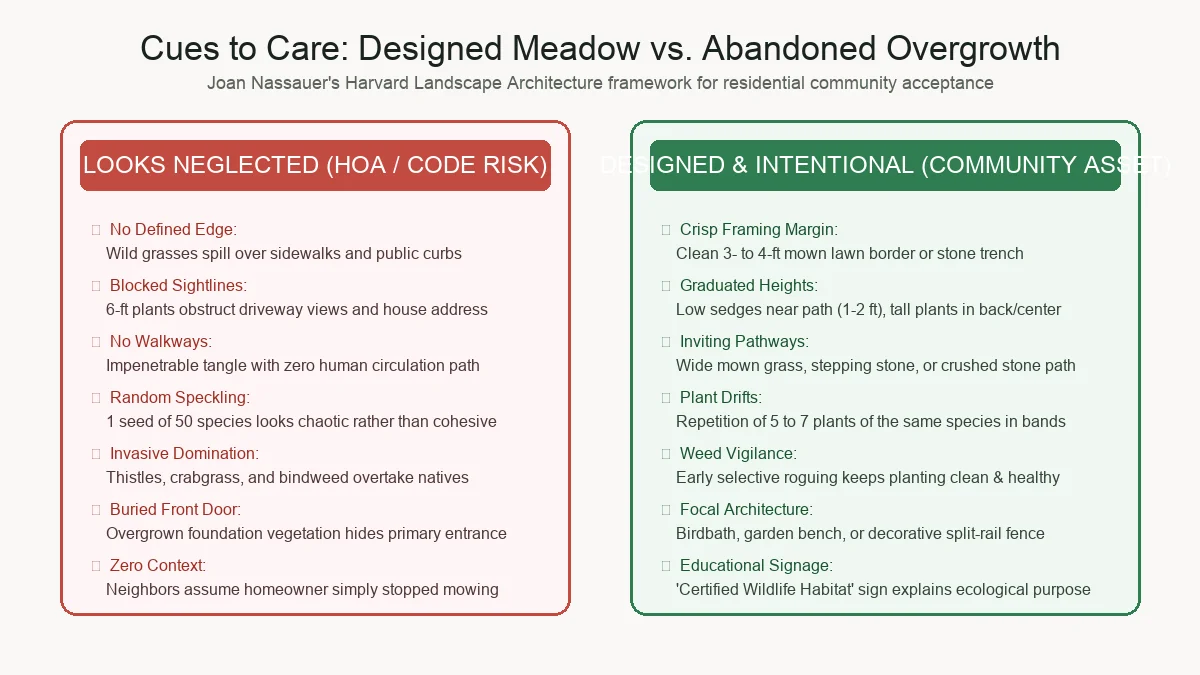
One of the greatest fears homeowners face when converting lawns to meadows is receiving a citation from municipal weed code enforcement or complaints from neighbors who assume the yard has been neglected.
In seminal research conducted at Harvard and the University of Michigan, landscape architect Joan Iverson Nassauer demonstrated that suburban communities eagerly embrace naturalistic, biodiverse plantings when they display unmistakable “Cues to Care.” These visible design signals prove to observers that the landscape is actively curated and intentional.
‘Cues to Care’ Intentionality Checklist
Based on Joan Nassauer's Harvard landscape architecture research. Select the cues present in your layout to calculate your HOA and neighbor acceptance rating.
60 / 100
Crisp Mown Margin or Hard Edge
+25 ptsA 3- to 4-foot neatly mowed lawn strip, steel edging, or stone border separating the meadow from public sidewalks, curbs, or neighbor lawns.
Inviting Human Walking Path
+20 ptsA continuous 36- to 48-inch mown turf lane, crushed gravel path, or stepping stones cutting through the meadow to invite interaction.
Controlled Front Heights (<30 inches)
+20 ptsAll vegetation within 15-20 feet of street corners, sidewalks, and driveways is kept under 30 inches to preserve vehicle and pedestrian visibility.
Grouped Plant Drifts (Not Random Speckles)
+15 ptsFlowers and grasses are planted in repeated clusters of 5 to 7 specimens of the same species rather than a chaotic mix of single stems.
Built Architectural Element
+10 ptsA garden bench, split-rail cedar fence, stone birdbath, or decorative boulder that signals the space is maintained and curated.
Subtle Educational or Habitat Plaque
+10 ptsA small, tasteful yard sign (such as National Wildlife Federation or local Extension 'Native Habitat') explaining the meadow's ecological purpose.
Audit Result: Good Foundation (Minor HOA Risk)
Your meadow has recognizable boundaries, but adding controlled height setbacks near the street or a dedicated focal anchor will significantly enhance neighborhood acceptance.
Regional Authenticity
Find Meadow Plants for Your Region: Native ≠ National
A plant native to the damp coastal plains of Massachusetts will rapidly wither in the alkaline soils of Colorado or the intense summer humidity of Georgia. There is no such thing as a single “national meadow plant list.”
Instead of purchasing generic national seed mixes, select keystone species proven to thrive within your state and EPA ecoregion. Use our regional directory below to explore adapted matrix grasses, seasonal forbs, and direct Extension links:
Ecoregional Native Meadow Plant Communities
Native is not national. A functioning meadow in Massachusetts relies on entirely different keystone species than one in Texas or California. Select your home region below to view adapted matrices and local Extension authorities.
Northeast & Mid-Atlantic
States: MA, ME, NH, VT, CT, RI, NY, NJ, PA, MD, DE • Humid Continental / Cool Temperate (USDA Zones 4-7)
Keystone Matrix Grasses & Sedges (50–70%)
- Little Bluestem2-3 ftSchizachyrium scoparium
- Pennsylvania Sedge6-10 in (shade/edge)Carex pensylvanica
- Purple Lovegrass1-2 ft (sandy/dry)Eragrostis spectabilis
- Switchgrass (Compact)3-4 ftPanicum virgatum 'Shenandoah'
Seasonal Flowering Forb Succession (30–50%)
- Golden AlexanderLate Spring (May-Jun)Zizia aurea
- Purple ConeflowerMid-Summer (Jul-Aug)Echinacea purpurea
- Wild BergamotMid-to-Late SummerMonarda fistulosa
- New England AsterEarly-to-Late FallSymphyotrichum novae-angliae
Wildfire Defensible-Space Requirement:
Standard residential buffer: keep standing dry grasses 5+ feet from wooden siding.
High weed seed bank pressure in former agricultural soils. Beware cool-season turfgrass re-invading borders; maintain a crisp 3-inch trench edge.
Step-by-Step Conversion
Phased Lawn-to-Meadow Conversion Framework
You do not need to bulldoze your entire property over a single weekend. In fact, both University of Maryland Extension and Wild Ones recommend a phased, modular conversion strategy for suburban homeowners. Converting your yard in phases allows you to learn local weed dynamics, observe how species perform on your specific soil, and maintain functional turf for outdoor recreation.
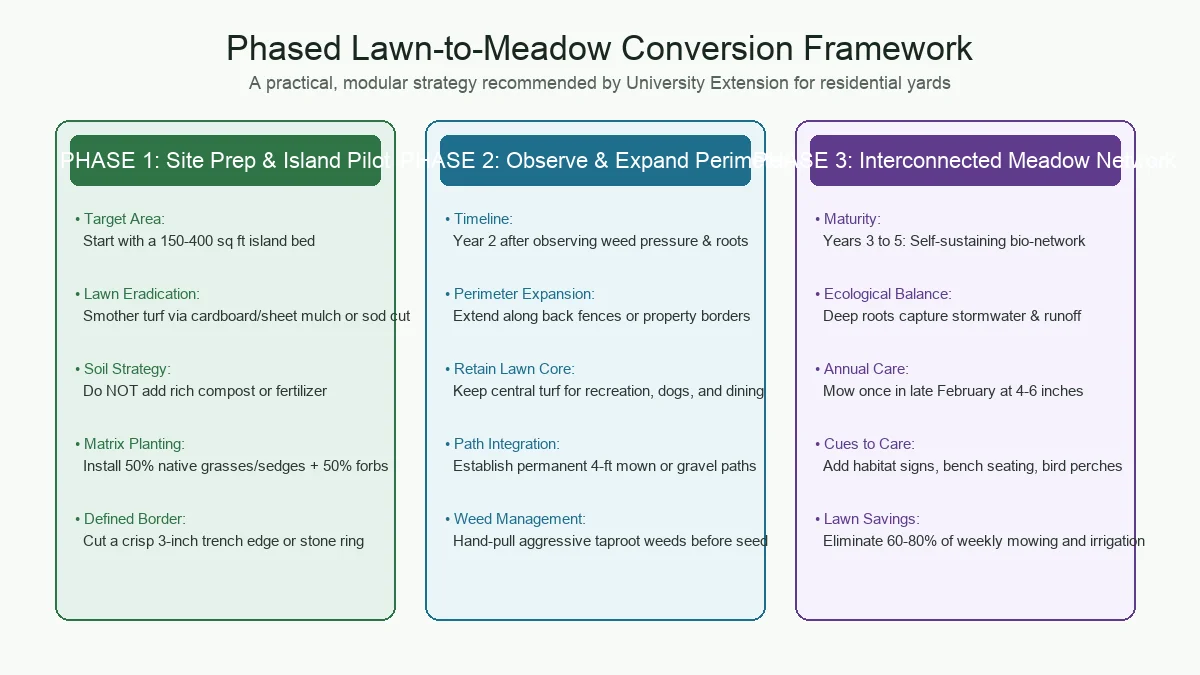
The 3-Phase Conversion Sequence:
Select an underutilized 150- to 300-square-foot sunny lawn pocket. Smother existing turf using cardboard sheet-mulching or sod cutter removal. Plant 100 to 200 native plugs (50% bunchgrasses, 50% forbs). Edge with a crisp 3-inch trench.
Having mastered early weed identification, expand along backyard fence lines or side yard slopes. Establish permanent 4-foot mown turf circulation lanes that connect functional patio spaces to the meadow.
Connect individual meadow beds into a continuous naturalistic ribbon. The central lawn remains a pristine recreational rug, while 60% to 80% of routine lawnmowing, supplemental irrigation, and synthetic fertilization is permanently eliminated.
Planting Technique
Seed vs. Plugs for Residential Meadow Gardens
One of the most consequential decisions in meadow creation is choosing between direct seed broadcasting and installing live vegetative plugs (small 2-inch root cell starts). Each method has distinct trade-offs:
| Factor | Vegetative Plugs (Recommended <1,000 sq ft) | Native Seed Broadcast (Best >2,000 sq ft) |
|---|---|---|
| Initial Material Cost | Higher ($2.00–$3.50 per plug; ~$2.00–$3.50/sq ft) | Significantly lower ($0.15–$0.40/sq ft for bulk seed) |
| Design & Drift Control | Complete control: place plants in intentional drifts and height tiers | Random distribution: micro-topography determines where seeds take |
| Establishment Speed | Fast: forms a closed canopy by late Year 2; flowers Year 1–2 | Slow: requires 3 to 5 years for full perennial dominance |
| Weed Identification | Easy: you know exactly where plugs were planted on your grid | Difficult: distinguishing tiny native seedlings from weeds requires expertise |
| Erosion Risk on Slopes | Low: rooted plugs immediately anchor soil | High: heavy rainstorms can wash seeds down slope without erosion blanket |
Extension Recommendation: University of New Hampshire and Penn State Extension suggest that for urban and suburban yards where aesthetic expectations and neighbor scrutiny are high, landscape plugs produce vastly superior, repeatable design outcomes compared to random seed broadcasting.
Realistic Expectations
How Long Does a Meadow Take to Establish? Sleep, Creep, and Leap
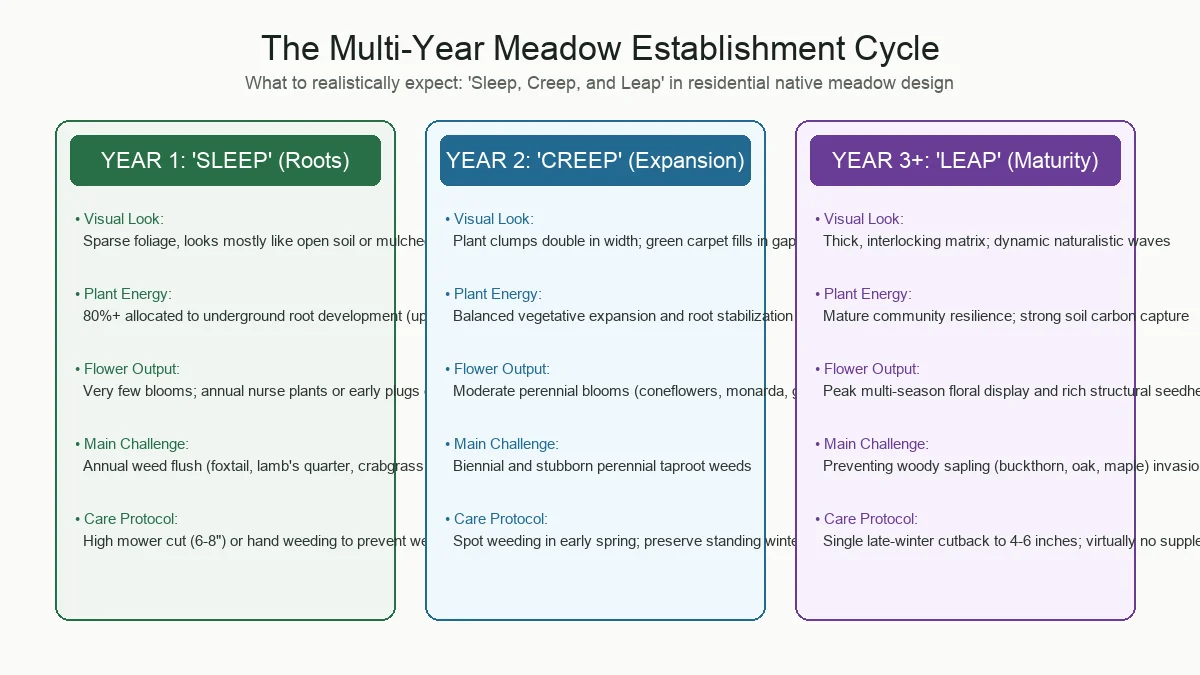
Establishing a perennial meadow requires patience. Unlike annual bedding plants that burst into instant blooms from nursery greenhouses, native prairie and meadow species follow a natural three-year physiological cycle:
Roots Before Blooms
Over 80% of plant energy is directed downward. Root systems dive 3 to 6 feet into subsoil to secure future drought resilience. Above ground, plants remain diminutive. Your primary role in year one is keeping aggressive annual weeds trimmed so native crowns receive sunlight.
Vegetative Expansion
Clumps double or triple in girth. Native bunchgrasses form thick tussocks that crowd out opportunistic weed seedlings. Perennial forbs produce their first substantial floral display. Hand-weeding drops by 60% compared to year one.
Mature Community
The meadow reaches ecological equilibrium. The canopy is dense and closed, and the soil carbon bank is actively building. Routine management is reduced to a single annual late-winter cutback and periodic monitoring for invasive woody saplings.
Ongoing Stewardship
Are Meadow Gardens Really Low Maintenance?
The honest answer is: meadows are low-mow, not no-maintenance.
A traditional turf lawn demands 25 to 30 weekly mowings per season, frequent supplemental irrigation, aerating, and synthetic fertilizer applications. By contrast, an established meadow eliminates weekly mowing entirely. However, meadows require seasonal discernment rather than mechanical repetition.
The Annual Late-Winter Cutback
Unlike manicured flowerbeds that are raked bare in autumn, meadows must remain standing throughout autumn and winter. Cut back standing vegetation once per year in late February or early March (prior to spring greenup). Use a heavy string trimmer, scythe, or high-clearance mower set at 4 to 6 inches. Leaving clippings in place creates a protective organic mulch layer that replenishes soil carbon.
Selective Weed Roguing & Saplings
In most temperate US biomes, undisturbed meadows naturally succeed into woody shrubland and deciduous forest. Birds deposit oak, maple, buckthorn, and honeysuckle seeds throughout the year. Spend 20 minutes each spring and autumn pulling woody saplings while their roots are shallow, ensuring your meadow remains an open grassland community.
Prevent Failures
10 Common Meadow Garden Mistakes to Avoid
Buying a generic “wildflower mix” without reviewing the species list for cheap annuals and invasive non-natives.
Omitting structural grasses and sedges, resulting in flopping flowers and rampant weed invasion by year two.
Attempting a meadow in deep shade; sun-loving prairie species will stretch, weaken, and fail without 6+ hours of light.
Adding rich compost or high-nitrogen fertilizer, which accelerates weeds and makes native grasses lodge (fall flat).
Converting too much lawn at once; start with an island bed before tackling a quarter-acre parcel.
Cutting down dead stems in autumn, destroying bird food and overwintering habitat for solitary bees.
Failing to provide a mown edge or path, prompting neighbors or municipal inspectors to assume the yard is abandoned.
Planting tall 6-to-8-foot species near sidewalks, obstructing driver sightlines and triggering municipal height citations.
Using non-native invasive species like Queen Anne's Lace or Oxeye Daisy mistakenly marketed as “native wildflowers.”
Ignoring wildfire defensible space in fire-prone regions by planting dense dry grasses directly against exterior home siding.
Homeowner Answers
Frequently Asked Questions About Meadow Gardens
Answers
Frequently asked questions
01What is a meadow garden?
A meadow garden is a naturalistic residential planting that combines native grasses or grass-like plants (such as sedges) with flowering perennials (forbs) to form a dense, interlocked plant community. Unlike a traditional ornamental flower bed with exposed wood mulch, a meadow garden mimics wild open ecosystems where plants cover every inch of soil, changing across seasons while requiring only an annual late-winter cutback once established.
02How is a meadow different from a wildflower garden?
The primary difference lies in the foundational matrix. A wildflower garden typically consists of 90% to 100% flowering plants, often including short-lived annuals planted in cultivated beds. A true meadow garden includes a structural backbone of 50% to 70% native grasses and sedges. This fibrous root matrix stabilizes soil, prevents aggressive weeds from establishing, supports heavy flower stems so they do not flop, and provides year-round wildlife cover.
03How is a meadow different from a prairie?
A prairie is a specific regional ecological biome—most famously the tallgrass, mixed-grass, and shortgrass ecosystems of the central United States characterized by deep glacial soils and specific evolutionary relationships. 'Meadow' is a broader residential design and horticultural term used nationwide to describe any open, sun-drenched, naturalistic community of grasses and flowering perennials adapted to local moisture and soil conditions.
04Can I simply stop mowing my lawn to create a wildflower meadow?
No. Merely stopping lawnmower passes on a conventional turf lawn will not yield a native wildflower meadow. Instead, cool-season turfgrass will grow into an unkempt thatch, and the soil seed bank will release aggressive weeds, crabgrass, dandelions, invasive vines, and woody tree saplings. Creating a true meadow requires deliberate site preparation, eradication of competitive lawn roots, and purposeful planting of adapted native species.
05Can a meadow garden work in a small residential yard?
Yes. In compact yards (under 500 square feet), a meadow-style garden works best as an island bed, patio border, or lawn edge using landscape plugs rather than broadcast seed. Choosing compact bunchgrasses (like Prairie Dropseed or Pennsylvania Sedge) and grouping 5 to 7 flowering perennials in repeating drifts delivers rich naturalistic texture without overwhelming the property.
06How do I make a front-yard meadow look intentional rather than neglected?
According to Joan Nassauer's 'Cues to Care' landscape architecture framework, you must frame naturalistic plantings with unmistakable signs of human stewardship. Key cues include: maintaining a crisp 3-foot mown turf margin or stone border along sidewalks; keeping plant heights under 30 inches near streets and driveways; creating a clear walking path; planting in visible drifts; and adding an architectural anchor like a birdbath or split-rail fence.
07Do meadow gardens need full sun?
Classic flowering meadows thrive best in open locations receiving 6 or more hours of direct sunlight. While certain moisture-loving sedges and woodland edge species tolerate partial shade (4 to 6 hours), deep shade under dense tree canopies is unsuitable for sunny meadow species. In dense shade, homeowners should plant a dedicated woodland shade garden or sedge lawn rather than forcing a meadow aesthetic.
08Why do retail 'wildflower meadow seed mixes' often fail in residential yards?
Iowa State and University of New Hampshire Extension warn that inexpensive retail wildflower mixes frequently contain cheap non-native annuals (such as European corn poppies and bachelor's buttons) rather than persistent regional perennials. While they produce an explosion of color in year one, the annuals fail to return in year two, leaving vast patches of bare soil that are rapidly colonized by invasive weeds.
09How long does a meadow take to establish?
Perennial meadows follow the classic ecological progression: 'The first year they sleep, the second year they creep, and the third year they leap.' In year one, native perennials invest up to 80% of their energy underground developing deep root systems, resulting in sparse top growth and few flowers. By year two, plants double in size, and by years three through five, the meadow forms a thick, self-sustaining community.
10Are meadow gardens really low maintenance?
Meadow gardens are significantly 'lower-mow,' but they are never zero-maintenance. During the first two establishment years, meadows require attentive hand-weeding and periodic high mowing (6 to 8 inches) to prevent annual weeds from going to seed. Once mature, routine maintenance drops to an annual late-winter cutback, seasonal perimeter edging, and occasional removal of woody tree saplings.
11When should I mow or cut back a residential meadow?
Authoritative ecological organizations like the Xerces Society and state Extension services recommend cutting back standing meadow vegetation once per year in late winter or early spring (late February through mid-March in most US zones). Leaving seedheads and hollow stems standing through autumn and winter provides vital food for native songbirds and shelter for overwintering pollinator larvae.
12Should I use landscape plugs or seed for my meadow?
For small residential projects (under 1,000 square feet), landscape plugs (2-inch root cells) are overwhelmingly superior because they provide immediate structural control, establish faster, and allow precise drift grouping. For large expanses (over 2,000 square feet to multiple acres), broadcast native seed is much more cost-effective per square foot, though it requires meticulous multi-season weed bank preparation.
Local North Shore Context
Planning a Naturalistic Landscape in Peabody, MA?
While the ecological and design principles covered in this guide apply across the entire United States, the actual plant community you choose must match the unique climate, glacial loam, and seasonal moisture of the Massachusetts North Shore.
In Essex County and coastal Massachusetts, resilient native meadow palettes feature Little Bluestem, Pennsylvania Sedge, Purple Lovegrass, New England Aster, Wild Bergamot, and Golden Alexander. For a complete research directory of species native to our local ecoregion, see our dedicated guide to native plants of Massachusetts.
If you are a homeowner in Peabody, Danvers, Beverly, Salem, or surrounding North Shore communities seeking professional assistance with site grading, turf eradication, masonry border edging, or a complete landscape transformation, LandscapingPeabodyMA.com connects you with independent, experienced landscape contractors.
Ready to Transform Your Lawn Into an Intentional Landscape?
Connect with pre-screened landscaping and site preparation professionals in Peabody and across the North Shore.
Get connected with an independent local landscaping professional. Calls go to (877) 537-6896.