Pollinator Garden Ideas: How to Design a Beautiful Habitat for Bees & Butterflies
Move beyond generic flower lists. Learn how to design an intentional residential garden combining continuous three-season bloom succession, caterpillar host nurseries, ground-and-cavity bee nesting, and landscape "cues to care."
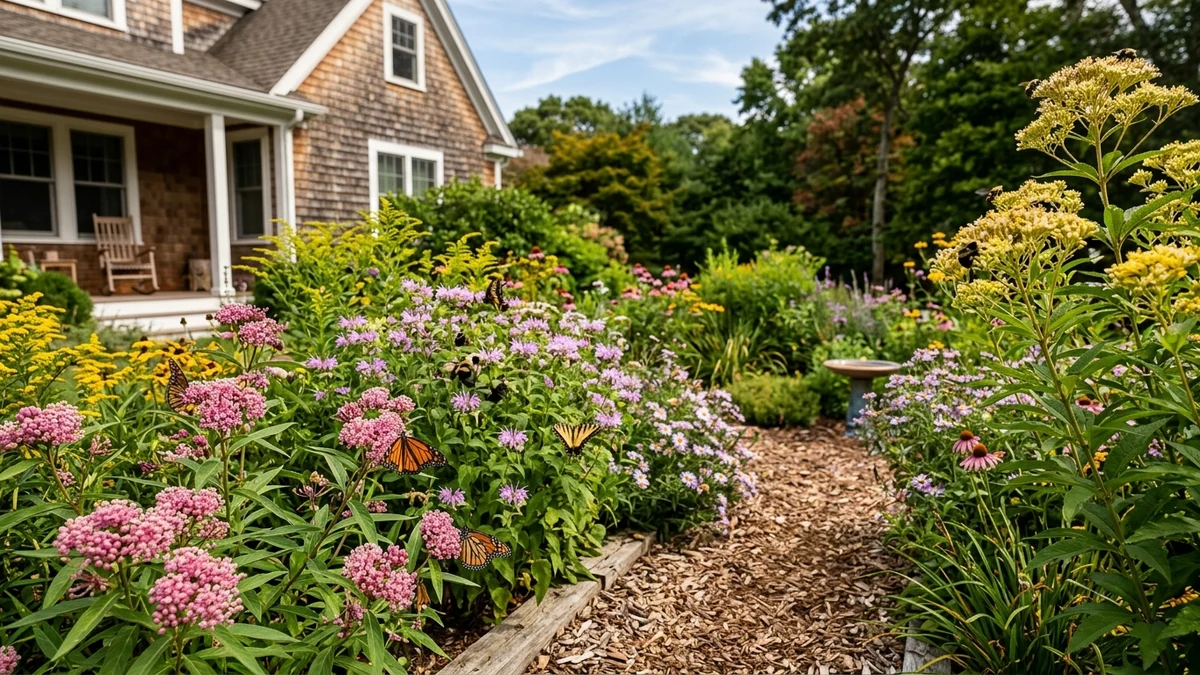
What Makes a True Pollinator Garden?
A successful pollinator garden combines regionally appropriate flowering plants, larval host species, and nesting habitat rather than relying solely on colorful nectar blooms. By sequencing flowers from early spring through late fall, planting in repeated drifts of 3 to 7 specimens, preserving small unmulched soil patches for ground-nesting solitary bees, and defining clean lawn or stone edges, you create an ecologically rich sanctuary that looks like an intentional, high-end residential landscape.
The Habitat Formula: FOOD (Pollen & Nectar) + HOST PLANTS (Caterpillar Foliage) + SEASONAL SUCCESSION + NESTING & SHELTER + SAFE WATER + ZERO PESTICIDES + CUES TO CARE.
Ecological Foundation
Beyond the Flower Bed: What a Pollinator Garden Actually Needs
The vast majority of gardening articles reduce pollinator landscaping to a simple command: "Plant bright flowers." Homeowners visit big-box nurseries, buy six assorted pots of hybrid zinnias or imported butterfly bushes, scatter them across a mulch bed, and wonder why their yard fails to hum with life.
As documented in updated ecological research from the Xerces Society for Invertebrate Conservation, Pollinator Partnership, and the University of Maryland Extension (updated September 2026), adult nectar is merely one fraction of an insect's life cycle. Flying adult pollinators require nectar for flight energy (carbohydrates). But reproducing insects require pollen for protein, specific native leaves to feed their caterpillars, bare mineral soil or pithy hollow twigs to build nursery cells, clean moisture to prevent dehydration, and unraked winter shelter to survive subzero freezes.
Pollinators Are Far More Than Just Honey Bees
A critical misconception is that pollinator gardens exist to "save the honey bee." The European Honey Bee (Apis mellifera) is an introduced, domesticated livestock species brought to North America in 1622. While valuable for commercial agriculture, honey bees are generalist foragers that compete with struggling wild pollinators.
North America is home to over 4,000 species of native wild bees—the vast majority of which are solitary (no hive, no queen, no honey), stingless or docile, and vastly more efficient at pollination than honey bees. For example, a single native Blue Orchard Mason Bee (Osmia lignaria) pollinates as many apple blossoms as 120 honey bees. A genuine habitat garden supports:
- Native Solitary Bees: Mining bees (Andrena), sweat bees (Halictidae), leafcutter bees (Megachile), and mason bees (Osmia).
- Social Bumblebees (Bombus): Essential buzz-pollinators that vibrate flowers at high frequencies to release trapped pollen from tomatoes, peppers, and blueberries.
- Butterflies and Moths (Lepidoptera): Keystone daytime and nocturnal pollinators whose caterpillars form the biological foundation of the terrestrial songbird food web.
- Syrphid / Hoverflies (Syrphidae): Expert pollinating flies whose predatory larvae devour garden aphids by the hundreds.
- Flower Beetles (Coleoptera): The planet's oldest lineage of pollinators, attracted to large, open, heavily scented blooms like magnolias and spicebush.
- Ruby-Throated & Rufous Hummingbirds: Fast-flying avian pollinators that seek deep, red or coral tubular blooms.
Ecoregional Authority
Rule #1: Plant Selection Is Strictly Regional
There is no such thing as a single "Top 25 Pollinator Plants in America" list. A flowering plant that thrives in the saturated, acidic coastal sands of Georgia will wither in the calcareous, high-pH caliche soils of central Texas, and an alpine penstemon from Colorado will rot in the humid summer rains of Ohio.
Furthermore, approximately 25% of North American native bees are pollen specialists (oligolectic): their larvae can digest pollen only from specific plant genera native to their immediate ecoregion. If you plant non-native flowers, specialist bees starve, even if the plant produces nectar.
To design an effective garden, always consult verified ecoregional tools such as the Pollinator Partnership Ecoregional Guides or the Xerces Society Regional Native Plant Lists. Use our interactive regional directory below to connect directly with your state's authoritative resources:
Find Native Pollinator Resources for Your US Region
Plant selection is strictly ecoregional. Use this directory to connect directly with verified ecological plant lists from the Xerces Society, Pollinator Partnership, and State University Extensions.
Northeast & New England (ME, NH, VT, MA, CT, RI, NY)
Ecoregional ProfileClimate & Soil Reality: Laurentian Mixed Forest, Eastern Broadleaf Forest, Coastal Plain (Zones 4a–7b). Dense tree canopies, acidic glacial till, cold winters, and hot humid summers.
Specialist Native Bees in this Region
Blueberry bee (Osmia atriventris), Squash bee (Peponapis pruinosa), Spring ephemerals and mining bees (Andrena spp.).
High-Value Native Plant Genera
Verified Authoritative Planting Resources
State Extension Spotlight: UMass Extension Landscape Message & Cornell Cooperative Extension Pollinator Resource Portal.
Regional Invasive Species Alert (Avoid in Gardens)
Butterfly Bush (Buddleja davidii) self-seeds aggressively in coastal buffers; Japanese Barberry; Burning Bush.
For broader statewide selection frameworks, explore our in-depth guides to native plant landscaping principles and state-specific species profiles in our Massachusetts native plants directory.
Site Analysis
Site Assessment First: Match Plants to Your Soil & Sun
Before buying a single plant, evaluate your property's physical conditions. Trying to force sun-loving prairie composites into wet shade or woodland ephemerals into baking driveway gravel leads to rapid plant mortality, unsightly straggling, and wasted money.
Evaluate four core site parameters: (1) Hours of Direct Sunlight (Full Sun: 6+ hrs; Partial Sun: 4–6 hrs; Canopy Shade: <4 hrs); (2) Soil Moisture & Drainage; (3) Spatial Footprint; and (4) Target Pollinator Goals. Use our interactive Habitat Planner below to generate a tailored structural blueprint:
Pollinator Habitat Blueprint Generator
Configure your site conditions and wildlife goals to generate a customized, multi-layer planting and habitat framework.
Integrated Multi-Season Pollinator Sanctuary
A complete habitat system designed to supply continuous nectar, species-specific larval host foliage, and natural ground-and-cavity nesting sites while maintaining a crisp, neighbor-friendly residential aesthetic.
Recommended Structural Vegetation Layers
Compact structural flowering shrubs (e.g., Sweet Pepperbush, Buttonbush, Viburnum) creating wind breaks and shelter.
Tiered sun perennials with staggered bloom: Bee Balm, Blazing Star (Liatris), Mountain Mint, and Goldenrods.
Low-growing wild geranium, golden groundsel, or native sedge plugs suppressing weed germination between tall stems.
Host Plant & Caterpillar Strategy
Incorporate foundational host plants: local milkweeds for monarchs, native violets for Great Spangled Fritillaries, and native grasses for Skipper butterflies.
Essential Nesting & Water Features
- Leave a 2×2 ft intentional patch of unmulched, sunny, well-drained bare soil for solitary ground-nesting mining and sweat bees.
- Leave 12 to 18-inch standing perennial stems in late winter / spring for cavity-nesting small carpenter bees.
- Incorporate a shallow terra-cotta saucer filled with pea gravel or river stones and shallow fresh water so bees and butterflies can drink without drowning.
"Cues to Care" & Visual Design
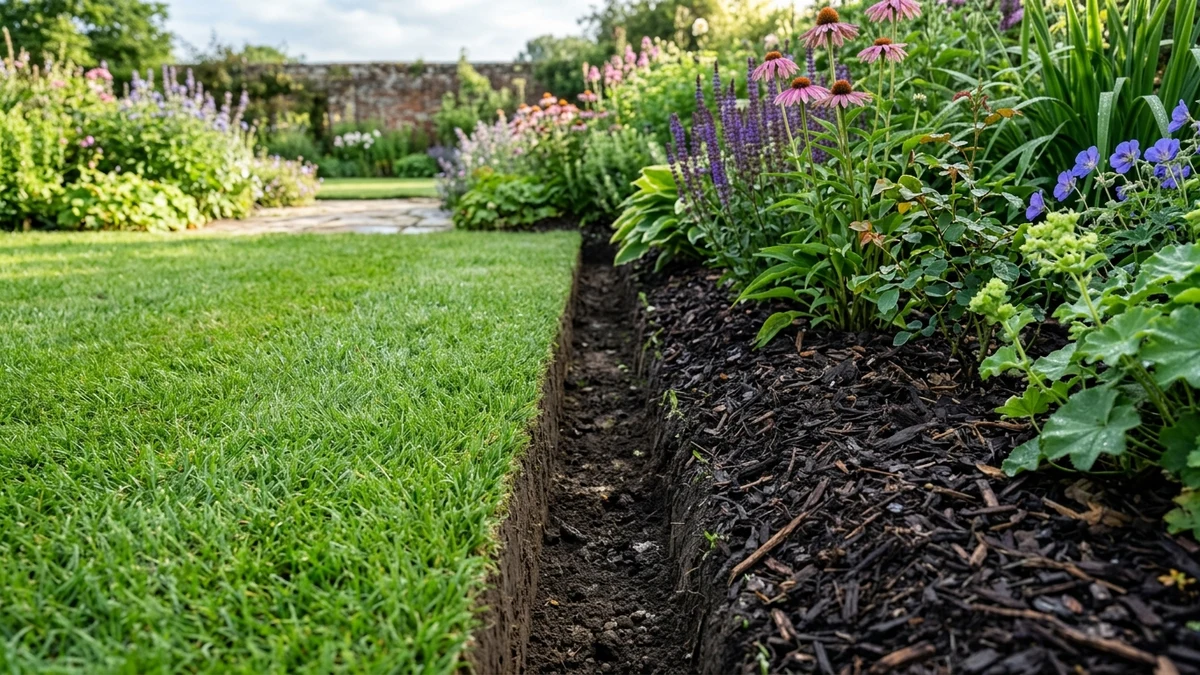
- Establish a crisp 3-to-4 inch deep spade-cut trench or flat cobblestone mowing strip separating garden from sidewalk/lawn.
- Keep plant heights stepped: lowest species (<18 inches) along borders, mid-height (2–3 ft) in center, tall species (>3 ft) strictly against house walls.
- Plant in repeated drifts of 3 to 7 specimens per species rather than scattering single plants randomly like a polka-dot collection.
- Add an intentional architectural ornament (birdbath, stone border, decorative stake) to signal deliberate horticultural design.
Agronomic Watch-Outs
- •Never spray chemical synthetic or broad-spectrum insecticides (including organic pyrethrins or spinosad) in or near the pollinator bed.
- •Avoid blanket-covering every square inch with weed barrier fabric or 4 inches of wood chips, which blocks ground-nesting bees from burrowing.
- •Do not rely solely on midsummer flowers; ensure early spring (April–May) and late autumn (September–October) bloomers are firmly in place.
- •Avoid aggressive rhizomatous spreaders (like common milkweed in tiny borders or aggressive wild mints) that will invade lawns or neighbor lines.
Floral Sequencing
The Unbroken Chain: Designing for Season-Long Bloom
In nature, a floral desert in April or September is just as fatal as a drought in July. Many conventional gardens suffer from the "June Burst & August Famine" syndrome: everything flowers dramatically in early summer, and by late August only tired green leaves remain.
Ecologists recommend providing at least three distinct plant species in active flower during every single month of the growing season. Explore the biological requirements and plant classes across all six seasonal windows below:
Season-Long Bloom Succession Calendar
Wild pollinators do not forage for just three weeks in June. A resilient habitat delivers an unbroken sequence of nectar and pollen from early spring emergence to late autumn freeze.
Early Spring Window
Ecological Function & Life-Cycle Role
Overwintered bumblebee queens emerge from underground hibernacula starving for carbohydrates to fly and pollen protein to mature their ovaries. Ground-nesting solitary mining bees (Andrena spp.) commence their brief 4-week active life cycle.
Queen bumblebees (Bombus), mining bees, mason bees, early hoverflies, mourning cloak butterflies.
Pollen-rich catkins and nectar from early-blooming woody trees, shrubs, and woodland spring ephemerals.
Residential Landscape Design Rule
Do not rely solely on perennials; herbaceous flowers are barely emerging from cold soil. Native woody trees and shrubs (Willows, Maples, Serviceberries, Redbuds, Spicebush) supply 80%+ of early spring pollen volume.
Caterpillar Nurseries
Host Plants vs. Nectar Plants: Feeding the Entire Life Cycle
A butterfly garden that contains only adult nectar flowers is like a restaurant with no maternity ward. Butterflies visit to drink, fly away, and lay their eggs on someone else's plants—or fail to reproduce altogether.
Host plants are the specific plants female butterflies and moths seek out to lay their eggs upon. Unlike adult butterflies, which can sip sugar water from almost any shallow flower or sugary slice of fruit, caterpillars have highly specialized digestive systems adapted to break down the specific chemical compounds of their co-evolved host plant genus.
Explore common North American butterflies and moths and their obligatory host plants in our interactive matcher below:
Host Plants vs. Nectar Plants: Species Directory
Adult butterflies and moths need nectar for fuel, but their caterpillars require specific host foliage to survive. A garden with only nectar flowers is an ecological dining hall without a nursery.
Monarch Butterfly
Life-Cycle Reality: Monarch caterpillars are obligate specialists: they can feed ONLY on plants in the Milkweed genus (Asclepias). The caterpillars sequester toxic cardiac glycosides (cardenolides) from milkweed sap into their tissues, making both the caterpillar and adult butterfly unpalatable to predatory birds.
Larval Host Plants (Caterpillar Nursery)
- Asclepias incarnata (Swamp Milkweed - wide US range)
- Asclepias tuberosa (Butterfly Weed - dry sandy soils)
- Asclepias syriaca (Common Milkweed - large borders)
- Asclepias fascicularis (Narrowleaf Milkweed - Western US)
- Asclepias viridis (Green Antelopehorn - South Central US)
Adult Nectar Sources (Flight Fuel)
- •Liatris (Blazing Star)
- •Echinacea (Coneflowers)
- •Pycnanthemum (Mountain Mint)
- •Symphyotrichum (Fall Asters)
- •Solidago (Goldenrods)
- •Buddleja / Zinnias (Non-native adults will nectar, but CANNOT feed larvae)
Critical Botanical Warning
CRITICAL: Avoid non-native Tropical Milkweed (Asclepias curassavica) in southern states and California. In mild winters it does not die back naturally, which halts monarch migration cues and harbors high concentrations of the deadly protozoan parasite Ophryocystis elektroscirrha (OE). Always plant species strictly native to your state.
Aesthetic Architecture
How to Make a Pollinator Garden Look Intentional (Cues to Care)
The number-one fear homeowners express about ecological gardening is: "Will my neighbors think my yard looks neglected or abandoned?" When native plants are scattered randomly without structural definition, they can indeed resemble an unkempt patch of weeds.
Landscape ecology pioneer Dr. Joan Iverson Nassauer developed the concept of "Cues to Care": visible, cultural landscape design elements that immediately communicate to observers that a wild, biodiverse planting is deliberate, managed, and treasured.
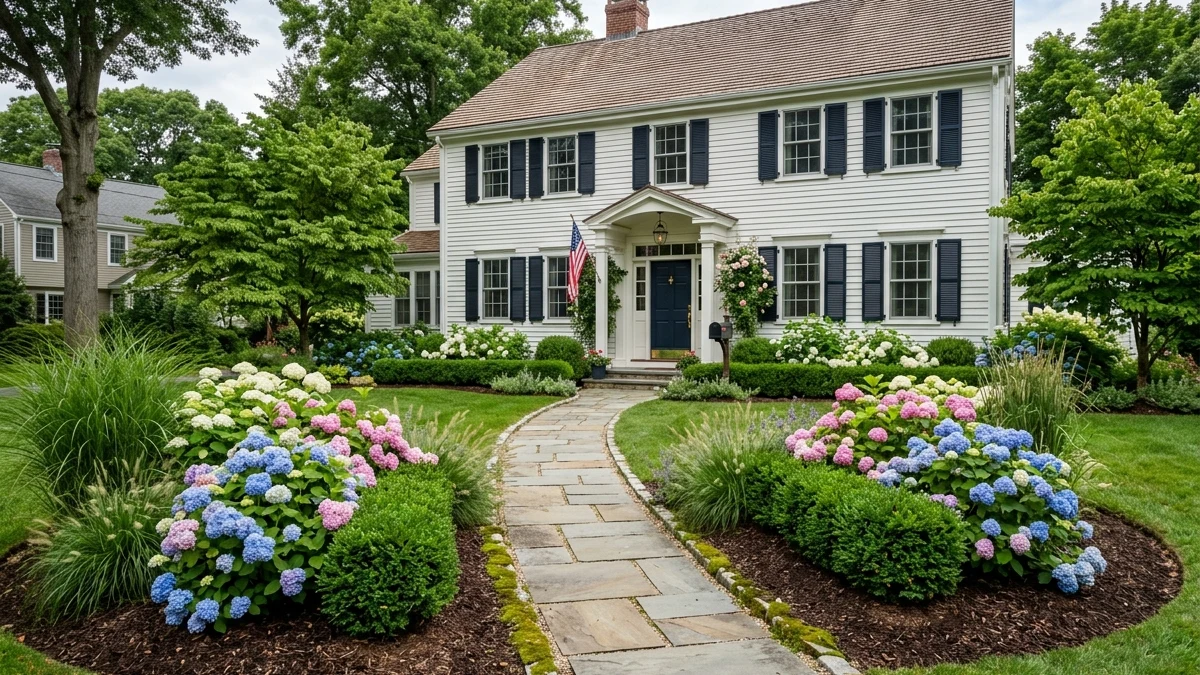
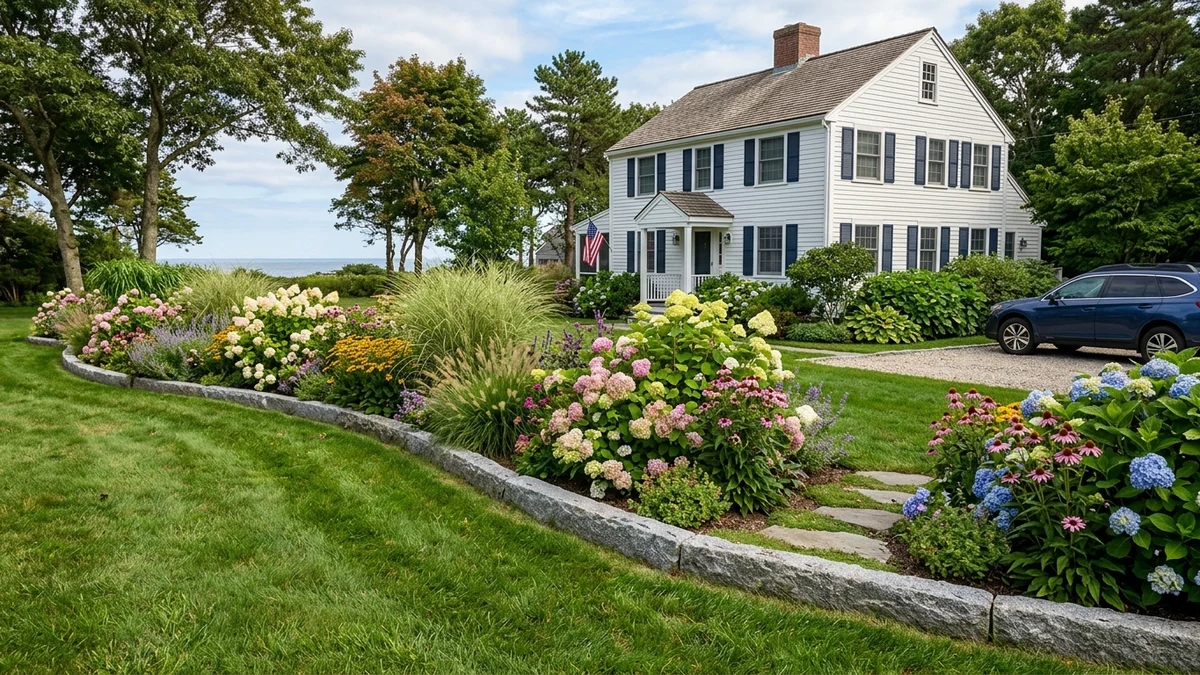
A crisp 3-to-4-foot mowed turf edge or flush cobblestone mowing strip creates an unmistakable visual frame. The sharp contrast between manicured turf and lush perennial drifts instantly legitimizes the planting.
Avoid planting one of everything like a polka-dot collection. Group 3 to 7 specimens of the same species into sweeping drifts. This provides immense visual rhythm for humans and allows foraging bees to collect pollen without wasting flight energy.
Always step plant heights deliberately: groundcovers and low flowers (<18 inches) along borders; mid-story perennials (2–3 ft) in the center; tall shrubs and perennials (>4 ft) strictly against walls, fences, or bed centers.
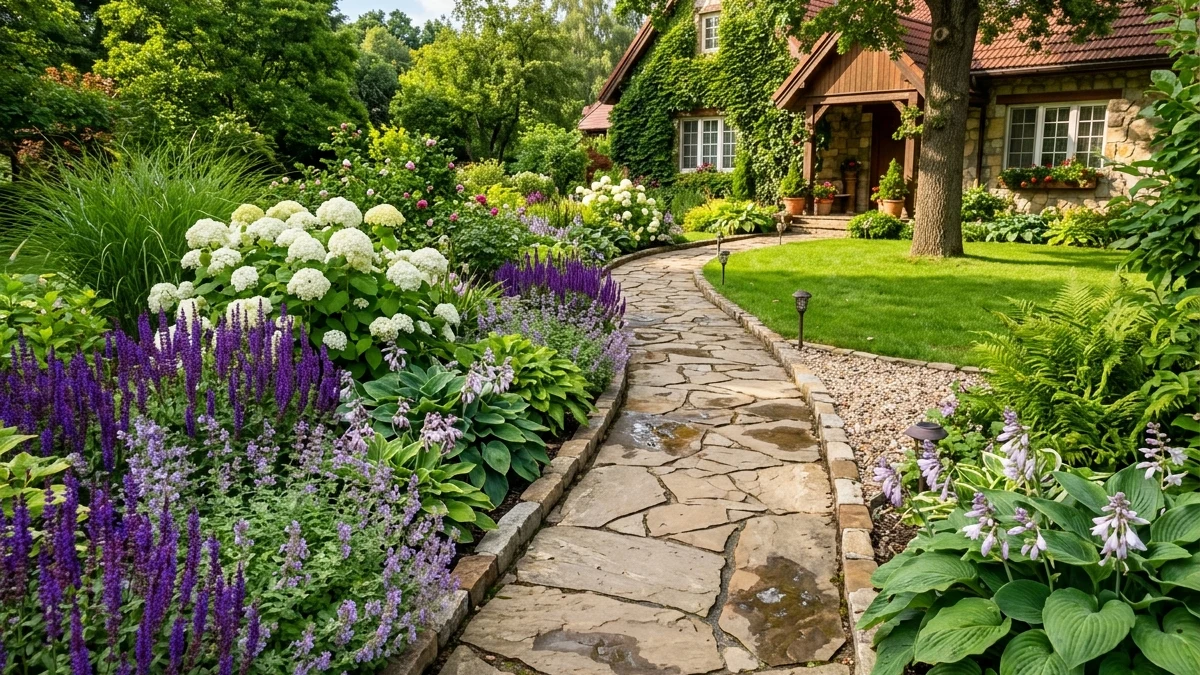
Incorporate a neat flagstone pathway, an artistic birdbath, a clean wooden bench, or an official "Certified Wildlife Habitat" sign. Observers recognize human craft and interpret the garden as a curated botanical installation.
Canopy Architecture
Why Pollinator Gardens Must Include Trees & Shrubs
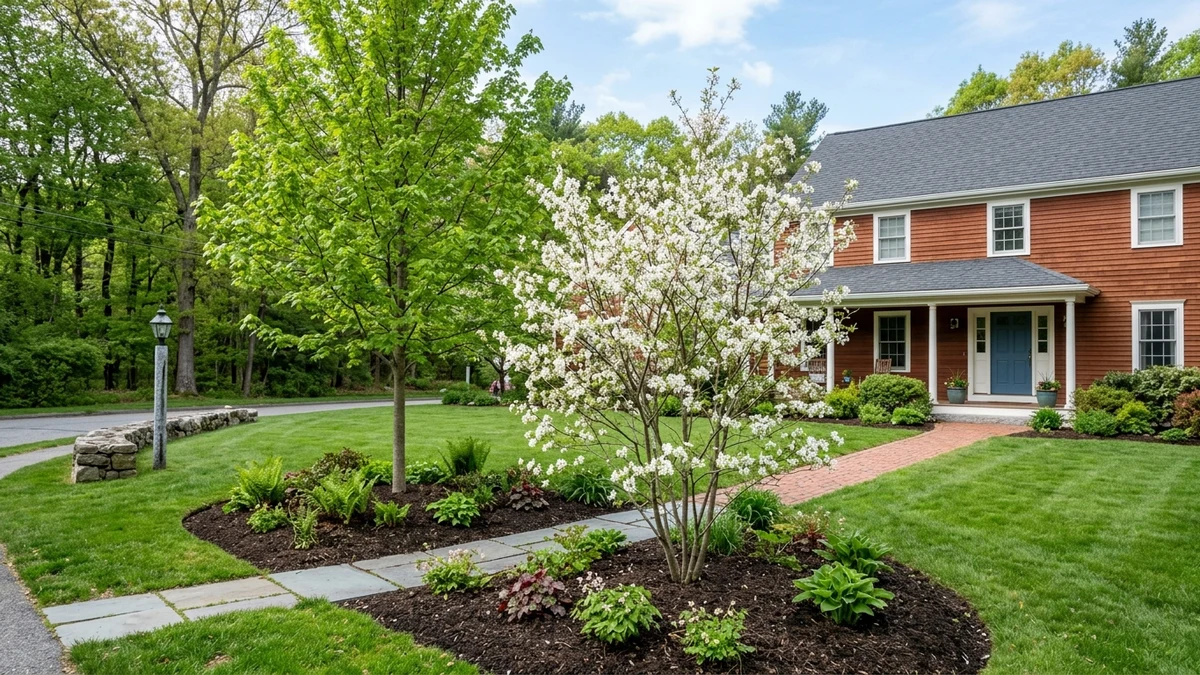
A garden comprised purely of herbaceous flowers is missing its primary ecological engine. Woody plants—native deciduous trees, flowering accent trees, and multi-stemmed shrubs—provide a staggering volume of floral resources in early spring when perennials have barely pushed through the soil.
In April, a single mature native Maple (Acer), Willow (Salix), or Serviceberry (Amelanchier) produces hundreds of thousands of individual nectar-rich florets in a single week—providing more food volume than an entire suburban acre of perennial flowers.
Furthermore, research led by entomologist Dr. Doug Tallamy reveals that native woody plants host exponentially more butterfly and moth caterpillars than herbaceous perennials. For example, native Oaks (Quercus) host over 500 caterpillar species, native Cherries/Plums (Prunus) host 450+, and native Willows host 450+. Without woody plants in your neighborhood canopy, local swallowtails, luna moths, and songbirds cannot thrive.
Nesting & Water
Nesting Sites, Overwintering Shelter, & Safe Water Stations
If your yard supplies abundant food but offers zero places to nest, pollinators will visit your flowers briefly and fly elsewhere to reproduce. Providing nesting habitat is the single biggest competitive advantage of an authentic ecological garden.
1. Ground-Nesting Bees Need Bare Soil (70% of Native Species)
Over 2,800 species of North American native bees excavate solitary underground tunnels where they raise their young. When homeowners blanket every square inch of a garden with heavy synthetic weed fabric covered by 4 inches of dense wood bark mulch, ground-nesting bees are physically locked out.
The Solution: Leave small, sunny, well-drained 2×2 foot patches of bare or lightly vegetated mineral soil in bed corners or under shrub skirts. These nesting patches are small, silent, and completely harmless to pets and children.
2. Cavity-Nesting in Standing Pithy Stems (30% of Native Species)
Mason bees, leafcutter bees, and small carpenter bees nest inside hollow twigs and pithy stems (such as elderberry, sumac, brambles, coneflowers, and bee balm). Cutting every perennial stalk down to ground level in October destroys these dormant nesting chambers.
The Solution: Leave standing stems at 12 to 18 inches through winter. In late spring (when temperatures consistently exceed 50°F), prune off old top growth. New spring foliage will rapidly conceal the 12-inch stubble, inside of which female bees will excavate summer brood cells.
3. Safe Water Stations (No Mosquito Breeding)
Bees and butterflies need water to regulate hive temperatures, dilute crystallized honey, and extract essential mineral salts (a behavior called "puddling"). However, deep birdbaths and open ponds pose drowning hazards.
How to Build a Pollinator Water Dish: Place a shallow terra-cotta saucer on the ground in dappled shade. Fill it with washed pea gravel or smooth river stones, adding water until the liquid level sits just beneath the rock tops. Insects can land safely on damp stone surfaces and drink without getting trapped. Rinse and refill every 2 to 3 days to prevent mosquito larvae from developing.
Garden Design Scenarios
15 Residential Pollinator Garden Ideas for Every Yard
Whether you have a quarter-acre suburban front lawn, an urban townhouse patio, or a deeply shaded woodland backyard, there is an intentional pollinator layout that fits your property:
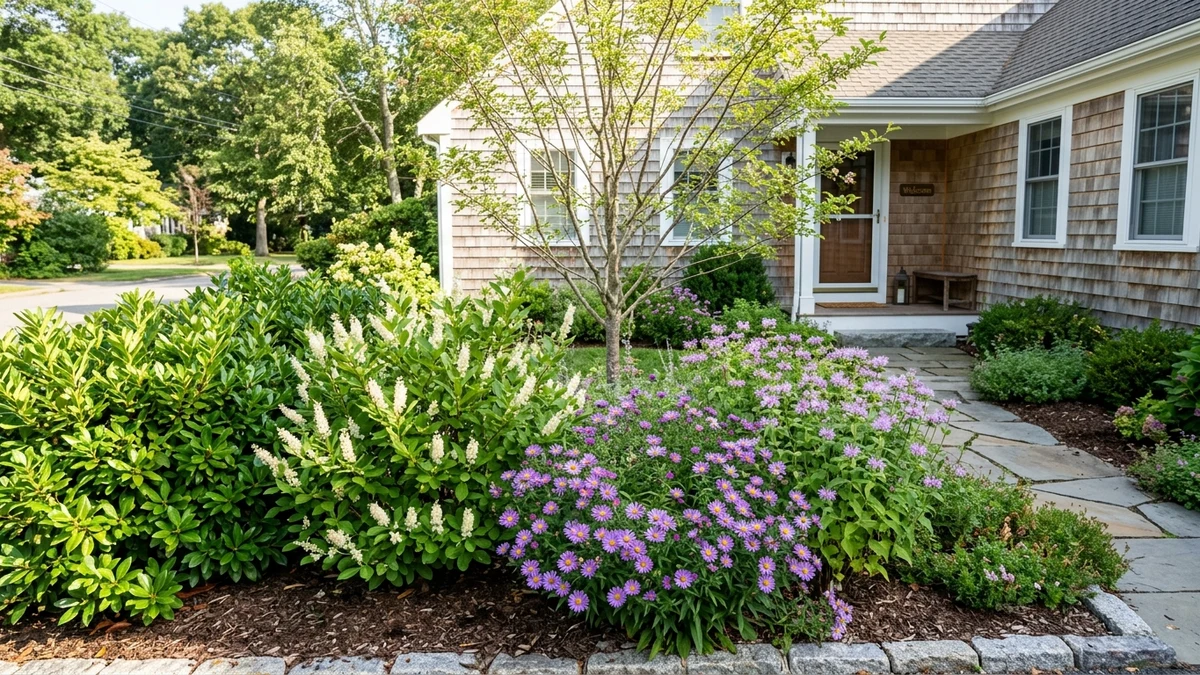
Transform an underutilized front lawn foundation into an eye-catching pollinator border. Anchor the house corner with an ornamental native Serviceberry tree, step down to mid-height drifts of purple coneflowers and butterfly weed, and finish with a crisp 4-inch trench edge along the lawn. Keeps sidewalk clear and boosts neighborhood curb appeal.
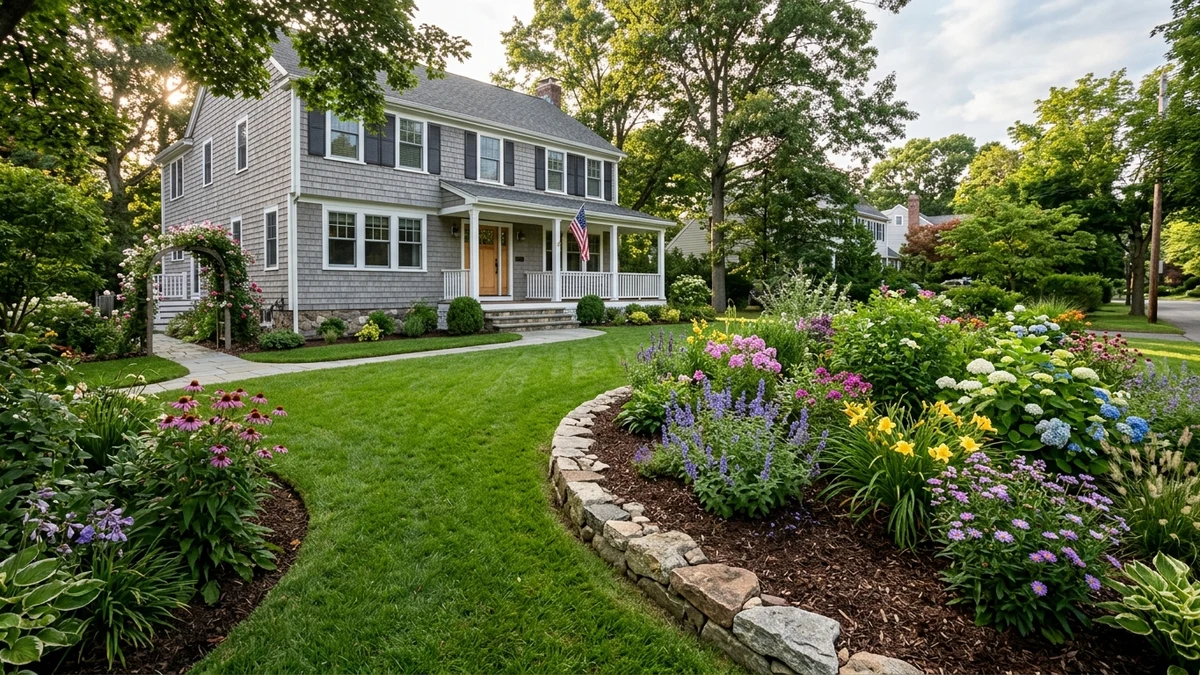
Flank your main arrival walkway with aromatic, non-flopping perennials like creeping thyme, blue mistflower, and dwarf calamint. Plants release fresh fragrance when brushed by arriving guests, while bees focus entirely on blooms without obstructing footsteps.
Convert narrow, baked turf strips between driveways and streets into tough, drought-tolerant pollinator strips. Use low-growing native salvias, black-eyed susans, and prairie dropseed that withstand asphalt radiant heat and winter snow salt.
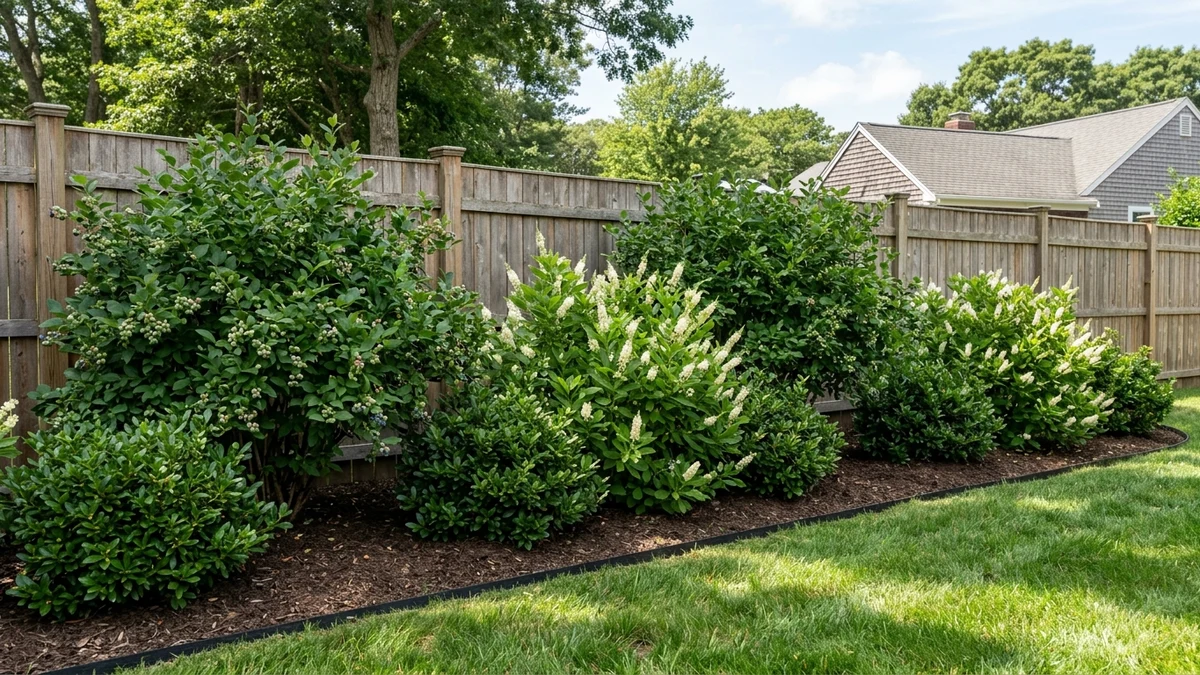
Replace a sterile fence line with an expansive 8-to-12-foot deep habitat corridor. Combine structural native viburnums, elderberries, tall ironweed, blazing star (Liatris), and joe-pye weed while preserving a central functional turf lawn for children and dogs.
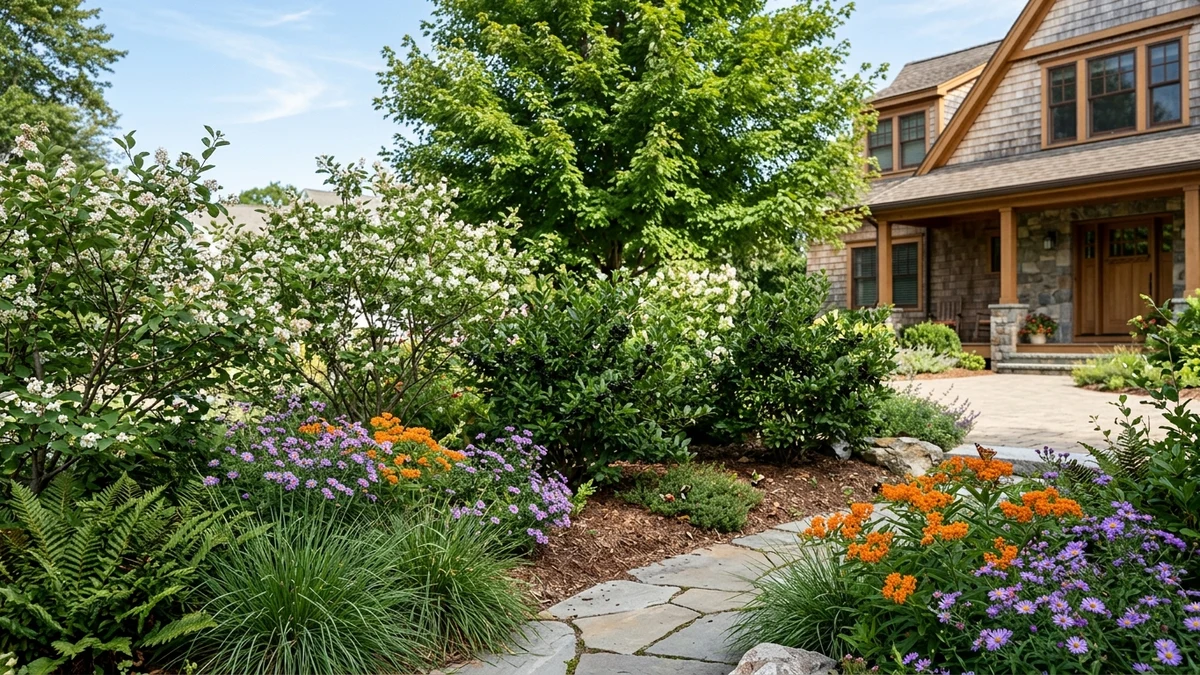
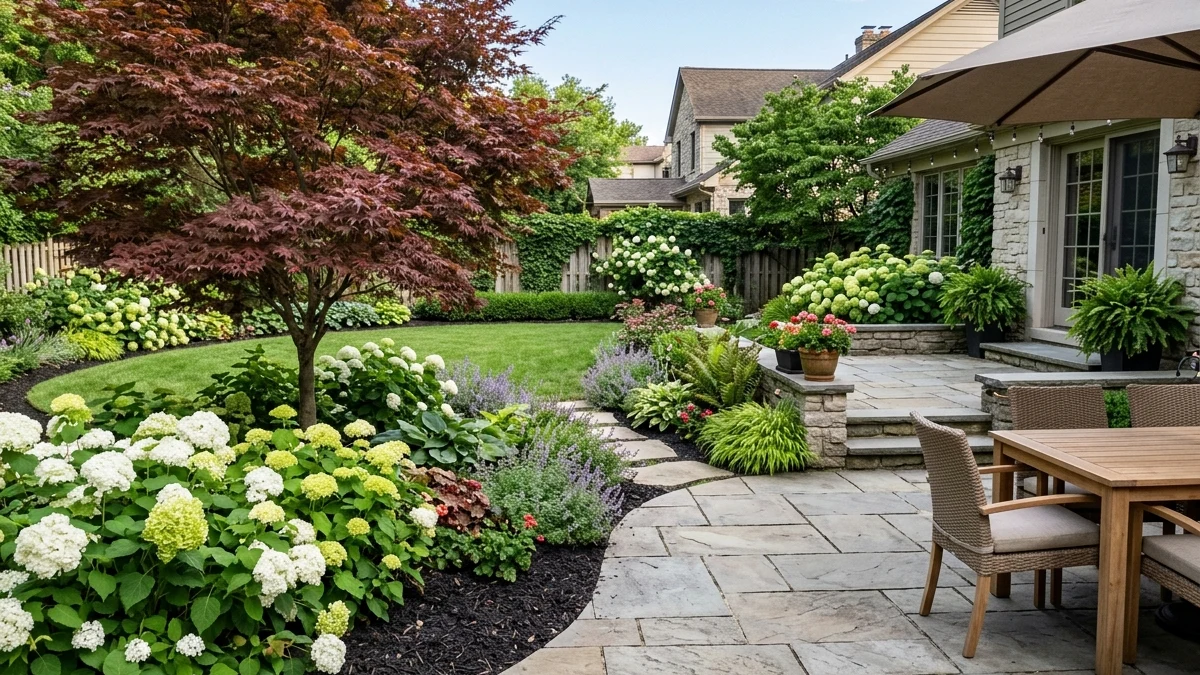
Surround hardscape dining patios with flowering perennial borders. Select gentle solitary bee favorites like mountain mint and coneflowers that allow homeowners to dine outdoors just feet from foraging butterflies without fear of aggressive stinging insects.
Carve an organic oval or teardrop bed into an expansive lawn. Plant a structural multi-stem shrub (like Buttonbush or Sweet Pepperbush) in the center, encircled by concentric rings of mid-height perennials and low-growing groundcovers for 360-degree viewing.
Do not feel pressured to strip 100% of your grass overnight. Start by converting a struggling, unused corner or sloped lawn perimeter using cardboard sheet mulching, planting native plugs directly into compost, and linking to our comprehensive lawn alternatives guide.
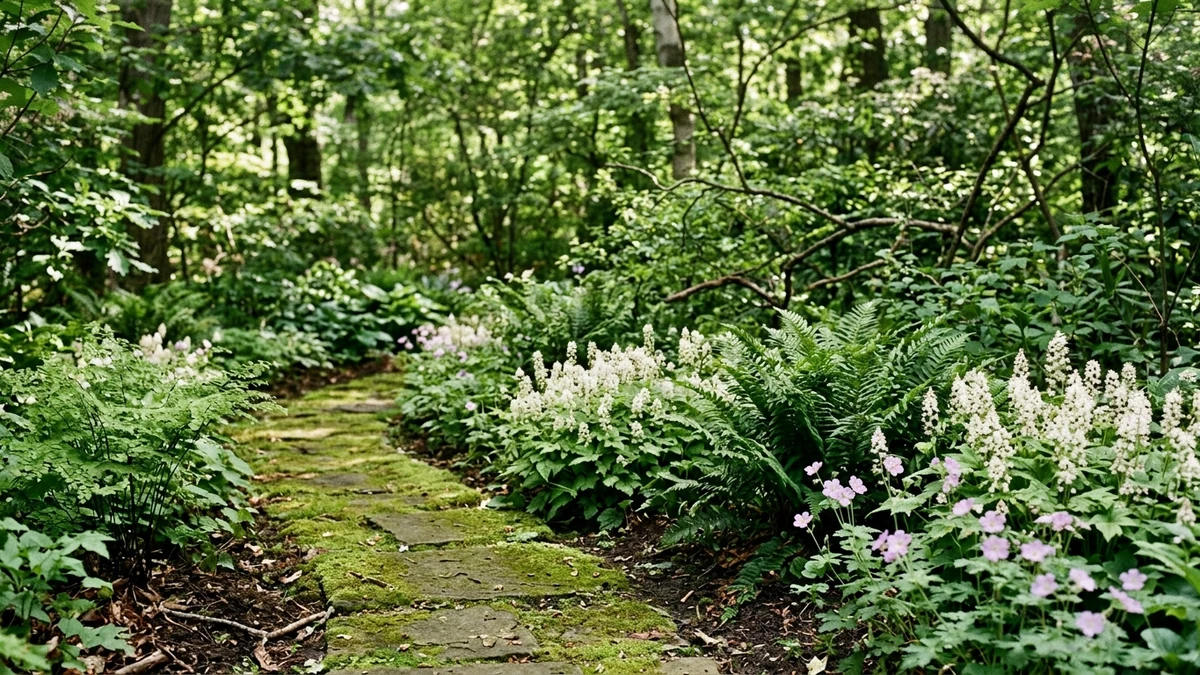
Banish the myth that pollinator gardens require blazing sun. Under mature oak and maple canopies, cultivate shade-adapted perennials like native columbine (Aquilegia), wild geranium, foamflower (Tiarella), and Pennsylvania sedge to support early spring woodland bees.
You do not need acreage. A tightly composed 6×8 foot pocket garden with 3 coneflowers, 3 mountain mints, 2 goldenrods, and a dwarf viburnum packs hundreds of daily floral visits into a small urban footprint.
Patios, decks, and urban balconies can host high-density pollinator stations. Use large 16-to-20-inch planters filled with native dwarf salvias, bee balm cultivars, and creeping thyme, paired with a pebble water saucer. Note: containers dry rapidly and require daily hydration.
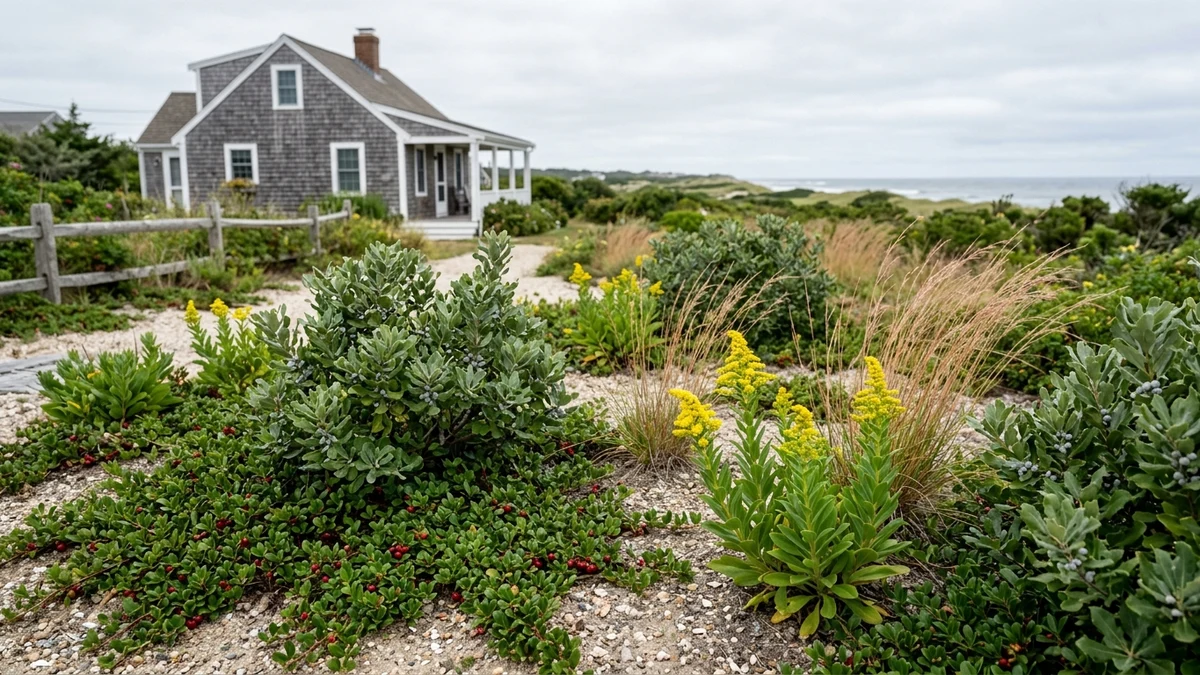
Combine water conservation with pollinator support by selecting deep-rooted native prairie perennials (Echinacea, Butterfly Weed, Penstemon, Rattlesnake Master). Never requires automated sprinklers once established. Explore our full drought-tolerant landscaping guide.
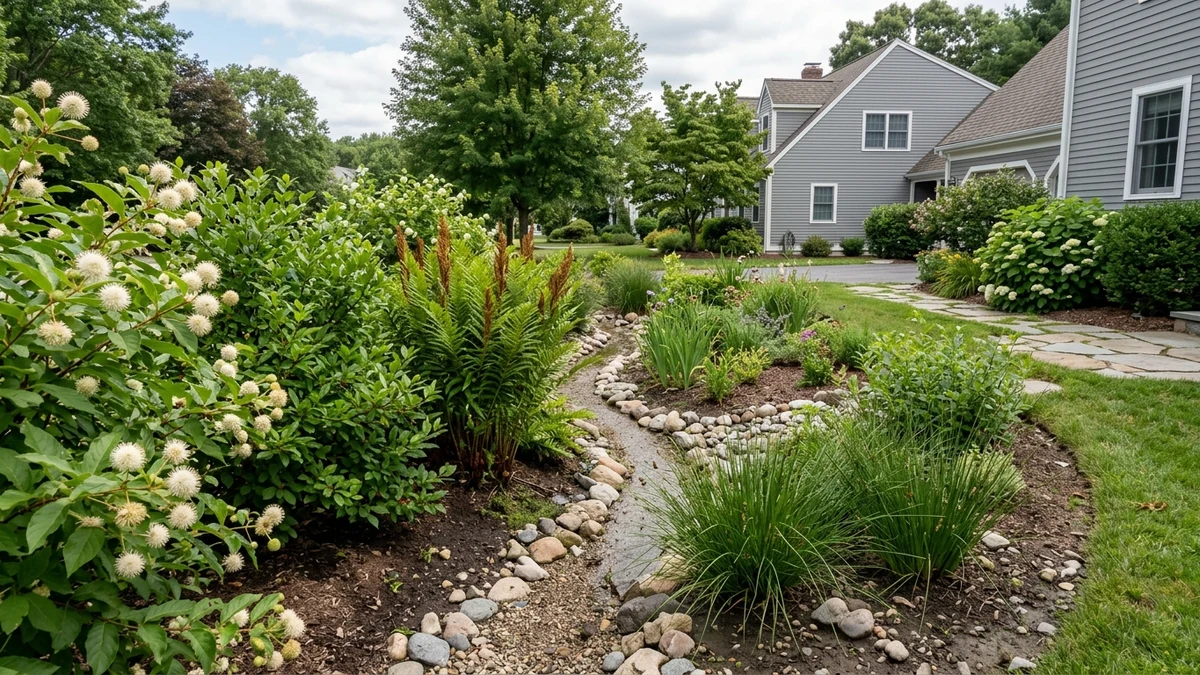
Naturally low or damp yard zones can be engineered to capture downspout stormwater while feeding pollinators. Plant wetland-adapted species like Swamp Milkweed (Asclepias incarnata), Cardinal Flower (Lobelia cardinalis), and Buttonbush. For site percolation testing, see our yard drainage solutions guide.
Interplant fruit and vegetable gardens with flowering herbs like dill, fennel, lavender, oregano, and basil. Black swallowtails lay eggs on dill, while predatory syrphid flies pollinate berries and consume vegetable aphids simultaneously.
Curate a long linear border specifically designed to showcase shifting color themes: blue and yellow woodland phlox in spring, fiery purple coneflowers and orange butterfly weed in summer, and rich magenta asters and goldenrods in autumn.
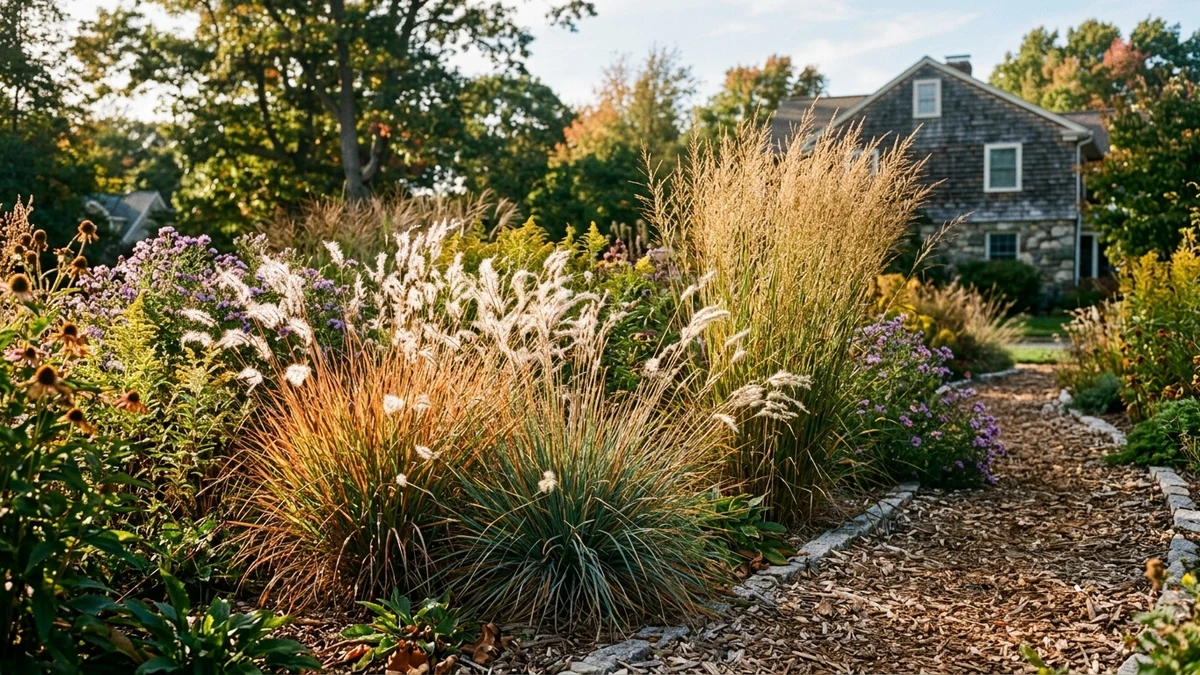
Pair architectural native clumping grasses (Little Bluestem, Prairie Dropseed, Sideoats Grama) with prairie forbs. Grasses hold tall perennial stems upright without staking, provide winter shelter for overwintering caterpillars, and feed winter songbirds.
Practical Stewardship
Establishment, Realistic Maintenance, & 12 Mistakes to Avoid
A pollinator garden is low-maintenance compared to high-input turfgrass, but it is never zero-maintenance. In horticulture, native perennial establishment follows the classic three-year adage:
Plants focus 80% of energy underground developing deep taproots. Top growth appears modest. Requires weekly establishment watering and vigilant hand-weeding.
Root crowns expand; plants double in vegetative size; moderate flowering begins. Requires seasonal gap-filling and edging maintenance.
Full botanical maturity. Root systems touch and form a living mulch that naturally smothers 90% of weed seeds. Supplemental watering is eliminated except in severe drought.
| Plant Material Type | Cost Profile | Establishment Time | Weed Pressure | Best Recommended Use |
|---|---|---|---|---|
| Bulk Wildflower Seed Mix | $ (Lowest upfront) | 2–3 seasons | Severe (High weeding) | Large rural meadows (>1,000 sq ft) with thorough tilling prep. |
| Landscape Plugs (2-inch root depth) | $$ (Economical) | 1 season | Moderate | Ideal for residential beds; rapid root growth and tight massing. |
| 1-Gallon Container Plants | $$$ (Highest upfront) | Immediate impact | Low (Immediate canopy) | Front entry focal points, container gardens, and small curb beds. |
12 Critical Pollinator Garden Mistakes to Avoid
Store-bought canned mixes contain 60%+ cheap filler seeds and non-native annuals (like Cosmos) that die after one summer, leaving bare ground vulnerable to crabgrass. Always buy regional seed mixes with verified native species lists.
Buddleja davidii provides adult sugar nectar but zero caterpillar foliage, and escapes cultivation to choke out native riparian plants. Choose native shrubs like Sweet Pepperbush, Buttonbush, or Ninebark instead.
Asclepias curassavica does not die back in warm southern winters, disrupting monarch migration timing and concentrating the lethal Ophryocystis elektroscirrha (OE) spore parasite. Plant only regional native milkweeds.
Suffocating beds under heavy synthetic plastic and 4 inches of wood chips permanently excludes the 70% of solitary native bees that nest in bare underground burrows.
Scalping perennials to the soil surface in October discards butterfly chrysalises and destroys stem nesting cavities. Leave standing seedheads until spring temperatures remain above 50°F.
Organic pyrethrins, spinosad, and insecticidal soaps kill bees and caterpillars just as quickly as synthetic chemicals. Practice zero chemical spraying in pollinator habitats.
High-nitrogen synthetic fertilizers cause native perennials to produce weak, leggy stems that flop over in the first windstorm, while giving competitive advantages to fast-growing turf weeds.
Failing to plant early flowering woody shrubs leaves emerging spring queen bees with zero forage before summer coneflowers bloom.
Cheap decorative bee boxes that cannot be cleaned accumulate lethal pollen mites, chalkbrood fungal spores, and parasitic wasps. Natural standing stems and undisturbed soil are vastly safer.
Failing to dig a clean 4-inch spade-cut trench border allows turfgrass to invade perennial crowns while making the garden look like an unmanaged weed patch to HOA inspectors.
Providing deep water dishes without gravel perches drowns bees and turns into a mosquito breeding ground within 72 hours. Always use shallow saucers filled with stones.
Attempting to dig up an entire quarter-acre lawn in a single weekend causes homeowner burnout and weed explosions. Convert property in thoughtful, phased sections.
Answers
Frequently Asked Questions: Pollinator Garden Design
01What is a pollinator garden?
A pollinator garden is an intentionally designed landscape that provides complete habitat for bees, butterflies, moths, hummingbirds, and beneficial insects. Rather than simply offering colorful adult nectar flowers, a complete pollinator garden provides species-specific caterpillar host plants, an unbroken succession of blooms from early spring to late fall, undisturbed ground-and-cavity nesting sites, clean shallow water, and zero pesticide exposure.
02How do I design a pollinator garden that doesn't look messy?
Incorporate landscape design 'Cues to Care' (developed by Dr. Joan Nassauer): establish a clean 3-to-4-foot mowed turf buffer or crisp stone mowing strip, plant flowers in repeated drifts of 3 to 7 specimens rather than scattering individual plants, maintain a stepped height hierarchy (shortest in front, structural shrubs in back), and include human architectural accents like stepping stones or a birdbath.
03What is the difference between a nectar plant and a host plant?
Nectar plants produce sugar-rich liquid that fuels adult flying pollinators like butterflies, bees, and hummingbirds. Host plants are specific plant species whose leaves feed the larval caterpillars of butterflies and moths. For example, while adult Monarch butterflies sip nectar from many summer flowers, Monarch caterpillars can eat only milkweed (Asclepias) foliage. A garden without host plants cannot support insect reproduction.
04How do I provide flowers from spring through fall?
Plan for three distinct seasonal bloom phases: (1) Early spring woody trees and shrubs (such as native willows, serviceberries, and redbuds) that feed emerging queen bumblebees; (2) Midsummer meadow perennials (coneflowers, milkweeds, bee balm, mountain mint) that sustain peak pollinator populations; and (3) Late autumn asters and goldenrods that provide high-lipid nectar for migrating monarchs and diapausing bees.
05Do I need only native plants for a pollinator garden?
While non-invasive garden ornamentals (such as zinnias, salvia, and catmint) can supply supplemental adult nectar, native plants are ecologically superior because local pollinators co-evolved with them. Approximately 25% of North American native bees are pollen specialists that can feed their larvae only on specific native plant genera, and native butterflies require native host plants to reproduce.
06Where do native bees nest in a residential yard?
Roughly 70% of North America's 4,000 native bee species (including mining bees and sweat bees) nest underground in the soil, while the remaining 30% nest in hollow or pithy plant stems and dead wood. Heavy landscape fabric and thick, continuous wood-chip mulch prevent ground bees from excavating burrows. Homeowners should leave small, sunny, unmulched soil patches and preserve 12-to-18-inch standing stems in spring.
07Can I create a pollinator garden in full shade?
Yes. Many native woodland species co-evolved to flower under deciduous tree canopies in early spring before tree leaves block sunlight. High-value shade pollinator plants include native columbine (Aquilegia canadensis), wild geranium, foamflower (Tiarella), woodland phlox, spicebush (Lindera benzoin), and native sedges (Carex).
08Can I make a pollinator garden in containers on a patio or balcony?
Yes. Compact native perennials and flowering herbs thrive in deep containers (minimum 14–18 inches wide). Group several containers together to provide diverse flower shapes, choose long-blooming cultivars, and incorporate shallow saucers filled with river pebbles and water. Because containers dry faster than ground beds, consistent watering is essential.
09Is butterfly bush good for a pollinator garden?
Butterfly bush (Buddleja davidii) produces abundant nectar for adult butterflies, but it is an ecological dead end: it supports zero native caterpillar species in North America. Furthermore, it is a designated invasive noxious weed in states like Washington and Oregon and escapes into riparian zones across the Mid-Atlantic. Native alternatives like Buttonbush, Sweet Pepperbush, and New Jersey Tea provide nectar, larval host foliage, and bird shelter.
10How do I provide water for bees and butterflies without breeding mosquitoes?
Use a shallow terra-cotta plant saucer filled with pea gravel, river stones, or cork floats, adding just enough water to keep the tops of the stones dry. This allows bees and butterflies to land and drink from thin water films without drowning. Change or rinse the water every 2 to 3 days to prevent mosquito larvae from developing.
11When should I cut back perennial stems in spring?
Do not cut back perennial stems early in March on the first sunny weekend. Cavity-nesting solitary bees and beneficial predators remain dormant inside hollow stalks until average daytime temperatures consistently stay above 50°F to 55°F (typically mid-April to early May depending on your USDA zone). When cutting, leave 12 to 18 inches of stubble to serve as new nesting chambers for the upcoming season.
12Are organic pesticides safe for pollinator gardens?
No. The label 'organic' does not mean non-toxic to insects. Broad-spectrum organic insecticides—such as natural pyrethrins, spinosad, neem oil, and insecticidal soaps—are lethal to foraging bees, butterfly caterpillars, and beneficial predatory insects upon contact. Pollinator gardens should be managed with zero chemical insecticides, relying instead on predatory ladybugs, syrphid fly larvae, and parasitic wasps.
Planning a Pollinator Landscape Project in Peabody, MA?
While ecological principles apply everywhere, plant selection is strictly local. In Peabody, Danvers, Salem, and across Essex County, soils range from rocky glacial till to shallow granite ledges in USDA Hardiness Zone 6b.
Massachusetts homeowners should consult our dedicated Massachusetts Native Plants Selection Guide for zone-specific trees, shrubs, and perennials.
If you live on the North Shore of Massachusetts and want assistance designing a master planting plan, grading beds around shallow ledge, or installing hardscapes, our referral network connects you with vetted independent professionals:
Ready to Transform Your Yard Into a Living Sanctuary?
Whether you are converting an unused lawn corner into a native butterfly border or planning a comprehensive master landscape redesign, connect with local professionals to get started.
Get connected with an independent local landscaping professional. Calls go to (877) 537-6896.