Horticultural Reference · Right Plant, Right Place
Small Trees for Front Yard: 14 Best Compact Picks & Design Guide
A front-yard tree should anchor your home's architecture, not swallow it. Discover fourteen thoroughly vetted compact trees that stay genuinely manageable at maturity—complete with mature heights and spreads, four-season performance, soil tolerances, and Massachusetts Zone 6b guidelines.
For residential front yards, a practical "small tree" is defined as a landscape specimen that matures at 15 to 25–30 feet in height with a lateral spread of 15 to 20 feet. Selecting trees based on mature size rather than nursery pot size prevents costly foundation conflicts, cracked walkways, and utility line interference. Top-performing compact selections for Massachusetts (USDA Zone 6b) include Allegheny Serviceberry (four-season native interest), Eastern Redbud (striking early pink blossoms), Kousa Dogwood (anthracnose-resistant June blooms and exfoliating bark), Paperbark Maple (glowing cinnamon winter bark), and Star Magnolia (ultra-compact 10-to-15-foot frame for tight foundation beds).
Scale & Proportion: A mature 18-foot ornamental specimen frames the front entryway without obscuring sightlines, blocking windows, or outgrowing its planting bed.
When homeowners search for small trees for front yard, most online guides deliver generic lists of pretty flowering saplings without ever mentioning how wide they become in fifteen years. A tree that looks charming in a seven-gallon container at a local nursery can eventually swell to a 40-foot spread, blocking second-story bedroom windows, dropping heavy fruit across parked cars, and buckling nearby concrete sidewalks.
In Massachusetts and across New England, front-yard trees must also endure harsh winter freeze-thaw cycles, heavy snow loads, road salt drifts, and rocky glacial till soils. Following the UMass Amherst Extension principle of "Right Plant, Right Place," this guide provides rigorous botanical specifications, realistic mature dimensions, and practical landscape placement rules so you can invest in a front-yard centerpiece that stays manageable for decades.
#1 · Four-Season Native All-StarMassachusetts Native · Zone 4–9
1. Allegheny Serviceberry (Amelanchier laevis)
Allegheny Serviceberry (and its naturally occurring hybrid Amelanchier × grandiflora) is widely considered by New England horticulturists to be the premier native small tree for residential yards. Available in both single-stem tree forms and graceful multi-stem clumps, it delivers distinct visual interest in every season without ever overwhelming front architecture.
Spring Bloom & Autumn Fire: Delicate white floral sprays open in April, yielding edible berries in June and brilliant orange-red foliage in October.
Mature Height15–25 Feet
Mature Spread15–20 Feet
Light NeedsFull Sun to Part Shade
Soil RequirementMoist, Well-Drained, Acidic
Why It Works in a Front Yard: In mid-to-late April, pendulous clusters of snow-white blossoms emerge just as leaves unfurl with a subtle bronze cast. By June, sweet, blueberry-like fruits ripen to dark purple, attracting songbirds like cedar waxwings and robins. Because birds strip the fruit rapidly, it rarely creates messy sidewalk litter. In autumn, the canopy ignites in brilliant hues of yellow, apricot, and rich scarlet.
Horticultural Watch-Out: Serviceberry is a member of the rose family (Rosaceae) and can develop cedar-serviceberry rust if Eastern red cedars (Juniperus virginiana) grow within several hundred yards. Ensure adequate air circulation and avoid overhead sprinkler spray hitting the foliage.
#2 · Spring Floral ShowstopperEastern US Native · Zone 4–9
2. Eastern Redbud (Cercis canadensis)
Eastern Redbud provides an unforgettable early spring display when clusters of vivid magenta-pink to rosy-purple pea-like blossoms erupt directly along bare dark branches and the main trunk (a botanical phenomenon called cauliflory). Heart-shaped leaves follow, casting dappled shade over front lawns and foundation beds.
Cauliflorous Floral Display: Magenta flowers clothe bare branches in early May before heart-shaped foliage creates a dense summer canopy.
Mature Height20–25 Feet
Mature Spread25–30 Feet (Wide!)
Light NeedsFull Sun to Partial Shade
Soil RequirementWell-Drained Loam; Intolerant of Sog
Why It Works in a Front Yard: Redbud serves as an exceptional lawn specimen or focal point set off the front corner of a house. Its early bloom provides crucial nectar for newly emerging native bees and pollinators. In autumn, foliage turns a clean butter-yellow, followed by persistent brown seed pods that hang on branches into winter.
Watch-Out for Mature Width: Redbud naturally grows wider than it is tall, often spreading 25 to 30 feet. Homeowners frequently make the mistake of planting redbuds 5 feet from a house corner, forcing aggressive pruning within eight years. In Massachusetts, always specify Northern-provenance stock (Zone 4/5 hardy) to avoid winter dieback.
#3 · Anthracnose-Resistant EleganceNon-Native Ornamental · Zone 5–8
3. Kousa Dogwood (Cornus kousa)
While native flowering dogwood (Cornus florida) has struggled across New England due to widespread dogwood anthracnose disease, Kousa Dogwood offers exceptional disease immunity, tough foliage, and outstanding four-season architectural appeal. It blooms two to three weeks later than native dogwood, extending the spring flowering season into mid-June.
June Blossoms & Winter Bark: Pointed white floral bracts smother the horizontal branches for up to six weeks, followed by exfoliating puzzle-bark trunks.
Mature Height15–25 Feet
Mature Spread15–20 Feet
Light NeedsFull Sun to Partial Shade
Soil RequirementAcidic, Rich, Well-Drained
Why It Works in a Front Yard: Pointed star-shaped bracts remain attractive for up to six weeks. By late summer, large, bumpy, raspberry-like red fruits dangle from the branches, feeding birds and small mammals. Autumn brings deep wine-red to purple foliage, and mature trunks exfoliate in mottled patches of gray, tan, and soft orange that stand out dramatically against winter snow.
Driveway & Walkway Caution: Kousa fruits are soft and fleshy when ripe. Avoid planting directly over driveways or flagstone walkways where dropped fruit can be stepped on or smeared by tires.
#4 · Tiered Native Understory ArchitectureMassachusetts Native · Zone 3–7
4. Pagoda Dogwood (Cornus alternifolia)
Named for its striking horizontal, tiered branches that resemble the upturned eaves of an Asian pagoda, this native understory tree brings sculptural grace to shady front yards. Unlike other dogwoods with opposite leaves, Pagoda Dogwood features alternately arranged leaves along distinct greenish-purple twigs.
Sculptural Tiered Form: Horizontal branching creates an airy, layered canopy that excels in partial shade beneath mature front-yard trees.
Mature Height15–25 Feet
Mature Spread20–25 Feet
Light NeedsPartial Shade to Morning Sun
Soil RequirementCool, Moist, Acidic, Mulched
Why It Works in a Front Yard: In late May and early June, fragrant, flat-topped clusters of creamy-yellow flowers blanket the tiered branches. By August, blue-black fruits ripen on striking coral-red stems, serving as high-fat nutrition for migrating songbirds. Autumn foliage turns deep reddish-purple.
Heat Sensitivity: Pagoda dogwood dislikes hot, dry, baking western afternoon sun. In suburban Essex County, plant it on the north or east side of the house or under the dappled canopy of taller oaks to keep its shallow root zone cool and moist.
If your front yard demands a specimen that looks spectacular 365 days a year—particularly in the depths of January and February—Paperbark Maple is unmatched. Its trunk and main limbs shed paper-thin curls of lustrous copper-cinnamon bark that glow vividly when illuminated by morning sunlight.
Peeling Cinnamon Bark: Paper-thin copper bark exfoliates all year, paired with brilliant ruby-scarlet autumn color and a tidy, non-aggressive root system.
Why It Works in a Front Yard: Unlike large, aggressive maples like Norway or Silver maple, Paperbark Maple has an exceptionally well-behaved, non-aggressive root system, making it one of the safest trees to plant within 6 to 8 feet of a bluestone front walkway or entry patio. In late autumn, its trifoliate leaves turn an intense, glowing scarlet and bronze that persists well after other neighborhood trees have dropped their leaves.
Slow Growth Rate: Paperbark Maple typically grows just 6 to 12 inches per year. Invest in a 2- to 2.5-inch caliper specimen at planting so you enjoy immediate visual presence while waiting for the tree to reach maturity.
#6 · Ultra-Compact Foundation ScaleNon-Native (Non-Invasive) · Zone 4–8
6. Star Magnolia (Magnolia stellata)
For small front yards, narrow property setbacks, or spaces beneath overhead utility wires, Star Magnolia is one of the most reliable true dwarfs available. Maturing at just 10 to 15 feet in height and spread, it functions as a large architectural shrub or a pristine, multi-stemmed small tree that never outgrows its bounds.
Early Spring Starlight: Fragrant 3-to-4-inch star-shaped flowers open in April on a compact 12-foot framework that safely clears utility lines.
Mature Height10–15 Feet
Mature Spread10–15 Feet
Light NeedsFull Sun to Partial Shade
Soil RequirementRich, Moist, Organically Amended
Why It Works in a Front Yard: In early to mid-April—weeks before most trees leaf out—Star Magnolia bursts into hundreds of fragrant, multi-petaled star flowers. Summer brings clean, dark green foliage that turns copper-bronze in fall. Its compact habit fits comfortably inside a front foundation planting bed or beside entry steps without obstructing front porch handrails.
Late Frost Management: Because it flowers very early, flowers can be damaged by sudden hard freezes in mid-April. In Massachusetts, plant Star Magnolia on the north or east side of a home rather than a warm south-facing wall; cooler microclimates keep buds dormant slightly longer, protecting flowers from frost snap.
Sweetbay Magnolia carries deep historical roots on the North Shore—the town of Magnolia in Gloucester was named after native stands of this species found in local coastal swamps. Unlike most ornamental trees that rot in damp ground, Sweetbay Magnolia naturally thrives in soggy, slow-draining soils while filling the early summer air with rich lemon fragrance.
Coastal & Rain Garden Native: Creamy lemon-scented flowers bloom in June and July over glossy foliage with flash-silver undersides.
Mature Height15–25 Feet
Mature Spread12–18 Feet
Light NeedsFull Sun to Partial Shade
Soil RequirementMoist to Wet, Acidic Soils (pH 5.0–6.0)
Why It Works in a Front Yard: Cup-shaped, creamy-white blossoms open gradually across June and July, releasing an exquisite citrus perfume that drifts through open front windows. The leaves are glossy green on top and chalky silver-white beneath, creating a glittering visual effect whenever summer breezes pass. It is the premier choice for front yards with downspout discharge zones or low-lying rain gardens.
Deciduous in Zone 6b: While Sweetbay is semi-evergreen in the Deep South, it behaves as a deciduous tree in Massachusetts, dropping its foliage in late November to reveal slender, smooth gray-green stems that withstand coastal winter winds.
#8 · Connoisseur Four-Season SpecimenNon-Native (Non-Invasive) · Zone 5–8
8. Japanese Stewartia (Stewartia pseudocamellia)
If you have room for only one small tree in your front yard and want show-stopping horticultural interest in all four seasons, Japanese Stewartia is the aristocrat of ornamental trees. It combines summer flowers, fiery autumn color, and a world-class winter trunk display in a gracefully upright pyramidal frame.
Camellia Blossoms & Camo Bark: Crisp white cup-shaped blossoms appear in July, leading into fiery autumn foliage and smooth camouflage-patterned winter bark.
Why It Works in a Front Yard: In July, when most flowering trees have long finished, Stewartia opens 2.5-inch white camellia-like blossoms accented with bright orange anthers. In October, its canopy glows with yellow, orange, and deep wine-red. Once leaves drop, its sinuous trunks reveal exfoliating bark in a striking camouflage pattern of cream, gray, and warm terracotta.
Soil & Wind Requirements: Stewartia demands well-drained, organically rich, acidic soil (pH 5.0–6.5) and dislikes baking, windy southwest exposures or drought. Incorporate compost at planting and maintain a 2- to 3-inch layer of organic bark mulch.
9. American Hornbeam / Musclewood (Carpinus caroliniana)
Also known as Musclewood or Ironwood, American Hornbeam is one of the most durable and adaptable small native trees in New England. Its common name derives from its smooth, fluted, slate-gray bark that resembles tensed muscular sinews under skin. Highly resistant to ice-storm breakage, it thrives in conditions where delicate ornamentals fail.
Sculptural Strength: Fluted muscle-like bark withstands New England ice storms, accompanied by clean birch-like foliage that turns apricot-orange in autumn.
Mature Height20–30 Feet
Mature Spread20–25 Feet
Light NeedsFull Sun to Deep Shade
Soil RequirementHighly Adaptable; Tolerates Clay & Till
Why It Works in a Front Yard: American Hornbeam provides formal, clean architecture without demanding frequent pruning or pest sprays. It is virtually immune to major pests, tolerates periodic flooding as well as seasonal dry spells, and grows happily in deep building shade. Autumn foliage ranges from glowing golden-yellow to rich apricot-orange.
Transplanting Note: Hornbeam establishes slowly due to its deep taproot. Plant in spring as container-grown or balled-and-burlapped (B&B) stock, ensuring steady irrigation through its first two summers.
#10 · Heavy May Bloom & Winter BerriesModern Disease-Resistant Cultivar · Zone 4–8
Historic crabapples were notorious for defoliating in July from apple scab, dropping messy rotting fruit across driveways, and developing powdery mildew. However, modern UMass-recommended disease-resistant cultivars have transformed crabapple into one of the most reliable and breathtaking front-yard flowering trees available.
Modern Disease Resistance: Selecting proven cultivars like 'Prairifire' or 'Adirondack' delivers full-canopy blooms without midsummer leaf drop or mushy fruit litter.
'Adirondack' (18′ H × 10′ W): Tightly columnar and narrow; carmine red buds open to snow-white flowers; persistent 1/2-inch orange-red fruit; virtually immune to scab.
'Prairifire' (20′ H × 20′ W): Rounded canopy; dark purplish-red blossoms; maroon-green summer leaves; 3/8-inch persistent purple fruit that feeds songbirds through winter.
'Sugar Tyme' (18′ H × 15′ W): Upright oval; pale pink buds opening to pure white fragrant flowers; shiny red 1/2-inch fruit that clings through sub-zero winter temperatures.
Avoid Old Cultivars: Never purchase generic unnamed crabapple stock or outdated varieties like 'Hopa' or 'Almey' that succumb to defoliating scab fungus by mid-July.
#11 · Urban & Road-Salt ResilientNon-Native (Non-Invasive) · Zone 3–7
11. Japanese Tree Lilac (Syringa reticulata 'Ivory Silk')
Unlike common shrub lilacs that form spreading multi-stem thickets, Japanese Tree Lilac grows as a sturdy, single-trunk shade tree with a rounded, compact crown. Renowned for its extreme urban toughness, it tolerates winter road salt spray, compacted street soils, and drought where other flowering trees languish.
June Panicles & Cherry-Like Bark: Massive 12-inch creamy-white flower clusters bloom in mid-June over smooth reddish-brown cherry-like bark.
Mature Height20–25 Feet
Mature Spread15–20 Feet
Light NeedsFull Sun (Required)
Soil RequirementWell-Drained; Tolerates Neutral to Alkaline pH
Why It Works in a Front Yard: In mid-to-late June—after spring-flowering trees have shed their petals—Japanese Tree Lilac erupts in massive, 12-inch feathery panicles of creamy-white blossoms. Its trunk features lustrous, reddish-brown bark with horizontal lenticels resembling sweet cherry. It is the top choice for planting near roads, driveways, or sidewalks receiving winter salt drift.
Flower Scent Note: The fragrance of tree lilac is musky and privet-like, rather than the sweet perfume of common spring lilacs. Avoid planting directly outside bedroom windows if you are sensitive to heavy pollen scents.
#12 · Courtyard & Entryway TextureNon-Native (Non-Invasive) · Zone 5b–8
12. Japanese Maple (Acer palmatum, e.g., 'Bloodgood' / 'Emperor I')
Japanese Maple is the benchmark for delicate, architectural curb appeal. With finely sculpted branching, palmate lobed leaves, and rich foliage ranging from wine-red to chartreuse, it transforms front porch steps, courtyard entries, and stone terraces into serene focal points.
Architectural Entry Anchor: Upright cultivars like 'Bloodgood' maintain deep burgundy foliage through summer, blazing crimson before late autumn leaf drop.
Why It Works in a Front Yard: Cultivars like 'Bloodgood' and 'Emperor I' hold their rich purple-red foliage through the heat of summer, transitioning to blazing scarlet in October. For ultra-compact spaces, weeping dissectum varieties (like 'Tamukeyama' or 'Crimson Queen') mature at just 6 to 10 feet tall with a cascading dome form.
Wind & Sun Scorching: Delicate foliage will scorch along leaf margins if subjected to intense afternoon western sun or howling winter winds. Plant on the north or east side of the home in sheltered alcoves, away from open wind tunnels.
#13 · Late-Autumn Yellow RibbonsMassachusetts Native · Zone 3–8
13. American Witch Hazel (Hamamelis virginiana)
When every other tree in the neighborhood has dropped its leaves and the landscape turns drab, American Witch Hazel stages its botanical finale. In late October and November, clusters of fragrant, spidery yellow ribbon-like petals emerge along bare stems, filling the crisp autumn air with sweet, clean perfume.
Mature Height12–18 Feet
Mature Spread12–15 Feet
Light NeedsFull Sun to Partial Shade
Soil RequirementMoist, Organically Rich Loam
Why It Works in a Front Yard: Native to Massachusetts woodlands, Witch Hazel is virtually pest-free and highly cold-hardy. It functions as an informal small multi-stem tree or specimen at foundation corners. Before blooming, its foliage turns a glowing, bright canary yellow.
Spring Alternative: If you prefer late-winter flowers rather than autumn blooms, consider Vernal Witch Hazel (Hamamelis vernalis) or hybrid witch hazels (Hamamelis × intermedia like 'Arnold Promise') which bloom in February and March.
#14 · Fleecy Late-Spring FragranceEastern US Native · Zone 4–9
14. White Fringetree (Chionanthus virginicus)
White Fringetree (also known as Old Man's Beard) produces one of the most ethereal floral displays of any native small tree. In late May and early June, as leaves are expanding, the tree is smothered in soft, fleecy panicles of fragrant, ribbon-like white petals that resemble light clouds or snow drifts caught in the branches.
Mature Height12–20 Feet
Mature Spread12–20 Feet
Light NeedsFull Sun to Partial Shade
Soil RequirementMoist, Acidic, Well-Drained
Why It Works in a Front Yard: Fringetree is slow-growing, highly tolerant of urban air pollution, and stays well under overhead power lines. Female trees produce clusters of dark blue grape-like drupes in late summer that provide food for wild turkeys and songbirds. In autumn, foliage turns a clean, bright yellow.
Late Foliage Emergence: Fringetree breaks winter dormancy later than almost any other landscape tree, often showing bare branches into mid-May before bursting into bloom. Don't panic in spring—it is simply waiting for warm soil temperatures!
Decision Support
Best Small Trees by Front-Yard Priority
Quick reference categories based on specific homeowner goals, spatial limitations, and lighting conditions.
Best for Spring Flowers
Homeowners seeking spectacular floral impact that welcomes visitors should prioritize:
Eastern Redbud: Magenta blossoms along bare stems in early May.
Serviceberry: Delicate white starry clusters in late April.
Kousa Dogwood: Long-lasting June white bracts lasting up to 6 weeks.
'Adirondack' Crabapple: Massive cloud of pure white blooms on an upright frame.
Best Massachusetts Natives
Indigenous species evolved to support local pollinators, birds, and New England winters:
Allegheny Serviceberry: Early nectar, bird berries, red fall leaves.
Weeping Japanese Maple: Mounding dwarf habit maturing under 8–10 feet.
Best Near Front Walkways
Well-behaved roots and minimal messy fruit or branch litter over pavement:
Paperbark Maple: Non-aggressive fibrous root system; no fruit mess.
American Hornbeam: Clean, non-heaving growth with sturdy branches.
Allegheny Serviceberry: Birds devour berries before they hit walkways.
Landscape Architecture
Front-Yard Tree Placement & Clearance Architecture
How to position small trees relative to house foundations, walkways, driveways, overhead power lines, and underground utilities.
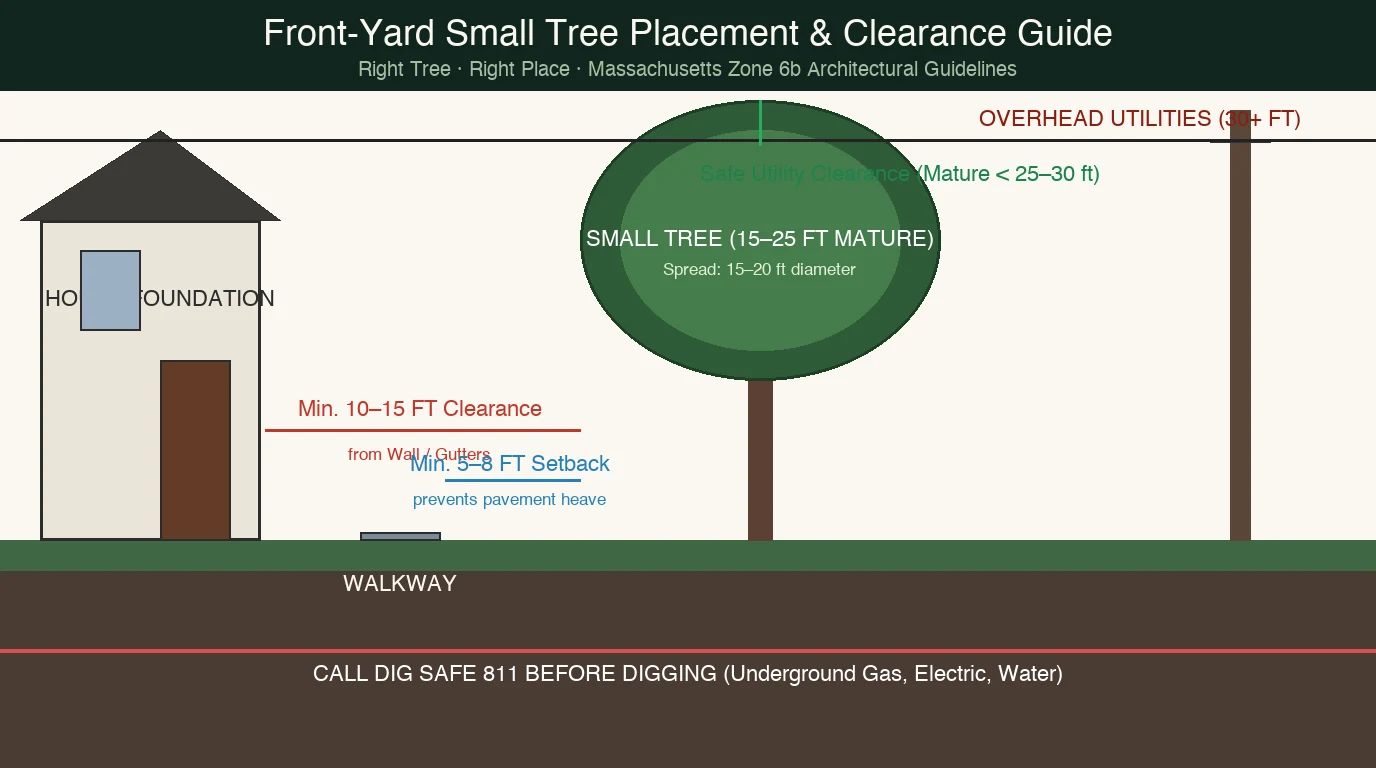
Architectural Clearance Framework: A small ornamental tree requires at least 10–15 feet of distance from house walls, 5–8 feet from walkways, and safe clearance below 30-foot overhead utilities.
1. Proportions & House Scale
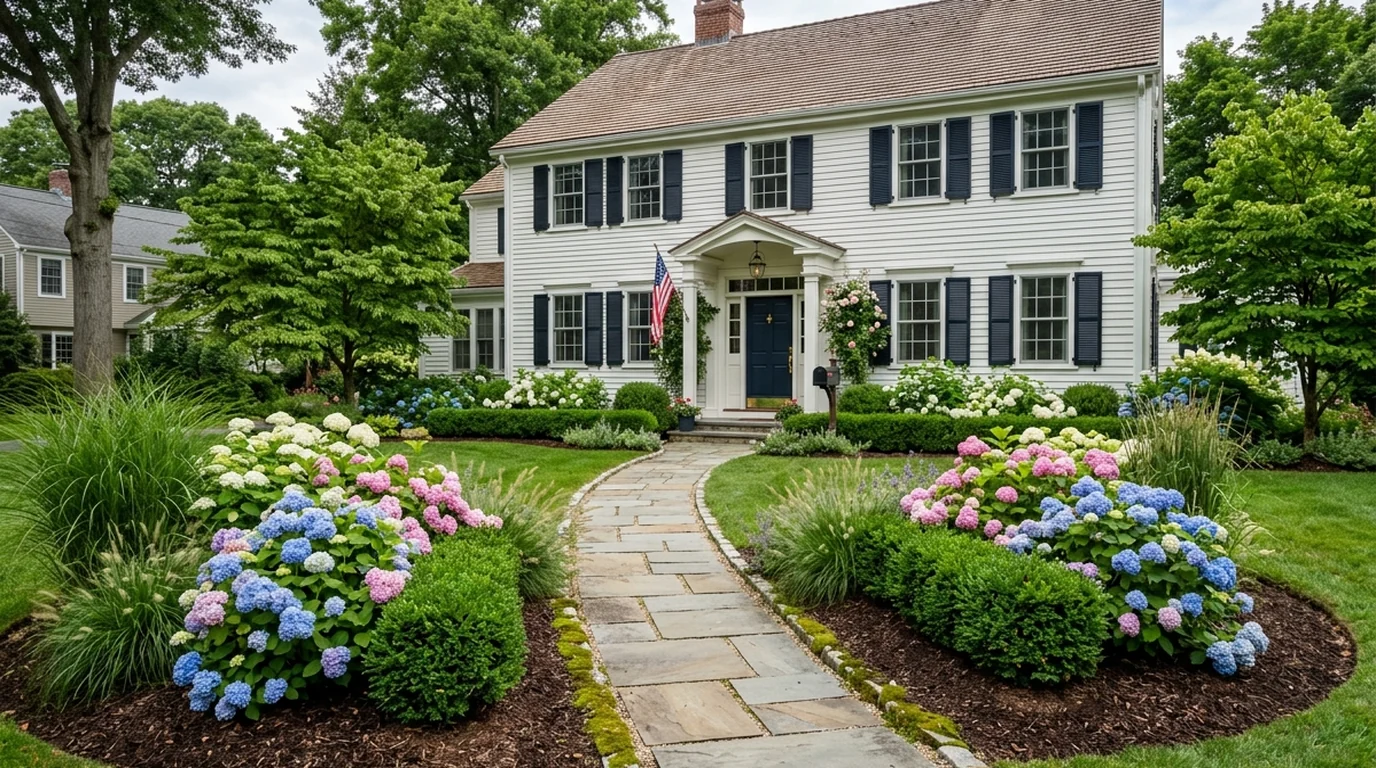
A front yard tree must complement your home's architectural scale. A single-story ranch or modest Cape Cod is easily overpowered by a 50-foot Sugar Maple, but a 15-to-20-foot Kousa Dogwood or Serviceberry provides balanced vertical framing. Place the tree slightly forward and off the corner of the house to soften rigid architectural angles and draw the eye naturally toward the front entrance.
2. Foundation & Gutter Clearances
Homeowners frequently plant trees too close to foundation walls. As branches expand, they rub against clapboards, drop debris directly into gutters, and create damp shade where mold and moss flourish. A reliable landscape rule of thumb: divide the tree's anticipated mature spread by two, and add 2 to 3 feet. If a tree matures at 20 feet wide, plant it at least 12 to 13 feet away from foundation walls.
3. Hardscape, Walkways & Root Mechanics
No tree has completely "safe" roots if planted inside a 24-inch soil strip. As trunk caliper swells, the root flare naturally expands outward. To prevent roots from heaving concrete or bluestone pavers, maintain a minimum 5-to-8-foot setback from walkways and driveways. Avoid surface-rooting trees (like weeping willows or silver maples) and opt for taprooted or compact fibrous-rooted species like Hornbeam, Paperbark Maple, or Serviceberry.
4. Overhead Utility Lines & National Arbor Day Guidance
Front yards frequently run overhead electric and communication wires from the street to the house roofline. Utility arborists (such as Eversource and National Grid in Massachusetts) are legally mandated to aggressively prune branches that threaten power lines. To avoid seeing your tree V-notched by utility crews, choose species that mature at under 25 feet (such as Star Magnolia, 'Adirondack' Crabapple, or Serviceberry) whenever planting directly within 15 feet of overhead line corridors.
5. Underground Utilities & Dig Safe (811) in Massachusetts
Massachusetts Law Mandates Dig Safe Notification Before Tree Planting:
Under Massachusetts General Law (M.G.L. c. 82, § 40), excavating for tree or shrub planting requires notifying Dig Safe at 811 at least 72 hours (excluding weekends and holidays) before breaking ground. Municipal water and sewer departments must also be contacted separately in cities like Peabody to mark private lateral connections. Striking a buried electrical line or gas service pipe is life-threatening and carries severe financial penalties.
Local Growing Conditions
Growing Small Trees in Peabody & Essex County (USDA Zone 6b)
Navigating glacial till, shallow granite ledges, winter de-icing salt, and seasonal temperature swings.
Under the updated 2023 USDA Plant Hardiness Zone Map, Peabody, Massachusetts (ZIP 01960) and neighboring North Shore communities sit squarely in Zone 6b, with average extreme minimum winter temperatures reaching -5°F to 0°F. However, soil and microclimate factors vary significantly across the region:
Glacial Till & Bedrock Ledge
Peabody yards frequently feature Paxton and Essex series stony sandy loam till over dense, compacted basal layers. In West Peabody and elevated ridges, granite bedrock sits just 12 to 24 inches below surface loam. Shallow soils require planting in wide, shallow saucers with imported compost rather than narrow deep holes that trap water like concrete bowls.
Winter Road-Salt Exposure
Front yards near streets like Lowell Street, Route 114, or Washington Street receive intense road-salt spray from municipal plows. Salt-sensitive species like Flowering Dogwood or Japanese Maple will suffer severe bud death and branch dieback. Opt for salt-tolerant species like Japanese Tree Lilac or Serviceberry along roadway margins.
Invasive & Hazardous Species
Popular Front Yard Trees to Avoid in Massachusetts
Why Callery pears, Norway maples, and brittle surface-rooting trees should never be planted in New England yards.
Callery Pear / 'Bradford' Pear (Pyrus calleryana) — Legally Banned in MA
Historically popular for its dense white spring flowers, Callery Pear is an aggressive invasive plant that escapes residential gardens, cross-pollinates, and forms impenetrable thickets that choke out native Massachusetts forest flora. Under Massachusetts Department of Agricultural Resources (MDAR) regulations (330 CMR 37.00), Callery pear is officially added to the Massachusetts Prohibited Plant List, with a final statewide sales ban effective December 31, 2028. Furthermore, its acute V-shaped branch crotches are structurally weak, routinely splitting down the middle during New England snow and ice storms.
Norway Maple (Acer platanoides) — Prohibited Invasive
Banned for sale and planting in Massachusetts, Norway Maple forms an excessively dense, shallow root mat that starves surrounding lawn turf and secretes chemicals that inhibit other plants. In late spring, its seedlings invade conservation land like Brooksby Farm, degrading native biodiversity.
Silver Maple (Acer saccharinum) and Weeping Willow (Salix babylonica) are far too large for front yards (reaching 60–80 feet). Both possess brittle, wind-vulnerable wood that snaps in minor storms and aggressive, water-seeking root systems that infiltrate sewer laterals and crack front walks.
Horticultural Execution
Tree Planting & Establishment Best Practices
Core planting techniques to protect your horticultural investment and ensure decades of healthy canopy development.
1. Find the Root Flare
The #1 cause of nursery tree death is planting too deeply. Identify the root flare—the widening trunk base where roots spread out—and set it exactly level with or 1 inch higher than surrounding grade. Never bury the flare.
2. Dig Wide, Not Deep
Dig the planting hole 2 to 3 times wider than the root ball, but only as deep as the ball itself. Digging too deep causes the tree to settle over time, suffocating root oxygen intake and rotting the trunk bark.
3. Stop Volcano Mulching
Spread a 2-to-3-inch layer of organic bark mulch across the root zone to conserve moisture, but pull mulch 3 to 4 inches back from the trunk. "Volcano mulching" against bark traps moisture, triggers fungal decay, and encourages girdling roots.
When to Involve a Landscape Professional:
While planting a small containerized shrub is a realistic homeowner weekend project, specimen ornamental trees (balled-and-burlapped with 200–500 lb root balls) require heavy equipment, proper soil grading, laser leveling, and coordinated integration with surrounding perennial borders, irrigation, and walkways. Connecting with an independent local landscape contractor ensures proper soil preparation, utility compliance, and establishment guarantees.
Frequently Asked Questions
Common Questions About Small Front Yard Trees
Clear, authoritative answers to common homeowner questions regarding mature size, root safety, shade tolerance, and local codes.
Answers
Frequently asked questions
7 questions
01
What tree stays under 20 feet for a small front yard?
Several outstanding ornamental trees reliably stay under 20 feet at maturity. Star Magnolia (Magnolia stellata) reaches only 10 to 15 feet tall with a compact rounded canopy; 'Adirondack' flowering crabapple (Malus) grows 15 to 18 feet tall with an upright 10-foot spread; Japanese Maple cultivars like 'Bloodgood' or weeping cutleaf varieties stay between 8 and 18 feet; and American Witch Hazel (Hamamelis virginiana) naturally tops out around 12 to 18 feet.
How far from a house foundation should you plant a small tree?
As a general rule, plant a small tree at a distance equal to at least half of its anticipated mature spread, plus an extra 2 to 3 feet of safety buffer. For a compact tree expected to spread 16 feet wide, place it at least 10 to 12 feet away from exterior foundation walls. This ensures branches do not scrape gutters or roof shingles, allows sunlight to reach lower windows, and keeps the root flare from competing with foundation drainage systems.
03
Which small trees have non-invasive roots that won't damage walkways?
While no tree root system is completely harmless if forced into restricted soil, small understory trees with well-behaved, non-aggressive fibrous root systems include Paperbark Maple (Acer griseum), Serviceberry (Amelanchier laevis), Kousa Dogwood (Cornus kousa), and Eastern Redbud (Cercis canadensis). Plant them at least 5 to 8 feet away from sidewalks and driveways to prevent root flare from lifting pavement as the trunk caliper expands.
What small ornamental trees grow well in partial shade in Massachusetts?
In Massachusetts (USDA Zone 6b), Pagoda Dogwood (Cornus alternifolia), American Hornbeam (Carpinus caroliniana), Serviceberry (Amelanchier), and Japanese Maple (Acer palmatum) thrive in partial shade or morning sun with afternoon canopy protection. These species evolved naturally as forest understory trees, making them ideal for north-facing front yards or properties shaded by mature oaks and pines.
05
What popular landscape trees are prohibited or illegal in Massachusetts?
The Massachusetts Department of Agricultural Resources (MDAR) bans species on the Massachusetts Prohibited Plant List (330 CMR 37.00). The Callery Pear / Bradford Pear (Pyrus calleryana) is strictly prohibited with an existing retail phase-out ending December 31, 2028. Norway Maple (Acer platanoides) and Tree of Heaven (Ailanthus altissima) are also completely banned from sale and planting due to severe invasive forest destruction.
06
Do you need to call Dig Safe before planting a small front yard tree in Massachusetts?
Yes. Under Massachusetts General Law (M.G.L. c. 82, § 40), tree planting qualifies as excavation. You or your landscape contractor must call Dig Safe at 811 (or submit a web ticket) at least 72 hours prior to digging. Front yards frequently conceal buried electric service, natural gas lines, fiber optic cables, and municipal water lateral lines that run directly through ideal planting spots.
07
What is the best native small tree for birds and pollinators in New England?
Allegheny Serviceberry (Amelanchier laevis) is arguably the finest all-around native small tree. It produces early nectar-rich white blossoms for emergent spring pollinators, followed by sweet, purple-black Juneberries eagerly devoured by cedar waxwings, catbirds, and robins. In autumn, its leaves turn fiery orange-red, and its smooth gray bark provides subtle winter interest.
Horticultural citations: UMass Amherst Extension Landscape, Nursery & Urban Forestry Program ("Right Plant, Right Place"), USDA Plant Hardiness Zone Map (2023), Massachusetts Department of Agricultural Resources (MDAR 330 CMR 37.00 Prohibited Plant List), Massachusetts General Law (M.G.L. c. 82 § 40 Dig Safe), and the Arbor Day Foundation.
Updated:
Ready to Transform Your Front Yard Landscape?
Connect with screened, independent landscape design and planting professionals in Peabody and Essex County for free, no-obligation on-site property consultations.