Evergreen Shrubs for the Front of Your House: Selection, Sizing & Curb Appeal
How to select, position, and space foundation evergreens that naturally stay below your window sills, clear your walkways, survive local winter conditions, and frame your home with effortless four-season curb appeal.
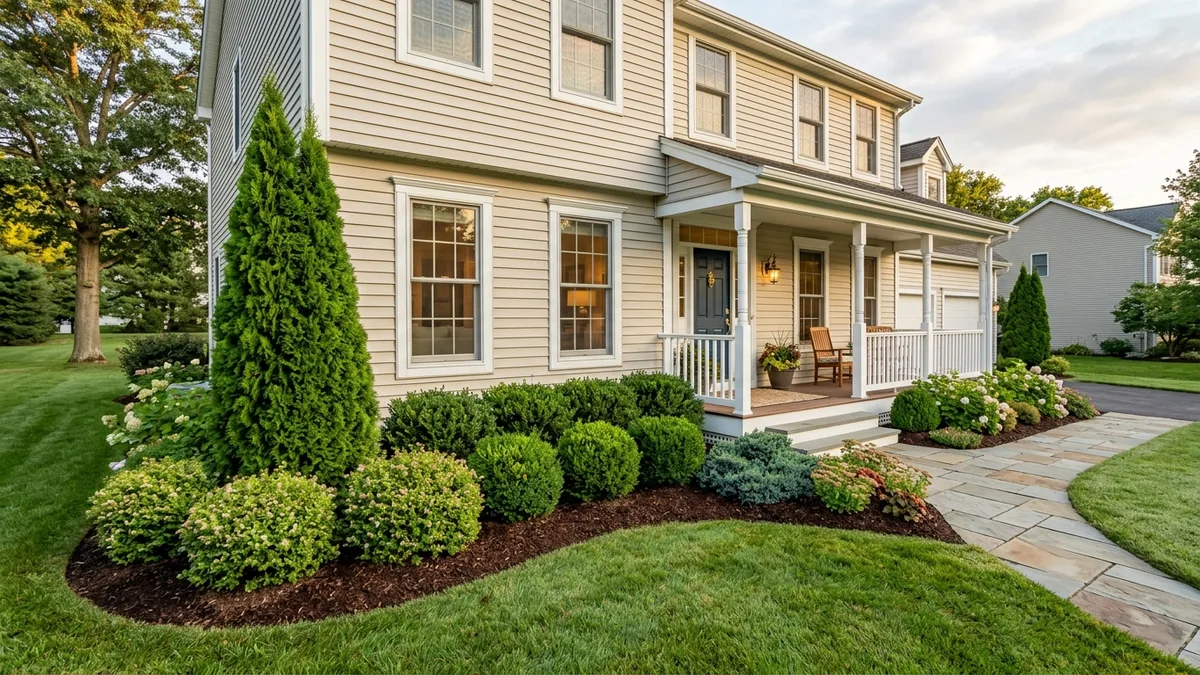
The best evergreen shrubs for the front of a house are cultivars whose mature height and spread fit your foundation bed dimensions without relying on constant shearing. Compact inkberry hollies, dwarf conifers, blight-resistant boxwoods, yews, and regional broadleaf evergreens provide permanent year-round structure. Choose varieties that naturally stay below window sills and maintain a minimum two-foot air buffer from siding to safeguard air circulation, daylight, and exterior maintenance access.
Decision Framework
How to Choose Evergreen Shrubs for the Front of a House
Every spring, millions of American homeowners walk into garden centers and make the single most expensive mistake in residential landscaping: they pick shrubs based entirely on how attractive an 18-inch potted nursery plant looks on the sales lot. Within five years, that adorable nursery specimen matures into an 8-foot impenetrable thicket that blocks sunlight from living room windows, scrapes paint off cedar siding, harbors wood-destroying moisture, and blocks sightlines to the front door.
Professional landscape design does not start at the nursery. It starts on your front porch with a tape measure, a compass, and an honest evaluation of your regional microclimate. Across the United States, successful foundation plantings follow a strict hierarchical planning order:
USDA Hardiness Zone
Determines minimum winter cold survival. A plant must survive your coldest recorded multi-year freeze without stem dieback.
Sun & Foundation Aspect
Actual solar exposure. South/west exposures reflect intense masonry heat; north walls endure deep winter shadow.
Soil Drainage & Roof Eaves
Percolation and roof runoff. Compacted clay or un-guttered drip lines cause rapid root rot in susceptible evergreens.
Mature Dimensions (H × W)
Select a named cultivar whose 10-year natural spread and height match your window sill and wall clearance exactly.
Official USDA Plant Hardiness Zone Map (2023 Update)
Always verify your exact ZIP code against the current 2023 USDA map. However, remember: hardiness zones indicate only average annual minimum winter temperatures. They do not account for summer heat index, humidity, duration of sunlight, soil pH, or winter wind desiccation.
The #1 Selection Factor
Mature Height & Spread: Stop the 'Green Meatball' Cycle
The fundamental tenet of sustainable residential horticulture is simple: Right-Sized Shrub > Constant Pruning. When an oversized shrub is planted beneath a 36-inch window, the homeowner is forced into an endless cycle of aggressive shearing. Shearing an 8-foot shrub down to 3 feet leaves an outer shell of scarred twigs over a dead, hollow interior, dramatically increases susceptibility to foliar blights, and turns the landscape into a collection of identical, unnatural "green meatballs."
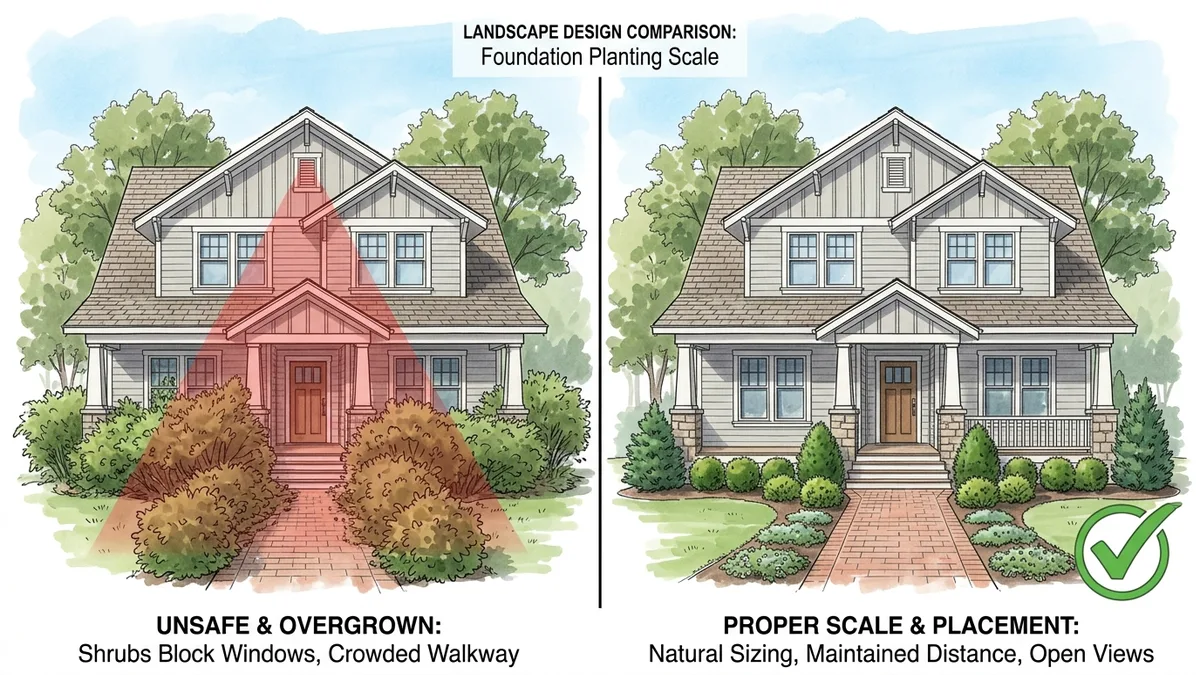
Why "Dwarf" Doesn't Mean Tiny Forever
In botanical terms, "dwarf" simply means a plant grows slower or stays smaller than the wild species. For instance, a wild White Pine grows 80 to 100 feet tall; a "dwarf" pine might mature at 12 to 15 feet—hardly suitable for beneath a front living room window! Furthermore, generic seed-grown plants can vary wildly. A seed-grown Mugo Pine (Pinus mugo) can reach 15 to 20 feet, whereas a verified grafted cultivar like Pinus mugo 'Slowmound' reliably stops at 2.5 to 3 feet. Always check the exact cultivar name.
The Window-Sill Clearance Standard
Before purchasing any foundation plant, take a tape measure and determine the exact distance from the ground (or top of mulch) to the bottom of the window frame. Select cultivars whose natural, unpruned 10-year mature height is at least 6 to 12 inches lower than your window sill. This ensures that even as the shrub reaches full maturity, sunlight streams into the home and you never have to climb into the garden with electric hedge trimmers every three weeks.
Interactive Evergreen Shrub Finder
Filter 26 authoritative cultivars by mature dimensions, hardiness zone, sun exposure, and architectural role.
Inkberry Holly 'Gem Box'
Ilex glabra 'Gem Box'
Habit: Dense, tight ball-shaped mound; branches to the ground without bare legs
Inkberry Holly 'Strongbox'
Ilex glabra 'Strongbox'
Habit: Compact, broad rounded mound with small dark green leaves
Little Missy Boxwood
Buxus microphylla 'Little Missy'
Habit: Naturally compact, dense rounded cushion requiring virtually zero shearing
Wintergreen Korean Boxwood
Buxus sinica var. insularis 'Wintergreen'
Habit: Vigorous, rounded formal evergreen with excellent cold hardiness
Green Velvet Boxwood
Buxus 'Green Velvet'
Habit: Low, rounded sphere maintaining rich green color better than English boxwood
Japanese Holly 'Helleri'
Ilex crenata 'Helleri'
Habit: Dense, dwarf mounding shrub with tiny spineless dark-green leaves
Japanese Holly 'Sky Pencil'
Ilex crenata 'Sky Pencil'
Habit: Extremely narrow, fastigiate vertical column; takes up almost no horizontal bed space
Dwarf Yaupon Holly 'Schillings Dwarf'
Ilex vomitoria 'Schillings Dwarf'
Habit: Tight, dense, formal rounded dome with tiny leaves and reddish new growth
Distylium 'Vintage Jade'
Distylium hybrid 'Vintage Jade'
Habit: Spreading, layered evergreen mound with glossy dark-green witch-hazel-like leaves
Distylium 'Blue Cascade'
Distylium hybrid 'Blue Cascade'
Habit: Arched, mounding shrub with matte blue-green foliage year-round
Anglo-Japanese Yew 'Densiformis'
Taxus × media 'Densiformis'
Habit: Broad, dense, flat-topped spreading conifer with deep forest-green needles
Hicks Columnar Yew
Taxus × media 'Hicksii'
Habit: Erect, columnar architectural accent with dark lustrous green needles
Globe Arborvitae 'Tater Tot'
Thuja occidentalis 'Tater Tot'
Habit: Naturally perfect compact globe; soft fan-like fragrant foliage that never needs shearing
Emerald Green Arborvitae
Thuja occidentalis 'Smaragd'
Habit: Narrow, tight, bright emerald-green pyramidal spire that holds winter color
Dwarf Hinoki Cypress 'Nana Gracilis'
Chamaecyparis obtusa 'Nana Gracilis'
Habit: Slow-growing, irregular conical form with dark glossy fan-shaped layered sprays
Dwarf Mugo Pine 'Slowmound'
Pinus mugo 'Slowmound'
Habit: True dwarf, dense, mounded cushion with rich dark-green needles year-round
Bird's Nest Spruce
Picea abies 'Nidiformis'
Habit: Broad, flat-topped dense spreading conifer with a distinctive nest-like central depression
Dwarf Alberta Spruce
Picea glauca 'Conica'
Habit: Formal, perfectly dense conical pyramid with fine, soft needle texture
Blue Star Juniper
Juniperus squamata 'Blue Star'
Habit: Compact, slow-growing rounded mound with intense silvery steel-blue needles
Shore Juniper 'Blue Pacific'
Juniperus conferta 'Blue Pacific'
Habit: Low cascading groundcover with ocean blue-green needles; hugs ground contours
Mountain Laurel 'Elf'
Kalmia latifolia 'Elf'
Habit: First true dwarf mountain laurel; compact, dense mounding habit with leathery leaves
P.J.M. Rhododendron
Rhododendron 'P.J.M. Elite'
Habit: Upright, rounded broadleaf shrub with aromatic foliage and extraordinary winter hardiness
Encore® Azalea 'Autumn Bonfire'
Rhododendron hybrid 'Autumn Bonfire'
Habit: Compact, rounded evergreen azalea that repeat-blooms multiple times per year
Camellia Sasanqua 'Shishi Gashira'
Camellia sasanqua 'Shishi Gashira'
Habit: Low spreading, layered evergreen with glossy dark-green serrated leaves
Japanese Pieris 'Cavatine'
Pieris japonica 'Cavatine'
Habit: Dwarf, compact mounded broadleaf evergreen with remarkable flower density
Catawba Rhododendron 'Chionoides'
Rhododendron catawbiense 'Chionoides'
Habit: Broad, dome-shaped evergreen with dark, leathery foliage that tolerates sun better than most rhododendrons
Authoritative Master Directory
The 26 Best Evergreen Shrubs for Front Foundations: Comparison Table
The following master comparison table indexes 26 verified evergreen cultivars suited to residential front-of-house landscapes across the United States. Every entry specifies the exact botanical name, 2023 USDA hardiness range, verified mature dimensions, sunlight tolerance, primary architectural role, native status, and major real-world watch-outs.
| Common Name & Cultivar | Botanical Name | Type | USDA Zones | Mature Size (H × W) | Sunlight | Best Front Role | Native / Flowering | Critical Watch-Out |
|---|---|---|---|---|---|---|---|---|
| Inkberry Holly 'Gem Box' | Ilex glabra | Broadleaf | Zones 5–9 | 2–3′ H × 2–3′ W | Full Sun, Part Sun | Under Windows, Low Border, General Foundation | ✓ Native | Requires acidic to neutral soil (pH 5.0–6.5). In alkaline soils (pH > 7.0), foliage will develop yellowing chlorosis. |
| Inkberry Holly 'Strongbox' | Ilex glabra | Broadleaf | Zones 5–9 | 2–3′ H × 2–3′ W | Full Sun, Part Sun | Under Windows, Low Border, General Foundation | ✓ Native | Not drought tolerant during initial two seasons of establishment; avoid hot dry sand unless mulched and irrigated. |
| Little Missy Boxwood | Buxus microphylla | Broadleaf | Zones 5–9 | 2–2.5′ H × 3–3.5′ W | Full Sun, Part Sun | Under Windows, Low Border | Introduced | Consistently ranked #1 for Boxwood Blight resistance in university trials, but still vulnerable to boxwood leafminer if unmonitored. |
| Wintergreen Korean Boxwood | Buxus sinica var. insularis | Broadleaf | Zones 5–8 | 3–4′ H × 4–5′ W | Full Sun, Part Sun | Under Windows, General Foundation | Introduced | Susceptible to Boxwood Blight (Calonectria) and Volutella canker. Can grow taller than 4 feet after 12+ years without light maintenance. |
| Green Velvet Boxwood | Buxus | Broadleaf | Zones 5–8 | 2–3′ H × 2.5–3′ W | Full Sun, Part Sun | Under Windows, Low Border | Introduced | Moderate susceptibility to boxwood blight spores; keep sprinkler heads aimed away from foliage to minimize leaf wetness. |
| Japanese Holly 'Helleri' | Ilex crenata | Broadleaf | Zones 6–9 | 2–3′ H × 3–4′ W | Full Sun, Part Sun | Under Windows, Low Border | Introduced | Highly prone to Thielaviopsis basicola (black root rot) in heavy, poorly drained clay. Do not plant near roof runoff downspouts. |
| Japanese Holly 'Sky Pencil' | Ilex crenata | Broadleaf | Zones 6–9 | 6–8′ H × 1.5–2′ W | Full Sun, Part Sun | Narrow Column, Corner Anchor | Introduced | Heavy wet snow or freezing ice can splay columns open permanently; tie outer branches loosely with soft arbor tie before northern winters. |
| Dwarf Yaupon Holly 'Schillings Dwarf' | Ilex vomitoria | Broadleaf | Zones 7–10 | 2–3′ H × 3–4′ W | Full Sun, Part Sun | Under Windows, Low Border | ✓ Native | Cold tender north of Zone 7. Male clone, so it does not produce berries, but has virtually zero pest or disease issues. |
| Distylium 'Vintage Jade' | Distylium hybrid | Broadleaf | Zones 7–9 | 2–3′ H × 3–4′ W | Full Sun, Part Sun | Under Windows, Low Border, General Foundation | Introduced 🌸 Showy Flowers | Not hardy in northern zones (dies to roots in Zone 6 or colder). Complete immunity to boxwood blight makes it the premier Southern foundation pick. |
| Distylium 'Blue Cascade' | Distylium hybrid | Broadleaf | Zones 7–9 | 3–4′ H × 3–4′ W | Full Sun, Part Sun | Under Windows, General Foundation | Introduced 🌸 Showy Flowers | Requires Zone 7 minimum winter warmth. Needs minimal pruning; shearing spoils its natural layered cascading habit. |
| Anglo-Japanese Yew 'Densiformis' | Taxus × media | Needled Conifer | Zones 4–7 | 3–4′ H × 4–6′ W | Full Sun, Part Sun, Full Shade | Under Windows, General Foundation | Introduced | FATAL TO PETS: All parts (except the red aril flesh) contain deadly taxine alkaloids. Highly intolerant of wet feet; rots quickly in soggy soil. |
| Hicks Columnar Yew | Taxus × media | Needled Conifer | Zones 4–7 | 10–12′ H × 3–4′ W | Full Sun, Part Sun, Full Shade | Corner Anchor, Narrow Column | Introduced | Extreme deer favorite in northern winters. Severe pet/horse toxicity. Requires tie protection against heavy snow splaying. |
| Globe Arborvitae 'Tater Tot' | Thuja occidentalis | Needled Conifer | Zones 3–7 | 2–2.5′ H × 2–2.5′ W | Full Sun, Part Sun | Under Windows, Low Border | ✓ Native | High deer palatability. Requires supplemental water during extended summer dry spells; dislikes hot dry southern climates (Zones 8+). |
| Emerald Green Arborvitae | Thuja occidentalis | Needled Conifer | Zones 3–7 | 12–14′ H × 3–4′ W | Full Sun, Part Sun | Corner Anchor, Narrow Column | ✓ Native | DO NOT PLANT UNDER WINDOWS. Plant at house corners only, set at least 4 to 5 feet out from foundation walls to accommodate height and eaves. |
| Dwarf Hinoki Cypress 'Nana Gracilis' | Chamaecyparis obtusa | Needled Conifer | Zones 4–8 | 3–6′ H × 2–4′ W (after 10+ yrs) | Full Sun, Part Sun | Corner Anchor, General Foundation | Introduced | Very slow growth rate (~2–3 inches per year). Dislikes heavy poorly drained clay and hot, dry desert heat. |
| Dwarf Mugo Pine 'Slowmound' | Pinus mugo | Needled Conifer | Zones 3–7 | 2–3′ H × 3–4′ W | Full Sun | Under Windows, Low Border | Introduced | CRITICAL: Purchase only named grafted cultivars like 'Slowmound'. Generic seed-grown Pinus mugo often matures into a 15–20 foot ragged tree! |
| Bird's Nest Spruce | Picea abies | Needled Conifer | Zones 3–7 | 2–3′ H × 4–5′ W | Full Sun, Part Sun | Under Windows, Low Border | Introduced | Struggles in hot, humid Southern climates (Zones 8+). Prone to spruce spider mites in dusty, dry, stagnant air. |
| Dwarf Alberta Spruce | Picea glauca | Needled Conifer | Zones 3–7 | 6–8′ H × 3–4′ W (over 15 yrs) | Full Sun, Part Sun | Corner Anchor, General Foundation | ✓ Native | Extremely susceptible to two-spotted spider mites in hot, dry weather. Avoid planting under roof eaves where hot reflected heat cooks foliage. |
| Blue Star Juniper | Juniperus squamata | Needled Conifer | Zones 4–8 | 1.5–2′ H × 2–3′ W | Full Sun | Low Border, Under Windows | Introduced | Quickly dies in damp shade or heavy wet clay. Avoid overhead watering to prevent Phomopsis needle blight. |
| Shore Juniper 'Blue Pacific' | Juniperus conferta | Needled Conifer | Zones 6–9 | 0.75–1′ H × 4–6′ W | Full Sun | Low Border | Introduced | Must have 6+ hours of hot direct sun. Completely rots if mulched too heavily or planted in poorly drained foundation soil. |
| Mountain Laurel 'Elf' | Kalmia latifolia | Broadleaf | Zones 5–8 | 3–4′ H × 3–4′ W | Part Sun, Full Shade | Under Windows, General Foundation | ✓ Native 🌸 Showy Flowers | Will fail in heavy alkaline clay or standing water. All parts are toxic to dogs, cats, and livestock if ingested. |
| P.J.M. Rhododendron | Rhododendron | Broadleaf | Zones 4–8 | 3–5′ H × 3–5′ W | Full Sun, Part Sun | General Foundation, Corner Anchor | Introduced 🌸 Showy Flowers | Foliage turns deep mahogany-bronze in winter; this is normal evergreen protection, NOT winter death. Toxic to pets. |
| Encore® Azalea 'Autumn Bonfire' | Rhododendron hybrid | Broadleaf | Zones 6–9 | 3′ H × 3′ W | Full Sun, Part Sun | Under Windows, Low Border | Introduced 🌸 Showy Flowers | Requires 4–6 hours of direct sun to trigger heavy re-blooming (unlike traditional shade azaleas). Toxic to pets if ingested. |
| Camellia Sasanqua 'Shishi Gashira' | Camellia sasanqua | Broadleaf | Zones 7–9 | 3–4′ H × 4–5′ W | Part Sun, Full Shade | Under Windows, General Foundation | Introduced 🌸 Showy Flowers | Cannot survive northern winters (dies below Zone 7). Premier fall-flowering evergreen for Mid-Atlantic, Southeast, and Pacific Northwest. |
| Japanese Pieris 'Cavatine' | Pieris japonica | Broadleaf | Zones 5–8 | 2–3′ H × 2.5–3′ W | Full Sun, Part Sun | Under Windows, Low Border | Introduced 🌸 Showy Flowers | Andromeda lacebug can cause leaf stippling in hot, dry, full-sun southern exposures. Highly toxic to pets and children. |
| Catawba Rhododendron 'Chionoides' | Rhododendron catawbiense | Broadleaf | Zones 4–8 | 4–5′ H × 4–6′ W | Part Sun, Full Shade | Corner Anchor, General Foundation | ✓ Native 🌸 Showy Flowers | Leaves curl tightly downward in sub-freezing temperatures as an evolutionary defense against winter desiccation (normal response). |
Horticultural data cross-referenced with Penn State Extension, UMass Extension, University of Georgia Cooperative Extension, University of Florida IFAS, and the USDA Agricultural Research Service.
Architectural Window Placement
Evergreen Shrubs for Under Front Windows: Compact Picks (≤ 3–4 Feet)
Windows are the eyes of your home. Covering them with dense foliage darkens your interior rooms, creates hiding spots for home intruders, and invites wood-rot fungi to thrive on wooden frames. For foundation beds beneath first-floor windows, select plants that maintain a natural spreading or mounding habit without exceeding 3 to 4 feet in height.
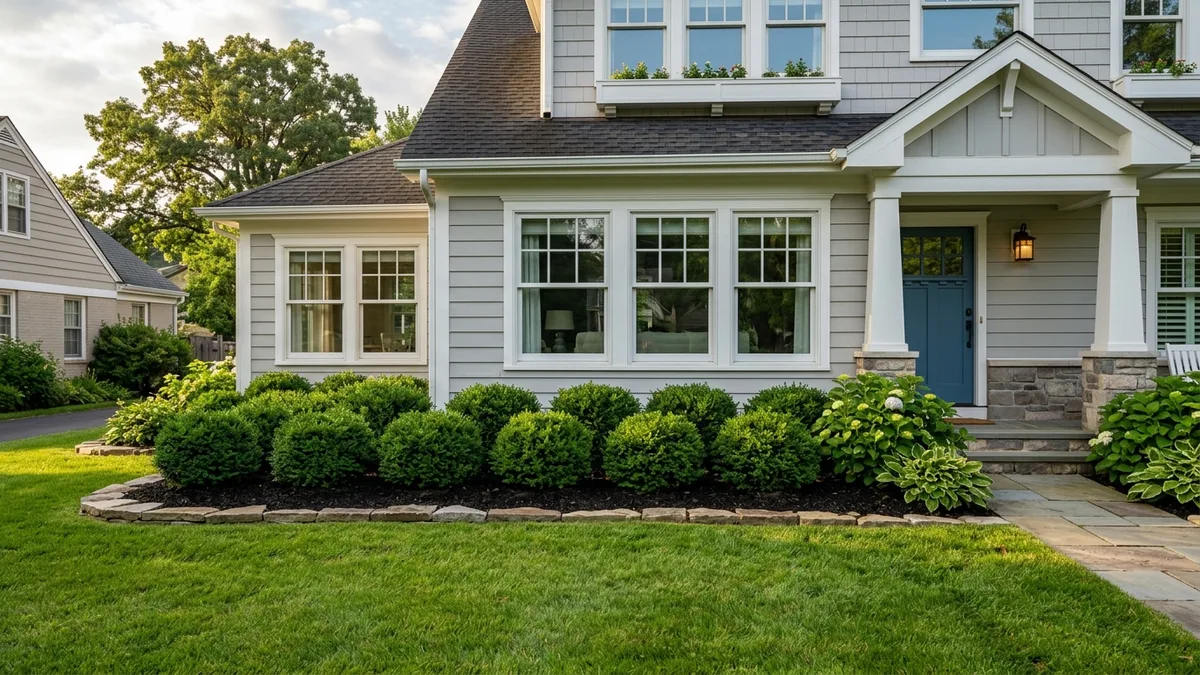
Inkberry Holly 'Gem Box'
Ilex glabra 'Gem Box' (Zones 5–9)
Branches completely to the soil line unlike older inkberry varieties. Dense, dark green, and completely immune to boxwood blight.
Little Missy Boxwood
Buxus microphylla 'Little Missy' (Zones 5–9)
Stays naturally under 30 inches tall with a tight rounded habit. Tested as the most blight-resistant commercial boxwood cultivar in Virginia Tech field trials.
Globe Arborvitae 'Tater Tot'
Thuja occidentalis 'Tater Tot' (Zones 3–7)
Soft, fragrant fan-shaped foliage that forms a neat globe all on its own. Requires zero shearing and handles bitter northern winters down to -40°F.
Distylium 'Vintage Jade'
Distylium hybrid (Zones 7–9)
Layered evergreen with leathery dark-green leaves. Tolerates brutal summer heat, wet clay, drought, and reflected asphalt heat with zero disease pressure.
Dwarf Mugo Pine 'Slowmound'
Pinus mugo 'Slowmound' (Zones 3–7)
True dwarf grafted selection that forms a dark-green cushion. Exceptional drought and wind tolerance in full sun beds.
Japanese Pieris 'Cavatine'
Pieris japonica 'Cavatine' (Zones 5–8)
Stays dwarf and compact, erupting with masses of delicate white bell flowers in March and April. Thrives in acidic foundation soils.
Vertical Architecture
Evergreen Shrubs for House Corners: Structural Anchors (5–12+ Feet)
While under-window plantings should stay low and horizontal, architectural house corners need verticality. An upright evergreen softens the hard, boxy 90-degree corner of a two-story home, guiding the viewer's eye from the roofline down to the foundation garden. However, planting a full-sized forest tree (like a Colorado Blue Spruce or White Pine) at a corner will overwhelm the house within a decade. Corner selections must possess controlled, columnar, or conical mature silhouettes.
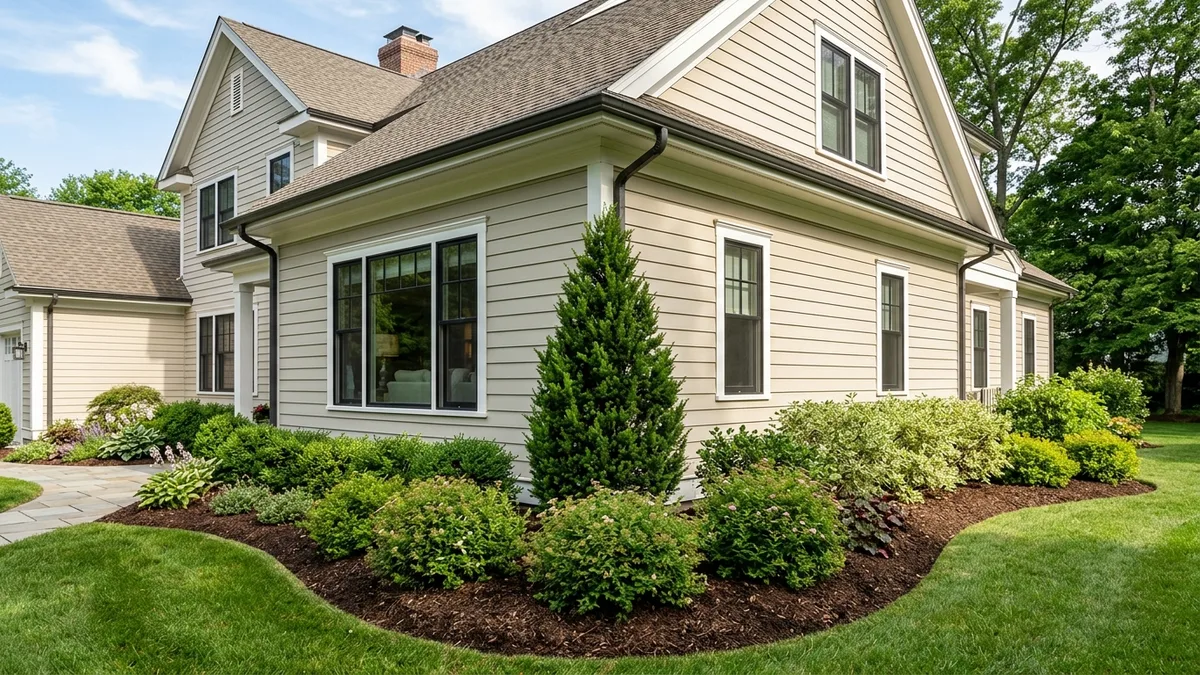
Emerald Green Arborvitae
Thuja occidentalis 'Smaragd'
Tight, bright-emerald spire that holds its vibrant green color through sub-zero northern winters. Plant at least 4.5 feet out from corner siding.
Hicks Columnar Yew
Taxus × media 'Hicksii'
Dense, vertical dark-green pillar that thrives in partial to deep shade. Outstanding corner anchor for shaded north-facing colonials. Note: Toxic to pets.
Japanese Holly 'Sky Pencil'
Ilex crenata 'Sky Pencil'
Extremely narrow, pencil-thin vertical column. Perfect for tight property corners, narrow beds between walkways, and flanking front porch entries (for using upright evergreens along boundary lines, see our guide to backyard privacy ideas with plants).
Botanical Anatomy
Broadleaf Evergreens vs. Needled Conifers (And Winter Color Shifts)
A dynamic foundation planting combines both major evergreen classes to produce rich textural variety. Broadleaf evergreens (such as Hollies, Boxwoods, Rhododendrons, and Camellias) feature wide, flat foliage with thick waxy cuticles that reflect sunlight and create solid, structural mounds. Needled conifers (such as Junipers, Pines, Yews, and Spruces) display fine-textured, needle-like or scale-like foliage that creates soft shadows and feathered transitions.
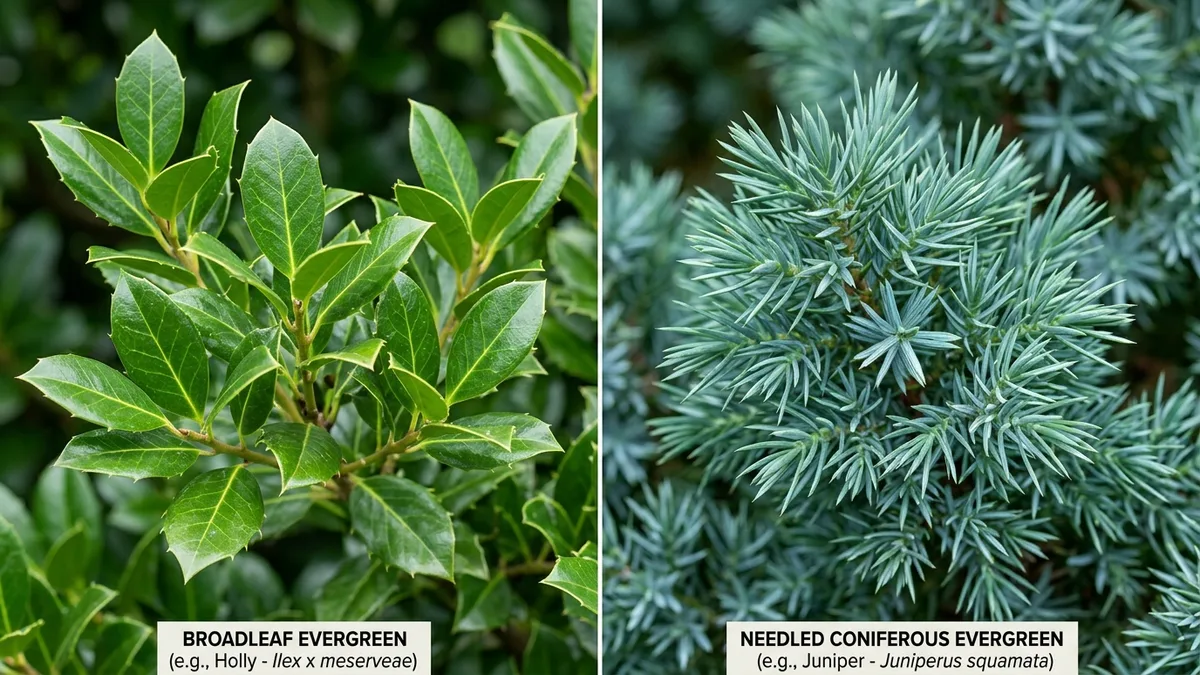
Information Gain: Evergreen Does NOT Mean Identical Green 365 Days a Year
One of the most frequent panic calls landscape contractors receive in January is from homeowners who believe their new evergreens are dying because the foliage has turned brown, plum, or bronze. In reality, many evergreens produce protective anthocyanin and carotenoid pigments during cold weather to protect their cellular chloroplasts from winter UV damage while the roots are frozen.
- P.J.M. Rhododendrons: Leaves transition from summer green to rich mahogany-bronze in winter; they green up completely within days of warm spring sun.
- Russian Cypress (Microbiota decussata): Needles turn an attractive coppery-purple in November before reverting to bright emerald in April.
- Creeping Junipers: Cultivars like 'Andorra' develop rich plum-purple winter tones.
- Broadleaf Rhododendron Leaf Curl: In sub-freezing temperatures, rhododendron leaves curl tightly like cigars and droop downward. This minimizes surface area and prevents water loss during freezes. It is healthy evolutionary behavior!
Solar Alignment
Evergreen Shrubs for Sunny Fronts: South & West Walls
A front foundation bed with south or west exposure receives 6 to 8+ hours of baking afternoon sun. In suburban settings, this heat is multiplied by heat absorbed and radiated from brick, stone, concrete foundation walls, asphalt driveways, and front walkways. Moisture evaporates rapidly from the soil, and tender broadleaf evergreens (like shaded mountain laurels or delicate camellias) will suffer severe leaf scorch.
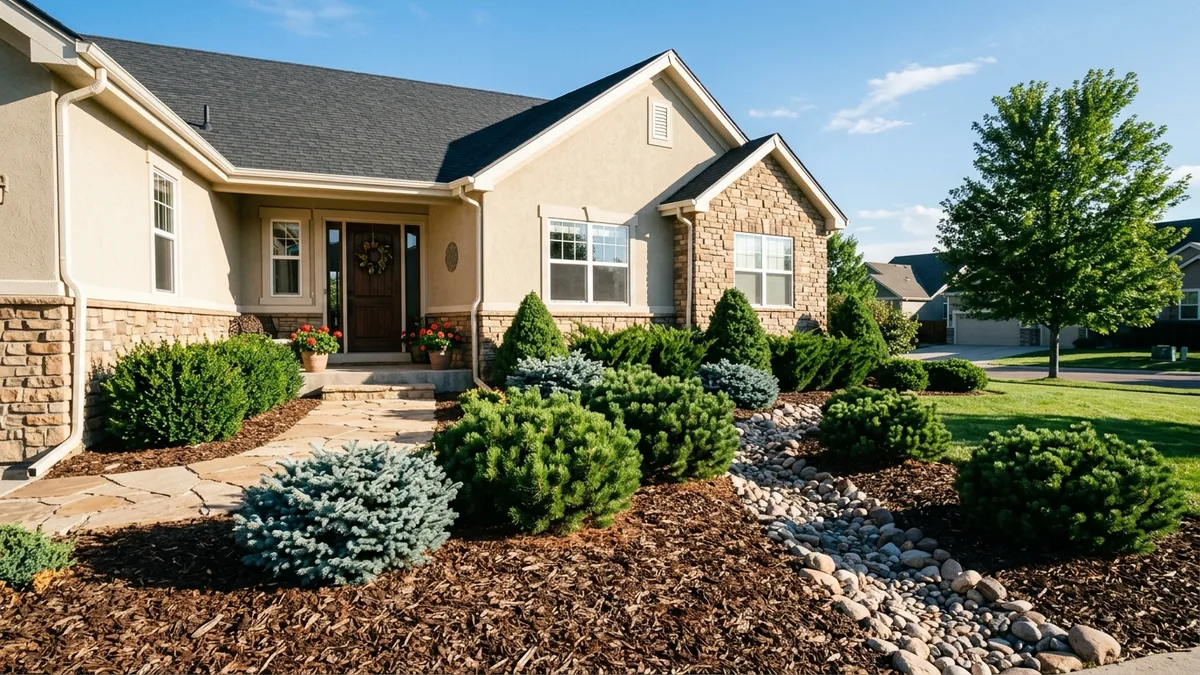
Top Full-Sun Foundation Performers
Silvery steel-blue needles thrive in hot, dry, rocky, full-sun beds. Sharp drainage essential.
Handles brutal wind and solar radiation. Requires zero shade and tolerates sandy, gravelly soil.
Native to coastal dunes; withstands intense southern solar heat, salt spray, and drought.
North & Shaded Walls
Evergreen Shrubs for Shade: North & East Facing Foundations
North-facing front beds receive little to no direct sunlight, remaining in cool, ambient light for much of the year. While these beds escape the baking summer heat of southern exposures, they present two distinct challenges: soil dries out much more slowly (increasing root-rot risks), and sun-dependent shrubs will become thin, leggy, and sparse as they stretch toward the sky searching for photons.
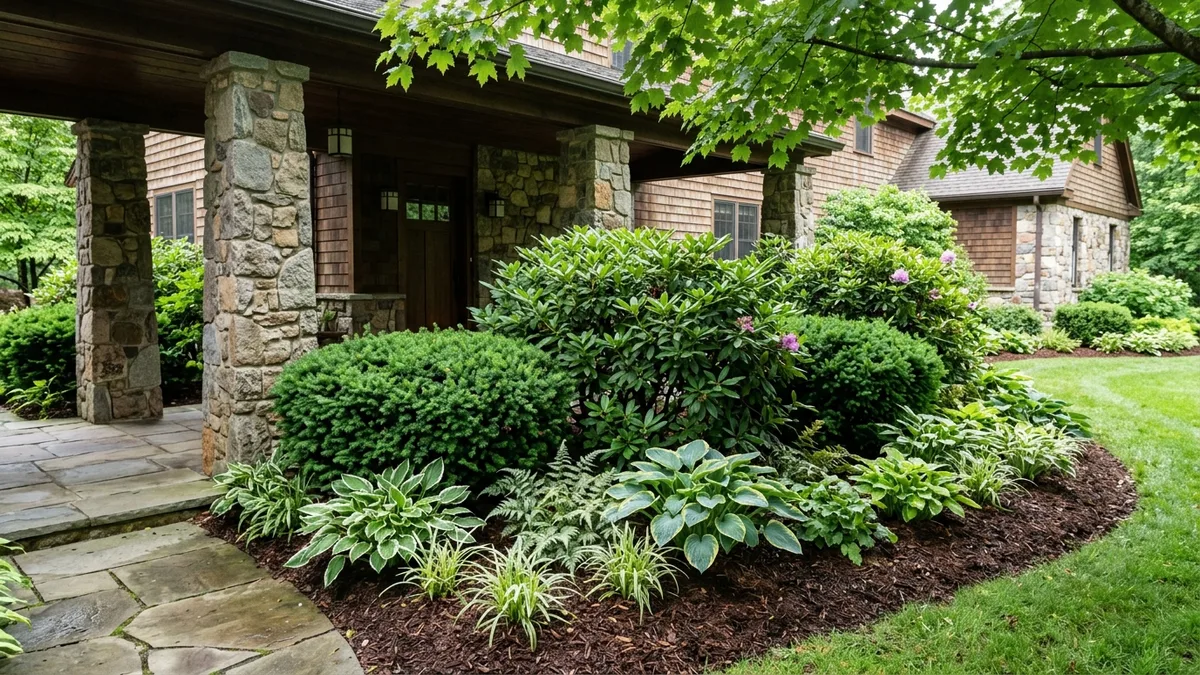
Differentiating Part Shade from Deep Shade
Ideal for flowering broadleaf evergreens. East-facing front yards receive gentle morning rays that trigger blossom buds on Mountain Laurel, Japanese Pieris, and Azaleas without scorching foliage during hot afternoon hours.
Under wide porch soffits or deep north-side overhangs, Anglo-Japanese Yews (Taxus × media 'Densiformis') reign supreme. They are one of the few evergreens on earth that maintain dense, dark-green needle density in true low-light conditions.
Four-Season Floral Displays
Flowering Evergreen Shrubs for Year-Round Curb Appeal
Deciduous flowering shrubs (like panicle hydrangeas or spireas) look spectacular for 6 to 8 weeks in summer, but they leave behind bare, dead-looking brown sticks for the remaining six months of the year. Flowering broadleaf evergreens provide the ultimate landscape design synergy: permanent, lustrous, dark-green architectural foliage all 365 days, punctuated by spectacular seasonal blooms.
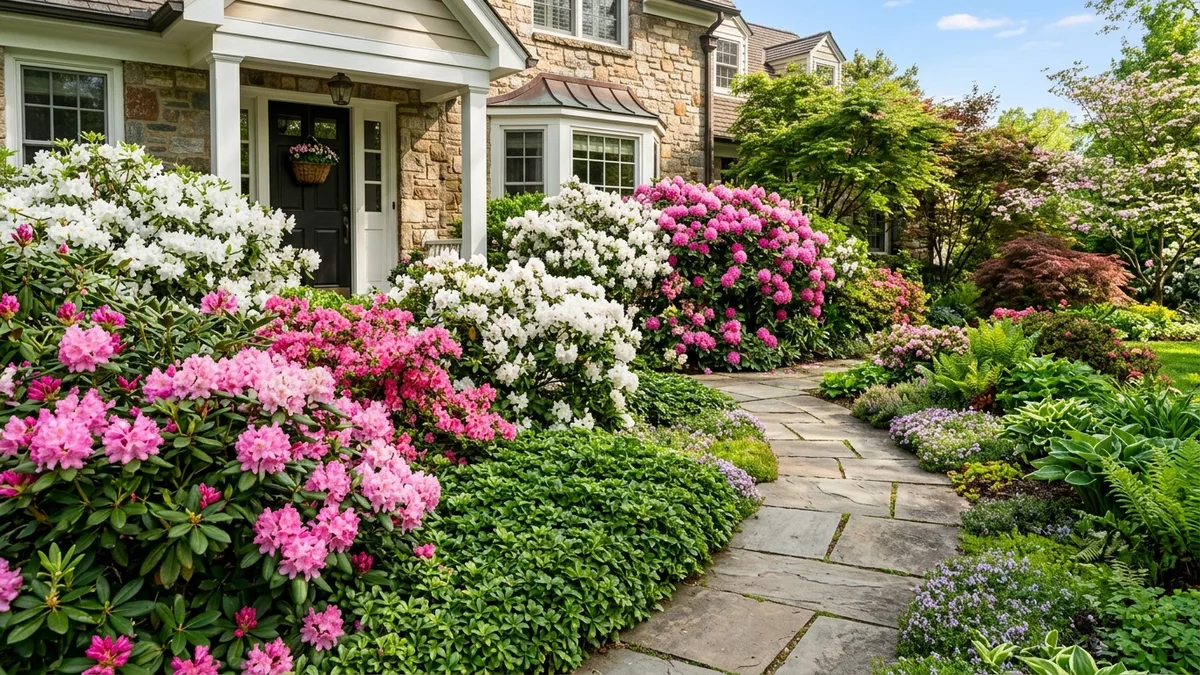
P.J.M. Rhododendron
Rhododendron 'P.J.M. Elite' (Zones 4–8)
One of the earliest foundation shrubs to flower. Erupts with electric lavender-pink blossoms before most deciduous trees leaf out. Tolerates bitter cold to -30°F.
Mountain Laurel 'Elf'
Kalmia latifolia 'Elf' (Zones 5–8)
Native understory shrub featuring intricate, geometric star-shaped buds opening into soft pink-and-white flower clusters. Requires cool, acidic soil.
Encore® Azalea 'Autumn Bonfire'
Rhododendron hybrid (Zones 6–9)
Unlike old-fashioned azaleas that bloom once for two weeks, Encore azaleas produce vivid red blooms in spring, scatter flowers in summer, and produce a heavy second flush in autumn.
Camellia Sasanqua 'Shishi Gashira'
Camellia sasanqua (Zones 7–9)
A marvel in southern and mid-Atlantic front yards. When every other shrub is barren, this compact camellia covers itself with radiant rose-pink blossoms from Halloween through Christmas.
Japanese Pieris 'Cavatine'
Pieris japonica (Zones 5–8)
Cascading panicles of lily-of-the-valley-like white bells drape across glossy evergreen foliage. New spring growth emerges in subtle copper-bronze tones.
Distylium 'Vintage Jade'
Distylium hybrid (Zones 7–9)
Subtle, intriguing petite ruby-red stamens line the horizontal stems in late January and February, providing cold-season color and feeding early emerging bees.
Disease Management
Boxwood Blight Realities & The Best Evergreen Alternatives
For three centuries, English and American boxwoods (Buxus sempervirens) served as the undisputed gold standard for formal foundation landscaping. Today, that legacy is under severe threat. Boxwood Blight (caused by the fungal pathogen Calonectria pseudonaviculata) causes rapid leaf spotting, dark black stem cankers, and catastrophic defoliation within weeks of warm, rainy summer weather.
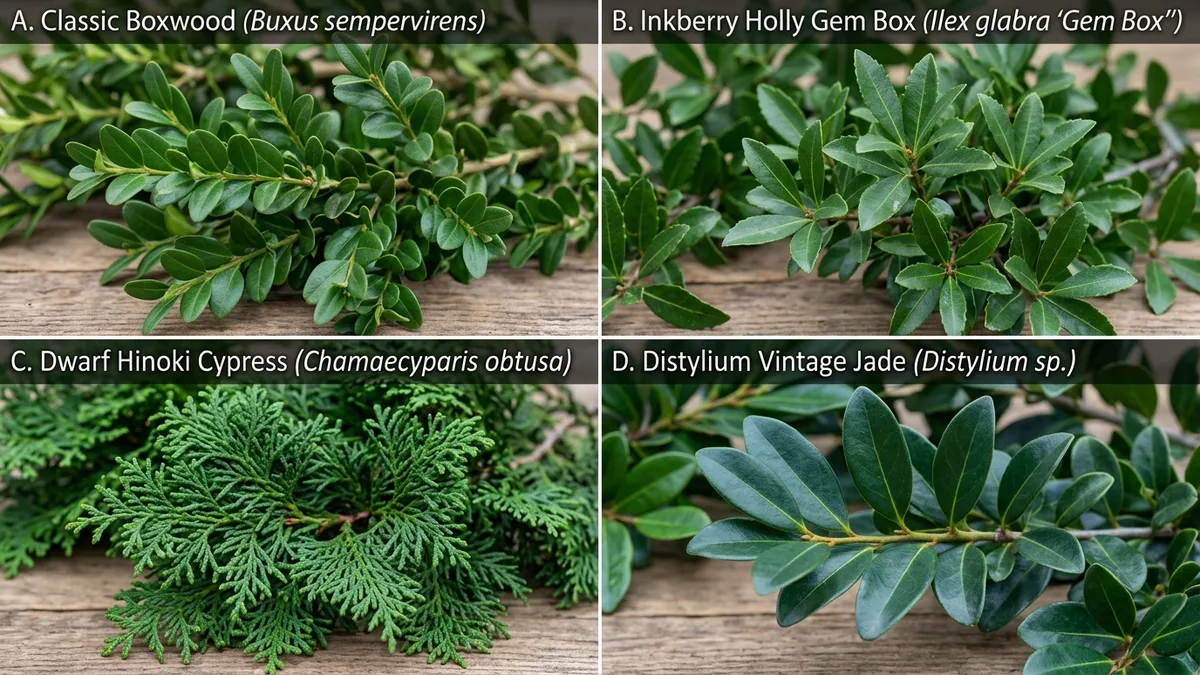
According to horticultural research from Penn State Extension and Virginia Cooperative Extension, once boxwood blight spores infest a property, they can persist on fallen leaf debris in the soil for years. There is currently no chemical cure for homeowner landscapes. If you are planting new foundation beds in areas with known blight pressure, horticultural specialists advise choosing non-host evergreen alternatives or heavily vetted blight-resistant cultivars.
Boxwood vs. The Best Evergreen Alternatives
Due to the spread of Boxwood Blight (Calonectria pseudonaviculata) across 30+ states, university extension services strongly recommend evaluating non-host evergreen alternatives for foundation beds.
Classic Boxwood High Disease Risk
Buxus sempervirens / Buxus microphylla
Inkberry Holly ('Gem Box' / 'Strongbox') Blight Immune
Ilex glabra
Japanese Holly ('Helleri' / 'Hoogendorn') Blight Immune
Ilex crenata
Dwarf Yaupon Holly ('Schillings Dwarf') Blight Immune
Ilex vomitoria
Distylium ('Vintage Jade' / 'Blue Cascade') Blight Immune
Distylium hybrid
Dwarf Hinoki Cypress ('Nana Gracilis') Blight Immune
Chamaecyparis obtusa
Anglo-Japanese Yew ('Densiformis') Blight Immune
Taxus × media
Structural Engineering
How Far Should Shrubs Be From the House? (Clearance Guidelines)
The phrase "foundation planting" is historically misleading: it does not mean shrubs should touch your foundation. Planting evergreens directly against siding traps moisture, provides highway bridges for carpenter ants and subterranean termites, causes wood siding and trim to rot, and makes painting or inspecting your home impossible.
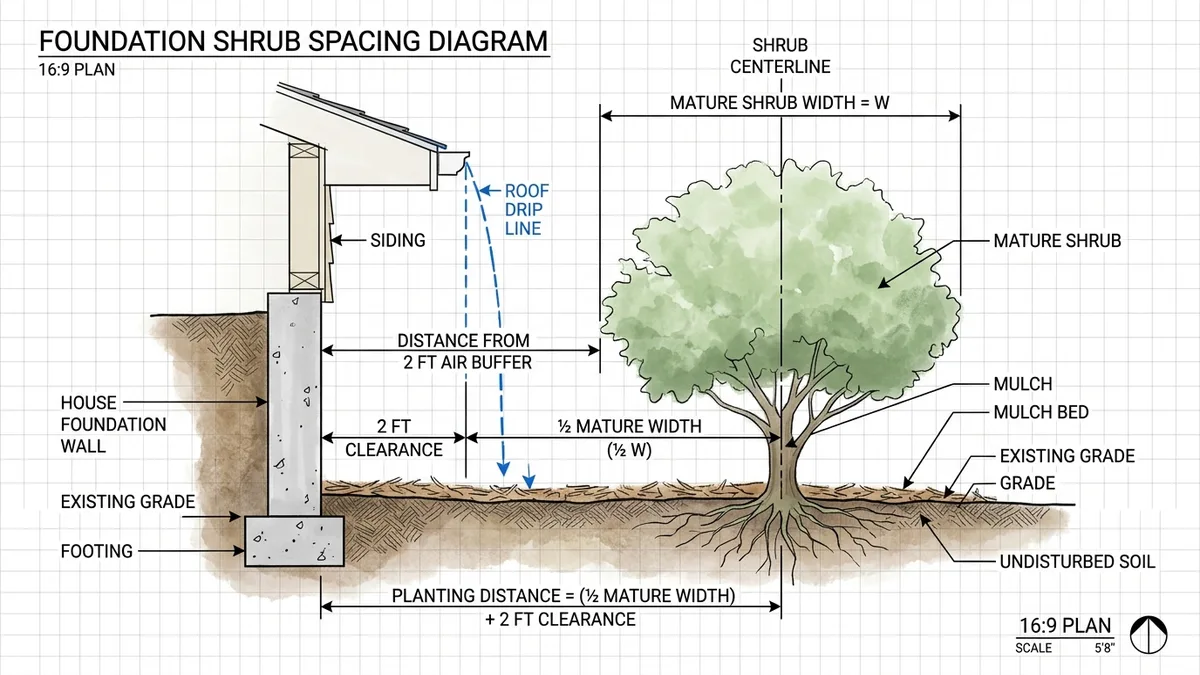
Foundation Shrub Clearance & Spacing Calculator
Calculate proper foundation wall distance, siding air buffer, and window sill clearance using UGA Cooperative Extension guidelines.
1. Enter Plant & Site Measurements
Distance from the concrete foundation or siding to the center of the root ball hole.
Cross-Section Architectural Elevation
Your planting distance of 3.5′ leaves an ample 1.5′ air buffer behind mature branches. This prevents moisture entrapment, mold, and pest bridges while allowing exterior painter access.
The shrub will mature right at the window sill line (0″ clearance). Expect light annual terminal tip pruning to prevent glass obstruction.
Exterior House Features You Must Keep Clear
Design for the mature landscape, not just the day of planting. Keep foliage clear of these essential utility and architectural elements:
Landscape Architecture
Front-of-House Foundation Design: Layering, Scale & Curb Appeal
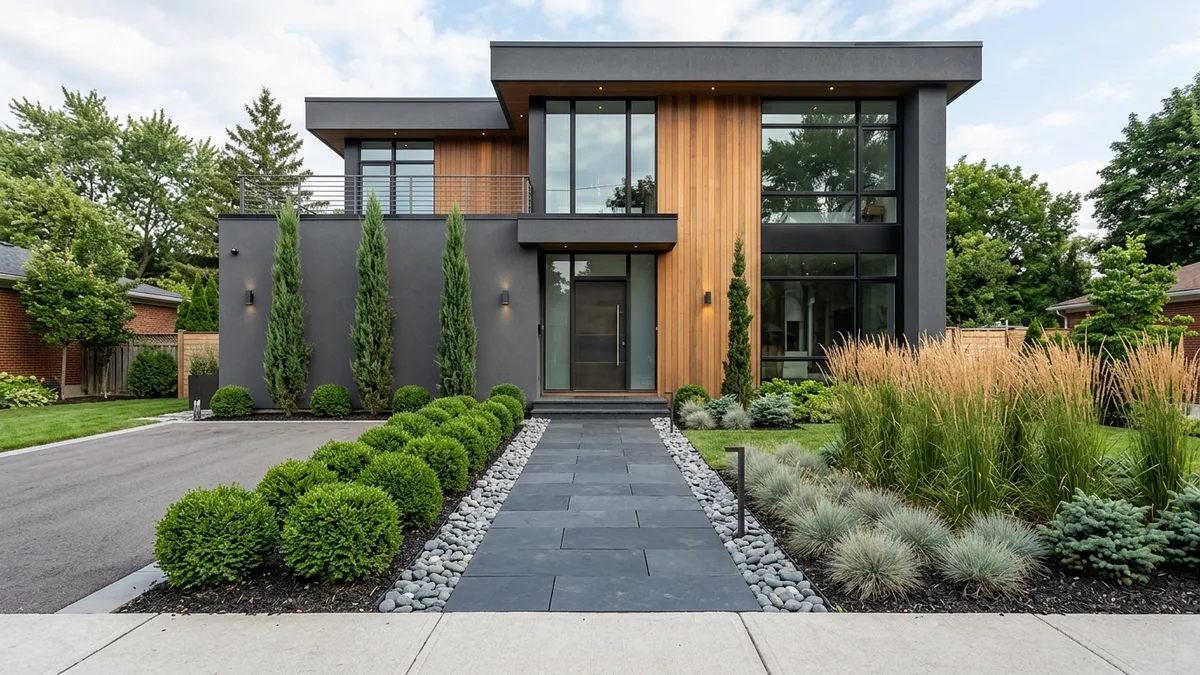
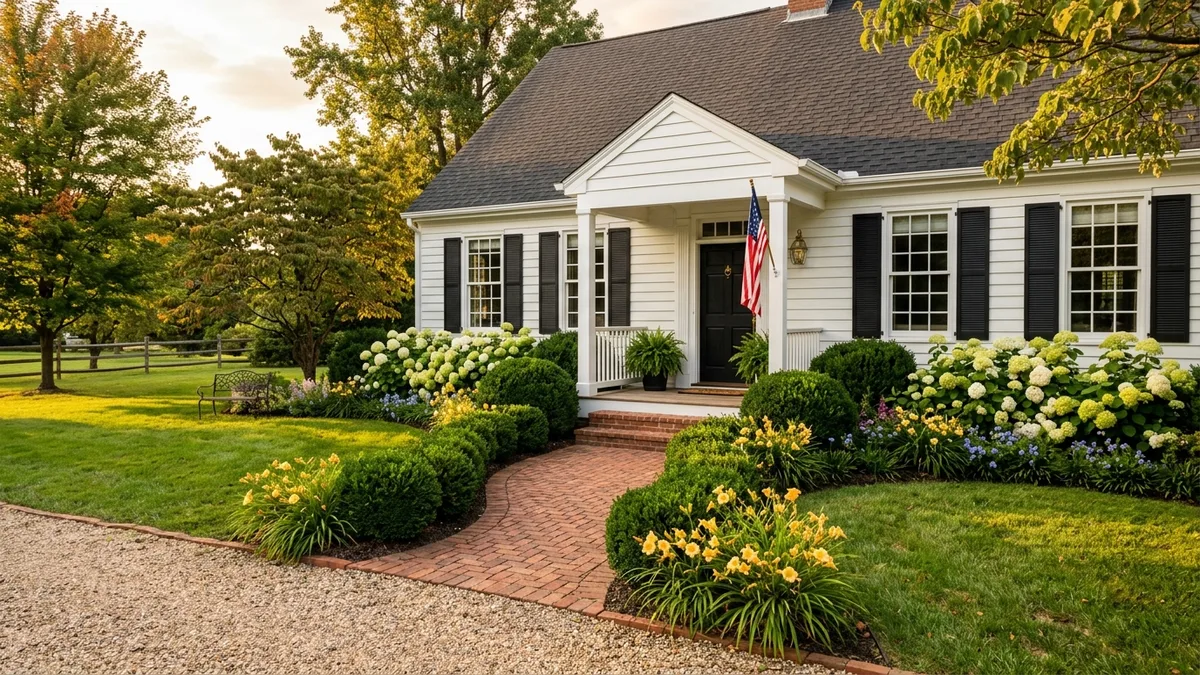
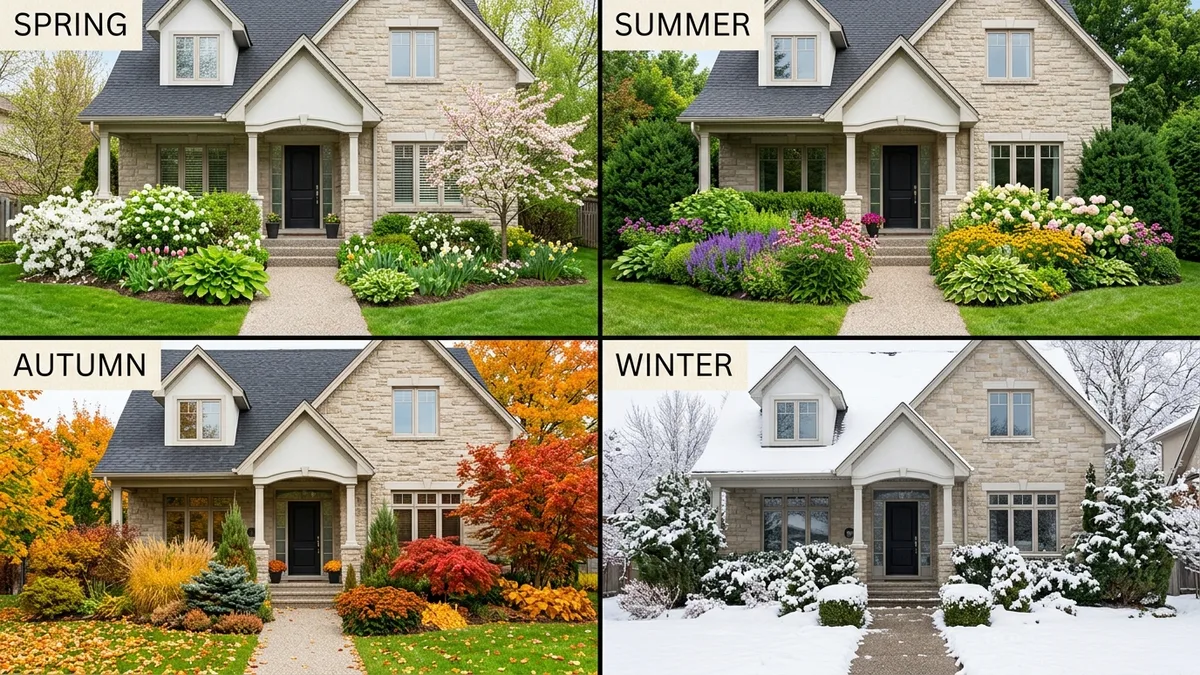
Great foundation landscaping is not a monoculture hedge. The most admired front yards in America balance evergreen structure with seasonal change, using a three-tier depth hierarchy:
Taller Background / Corners
6 to 14-foot upright evergreens placed at outer house corners, between blank two-story window walls, or flanking large porticos (e.g., Emerald Green Arborvitae, Hicks Yew).
Medium Under-Window Shrubs
2.5 to 4-foot compact evergreens and flowering broadleaf shrubs arranged in loose, repeated drifts under windows (e.g., Inkberry Holly 'Gem Box', Little Missy Boxwood).
Front Border & Perennials
Under-18-inch creeping evergreens (Blue Star Juniper), perennial flowers (catmint, coneflowers), and ornamental grasses softening the mulch edge along walkways.
Evergreen Shrub Recommendations by US Geographic Region
The United States contains vastly different winter minimums, summer heat, soil pH, and fungal disease pressures. Select your geographic region to review verified cultivars and site hazards.
Northeast & New England
Climate Profile: Cold sub-zero winters, heavy snow accumulation, freeze-thaw cycles, humid summers, and maritime coastal winds.
- •Inkberry Holly 'Gem Box' (2–3′ H × 2–3′ W, native)
- •Globe Arborvitae 'Tater Tot' (2–2.5′ H × 2–2.5′ W)
- •Dwarf Hinoki Cypress 'Nana Gracilis' (3–5′ H × 2–3′ W)
- •P.J.M. Rhododendron (3–4′ H × 3–4′ W, spring lavender blooms)
- •Emerald Green Arborvitae (12–14′ H × 3–4′ W)
- •Hicks Columnar Yew (10–12′ H × 3–4′ W)
- •Dwarf Alberta Spruce (6–8′ H × 3–4′ W)
Naturally acidic, glaciated rocky or sandy loams (pH 5.2–6.5). Excellent moisture retention in spring; requires good winter drainage.
- Winter desiccation & needle burn from harsh southwest sun reflecting off snow onto frozen soil.
- Heavy snow sliding off steep rooflines, splitting arborvitae and boxwood branches.
- Road and driveway salt spray damaging outer foliage.
UMass Extension recommends soaking evergreen root zones thoroughly in late October prior to soil freeze, and shielding south-facing broadleaf evergreens with burlap wind screens.
Landscape Pitfalls
12 Costly Foundation Planting Mistakes to Avoid
Buying a shrub because it is currently small. An unlabelled "Pine" or "Arborvitae" in a 2-gallon pot might reach 30 feet in height. Always verify the registered cultivar tag.
Placing shrubs directly where un-guttered rainwater streams off roof shingles. Concentrated torrents and winter ice sheets split evergreen branch unions and erode root crowns.
If rainwater pools near your foundation, do not attempt to soak it up with shrubs. Plants cannot replace proper grading, downspout extensions, or French drains. Fix drainage first.
Piling mulch high against the base of shrub stems causes crown rot, suffocates the root flare, and attracts tunneling rodents that girdle bark in winter. Keep mulch 3 inches away from stems.
Buying one of every single shrub species at the garden center. A cohesive front landscape repeats a limited palette of 3 to 5 complementary evergreen varieties in unified drifts.
Many popular azalea species (including deciduous native azaleas and Exbury hybrids) drop 100% of their foliage in autumn, leaving bare twigs. Verify the exact cultivar is broadleaf evergreen.
Most hollies are dioecious (separate male and female plants). A female holly (like 'Blue Princess') requires a compatible male pollinator (like 'Blue Prince') nearby to produce red winter berries.
In wildfire-prone Western regions, California Public Resources Code § 4291 mandates Zone 0 (0 to 5 feet from structures) as a non-combustible ember-resistant zone. Resinous junipers next to siding are severe fire hazards.
Many outdated nursery listicles recommend Wintercreeper (Euonymus fortunei), Japanese Barberry, or Privet. These species escape into native woodlands and are legally prohibited in many states.
No plant is completely deer-proof. During severe winters with deep snow, starving deer will browse plants they normally avoid, including boxwoods and junipers. Choose "less preferred" varieties.
Anglo-Japanese Yews (Taxus) contain taxines that are lethal to dogs and horses if chewed. Mountain laurel and Pieris are also toxic. If you have puppies that chew shrubbery, choose non-toxic evergreens.
After a harsh winter, evergreens may display brown winter-burned foliage. Do not prune prematurely in March; dormant buds inside the stems are often still alive and will push fresh green needles by May.
Answers
Frequently Asked Questions About Foundation Evergreen Shrubs
01What is the best evergreen shrub for the front of a house?
There is no single universal evergreen shrub for every American home because winter lows, summer heat, humidity, and soil chemistry vary widely. However, the best foundation evergreens are cultivars whose mature height naturally stays below window sills and whose mature width leaves a two-foot air buffer from the siding. In northern and eastern states, compact Inkberry Holly ('Gem Box') and Dwarf Hinoki Cypress ('Nana Gracilis') excel; in the transition zone, blight-resistant boxwoods ('Little Missy') and Anglo-Japanese yews ('Densiformis') dominate; in the hot South, Distylium ('Vintage Jade') and Dwarf Yaupon Holly thrive; and in the West, Dwarf Mugo Pine, Blue Star Juniper, and native Manzanitas provide water-wise structure.
02What evergreen shrubs stay small under windows?
Top cultivars that naturally mature between 2 and 3.5 feet without aggressive pruning include: Inkberry Holly 'Gem Box' (2–3′ H × 2–3′ W), Little Missy Boxwood (2.5′ H × 3.5′ W), Globe Arborvitae 'Tater Tot' (2–2.5′ H × 2–2.5′ W), Dwarf Mugo Pine 'Slowmound' (2–3′ H × 3–4′ W), Distylium 'Vintage Jade' (2–3′ H × 3–4′ W), Bird's Nest Spruce (2–3′ H × 4–5′ W), and Japanese Pieris 'Cavatine' (2–3′ H × 2.5–3′ W). Always measure your ground-to-sill height first.
03How far should evergreen shrubs be planted from the house foundation?
Follow the University of Georgia (UGA) Cooperative Extension rule of thumb: calculate half of the shrub's anticipated mature spread, then add 1.5 to 2.0 feet of maintenance buffer. For example, for a shrub that matures 4 feet wide, the radius is 2 feet; adding a 1.5-foot buffer means the planting center hole must be dug at least 3.5 feet out from the foundation wall. This prevents root competition, allows air circulation to protect siding from mold, and preserves physical access for exterior painting and window washing.
04Are boxwoods still a good choice for front foundation beds?
Boxwoods remain popular for formal structure, but homeowners must exercise caution due to Boxwood Blight (Calonectria pseudonaviculata), a devastating fungal disease now present across more than 30 US states. If planting boxwood, select proven blight-tolerant cultivars such as 'Little Missy' or the Better Boxwood® series ('Skylight™', 'Babylon Beauty™'). In high-humidity areas, university extension programs recommend replacing boxwood with immune alternatives like compact Inkberry Holly, Japanese Holly, or Distylium.
05What evergreen shrubs grow well in the shade on the north side of a house?
For north-facing foundations and shaded entries receiving less than 3 to 4 hours of direct sun, the finest evergreen choices are Anglo-Japanese Yew (Taxus × media 'Densiformis'), Mountain Laurel (Kalmia latifolia 'Elf'), Japanese Pieris (Pieris japonica 'Cavatine'), Camellia sasanqua (in Zones 7–9), and native Inkberry Holly. Ensure the soil is rich in organic matter and drains freely, as shaded foundation soil dries out much slower than sunny beds.
06Which evergreen shrubs produce colorful flowers?
Broadleaf flowering evergreens provide both four-season structural foliage and seasonal floral displays. Premier cultivars include: P.J.M. Rhododendron (early spring lavender blooms, Zones 4–8), Mountain Laurel 'Elf' (intricate late-spring pink-and-white geometric blossoms, Zones 5–8), Encore® Azaleas like 'Autumn Bonfire' (reblooming in spring, summer, and autumn, Zones 6–9), Japanese Pieris 'Cavatine' (cascading white bell clusters in March/April, Zones 5–8), and Camellia sasanqua 'Shishi Gashira' (radiant rose-pink blooms from October to December, Zones 7–9).
Explore flowering habitat shrubs in our national pollinator guide →
07Do evergreen shrubs stay bright green all winter?
Not necessarily. 'Evergreen' botanically means the plant retains its living foliage through multiple growing seasons; it does not guarantee that the color remains static emerald green. Many evergreens undergo seasonal chromatic shifts as an evolutionary defense against winter cold and sun scorch: P.J.M. Rhododendrons turn a deep lustrous mahogany-bronze, Russian Cypress (Microbiota) turns copper-purple, and certain junipers take on plum tones. This winter color change is completely natural and does not indicate plant death.
08What should I plant at the corners of my house?
House corners require taller, upright evergreen specimens to soften the sharp vertical lines of the architecture and ground the structure visually. Excellent corner anchors include: Emerald Green Arborvitae (Thuja occidentalis 'Smaragd', 12–14′ H × 3–4′ W), Hicks Columnar Yew (Taxus × media 'Hicksii', 10–12′ H × 3–4′ W), Japanese Holly 'Sky Pencil' (6–8′ H × 1.5–2′ W), and Dwarf Alberta Spruce (6–8′ H × 3–4′ W). Always place corner shrubs far enough out to clear roof gutters and overhead soffits.
Compare small ornamental trees for architectural corner anchoring →
09Can I use foundation shrubs to hide standing water or poor drainage?
Never use foundation plantings to mask an unresolved drainage problem. While water-tolerant evergreens like Inkberry Holly survive wet soils, planting shrubs against a foundation where roof runoff pools will saturate the soil against basement walls, elevate crawlspace humidity, and rot foundation masonry. Always address grading, downspout extensions, or French drains before designing your foundation planting beds.
Read our comprehensive guide to residential yard drainage solutions →
10What evergreen shrubs are truly low maintenance?
True low maintenance is achieved through proper genetic sizing, not a miracle species. A shrub whose mature spread and height naturally fit your bed requires zero annual shearing. Standouts that maintain tidy, dense habits with virtually no pruning include: Globe Arborvitae 'Tater Tot', Dwarf Mugo Pine 'Slowmound', Distylium 'Vintage Jade', Dwarf Yaupon Holly 'Schillings Dwarf', and Little Missy Boxwood. Conversely, planting an 8-foot shrub under a 3-foot window creates a permanent, high-maintenance pruning battle.
Planning Foundation Landscaping in Peabody, MA?
The plant selections and architectural spacing principles detailed above apply nationwide across the United States. For homeowners located in Peabody, Danvers, Salem, Beverly, and the Massachusetts North Shore (USDA Zone 6b), specific local site factors must be accounted for: glacial rocky subsoils, coastal winter salt winds off Massachusetts Bay, and intense snow drifting off roof eaves.
In Massachusetts, native Inkberry Holly ('Gem Box'), compact Mountain Laurel ('Elf'), Dwarf Hinoki Cypress, and P.J.M. Rhododendrons thrive exceptionally well when planted with adequate air clearance. If you are exploring regional native plantings for pollinators and coastal resilience, review our state guide to Massachusetts Native Plants.
If your front yard requires a comprehensive site redesign—including regrading, stone walkways, granite step masonry, and foundation plant installation—LandscapingPeabodyMA.com connects local property owners with independent, qualified landscaping specialists across Essex County.
Related Guides & Landscape Planning Resources
Transform Your Home's Curb Appeal With Right-Sized Foundation Landscaping
Connect with local Massachusetts landscape design professionals to plan foundation plantings, stone walkways, and four-season outdoor spaces.
Get connected with an independent local landscaping professional. Calls go to (877) 537-6896.