Yard Drainage Solutions
A comprehensive homeowner guide to diagnosing residential water problems, comparing drainage methods, and choosing the right solution for standing water, soggy lawns, and heavy runoff.
The right yard drainage solution depends on where the water originates, whether it sits on the surface or saturates the soil root zone, how your property is graded, how quickly the soil absorbs water, and where the water can legally and safely discharge. A homeowner seeing water in a yard does not automatically need a French drain; diagnosing the root mechanism first ensures you invest in the right intervention.
Quick Yard Drainage Decision Guide
Common starting points — actual site conditions determine the final solution.| Problem You See | Likely Mechanism | Primary Solutions to Investigate |
|---|---|---|
| Standing water pooled in one low lawn spot | Surface depression / localized grade bowl | Regrading, topsoil filling, catch basin, or shallow rain garden |
| Whole lawn stays squishy & soggy for days | Subsurface saturation / soil compaction | Core aeration + compost, perc test, or French drain |
| Gutter downspout creates a torrent near the house | Concentrated roof runoff point source | Downspout extension, buried smooth pipe, rain garden, or dry well |
| Water sheets across lawn from uphill neighbor | Overland sheet runoff across slope | Vegetated swale, dry creek bed, or interception berm |
| Water collects at edge of patio or driveway | Impervious hardscape shedding runoff | Linear channel drain, permeable paver border, or gravel drip strip |
| Water pooling directly against foundation wall | Negative grade toward structure | High-priority site grading & structural foundation evaluation |
Interactive Decision Tree
Step-by-Step Drainage Diagnostic Flowchart
Use this interactive decision tool to evaluate your property's specific symptoms, water movement patterns, and discharge options:
Residential Drainage Decision Framework
Diagnose the exact water behavior on your property before selecting a drainage intervention.
“Visible puddle in a localized lawn hollow that stays 24–48 hours after rain”
When water is purely pooled on the surface in a bowl-shaped low point, the issue is topographical geometry. Light surface regrading or filling with sandy loam eliminates the hollow. If the area is bounded and cannot be regraded, a surface catch basin tied to a buried smooth pipe moves the volume downhill.
Core Diagnostic Framework
What Causes Poor Yard Drainage? The 4 Critical Questions
Before purchasing pipes, renting mini-excavators, or ordering tons of drainage stone, every homeowner should evaluate their property through four fundamental diagnostic questions. Jumping straight to an expensive installation without answering these questions often results in a drain that moves water to the wrong place—or fails to capture it at all.
1. Where is the water coming from?
Water does not appear randomly. Is it falling directly onto the lawn as rain? Is a gutter downspout dumping 800 gallons of roof runoff into a 10-foot area? Is it sheeting across an asphalt driveway, cascading downhill from an adjacent property, or leaking from a broken subsurface sprinkler line? Identifying the water source is the first rule of stormwater management.
2. Is the problem surface ponding or subsurface saturation?
Surface ponding is water you can see sitting in a puddle. Subsurface saturation is squishy, waterlogged soil where no standing puddle exists, but soil pores stay choked with water. A surface puddle requires topographical reshaping or a surface inlet; subsurface saturation requires soil decompaction, percolation testing, or a gravel-wrapped French drain.
3. Where can the water legally and safely go?
Water must follow gravity to an approved outlet. Do you have a downhill slope leading to a safe "daylight" exit on your property? Can you direct it to a bioretention rain garden? If your property is completely flat or bowl-shaped with no natural outlet, you must evaluate deep soil percolation for an infiltration system like a dry well.
4. Why is it not getting there naturally right now?
Is there a physical hump or raised landscape bed blocking the natural flow path? Is subsoil heavily compacted by construction equipment? Is the soil heavy, unyielding clay that absorbs water at less than 0.1 inches per hour? Understanding the barrier reveals the fix.
Surface Ponding vs. Subsurface Saturation
Water behaves fundamentally differently above and below the soil surface. Selecting a drainage system requires identifying where the water is trapped.
Visible Standing Water / Low Spots
Water collects in a topographical depression or bowl on top of the turf because the surrounding grade is higher than the hollow.
- Surface regrading or filling depression with loam
- Surface catch basin connected to smooth discharge pipe
- Shallow vegetated swale to direct flow away
Soggy, Squishy Turf / High Water Table
No visible puddle on top, but soil pore spaces remain completely filled with water. Walking across the turf feels like walking on a saturated sponge.
- Mechanical core aeration to relieve soil compaction
- Organic compost topdressing to rebuild soil pore structure
- Perforated French drain to lower perched water tables
Targeted Problem Guide
How to Fix Standing Water in Your Yard
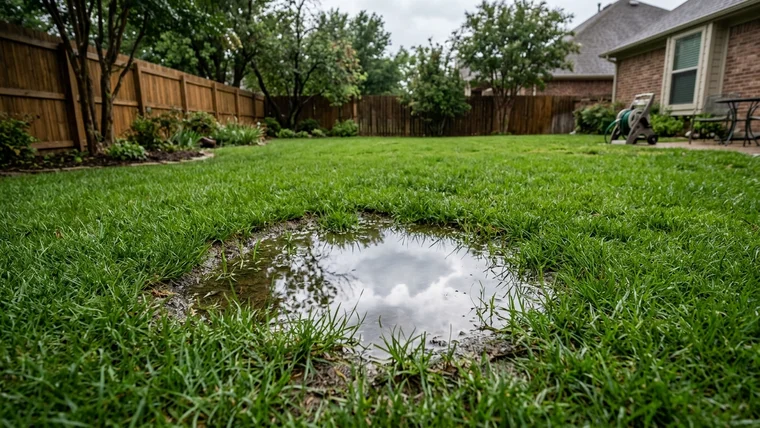
Standing water in a yard is a symptom, not a diagnosis. To fix standing water, first correct upstream sources like downspouts and irrigation leaks. For minor depressions, regrade or topdress with sandy loam. For larger low points where regrading is constrained, install a surface catch basin or plant a shallow rain garden. Do not automatically install a French drain for surface puddles without verifying subsurface percolation.
Common Causes of Standing Water
Standing water that persists for more than 24 to 48 hours after rain indicates that water is arriving faster than it can infiltrate or run off. The most frequent causes include:
- Settled Lawn Hollows: Over years, decomposing tree roots, buried organic matter, or settled utility trenches create subtle depressions that trap water.
- Concentrated Gutter Dumps: Roof valleys and high-capacity gutters channeling hundreds of gallons into a single corner without positive slope away from the house.
- Surface Compaction: Heavy mower traffic or clay subsoils forming an impermeable crust that blocks water from reaching underlying aquifers.
- Perched Water Tables: A thin layer of topsoil resting on top of dense, unyielding marine clay or hardpan ledge that prevents downward percolation.
Decision-Oriented Steps to Fix It
- Observe During Rain: Walk outside during a downpour with an umbrella. Note exactly where water enters the low spot and where the highest surrounding ground is.
- Extend Downspouts: Ensure all gutter downspouts discharge at least 10 feet away from the low spot and grade away from your home.
- Level Minor Dips: If the puddle is less than 2 to 3 inches deep, topdress the depression over several seasons with a 50/50 mix of coarse sand and loam, raising the grade without smothering existing turf.
- Install a Catch Basin: If the low point is bounded by patios or fences, set a 12-inch catch basin with an atrium grate at the lowest point, connecting it to a buried, smooth-walled PVC pipe that slopes to a lower daylight exit.
- Consider a Rain Garden: If you have no downhill outlet, excavate the low spot into a shallow, concave bioretention garden filled with compost-amended soil and deep-rooted native plants.
System Mechanics
How to Drain Water From a Yard: The 4-Step Movement Model
Effective residential stormwater management relies on an engineered sequence of four functional stages. Never build a drainage system without establishing all four components:
Control Source
Minimize excess volume. Repair sprinkler leaks, clean gutters, and install rain barrels or downspout diverters.
Collect
Capture runoff where it gathers using catch basins, channel drains, gravel trenches, or landscaped swales.
Move (Convey)
Transport water by gravity along smooth PVC pipes, sloped gravel trenches, or vegetated open swales.
Infiltrate / Discharge
Release water safely into daylight pop-ups, bioretention rain gardens, or authorized infiltration dry wells.
Solutions Evaluation
Yard Drainage Solutions Compared by Function
There is no single "best" drainage system. The best solution is the one matched specifically to your water mechanism, landscape aesthetics, and soil type:
| Solution | Primary Function | Best-Matched Problem | Surface / Subsurface | Requires Gravity Outlet? | Depends on Soil Perc? | Main Limitation |
|---|---|---|---|---|---|---|
| Regrading | Reshaping surface slope | Low spots, negative pitch toward home | Surface | Yes | No | Limited by existing property line elevations |
| Vegetated Swale | Conveying sheet runoff | Water crossing property from uphill | Surface | Yes | Partial | Requires space and continuous downhill pitch |
| Catch Basin | Point-source surface intake | Deep low spots, localized ponding | Surface | Yes | No | Grates can clog with autumn leaves; requires pipe |
| Channel Drain | Linear surface capture | Patio edges, driveway sheet flow | Surface | Yes | No | Must be set flush into hardscape during installation |
| French Drain | Subsurface interception | Chronic soggy lawn, lateral seepage | Subsurface | Yes | No | Does not collect surface puddles without open stone |
| Dry Well | Storage & infiltration | Runoff on flat yards with no outlet | Subsurface | No (Infiltrates) | Critical Yes | Fails in clay/bedrock; EPA Class V rules apply |
| Rain Garden | Bioretention & filtering | Roof downspout and driveway runoff | Both | No (Infiltrates) | Yes | Must drain within 24–48 hours to prevent mosquitoes |
| Downspout Piping | Source runoff diversion | Foundation water pooling from roof | Source | Yes | No | Must use solid smooth pipe, never perforated near home |
| Permeable Pavers | Porous runoff reduction | Hardscape ponding, patio runoff | Both | Optional | Yes | Requires open-graded aggregate base; higher upfront cost |
System Comparison
French Drain vs. Dry Well: Understanding the Core Difference
A French drain and a dry well perform opposite hydraulic functions. A French drain collects and conveys water downhill through a sloped, perforated pipe wrapped in gravel; it requires a safe downhill outlet. A dry well is an underground holding chamber that stores runoff and allows it to percolate into surrounding permeable soil; it requires no outlet, but depends entirely on deep soil permeability.
French Drain vs. Dry Well: Functional Comparison
A French drain moves water from point A to point B. A dry well stores water at point B so it can soak into deep soil.
Linear Perforated Trench
Primary Job: Intercepts groundwater migrating through saturated soil and channels it downhill.
Critical Requirement: Must have an outlet. Requires a downhill destination (daylight exit, storm swale, or dry well) to discharge water.
Common Misconception: French drains do not magically absorb surface standing water unless designed with open surface grates or rock-to-the-surface trenches.
Subsurface Infiltration Chamber
Primary Job: Acts as an underground holding basin that stores sudden runoff volumes and allows them to slowly soak into surrounding subsoil.
Critical Requirement: Requires permeable, well-draining subsoil. Fails completely in shallow bedrock, dense hardpan clay, or high groundwater.
EPA Class V Notice: Subsurface stormwater drainage wells may be regulated under federal and state Underground Injection Control (UIC) rules.
When choosing between the two systems, ask a simple topographical question: Do you have a lower point on your property where water can exit by gravity?
- If you have a downhill slope with an approved exit: A French drain or buried solid pipe is virtually always more reliable, because gravity moves water away without relying on unpredictable soil absorption.
- If your yard is flat, landlocked, or bowl-shaped: A dry well or bioretention rain garden may be your only gravity-based choice, provided a percolation test proves your subsoil can absorb the volume.
Turfgrass Agronomy
Why Is My Lawn Always Soggy? Fixing Saturated Turf
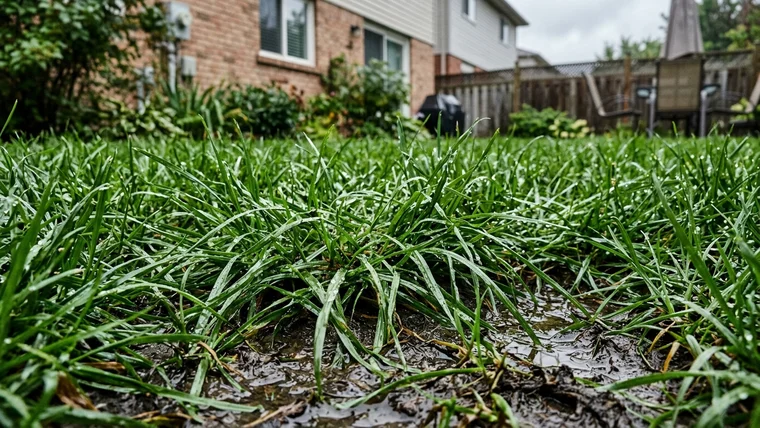
A chronically wet, spongy lawn that squishes underfoot is one of the most frustrating problems for homeowners. It turns mowing into a muddy rutting nightmare and causes turfgrass roots to suffocate and rot.
University Extension Agronomic Guidelines
Horticultural research from the University of Maryland Extension and other university turf laboratories highlights that poor drainage and soil compaction are primary drivers of lawn decline. When addressing a soggy lawn:
- Never Add Sand to Clay Soil: A widespread DIY myth suggests spreading play sand or masonry sand across heavy clay lawns to "improve drainage." Agronomists warn that mixing sand into clay without incorporating massive amounts of organic compost creates a soil texture akin to low-grade concrete, making compaction and drainage significantly worse.
- Stay Off Wet Turf: Walking, playing, or running heavy zero-turn mowers across saturated soil crushes remaining soil macro-pores, exacerbating soil compaction.
- Perform Mechanical Core Aeration: Use a hollow-tine core aerator in spring or early fall to extract 2- to 3-inch plugs of compacted soil, opening vertical channels for air and water.
- Topdress with Quality Organic Compost: Rake a 1/4-inch layer of screened compost into the aeration holes. As microbes break down the organic matter, they build crumbly, granular soil structure that naturally drains excess water.
Outdoor Living Spaces
Backyard Drainage Solutions for Patios, Lawns & Slopes
Backyards often present complex drainage challenges because they combine multiple surfaces: open turf, paved dining patios, fence lines, and sloped garden beds:
Key Backyard Drainage Strategies
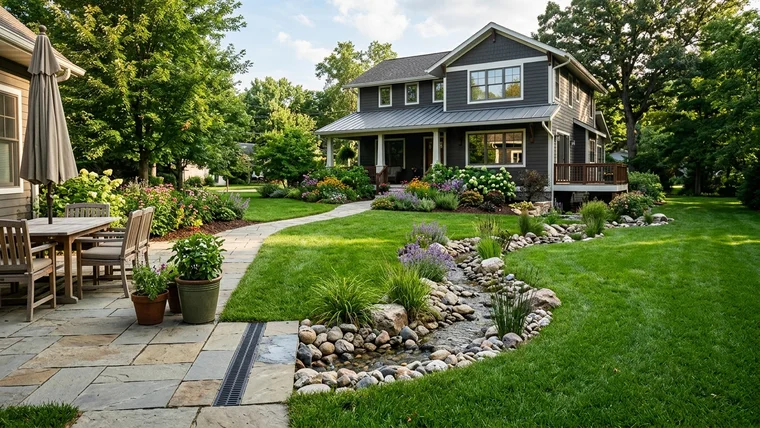
- Patio & Walkway Runoff: Patios shed 100% of rainwater. Always install paver patios with a 1/8″ to 1/4″ per foot pitch sloping away from the house. If a patio slopes toward a lawn border, install a linear channel drain or a 6-inch crushed stone drip trench to capture water before it creates a muddy trench along the pavers. Use our gravel calculator to estimate crushed aggregate volume.
- Fence Line Runoff: Water frequently pools along property fences because fence posts and grade variations create mini-dams. Cutting a shallow, 4-foot-wide grass swale along the fence line provides a clear, natural flume for runoff to escape toward the street or swale easement.
- Retaining Wall Footings: Saturated soil behind retaining walls creates immense hydrostatic pressure. Never build a retaining wall without 12 inches of clean washed drainage stone and perforated pipe behind the blocks.
Curb Appeal & Landscape Design
Front Yard Drainage Ideas: Functional Design with Curb Appeal
In front yards, drainage solutions must perform double duty: they must solve water runoff while enhancing the architectural beauty and curb appeal of the home.
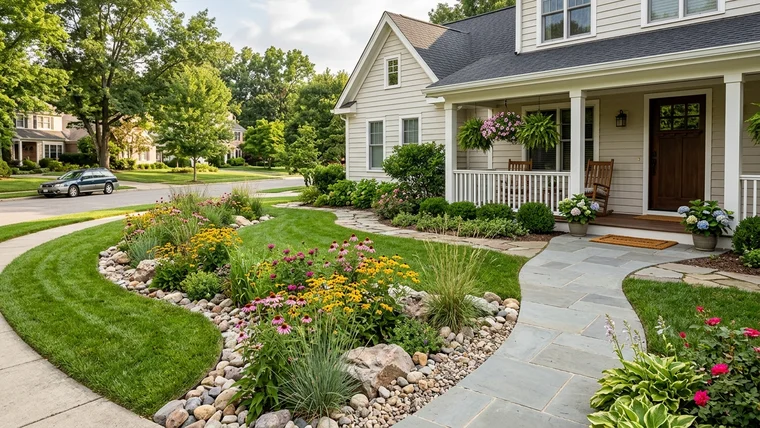
Architectural Front Yard Drainage Upgrades
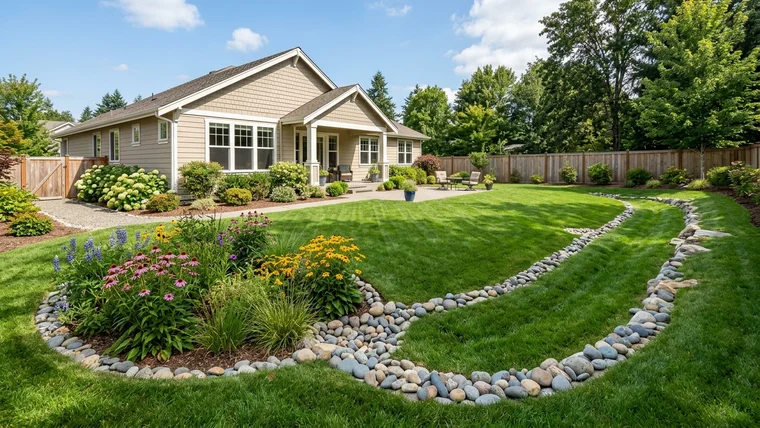
- Landscaped Dry Creek Beds: Instead of burying ugly corrugated plastic pipes across a front lawn, excavate a meandering 3-foot-wide shallow swale lined with non-woven geotextile, rounded New England river rock, and smooth granite boulders. It looks like a natural streambed during dry summer days and functions as an overflow flume during spring rains.
- Bioretention Rain Gardens: A shallow (6- to 8-inch deep) depression planted with native water-tolerant perennials like Blue Flag Iris, Coneflowers, Joe-Pye Weed, and Switchgrass filters roof stormwater and recharges local groundwater while adding vibrant seasonal color.
- Discreet Downspout Concealment: Transition exposed gutter downspouts into rigid, buried PVC lines that run beneath front walkways and terminate at spring-loaded pop-up relief emitters set flush in the turf.
- Permeable Front Walkways: Replace solid concrete walkways with permeable concrete pavers or open-jointed bluestone set on crushed aggregate bedding, allowing rain to filter directly into the ground rather than sheeting across the lawn.
Safety & Legal Compliance
Critical Safety Boundaries & Complex Site Conditions
While simple low-spot leveling and downspout extensions are within the realm of skilled DIY homeowners, several drainage conditions involve serious structural, legal, and safety risks that require professional engineering or licensed contractor evaluation:
Foundation Walls & Basements
Water collecting against foundation footings, basement windows, or crawlspaces creates hydrostatic pressure that cracks concrete and causes interior flooding. Never attempt a quick surface DIY fix for foundation seepage; obtain a dedicated foundation waterproofing inspection.
Retaining Wall Movement
If a retaining wall is bulging, leaning, or weeping water through face joints, water pressure behind the wall is actively undermining its structural integrity. Seek an assessment from a qualified retaining wall contractor.
Call 811 Before Any Digging
Gas lines, electrical feeds, buried fiber optics, and water mains often run just 8 to 18 inches below residential lawns. Always call 811 (free nationwide utility locate) several business days prior to trenching.
Legality of Stormwater Discharge
Under civil stormwater laws across all 50 states, homeowners are legally prohibited from discharging concentrated stormwater onto adjacent private property, public sidewalks, or public roadways without official authorization.
Budgeting & Planning
Yard Drainage Cost Categories & Key Cost Drivers
Drainage project investments vary based on soil type, trench depth, equipment access, and system complexity. Here is how relative cost tiers compare:
Downspout Extensions, Minor Regrading & Core Aeration
Simple surface adjustments, clearing gutters, spreading topsoil in shallow hollows, and renting a mechanical core aerator.
Buried Downspout Pipes, Catch Basins & Rain Gardens
Excavating 50–100 feet of rigid PVC piping, installing catch basins with pop-up emitters, or planting a 100-sq-ft landscaped rain garden.
Full French Drain Systems, Dry Wells & Heavy Machine Grading
Extensive trenching with mini-excavators, multiple tons of washed aggregate, geotextile wrap, deep dry well chambers, and lawn restoration.
Avoid Costly Pitfalls
8 Common Yard Drainage Mistakes Homeowners Make
Installing a French drain for a surface puddle
French drains collect water below ground. If you have an above-ground low spot, water will sheet right past the buried pipe.
Digging a trench with no outlet destination
Piping water to the end of a trench without a lower daylight exit creates an underground water trough that backs up during heavy storms.
Using perforated pipe for roof downspouts
Connecting downspouts to perforated pipe dumps hundreds of gallons directly into your foundation soil. Always use solid, smooth PVC pipe.
Mixing sand into heavy clay soil
Adding sand to clay creates a dense, brick-like material. Use mechanical core aeration and organic compost to open soil pores.
Discharging water onto neighboring property
Directing concentrated runoff across property borders violates civil drainage laws and invites municipal citations and neighbor disputes.
Skipping non-woven geotextile fabric
Failing to wrap drainage gravel in non-woven geotextile fabric allows fine subsoil silts to clog gravel voids within a couple of seasons.
Trenching without calling 811
Striking an unmarked gas line, buried electrical wire, or fiber conduit creates severe safety hazards and expensive repair liabilities.
Ignoring automatic irrigation schedules
Many "drainage emergencies" are simply broken sprinkler heads or irrigation zones watering three times longer than necessary.
Expert Knowledge
Frequently Asked Questions About Yard Drainage
Answers
Frequently asked questions
01How do I fix drainage in my yard?
Fixing yard drainage requires a diagnose-first approach: identify the source of excess water (roof runoff, surface sheet flow, irrigation, or high groundwater), determine whether it is surface ponding or subsurface soil saturation, and confirm a safe downhill discharge route. Minor surface low spots are corrected with regrading or catch basins; roof runoff is directed via downspout extensions or rain gardens; and chronically waterlogged soil with lateral seepage is managed with a sloped, gravel-wrapped French drain.
02How do I get rid of standing water in my yard?
Standing water is a symptom of poor surface topography, compacted soil, or concentrated runoff. If water pools in an isolated hollow, regrading the depression or installing a surface catch basin tied to smooth solid pipe routes the water downhill. If water pools because of gutter discharge, extend downspouts at least 10 feet away. If the soil beneath the puddle is hardpacked, mechanical core aeration and organic compost topdressing help re-establish natural percolation.
03Will a French drain fix standing water?
Not always. A traditional French drain is a subsurface interception trench designed to collect groundwater moving through saturated soil and convey it downhill. If your problem is an above-ground puddle in a surface depression with dense clay soil, water may sheet right over a grassed French drain without entering it. Surface ponding is often better resolved with surface regrading, swales, or catch basins with open grates.
04What is better, a French drain or a dry well?
Neither is universally 'better' because they perform different functions. A French drain collects and moves water from one location to another; it requires a safe downhill outlet to discharge. A dry well is an underground holding chamber that stores runoff and allows it to percolate into surrounding deep soil; it requires permeable, sandy or loamy soil. In many residential systems, a French drain or downspout line actually empties into a dry well if no surface daylight exit exists.
05What causes a soggy lawn?
A chronically soggy or spongy lawn occurs when soil pore spaces remain completely filled with water long after rainfall stops. Primary causes include severe subsoil compaction from foot traffic or construction, heavy clay soil with low percolation rates, excessive automatic irrigation schedules, uphill surface runoff, or a seasonally high water table. Core aeration and topdressing with compost relieve compaction, but high water tables require engineered subsurface drainage.
06Does aeration help a soggy lawn?
Yes, if the sogginess is caused by surface compaction. Mechanical core aeration pulls 2- to 3-inch plugs of soil from the turf, relieving bulk density and opening channels for water, oxygen, and roots to penetrate into the subsoil. However, aeration cannot fix low-lying topographic bowls where runoff accumulates from higher ground, nor can it overcome an elevated water table.
07Where should yard drainage water go?
Collected yard drainage must discharge into a legally authorized, safe destination. Approved outlets typically include a downhill daylight exit on your own property, a vegetated rain garden, an approved municipal storm drain connection (with permit), or a subsurface infiltration dry well. You may not legally discharge concentrated stormwater onto a neighbor's property, public sidewalks, or public roadways.
08What is the cheapest way to improve yard drainage?
The most cost-effective drainage solutions focus on source control and surface shaping: clearing clogged gutters, adding $15 downspout extension pipes to direct roof water 10 feet away from foundations, filling minor lawn dips with sandy loam topsoil, and cutting shallow surface swales with a hand shovel. These adjustments cost very little compared to heavy equipment trenching or underground dry wells.
09Can I install a dry well anywhere in my yard?
No. Dry wells require permeable subsoil that passes a percolation test; in dense hardpan clay or shallow bedrock, a dry well simply fills with water and acts as an underground bathtub that overflows. Additionally, dry wells must be set back at least 10 to 15 feet from building foundations, and certain subsurface infiltration systems are regulated under federal EPA and state Underground Injection Control (UIC) rules.
10Do I need landscape fabric around a French drain?
Yes. Non-woven geotextile drainage fabric is mandatory. Wrapping the gravel trench and perforated pipe in permeable non-woven geotextile allows water to pass through while filtering out fine clay and silt particles. Without fabric, migrating sediment will clog the void spaces between gravel stones within two to three seasons, rendering the drain useless.
Interactive Tools
Explore Our Free Landscaping & Drainage Calculators
Gravel Calculator
Calculate cubic yards, US tons, and gravel bags for French drain trenches and rock swales.
Topsoil Calculator
Calculate exact soil volume to fill lawn depressions, regrade low spots, and prep planting beds.
Sod Calculator
Calculate square footage, pallets, and rolls of fresh sod to restore lawn areas after drainage excavation.
Residential stormwater principles and drainage standards referenced from the US EPA Green Infrastructure Stormwater Management Manual, the EPA Underground Injection Control (UIC) Class V Well Guidelines (Safe Drinking Water Act), the University of Maryland Extension Home and Garden Information Center Turfgrass Guidelines, and the USDA Natural Resources Conservation Service (NRCS) Engineering Field Handbook.
Need Yard Drainage Help in Peabody, MA?
Dealing with standing water, muddy lawns, or runoff issues on the North Shore? LandscapingPeabodyMA.com connects local homeowners with independent licensed drainage and hardscape contractors for professional laser-grading evaluations and on-site estimates.
Get a Drainage Estimate
Dealing with Standing Water or Drainage Problems in Peabody?
Connect with independent local drainage and hardscape specialists in Peabody and the North Shore for on-site property walkthroughs, laser grading evaluations, and written estimates.
Get connected with an independent local landscaping professional. Calls go to (877) 537-6896.