Ground Cover Plants: How to Choose the Right One for Your Yard
A comprehensive, full-USA guide to selecting functional groundcovers for sun, dry shade, slopes, and walkways—debunking fast-growth myths, foot-traffic exaggerations, and regional invasive risks.
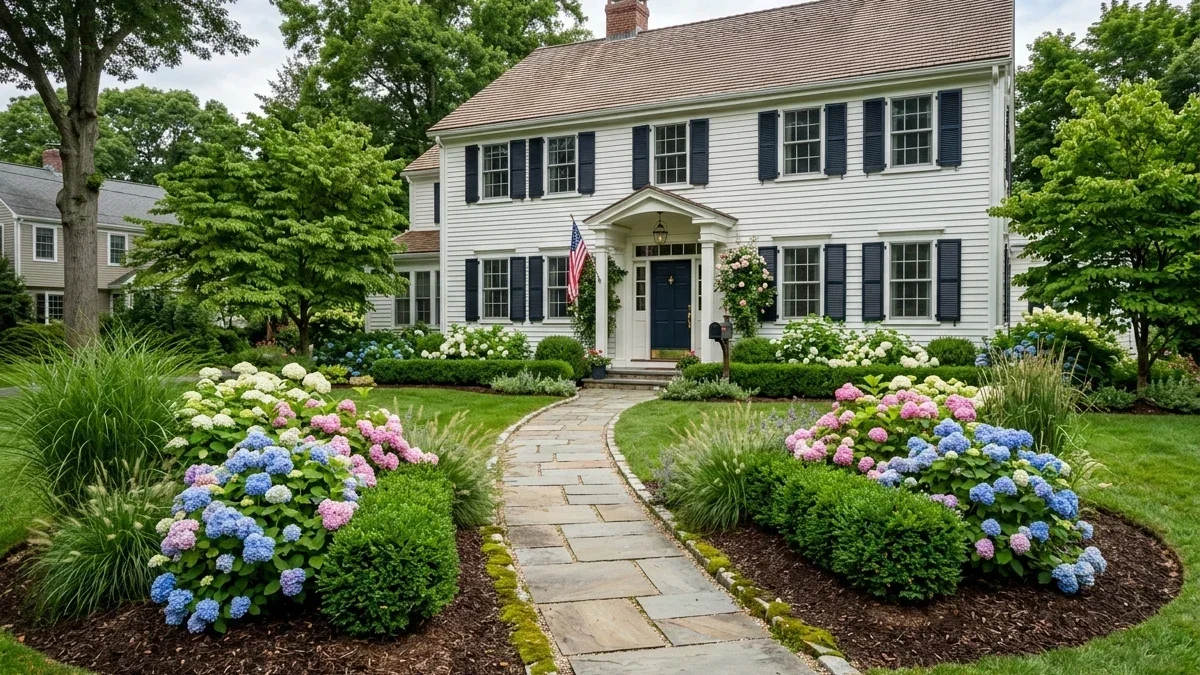
Direct Answer: What Is a Ground Cover Plant and How Do You Choose One?
Ground cover plants are low or spreading plants used to cover exposed soil, connect planting beds, reduce bare-ground weed opportunities, and replace turf in some difficult areas. The best groundcover depends on your region, sunlight, soil moisture, drainage, foot traffic, and how aggressively the plant spreads. No single groundcover is suitable for every US yard.
Topical Principle: There Is No Universal "Best" Ground Cover
Retail seed catalogs and generic online listicles frequently market a single plant—such as Creeping Thyme, English Ivy, or Periwinkle—as the "ultimate miracle groundcover." In reality, plant success is dictated by microclimate physics. A plant that thrives on an arid Colorado hillside will drown in a humid Maryland wetland; a vigorous European vine celebrated in suburban lawns can become an ecological disaster in an adjacent deciduous forest. Site suitability always precedes species selection.
Ground Cover Plant Finder
Filter scientifically verified US groundcovers by region, sunlight, moisture, traffic, and landscape function.
Barren Strawberry
US NativeUSDA Zones 3–9Waldsteinia fragarioides • Native to Eastern & Central North America
Spread Mechanics: Creeping stolons and rhizomes forming a dense, non-invasive carpet
Bloom Value: Spring (April–May) with yellow strawberry-like blooms
Wild Ginger
US NativeUSDA Zones 3–8Asarum canadense • Native to Eastern & Central US Deciduous Woodlands
Spread Mechanics: Slowly creeping underground rhizomes with large kidney leaves
Bloom Value: Spring (hidden maroon ground-level cup flowers for beetles/ants)
Allegheny Spurge
US NativeUSDA Zones 5–9Pachysandra procumbens • Native to Eastern & Southeastern US Woodlands
Spread Mechanics: Tight clump-forming rhizomes; forms a restrained woodland colony
Bloom Value: Early spring fragrant pink-white bottlebrush spikes
Golden Ragwort
US NativeUSDA Zones 3–8Packera aurea • Native to Eastern & Central North America
Spread Mechanics: Vigorous basal stolons and wind-dispersed seed
Bloom Value: Early spring (April–May) cheerful yellow daisy clusters
Creeping Phlox / Moss Phlox
US NativeUSDA Zones 3–9Phlox subulata • Native to Eastern & Central US rocky bluffs
Spread Mechanics: Dense prostrate creeping stems rooting at leaf nodes
Bloom Value: Mid spring (April–May) solid blanket of pink, purple, or white
Pennsylvania Sedge
US NativeUSDA Zones 3–8Carex pensylvanica • Native to Eastern & Central North America Oak Forests
Spread Mechanics: Fine creeping rhizomes forming a soft, weeping, turf-like sod
Creeping Thyme
Introduced (Non-Invasive)USDA Zones 4–9Thymus serpyllum • Native to Southern & Central Europe (Introduced, Non-invasive)
Spread Mechanics: Prostrate woody stems rooting into porous gravel/sand joints
Bloom Value: Early to mid summer fragrant pink/purple nectar blooms
Bearberry / Kinnikinnick
US NativeUSDA Zones 2–7Arctostaphylos uva-ursi • Native to Circumboreal / Northern US & Mountain West
Spread Mechanics: Woody prostrate trailing branches rooting in sandy/acidic soils
Bloom Value: Spring white-pink urn flowers followed by persistent red berries
Creeping Juniper
'Wiltonii / Bar Harbor'US NativeUSDA Zones 3–9Juniperus horizontalis • Native to Northern US & Canada Rocky Embankments
Spread Mechanics: Long trailing woody horizontal branches forming a dense evergreen mat
Wild Stonecrop
US NativeUSDA Zones 4–8Sedum ternatum • Native to Eastern & Central North America
Spread Mechanics: Creeping succulent stems rooting at nodes
Bloom Value: Spring (May–June) bright white 4-petaled starry clusters
Two-Row Stonecrop
'Dragon's Blood / John Creech'Introduced (Non-Invasive)USDA Zones 3–9Phedimus spurius • Native to Caucasus (Non-native, non-invasive in gardens)
Spread Mechanics: Rooting prostrate stems and succulent offsets
Bloom Value: Mid summer pink-red or bronze starry blooms
Goldenstar / Green-and-Gold
US NativeUSDA Zones 5–9Chrysogonum virginianum • Native to Eastern & Southeastern US Woodlands
Spread Mechanics: Short leafy stolons and expanding crowns
Bloom Value: Long bloom from mid-spring into mid-summer (golden yellow stars)
Christmas Fern
US NativeUSDA Zones 3–9Polystichum acrostichoides • Native to Eastern & Central North America
Spread Mechanics: Clumping crown expansion; plant on 18" centers for continuous cover
Foamflower
US NativeUSDA Zones 3–8Tiarella cordifolia • Native to Eastern North America Rich Woodlands
Spread Mechanics: Running above-ground stolons (var. cordifolia) weaving through mulch
Bloom Value: Spring foamy white and soft pink feathery spires
Wild Strawberry
US NativeUSDA Zones 3–9Fragaria virginiana • Native to Native across all 50 US States
Spread Mechanics: Rapid horizontal above-ground runners (stolons)
Bloom Value: Spring white flowers followed by small, sweet edible red berries
Barrenwort / Bishop's Hat
'Frohnleiten'Introduced (Non-Invasive)USDA Zones 4–9Epimedium x perralchicum • Native to Eurasian hybrid (Non-native, non-invasive)
Spread Mechanics: Wiry creeping rhizomes forming an impenetrable, drought-proof underground crown
Bloom Value: Spring delicate winged yellow flowers hovering over heart leaves
Creeping Mazus
Introduced (Non-Invasive)USDA Zones 5–9Mazus reptans • Native to Himalayas / Asia (Non-native, non-invasive)
Spread Mechanics: Prostrate rooting stems forming a miniature, bright green flat mat
Bloom Value: Late spring tiny blue-purple orchid-like blossoms
Bigroot Geranium
'Ingwersen's Variety / Spessart'Introduced (Non-Invasive)USDA Zones 3–8Geranium macrorrhizum • Native to Southern Europe (Non-native, non-invasive in US)
Spread Mechanics: Stout surface rhizomes weaving a thick, aromatic, weed-blocking layer
Bloom Value: Late spring magenta or soft pink flowers; brilliant red fall foliage
Buffalograss (Turf & Prairie)
'Prestige / Legacy / Sundancer'US NativeUSDA Zones 3–9Bouteloua dactyloides • Native to North American Great Plains & Southwest
Spread Mechanics: Vigorous surface stolons creating a drought-defying dense sod
Kurapia (Selected Drought Turf)
'Kurapia White / Pink'US NativeUSDA Zones 7–11Phyla nodiflora var. minor • Native to Coastal & Southern US (Selected sterile non-invasive cultivar)
Spread Mechanics: Dense prostrate rooting stolons weaving an ultra-low, walkable mat
Bloom Value: Summer long tiny white/pink flowers (can be mowed if bee activity is unwanted)
Master Ground Cover Plant Comparison
| Plant & Scientific Name | Native Range | Zones | Sun Exposure | Moisture | Height / Spread | Traffic | Spread Rate | Primary Use & Caution |
|---|---|---|---|---|---|---|---|---|
Barren Strawberry Waldsteinia fragarioides | Eastern & Central North America | 3–9 | full sun | dry | 3–6" / 12–18" | occasional | moderate | Non-invasive native; well-behaved in mixed perennial borders. |
Wild Ginger Asarum canadense | Eastern & Central US Deciduous Woodlands | 3–8 | part shade | average | 4–8" / 12–18" | none | slow | Non-invasive woodland native; stays within designated shade beds. |
Allegheny Spurge Pachysandra procumbens | Eastern & Southeastern US Woodlands | 5–9 | part shade | average | 6–10" / 12–18" | none | slow | Ecological native replacement for invasive Japanese Pachysandra (P. terminalis). Does not escape into wild forests. |
Golden Ragwort Packera aurea | Eastern & Central North America | 3–8 | full sun | average | 4–6" (leaves), 12–18" (flowers) / 12–24" | occasional | fast | Native, but aggressive in small manicured beds. Superb for naturalizing and choking weeds. |
Creeping Phlox / Moss Phlox Phlox subulata | Eastern & Central US rocky bluffs | 3–9 | full sun | dry | 3–6" / 18–24" | occasional | moderate | Well-behaved native; excellent border plant with zero invasive risk. |
Pennsylvania Sedge Carex pensylvanica | Eastern & Central North America Oak Forests | 3–8 | part sun | dry | 6–8" / 12–18" | light | moderate | Top-tier native shade turf substitute; strictly non-invasive. |
Creeping Thyme Thymus serpyllum | Southern & Central Europe (Introduced, Non-invasive) | 4–9 | full sun | dry | 1–3" / 12–18" | light | moderate | Non-native, but non-invasive in US landscapes. |
Bearberry / Kinnikinnick Arctostaphylos uva-ursi | Circumboreal / Northern US & Mountain West | 2–7 | full sun | dry | 4–8" / 24–48" | none | slow | Native sub-shrub with exceptional coastal and high-elevation stability. |
Creeping Juniper Juniperus horizontalis | Northern US & Canada Rocky Embankments | 3–9 | full sun | dry | 4–6" / 48–72" | none | moderate | Durable native evergreen groundcover ideal for sunny highway banks and steep hillsides. |
Wild Stonecrop Sedum ternatum | Eastern & Central North America | 4–8 | part sun | average | 3–6" / 8–12" | none | moderate | Rare native shade sedum; perfectly restrained, non-invasive. |
Two-Row Stonecrop Phedimus spurius | Caucasus (Non-native, non-invasive in gardens) | 3–9 | full sun | dry | 2–4" / 12–24" | occasional | moderate | Well-behaved non-native; widely used on green roofs and retaining wall tops. |
Goldenstar / Green-and-Gold Chrysogonum virginianum | Eastern & Southeastern US Woodlands | 5–9 | part sun | average | 4–8" / 12–18" | occasional | moderate | Native woodland gem; forms a dense, friendly perennial tapestry. |
What Are Ground Cover Plants? (Function Over Form)
In traditional consumer gardening, groundcovers are often stereotyped as low-growing, mat-forming flowering vines. In professional ecological landscape architecture, however, ground cover is recognized as a structural layer—the "green mantle" or lowest vegetative stratum within a multi-tiered planting matrix.
Any plant that stays relatively low, spreads horizontally, shields exposed subsoil from rain-drop impact, outcompetes opportunistic annual weed seeds, and knits together the root zones of taller shrubs and trees performs the groundcover function. This includes:
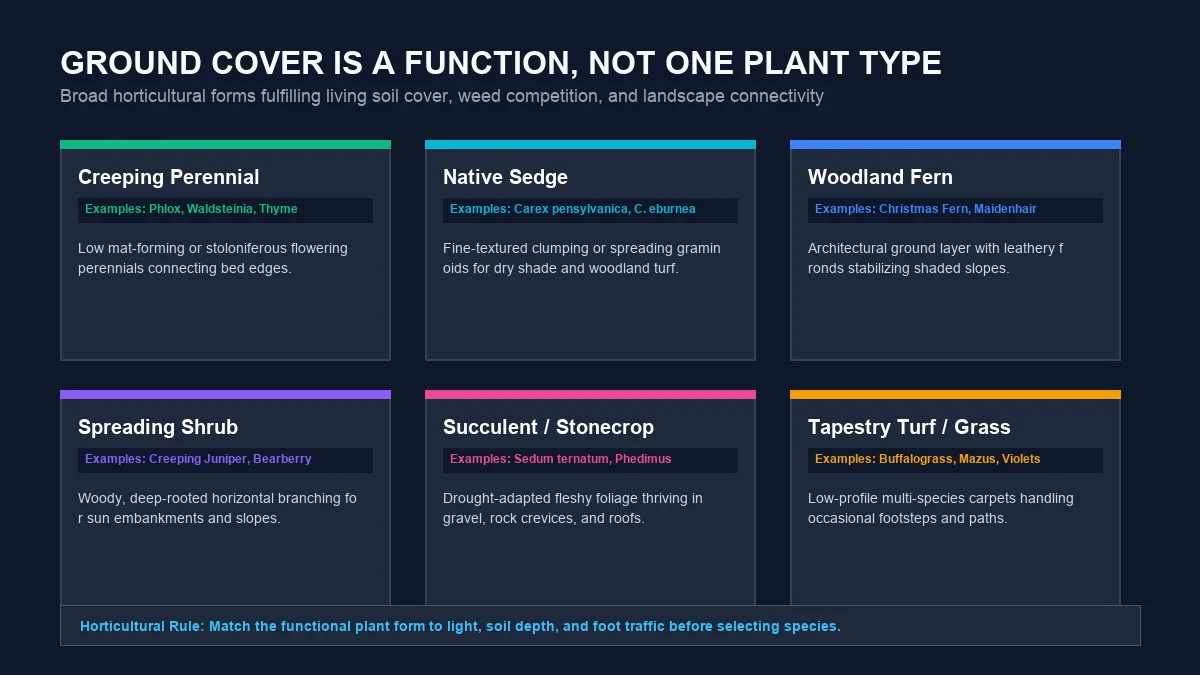
Low perennials like Foamflower, Wild Ginger, and Creeping Phlox that weave across bed floors, offering seasonal floral flushes.
Fine-textured grass-like plants (such as Carex pensylvanica) with dense fibrous root mats that thrive in dry shade where turfgrass fails.
Horizontal prostrate woody plants like Creeping Juniper and Bearberry that anchor harsh embankments against water erosion.
The 12-Step Ground Cover Selection Framework
Never invert this sequence. Selecting a plant because you saw it at a big-box nursery (Step 12) without first measuring your sun exposure (Step 2) or screening its invasive status (Step 11) is the leading cause of landscape failure.
Sunlight & Exposure: The Solar Reality
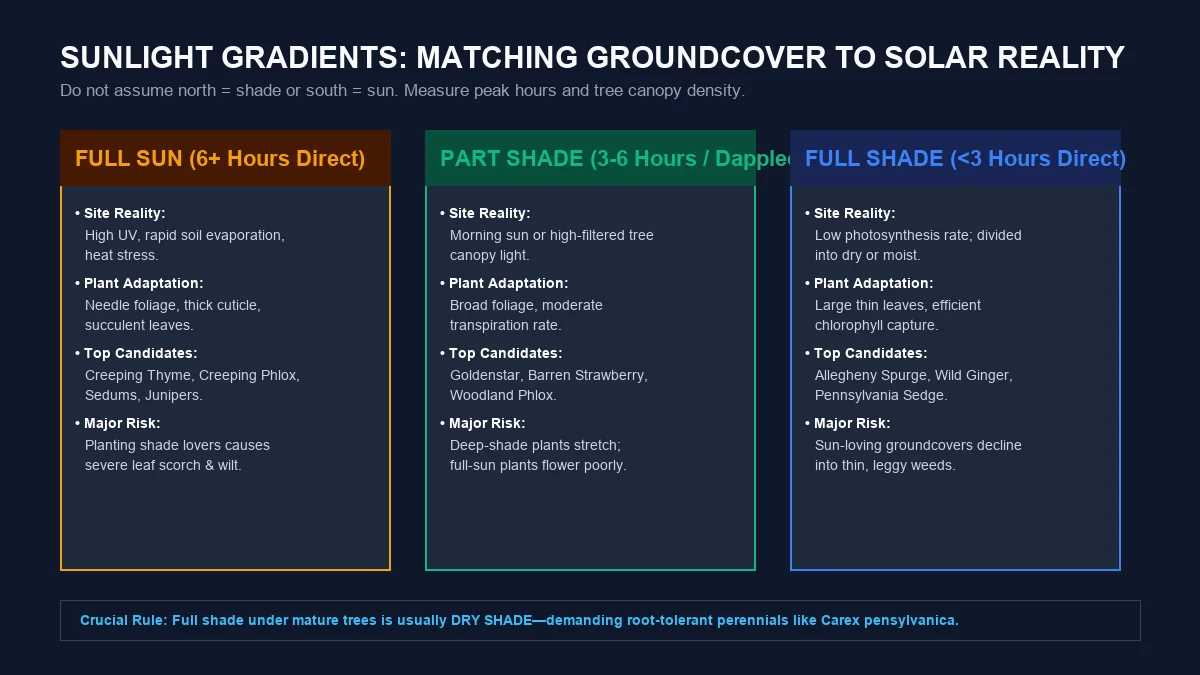
Homeowners frequently assume that a south-facing bed is automatically "full sun" and a north-facing bed is automatically "deep shade." However, tree canopies, two-story house rooflines, and adjacent fences dramatically alter light hours:
- Full Sun (6+ hours of unobstructed direct sun): Demands plants with thick leaf cuticles, waxy gray coatings, or needle-like foliage that resist rapid transpiration. Top performers: Phlox subulata, Thymus serpyllum, Sedum spurium, and Juniperus horizontalis.
- Part Sun / Part Shade (3 to 6 hours of light): Ideal for morning-sun beds or sites with high-filtered woodland dappling. Top performers: Waldsteinia fragarioides, Chrysogonum virginianum, and Phlox divaricata.
- Full Shade (<3 hours of direct sun): Requires plants with large, chlorophyll-rich leaves capable of photosynthesizing under low light levels. Top performers: Pachysandra procumbens, Asarum canadense, and Polystichum acrostichoides.
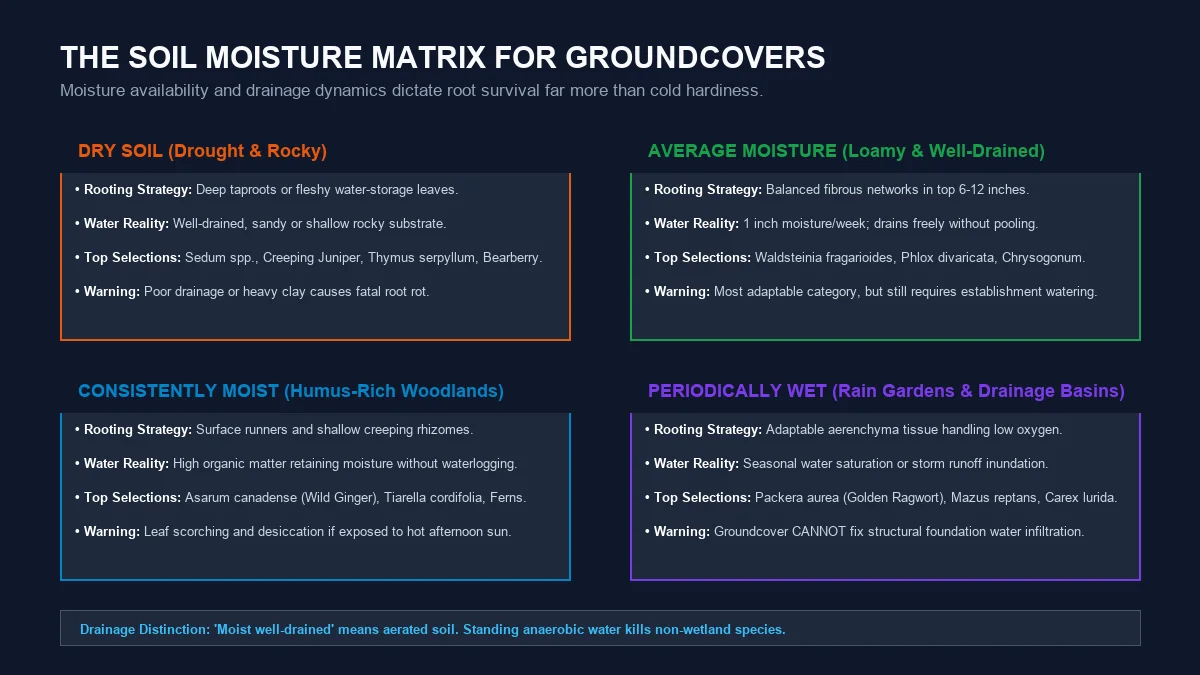
The Soil Moisture & Drainage Matrix
Can You Walk on Ground Cover Plants? (The CSU Reality)
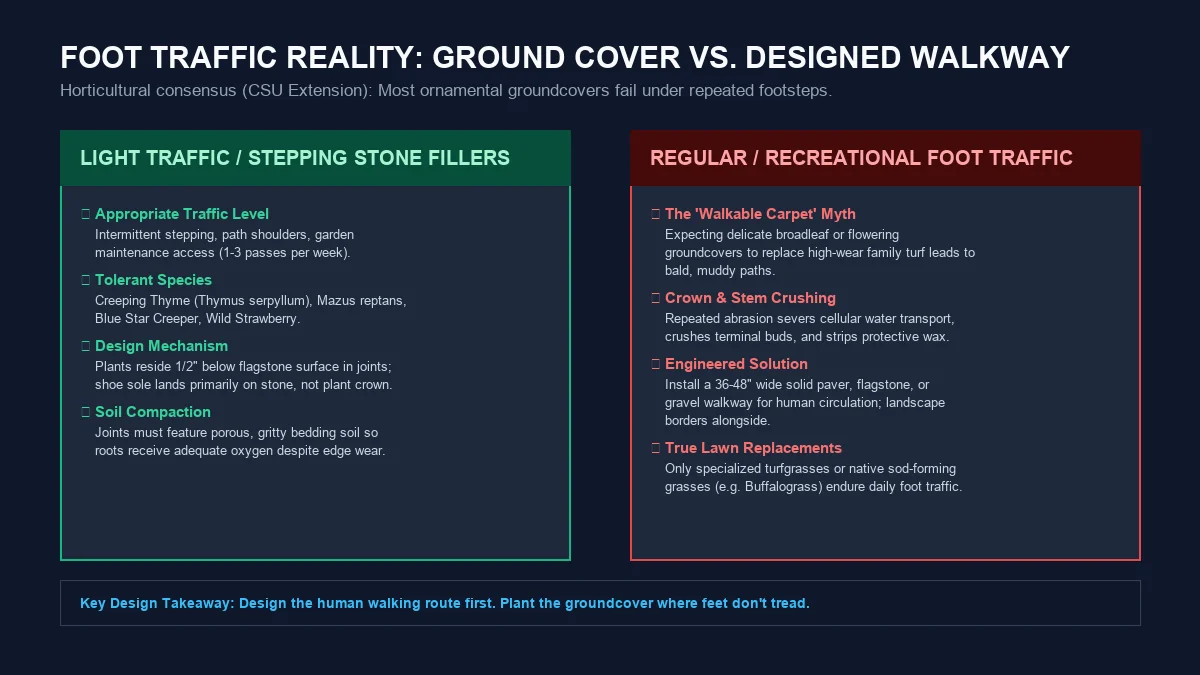
One of the most persistent marketing claims in residential gardening is that you can replace your high-maintenance lawn with a "walkable flowering groundcover" that you can stroll across daily.
According to extensive research from Colorado State University Extension, virtually all ornamental broadleaf groundcovers fail under sustained foot traffic. Walking across broadleaf perennials snaps brittle stems, crushes terminal flower buds, and compacts the top 2 inches of soil, suffocating feeder roots.
When a nursery labels a plant "walkable," they usually mean intermittent stepping—such as planting Creeping Thyme (Thymus serpyllum) or Creeping Mazus (Mazus reptans) between irregular bluestone pavers or stepping stones. In this configuration, the sole of your shoe makes contact with the hardstone surface, while the plant's crown sits nestled safely 1/2 inch below the stone face.
If an area experiences daily family foot traffic, dog exercise, or children playing, do not install delicate broadleaf groundcovers. Instead, install a solid 36-to-48-inch walkway (explore our Walkway Landscaping Ideas Guide) or use a true sod-forming native turfgrass like Buffalograss (Bouteloua dactyloides).
Spread Mechanics: Why Faster Is Not Always Better
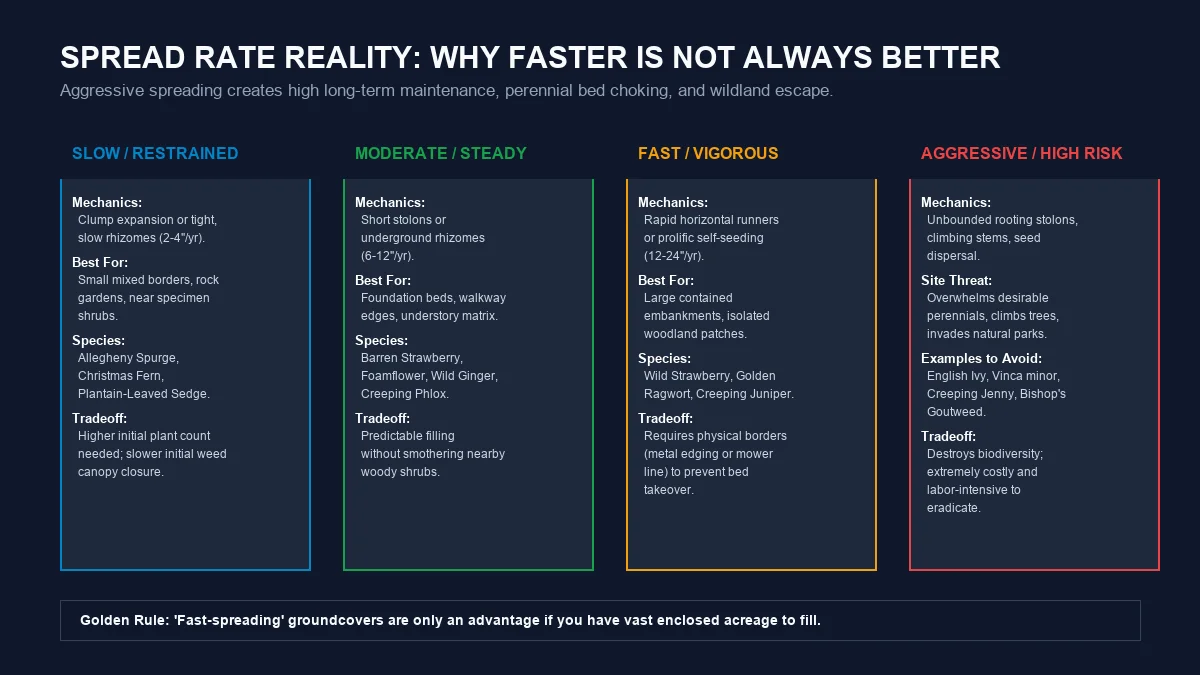
Ground Cover Spread Mechanisms & Containment
How a groundcover spreads determines how often you must prune, whether it smothers your shrubs, and whether it poses an ecological escape risk.
Above-Ground Runners (Stolons)
Horizontal modified stems arching across the surface of the soil/mulch, rooting at leaf nodes to create daughter plantlets.
Creeps over existing mulch and rocks; branches leap outward in multiple directions during spring flush.
Mechanical spade trench edging, 4-inch deep steel landscape edging, or regular string trimming along bed perimeter.
- Lawn reduction zones
- Contained slope beds
- Walkway edge bands with defined hardscape barriers
Stolons will readily crawl over pavers or into mixed perennial crowns if border edging is absent.
Controlled vs. Aggressive vs. Invasive Groundcovers
Expands steadily (2–6 inches per year) via tight clumping crowns or short stolons. Easily edged with a simple garden spade once a year. Examples: Pachysandra procumbens, Waldsteinia fragarioides, Polystichum acrostichoides.
Spreads rapidly (12–24+ inches per year) within garden borders via vigorous runners or heavy self-seeding. Great for large enclosed slopes, but will overwhelm delicate perennials if not boxed in with physical edging. Example: Packera aurea, Fragaria virginiana.
A non-native plant that escapes garden boundaries into adjoining native woodlands, parks, or stream corridors, causing severe ecological degradation by displacing native species. Examples: Hedera helix (English Ivy), Vinca minor, Aegopodium podagraria.
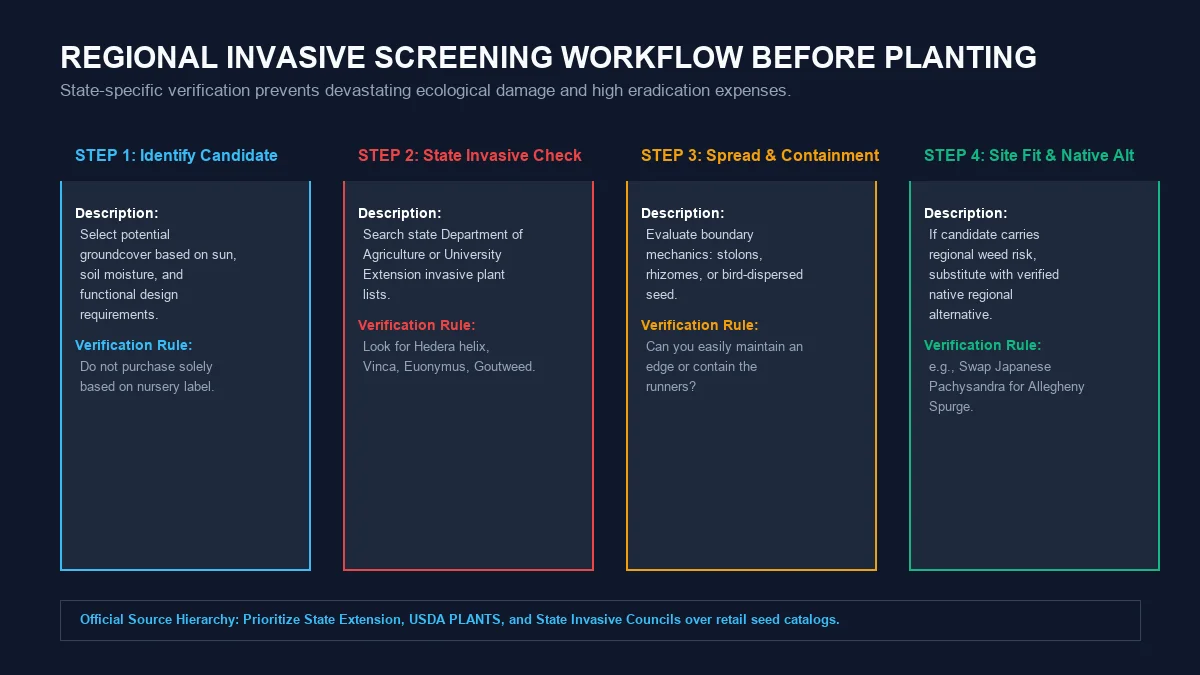
State & Regional Invasive Groundcover Screening
Select your US region to verify local invasive plant warnings from University Extension services and find ecologically sound native substitutes.
Mid-Atlantic (MD, PA, VA, NJ, DE, DC)
Common Big-Box Groundcovers to Screen vs. Verified Native Alternatives
| High-Risk Plant (Avoid) | Why It Threatens Ecosystems | Ecological Native Alternative |
|---|---|---|
English IvyHedera helix | Aggressively smothers forest floor; climbs and strangles mature canopy trees, causing limb breakage and decay. | Allegheny Spurge / Wild GingerPachysandra procumbens / Asarum canadense |
Periwinkle / MyrtleVinca minor & Vinca major | Forms dense evergreen monocultures in deciduous woods, preventing native wildflower germination. | Goldenstar (Green-and-Gold)Chrysogonum virginianum |
Japanese PachysandraPachysandra terminalis | Escapes residential plantings into adjoining forest tracts via persistent rhizomes. | Allegheny SpurgePachysandra procumbens |
Creeping Jenny / MoneywortLysimachia nummularia | Rapidly invades wet stream banks, riparian buffers, and floodplains, crowding out wetland sedges. | Golden RagwortPackera aurea |
Do Ground Cover Plants Stop Weeds? (The Living Mulch Reality)
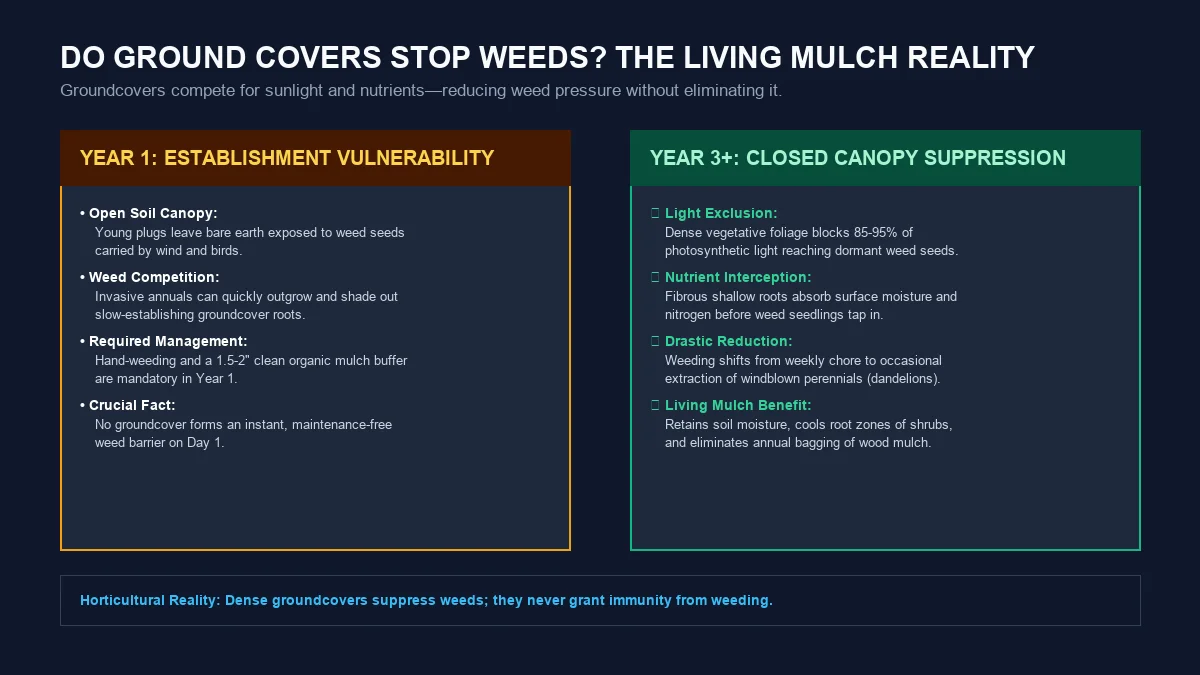
The promise of "never weeding again" is the most frequent misconception sold to homeowners. In their comprehensive groundcover guidance, University of Maryland Extension emphasizes that groundcovers suppress weeds by competing for light, water, and nutrients, not by placing an impenetrable plastic shield over the earth.
During Year 1, newly installed 2-inch to 4-inch plugs leave significant bare soil exposed. Windblown dandelion, crabgrass, and clover seeds will readily sprout in these gaps. Homeowners must maintain a 1.5-to-2-inch clean layer of organic shredded bark mulch and pull weeds by hand while the young groundcover establishes root anchors.
By Year 3, once the vegetative canopy closes, the dense interlocking foliage excludes 85% to 95% of sunlight from reaching the soil surface. Dormant weed seeds cannot germinate, reducing your weeding chores from a weekly labor into pulling an occasional stray windblown seedling.
Ground Cover Weed Suppression & Spacing Audit
Estimate how many groundcover plugs your bed requires, how long until the vegetative canopy closes, and what level of weed suppression to realistically expect.
Bed & Planting Parameters
Standard commercial recommendation
Based on triangular grid layout (~1.0 plugs/sq ft).
Time until leaves touch and shade bare soil.
Weed Suppression Timeline & Reality Check
Open soil remains between plugs. Windblown weed seeds will sprout. You must maintain a 1.5–2" wood mulch buffer and hand-weed monthly until stems interlock.
Interwoven foliage blocks 90%+ of light reaching the ground. Weed seeds starve of light. Weeding reduces to plucking isolated airborne weeds 2–3 times per season.
Ground Cover Solutions for Difficult Landscape Zones
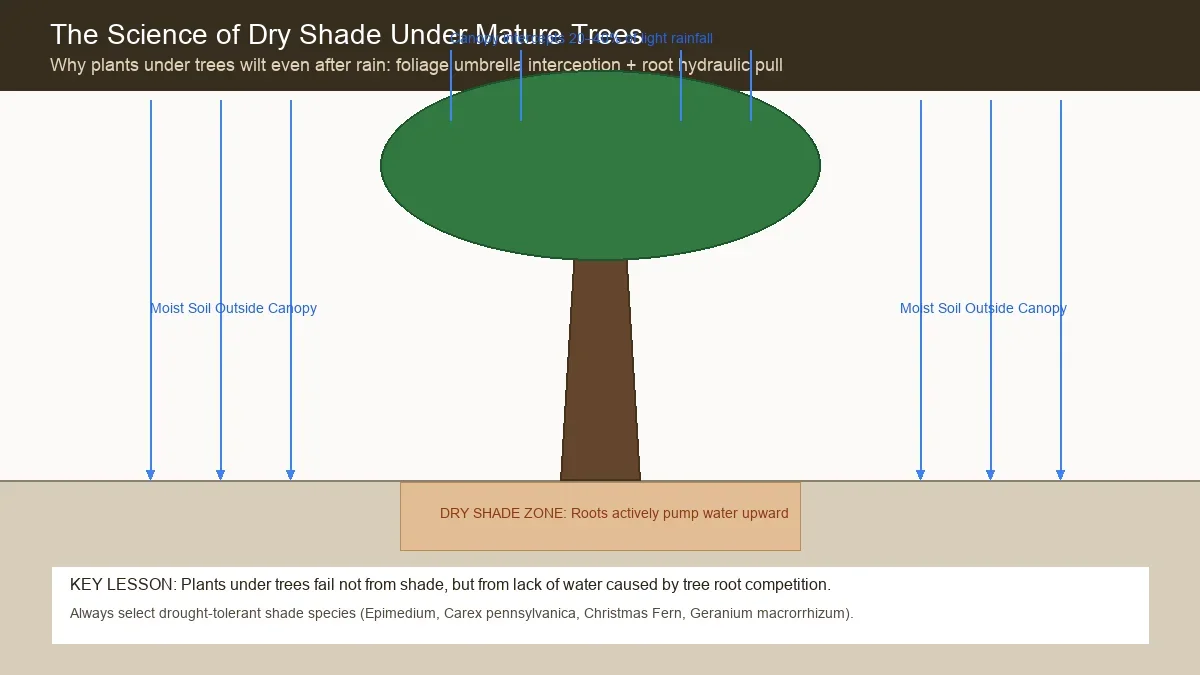
Dry Shade Under Mature Trees
Mature maple, oak, and pine canopies create a harsh dual obstacle: dense shade above and a thirsty network of shallow fibrous roots below that sucks out all available soil moisture.
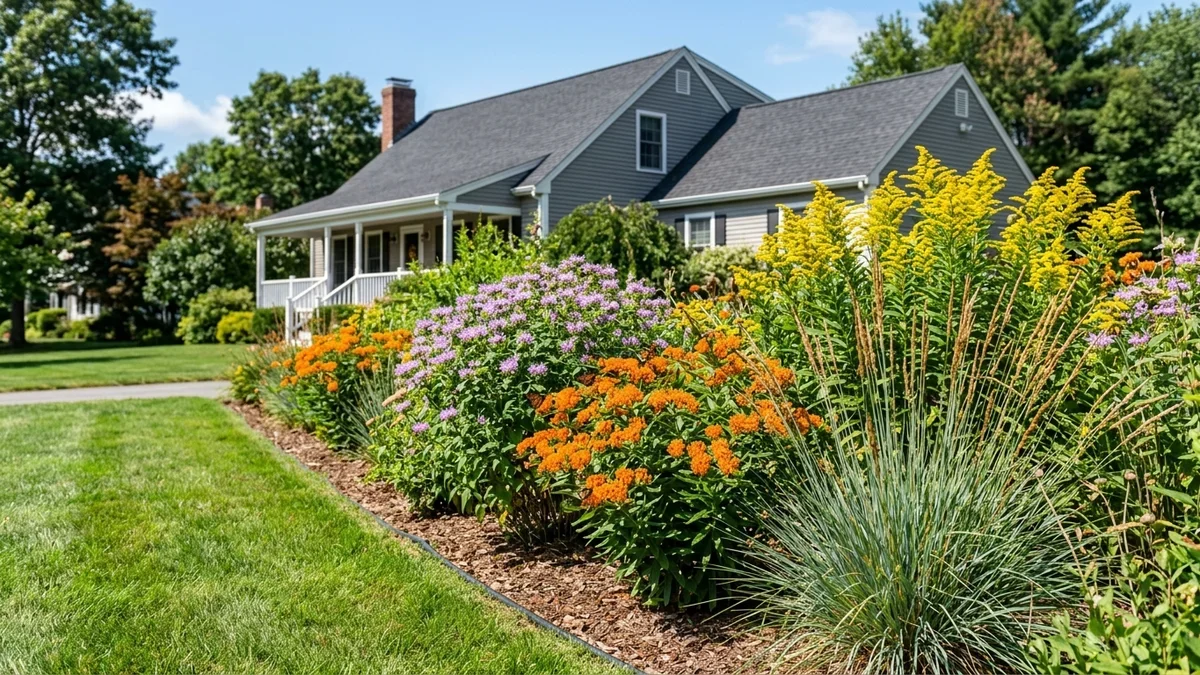
Slope & Embankment Erosion Mitigation
Mowing grass on steep hillsides is hazardous. Installing deep-rooting, woody or stoloniferous groundcovers binds the top 6 to 12 inches of soil, absorbs rainfall energy, and slows downslope runoff.
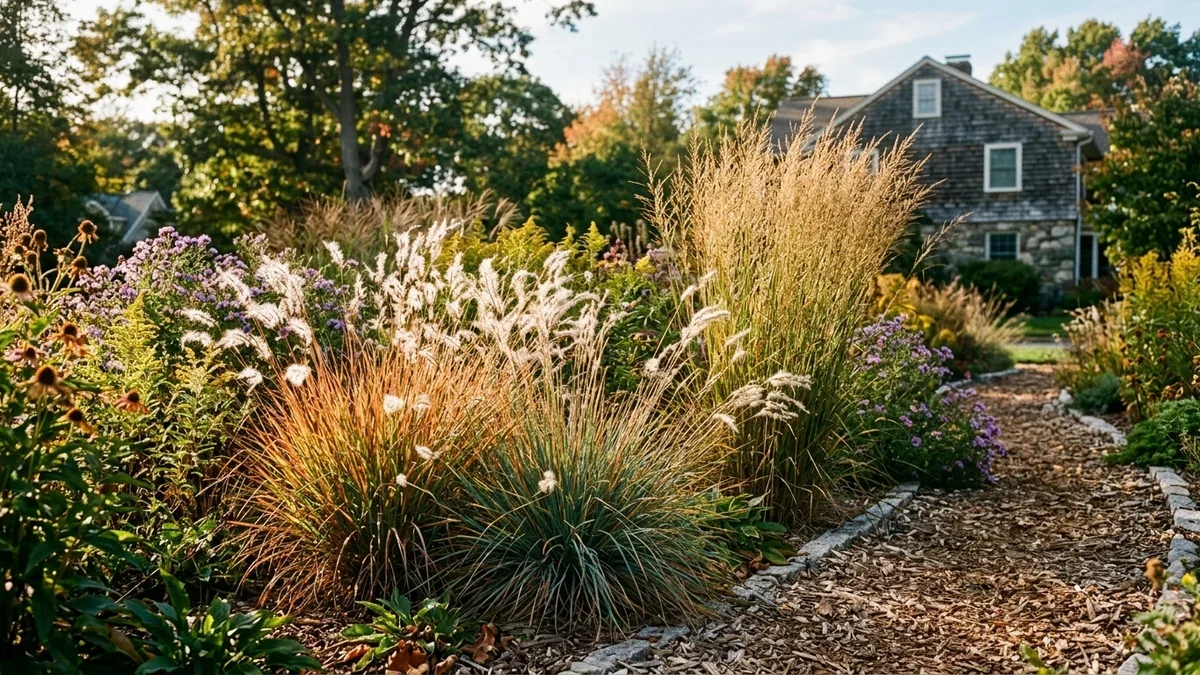
Low-Traffic Lawn Replacement
Homeowners looking to eliminate synthetic chemical fertilizers, weekly mowing, and excessive irrigation can convert secondary front lawn sections or shady side yards into living groundcover tapestries.
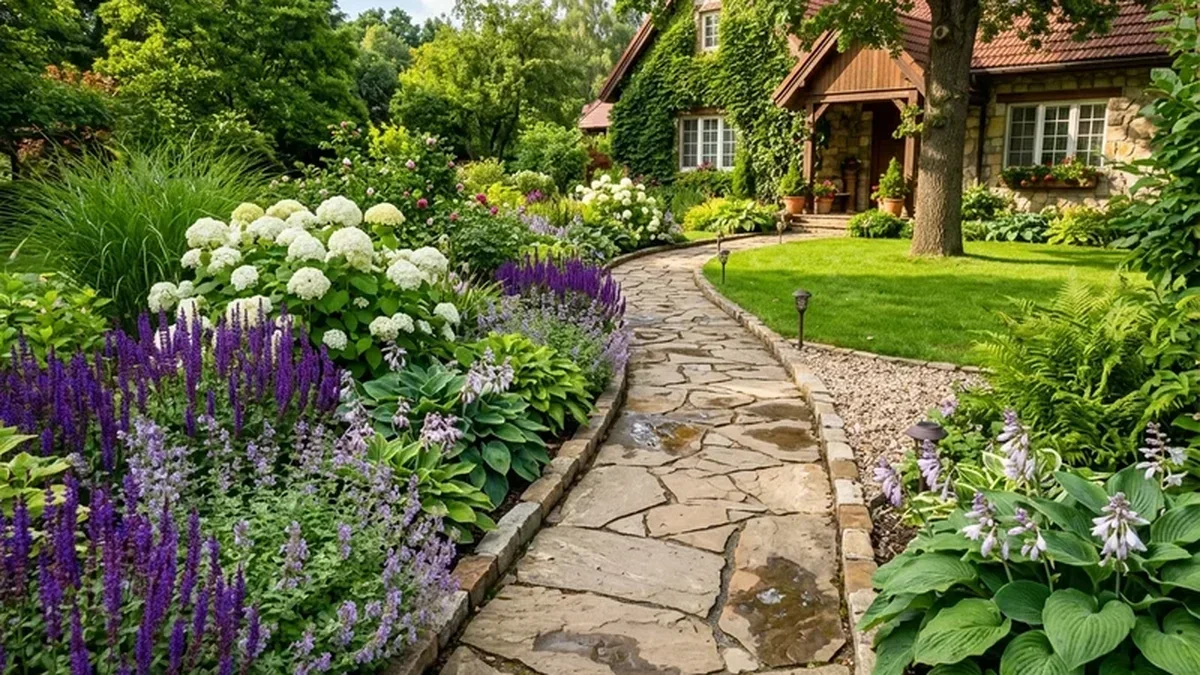
Walkway & Patio Edge Softening
Hardscape walkways require gentle, low-growing vegetative borders that soften the crisp transition between pavers and mulch without sprawling across walking surfaces or creating slip hazards.
15 Critical Ground Cover Mistakes Homeowners Make
Buying a blooming groundcover at a garden center without checking whether it tolerates your site's specific sun, soil moisture, and drainage.
Treating creeping flowering perennials like turfgrass. Repeated footsteps crush soft foliage, compact soil, and kill crowns.
Failing to apply a 1.5–2" wood mulch buffer and neglecting hand-weeding during the critical 12 to 24 month establishment period.
Planting vigorous runners (like English Ivy or Creeping Jenny) that quickly swallow nearby delicate perennial crowns and shrubs.
Planting species legally banned or formally discouraged by your state Extension service (e.g. Aegopodium goutweed, Vinca, Euonymus).
A plant native to the Pacific Northwest or Gulf Coast is not ecologically adapted to high-elevation Colorado or northern Maine.
Adding 4 to 8 inches of topsoil over tree roots smothers essential oxygen uptake, leading to crown dieback and fatal trunk rot.
Cutting major tree roots (>1.5" diameter) destabilizes the tree structurally and introduces wood-rotting fungal pathogens.
Even ultra-drought-tolerant sedums and junipers require 1 inch of supplemental water per week during their first 8 to 12 weeks in the ground.
Planting water-loving groundcovers over a foundation leak or sinking patio instead of fixing grade slopes and downspout pipes.
Assuming an evergreen groundcover in Zone 8 will retain green foliage during sub-zero Zone 4 winter blizzards without browning.
Installing creeping thyme or sedum beneath a dense oak tree, where they stretch into leggy, rotting stalks and quickly die.
Spacing plugs too widely to save money, creating 4 years of weed maintenance; or crowding plugs too tightly, creating fungal air stagnation.
Allowing aggressive vines like English Ivy or Wintercreeper to climb trees, which adds heavy wind-sail weight and traps moisture against bark.
Failing to install a crisp spade trench or 4" steel edging along walkways, allowing runners to crawl uncontrollably into turf and pavers.
Common Questions About Ground Cover Plants
Answers
Frequently asked questions
01What is the best ground cover plant?
There is no single best groundcover plant for every yard. The best choice depends entirely on your specific site conditions: your US climate zone, direct sunlight hours, soil moisture, drainage, and expected foot traffic. A sun-loving drought groundcover like Creeping Thyme will quickly rot in damp shade, while a lush shade plant like Wild Ginger will scorch in full afternoon sun. Match the species to your site first, then verify that it is not invasive in your region.
02Do ground cover plants stop weeds completely?
No groundcover eliminates weeds entirely. Dense, mature groundcovers suppress weeds by 85% to 95% by shading out dormant weed seeds and competing for moisture and nutrients. However, during the first 1 to 2 years of establishment, open soil between young plugs will sprout weeds, requiring a 1.5-to-2-inch clean mulch buffer and regular hand-weeding until the foliage canopy closes.
03Can you walk on ground cover plants instead of grass?
Most ornamental groundcovers cannot tolerate regular foot traffic. According to Colorado State University Extension, walking on broadleaf or flowering groundcovers crushes their tender stems and compacts the soil. Only specialized turf-forming plants (such as Buffalograss in dry climates or Kurapia in warm zones) or stepping-stone joint fillers (like Creeping Thyme and Mazus reptans) tolerate occasional stepping. For daily human circulation, install a dedicated flagstone, paver, or gravel walkway.
04What ground cover grows well in dry shade under trees?
Dry shade beneath mature trees is one of the most challenging planting sites due to intense root competition and reduced rainfall penetration. The best groundcovers for dry shade include Pennsylvania Sedge (Carex pensylvanica), Barrenwort (Epimedium spp.), Bigroot Geranium (Geranium macrorrhizum), Christmas Fern (Polystichum acrostichoides), and Allegheny Spurge (Pachysandra procumbens). Always plant small plugs into natural root pockets without severing structural tree roots.
05What ground covers should I avoid planting?
Avoid planting non-native groundcovers that have documented invasive behavior in your region. Common big-box staples like English Ivy (Hedera helix), Periwinkle (Vinca minor), Japanese Pachysandra (Pachysandra terminalis), Wintercreeper (Euonymus fortunei), Bishop's Goutweed (Aegopodium podagraria), and Creeping Jenny (Lysimachia nummularia) frequently escape residential yards and aggressively invade natural forests, smothering native wildflowers and killing trees.
06What is the fastest growing ground cover?
Vigorous spreaders like Wild Strawberry (Fragaria virginiana), Golden Ragwort (Packera aurea), and Creeping Juniper can cover bare ground rapidly. However, rapid growth is a double-edged sword: plants that spread fast often require constant edging to prevent them from invading nearby perennial beds and can present high escape risks. Faster is not always better; choose a spread rate that fits the size and boundaries of your space.
07What is the difference between an aggressive plant and an invasive plant?
An aggressive plant spreads rapidly within a garden bed (by vigorous stolons, rhizomes, or self-seeding) and may require frequent trimming, but it does not necessarily disrupt natural ecosystems. An invasive plant is a non-native species that escapes cultivation, reproduces aggressively in natural wildlands, and causes demonstrable ecological or economic harm by displacing native plants and wildlife.
08Can ground covers stabilize a steep slope and prevent erosion?
Groundcovers with deep or fibrous root systems (such as Creeping Juniper, Bearberry, and native sedges) help reduce surface soil washouts and slow storm runoff on gentle to moderate slopes (under 20% grade). However, groundcovers cannot fix deep structural slope instability, rotational soil shear, or active groundwater slumping. Slopes with significant structural movement require professional grading, terracing, or engineered retaining walls.
09How does a groundcover function as 'living mulch'?
A 'living mulch' is a dense understory layer of low-growing plants that carpets exposed soil beneath taller shrubs and perennials. It provides the same functional benefits as bagged wood mulch—shading soil, moderating soil temperatures, reducing moisture evaporation, and suppressing weeds—while eliminating the annual labor and expense of hauling new mulch bags every spring.
10What is the best native ground cover for full sun?
Excellent full-sun native groundcovers include Creeping Phlox (Phlox subulata), Barren Strawberry (Waldsteinia fragarioides), Bearberry (Arctostaphylos uva-ursi), and native clump-forming prairie grasses and sedges. In arid or western climates, Buffalograss and Sulphur-Flower Buckwheat provide outstanding drought resilience.
11How do I plant ground cover under mature trees without hurting the tree?
Protect tree health by following three arboricultural rules: 1) Never bring in deep topsoil or build raised planters over the root zone, which smothers tree roots; 2) Never cut structural woody roots larger than 1.5 inches in diameter; 3) Plant small 2-inch to 4-inch plugs or bare-root divisions into existing soil pockets between major roots, keeping all foliage back from the tree's basal root flare.
12Are evergreen ground covers truly evergreen in all US climates?
No. Evergreen foliage retention depends on winter temperature severity, wind exposure, and snow cover. A broadleaf plant like Allegheny Spurge or Goldenstar may stay pristine green throughout winter in USDA Zone 7 or 8, but will drop foliage or suffer winter burn and die back to the ground in USDA Zone 4 or 5. Always evaluate evergreen performance relative to your local USDA hardiness zone.
Planning Ground Cover Planting in Peabody, MA?
The selection rules outlined above apply nationwide. If you are landscaping in Peabody, Danvers, Salem, Beverly, or surrounding North Shore communities (USDA Hardiness Zone 6b), your groundcovers must endure heavy winter freeze-thaw cycles, coastal nor’easters, road salt exposure, and summer humidity.
Native Massachusetts choices like Pennsylvania Sedge (Carex pensylvanica), Bearberry (Arctostaphylos uva-ursi), Wild Ginger (Asarum canadense), and Creeping Phlox (Phlox subulata) provide exceptional four-season resilience without running the risk of invasive ecological escape. For a complete regional plant directory, explore our guide to Native Plants for Massachusetts Landscaping.
Homeowners across the North Shore planning a comprehensive yard renovation, bed overhaul, or living mulch installation can connect with independent local landscaping professionals for an on-site design consultation through our matching network.
Transform Your Yard with Resilient Groundcovers
Connect with screened, independent landscaping professionals serving Peabody and the North Shore for comprehensive landscape design, sod replacement, and planting bed installation.
Get connected with an independent local landscaping professional. Calls go to (877) 537-6896.