Hydrangea Landscaping Ideas: How to Design With Hydrangeas
The definitive, horticulturally verified guide to designing residential landscapes with hydrangeas: species selection, mature sizing frameworks, sun microclimates, evergreen companion layering, soil pH science, and old vs. new wood pruning rules.
Successful hydrangea landscaping follows a strict 6-step design hierarchy: Hydrangea Type → Site Exposure → Mature Cultivar Size → Landscape Role → Evergreen Companion Structure → Pruning Maintenance. Rather than treating hydrangeas as one generic shrub, professional landscape designers match the specific botanical species (Bigleaf, Panicle, Smooth, Oakleaf, Mountain, or Climbing) to actual sun hours and soil drainage, size cultivars to prevent window and walkway blockage, and pair deciduous canes with at least 40% cold-hardy evergreen massing to prevent bare winter voids.
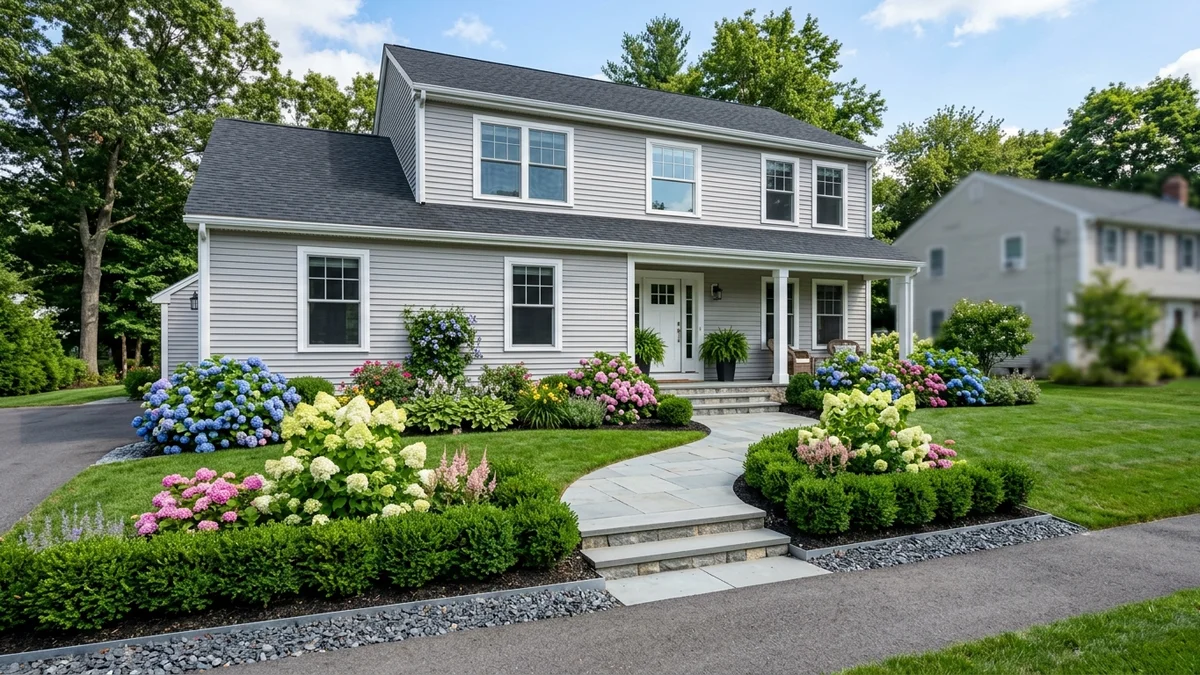
Hydrangea Landscape Type & Cultivar Finder
Match your exact yard microclimate, available bed dimensions, and design intent to the horticulturally correct hydrangea species, proven cultivars, and companion structural layers.
Classic Bigleaf Hydrangea (Reblooming Selection)
Hydrangea macrophylla
3–5 ft H × 3–5 ft W
Deadhead old flowers in summer. Never cut old canes to ground in spring or you lose early blooms.
- BloomStruck (3–4 ft sturdy ruby stems)
- Endless Summer The Original (3–5 ft)
- Tilt-A-Whirl (3–4 ft bi-color)
Eastern exposure: bright morning light with shade during peak 1 PM–5 PM summer heat. Consistently moist, well-aerated loam. Large broad leaves wilt quickly in dry compacted soils.
Can shift between deep violet-blue, purple, and vibrant pink based on bioavailable aluminum.
Deciduous bare stems with dried mophead heads. Relies heavily on companion evergreens.
Inkberry holly, Japanese painted fern, Coral bells, Astilbe, Siberian bugloss (Brunnera)
Know Your Hydrangea Before Designing the Garden
In residential nursery centers across the United States, hydrangeas are often marketed under a single umbrella term as if they were interchangeable garden shrubs. In reality, the genus Hydrangea spans distinct deciduous woody species and vigorous climbing vines originating from very different native habitats across East Asia and North America.
Each species operates under its own immutable genetic rules governing winter hardiness, drought tolerance, bloom wood, and floral pigmentation. A panicle hydrangea (Hydrangea paniculata) can bask in six to eight hours of direct Midwestern summer sun and survive -30°F winter freezes in USDA Zone 3 without dropping a single bloom bud. In stark contrast, a classic bigleaf mophead (Hydrangea macrophylla) sited in that same baking sun will wilt severely by noon, and its tender overwintering old-wood flower buds will freeze and die if exposed to sub-zero northern winds.
Designing an enduring, low-maintenance landscape requires stepping away from pot tags and anchoring your layout in botanical reality. Before digging a single hole or purchasing a flat of nursery containers, you must answer three fundamental botanical questions:
Does the species require high-intensity full sun (Panicle), gentle morning light with afternoon shade (Bigleaf & Mountain), or open woodland dappling (Smooth & Oakleaf)?
Does the plant bloom on "new wood" grown in the current spring, or on "old wood" formed during late summer that must survive winter freezes intact?
Will the cultivar reach a modest 3-foot mounding dwarf sphere, or expand into an 8-to-10-foot massive woody thicket that swallows first-floor windows and walkways?
Bigleaf vs Panicle vs Smooth vs Oakleaf Hydrangeas
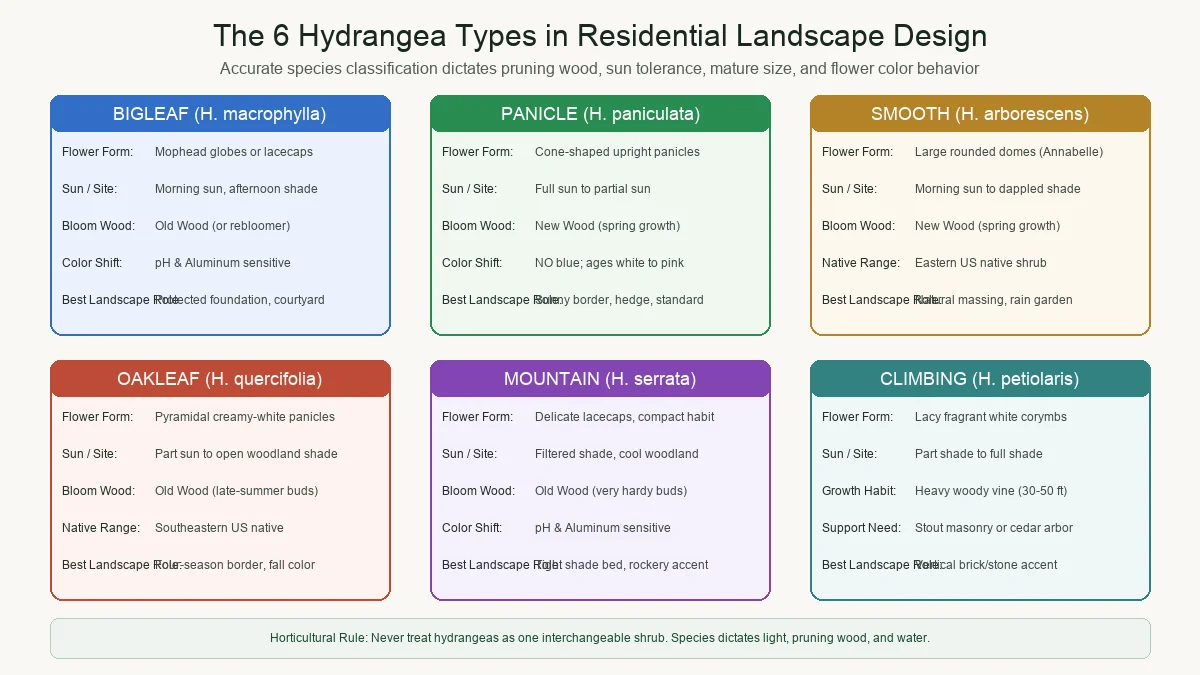
The 6 Primary Hydrangea Species Compared
Compare bloom wood, flower shapes, mature spreads, native status, and soil pH behavior side-by-side.
| Type & Botanical | Flower & Sun | Bloom Wood | Zones & Spread | US Native? | pH / Color Behavior | Top Cultivars |
|---|---|---|---|---|---|---|
Bigleaf Hydrangea Hydrangea macrophylla Protected front foundation, shaded courtyard, patio container | Mophead (globose) or Lacecap Morning sun + afternoon shade (or dappled) | Old Wood | Zones 5–9 (Buds vulnerable below 0°F) 3–6 ft H × 3–6 ft W (dwarfs 2–3 ft) | No (Asian origin) | Yes: Acid (pH 5.0–5.5) + Al = Blue; Alkaline = Pink | Endless Summer, BloomStruck, Nikko Blue, Let's Dance |
Panicle Hydrangea Hydrangea paniculata Sunny mixed borders, privacy hedges, standard specimen trees | Cone-shaped upright panicles (6–18") Full sun to partial sun (most sun tolerant) | New Wood | Zones 3–8 (Extreme winter hardiness) 6–10 ft H × 6–8 ft W (dwarfs 2.5–4 ft) | No (Asian origin) | No: Starts lime/ivory, ages rose-cranberry regardless of pH | Limelight, Bobo, Quick Fire, Vanilla Strawberry, Phantom |
Smooth Hydrangea Hydrangea arborescens Naturalistic woodland borders, rain gardens, mass plantings | Massive rounded corymbs / domes Morning sun to partial shade (needs moisture) | New Wood | Zones 3–9 (Exceptional cold tolerance) 3–5 ft H × 3–5 ft W (dwarfs 1.5–2.5 ft) | Yes (Eastern US) | No: White/lime or stable pink; unaffected by soil aluminum | Annabelle, Incrediball, Invincibelle Wee White, Haas' Halo |
Oakleaf Hydrangea Hydrangea quercifolia Four-season structural shrub, woodland border, rich fall color | Elongated cone panicles + oak-lobed leaves Part shade to open woodland sun | Old Wood | Zones 5–9 (Deeply rooted once established) 6–8 ft H × 6–8 ft W (compact 3–4 ft) | Yes (Eastern US) | No: Creamy white aging to rich dusky bronze-rose | Ruby Slippers, Alice, Snow Queen, Munchkin, Pee Wee |
Mountain Hydrangea Hydrangea serrata Low foundation edging, rockery accents, small urban borders | Delicate lacecaps, refined compact habit Partial shade to cool woodland dappling | Old Wood | Zones 5–9 (Buds hardier than macrophylla) 2–4 ft H × 2–4 ft W | No (Asian origin) | Yes: Highly sensitive to soil pH and aluminum availability | Tuff Stuff, Tiny Tuff Stuff, Bluebird, Preziosa |
Climbing Hydrangea Hydrangea anomala subsp. petiolaris Massive brick/stone walls, sturdy cedar pergolas, chimneys | Broad fragrant lacecaps (8–10" wide) Partial shade to full north-facing shade | Old Wood (Vigorous Vine) | Zones 4–8 (Very hardy once anchored) 30–50 ft vertical vine spread | No (Asian origin) | No: Pure white fertile & sterile florets; unaffected by pH | Species form, Miranda (Variegated), Firefly |
Horticultural takeaway: Only Hydrangea macrophylla and Hydrangea serrata change flower color based on soil pH and soluble aluminum. White, smooth, panicle, and oakleaf hydrangeas will never turn blue, regardless of aluminum sulfate or soil acidifiers applied.
Bigleaf Hydrangea (H. macrophylla)
Native to coastal maritime Japan. Celebrated for massive globose mophead clusters and lacecaps in shades of blue, purple, and pink. Features large, thick, glossy serrated foliage.
Best Landscape Use: Sheltered eastern foundation beds, shaded courtyards, and patio containers protected from harsh western wind and afternoon heat.
Panicle Hydrangea (H. paniculata)
Native to eastern Asia. The most sun-tolerant, cold-hardy (down to Zone 3), and structurally dependable hydrangea in America. Produces large upright conical floral panicles that age gracefully from white to pink and bronze.
Best Landscape Use: Full-sun shrub borders, property boundary hedges, and single-stem trained specimen standards (hydrangea trees).
Smooth Hydrangea (H. arborescens)
Native to the Eastern United States. A resilient woodland shrub bearing immense dome-shaped flower heads (such as classic 'Annabelle' and stout-stemmed 'Incrediball'). Thrives in moist soils and blooms dependably on new wood.
Best Landscape Use: Naturalistic woodland edges, rain garden margins, cottage walkways, and mass drift plantings.
Oakleaf Hydrangea (H. quercifolia)
Native to Southeastern US river bluffs. Unmatched four-season architectural interest: distinctive deeply lobed oak-like foliage, pyramidal summer panicles, brilliant burgundy autumn color, and peeling winter cinnamon bark.
Best Landscape Use: Woodland transition gardens, wildlife plantings, and multi-season foundation anchoring where winter presence is vital.
Mature Size: The Critical Hydrangea Design Rule
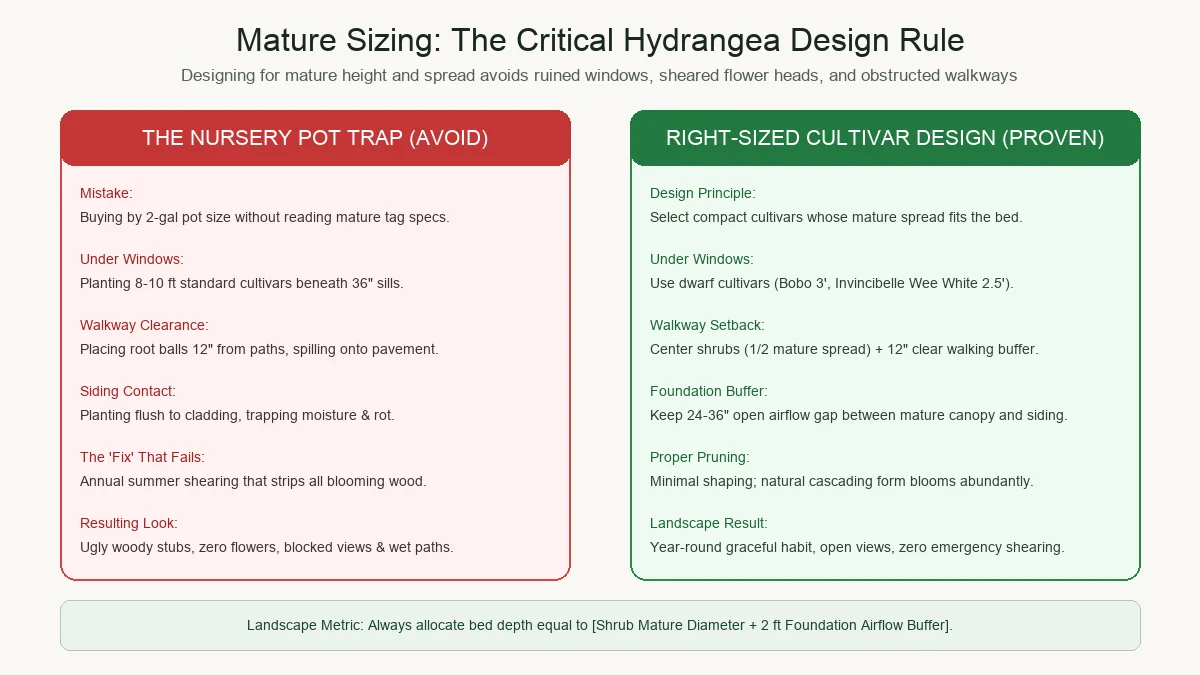
Homeowners frequently purchase a 2-gallon nursery hydrangea measuring barely 14 inches across, install it 18 inches away from their living room window sill, and expect it to stay compact. Three to five growing seasons later, standard cultivars like 'Limelight' or 'Nikko Blue' have exploded to their natural mature dimensions: 8 feet tall and 8 feet wide.
When a large shrub swallows a first-floor window, the homeowner inevitably reaches for hedge shears. Severe summer pruning removes the plant's natural graceful arching silhouette, reduces flowering stems to bare woody stubs, and strips away flower buds.
Never attempt to control a large hydrangea's size through chronic pruning. Instead, select from the rich catalog of modern, genetically stabilized dwarf and compact cultivars bred specifically for tight residential foundation beds:
- For Under 3-Foot Windows: 'Bobo' panicle (2.5–3 ft), 'Invincibelle Wee White' smooth (1.5–2.5 ft), 'Tiny Tuff Stuff' mountain (1.5–2 ft).
- For 4-to-5-Foot Mid-Height Foundations: 'Little Lime' panicle (3–5 ft), 'Little Quick Fire' panicle (3–5 ft), 'Ruby Slippers' oakleaf (3.5–4 ft), 'BloomStruck' bigleaf (3–4 ft).
- For Expansive Borders & Tall Blank Walls: Standard 'Limelight' (6–8+ ft), 'Incrediball' (4–5 ft), 'Alice' oakleaf (6–8 ft).
Hydrangea Front Yard & Foundation Landscaping Ideas
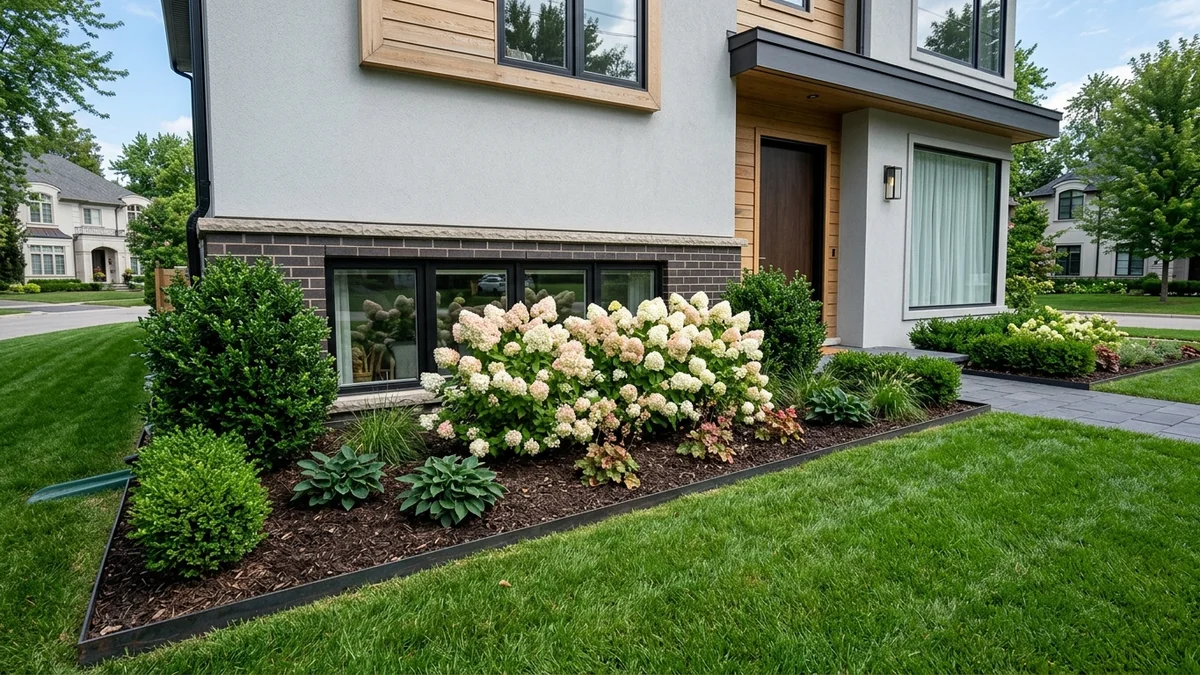
The 3 Architectural Rules of Foundation Planting
Foundation plantings serve to visually anchor a home to the surrounding earth and soften harsh 90-degree masonry corners. Because hydrangeas produce lush, expansive foliage and heavy seasonal flower heads, they are magnificent foundation specimens—provided you respect physical building envelopes:
- The Siding Airflow Gap: Maintain a minimum 24-to-36-inch clearance between the mature branch canopy and exterior home cladding. Canopies planted flush against wood or vinyl siding trap ambient humidity, promote mildew and wood rot, and provide pest runways into soffits.
- The Roof Drip Line Offset: Never locate the center of a hydrangea root ball directly underneath an un-guttered roof drip line. Heavy winter snow shedding and intense storm cascades will snap brittle woody canes in half.
- The Concrete Foundation Leaching Factor: Poured concrete footings and mortar continuously leach calcium carbonate (lime) into surrounding backfill soil, elevating pH above 6.5–7.0. If you desire blue bigleaf hydrangeas beside a new foundation, you must plant them in isolated acid-buffered planting pockets.
Hydrangeas Along Walkways: Framing Without Encroaching
Few garden experiences match the romance of walking beside lush, billowy hydrangea blossoms. However, an unmanaged shrub border quickly turns into an obstacle course when heavy summer thunderstorms soak massive mopheads, causing branches to bow forward and completely block walkway passage.
The Walkway Setback Calculation Formula:
Minimum Setback Distance = (1/2 Mature Shrub Spread) + 12 Inches
For a cultivar with a 4-foot mature spread (such as 'Little Lime'), center the root ball at least 36 inches away from the pavement edge. The front 12 to 24 inches of bed space should be filled with non-flopping creeping groundcovers (such as creeping thyme or dwarf calamint) that cushion the hardscape without invading the walkway.
Explore our detailed mathematical guide on walkway landscaping ideas to master 3-zone pedestrian setback geometry.
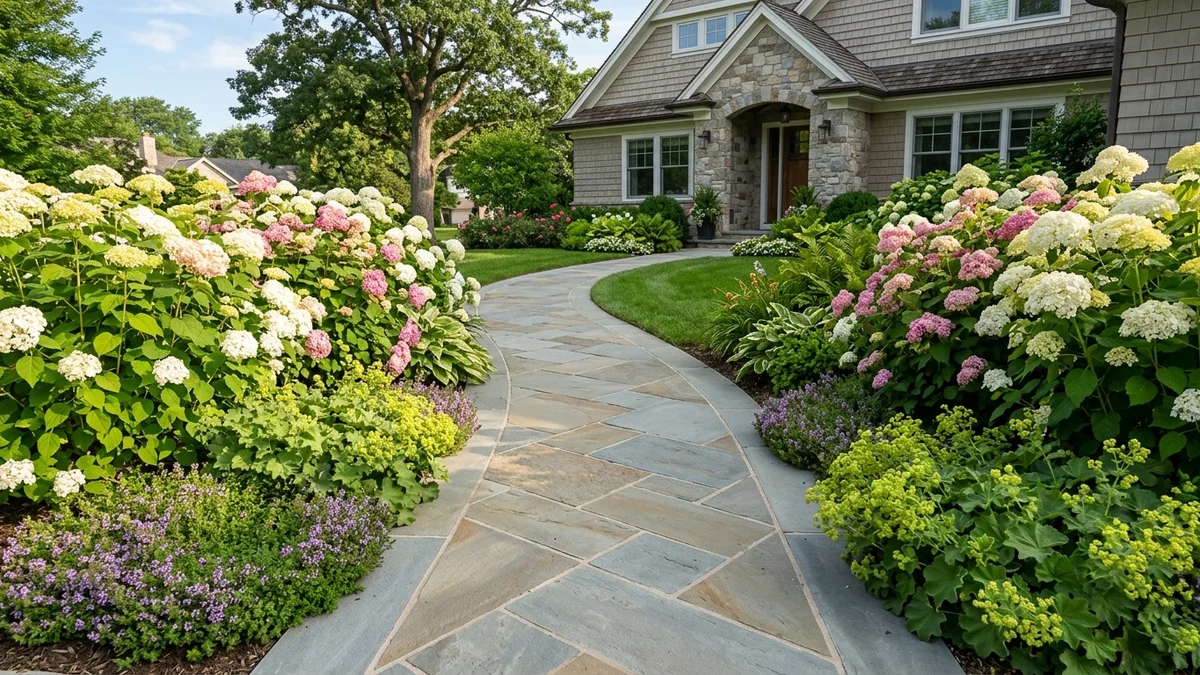
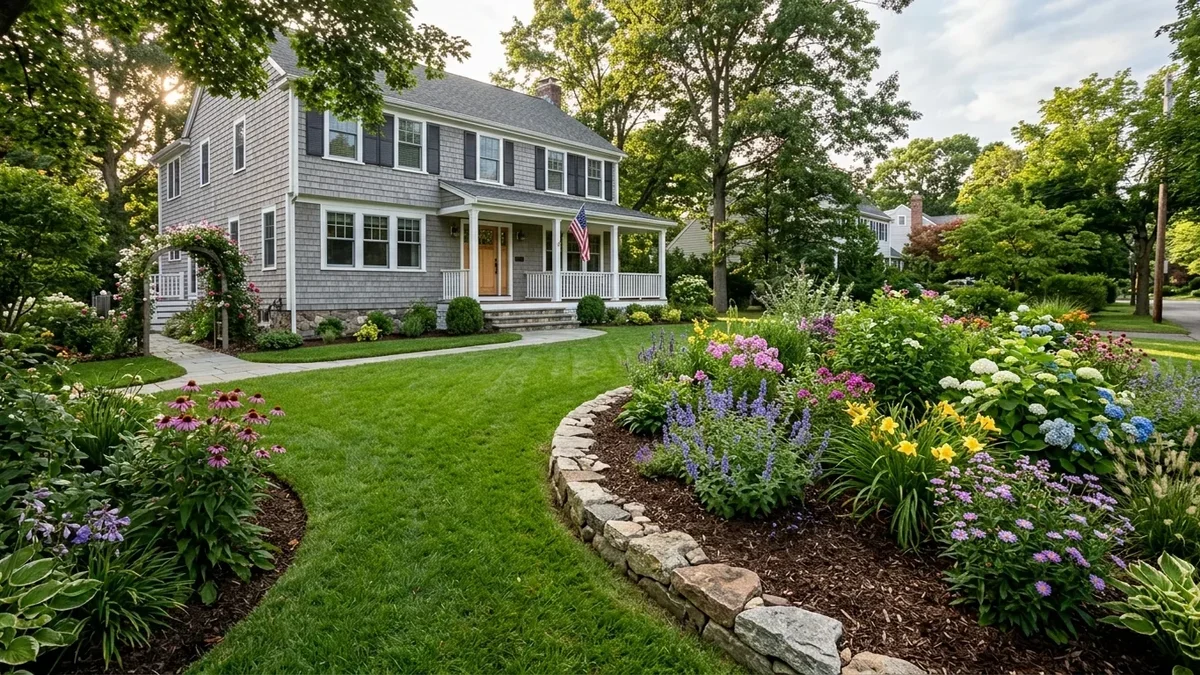
Hydrangea Borders, Summer Hedges & Tree Standards
Deep Mixed Borders
Plant in odd-numbered drifts of 3, 5, or 7 shrubs of the same cultivar. Stagger plants in an undulating triangular matrix rather than a rigid bowling-alley row for maximum depth.
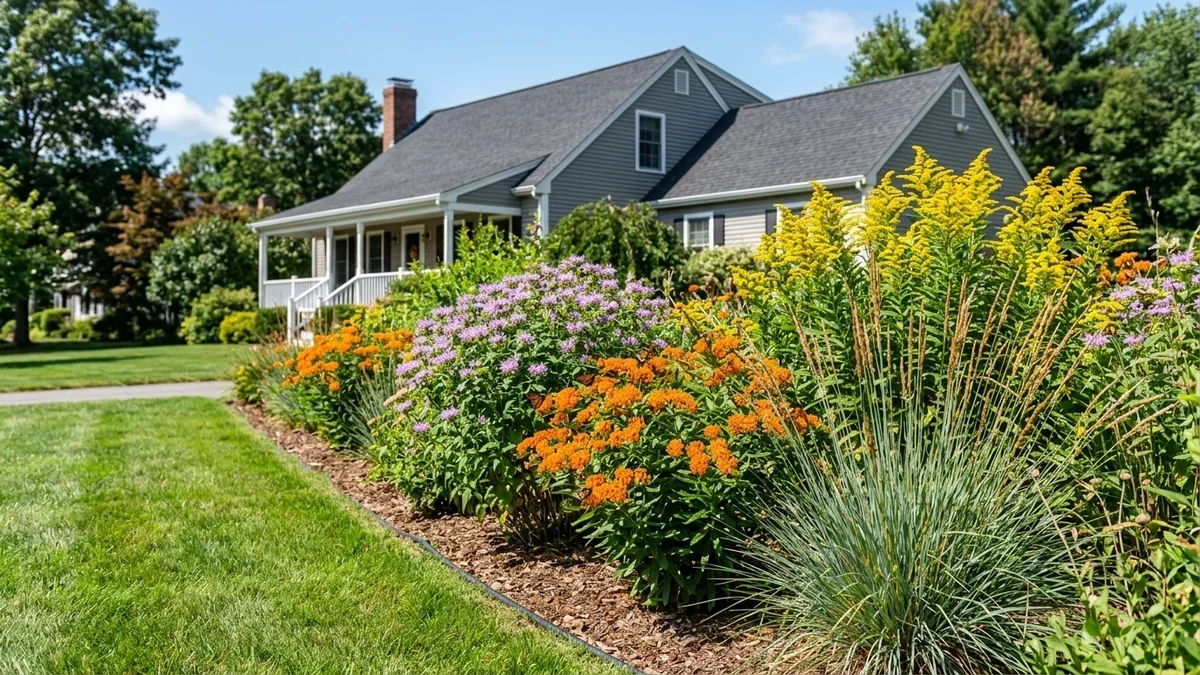
Deciduous Summer Hedges
Hydrangeas make sensational summer screening walls from June to October. However, remember they are 100% deciduous. Never rely on them for winter privacy; pair with background conifers.
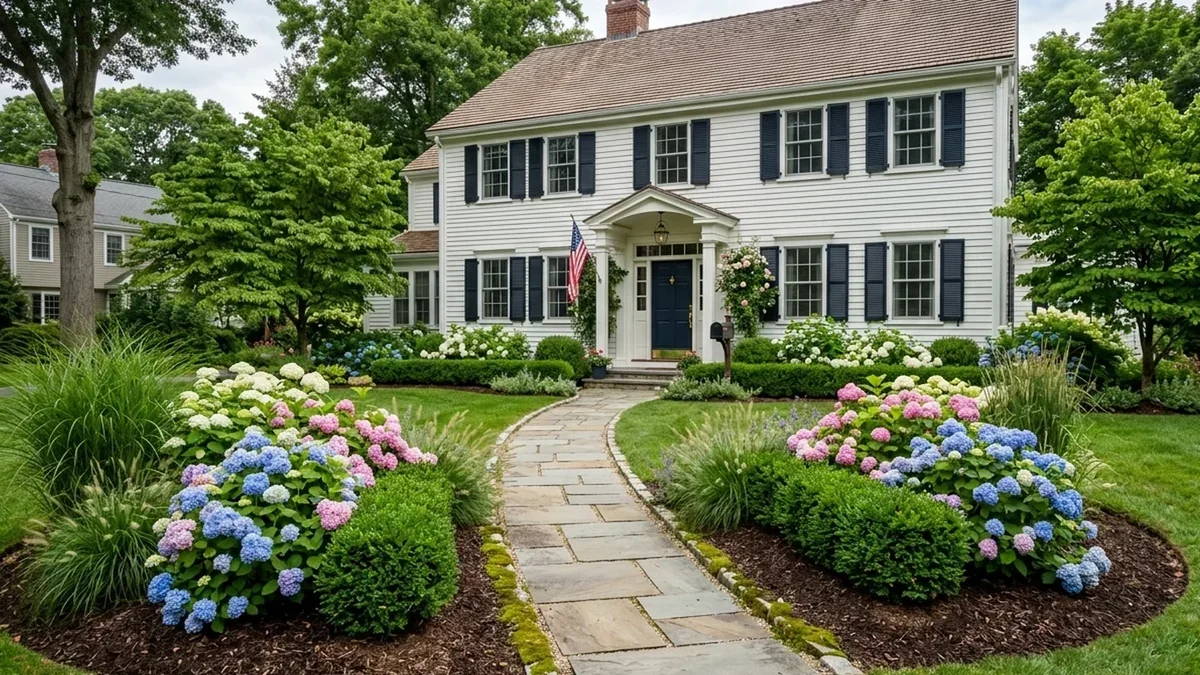
Trained Tree Standards
Panicle hydrangeas trained to a single 4-to-5-foot clear trunk form magnificent 8-to-12-foot weeping specimen trees. Perfect for lawn focal points, patio corners, and flanking front gates.
Modern, Cottage & Native Hydrangea Landscaping
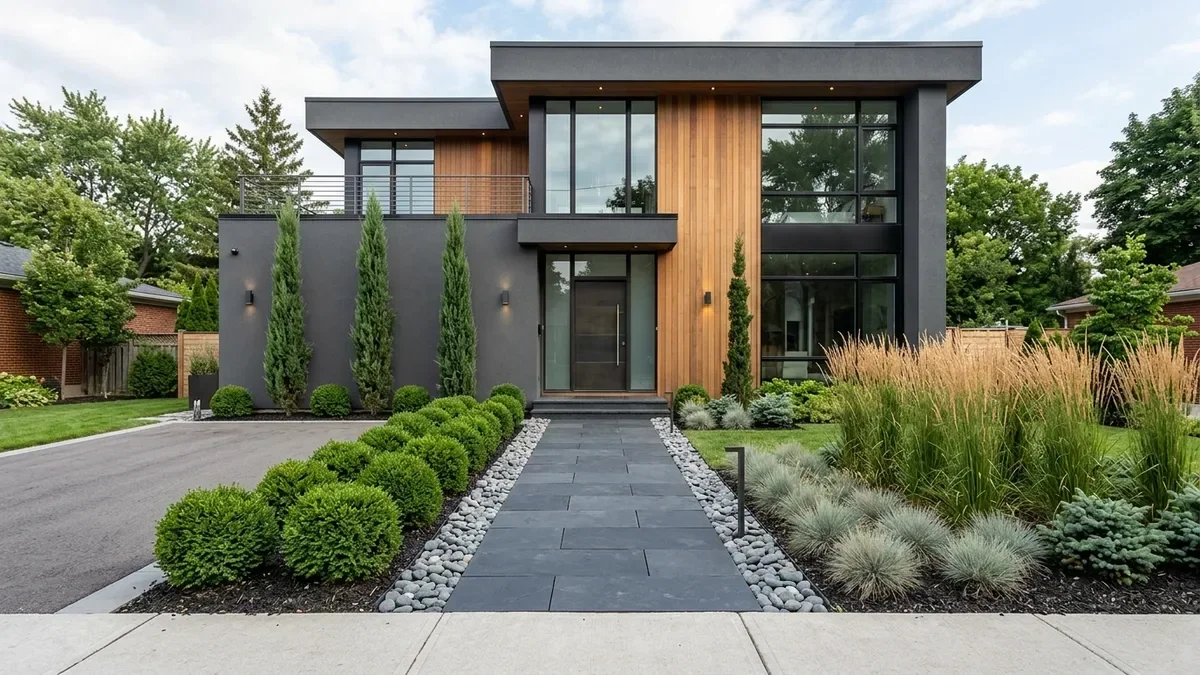
Modern Architectural
- Palette: Strictly restrained (whites, chartreuse, deep greens).
- Composition: Linear mass repetition of a single cultivar (e.g. 9 'Limelight' in a crisp row).
- Hardscape: Large-format bluestone, board-formed concrete, dark river rock.
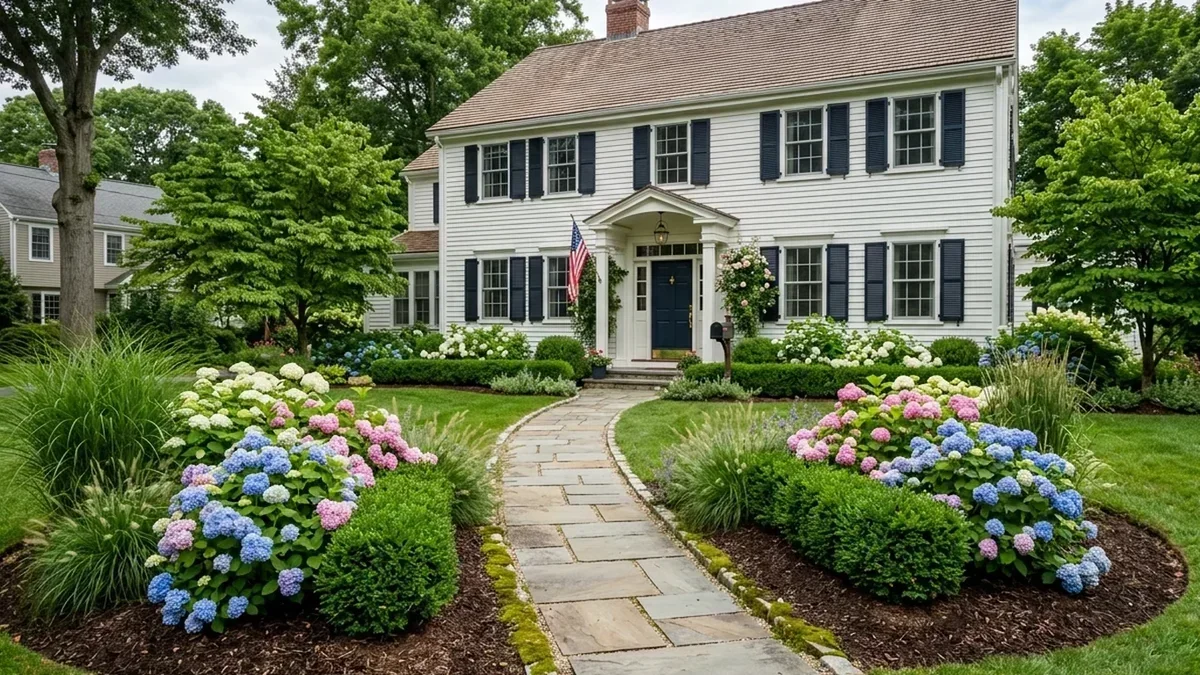
Romantic Cottage
- Palette: Soft pastels (sky blue, lavender, blush pink, ivory).
- Composition: Layered billowing tapestries with soft overlapping edges.
- Companions: Climbing roses, nepeta ('Walker's Low'), foxglove, delphiniums, rustic wooden fences.
- Architectural Context: To see how these styles coordinate across entire front yards, porches, and fence lines, explore our guide to farmhouse landscaping ideas.
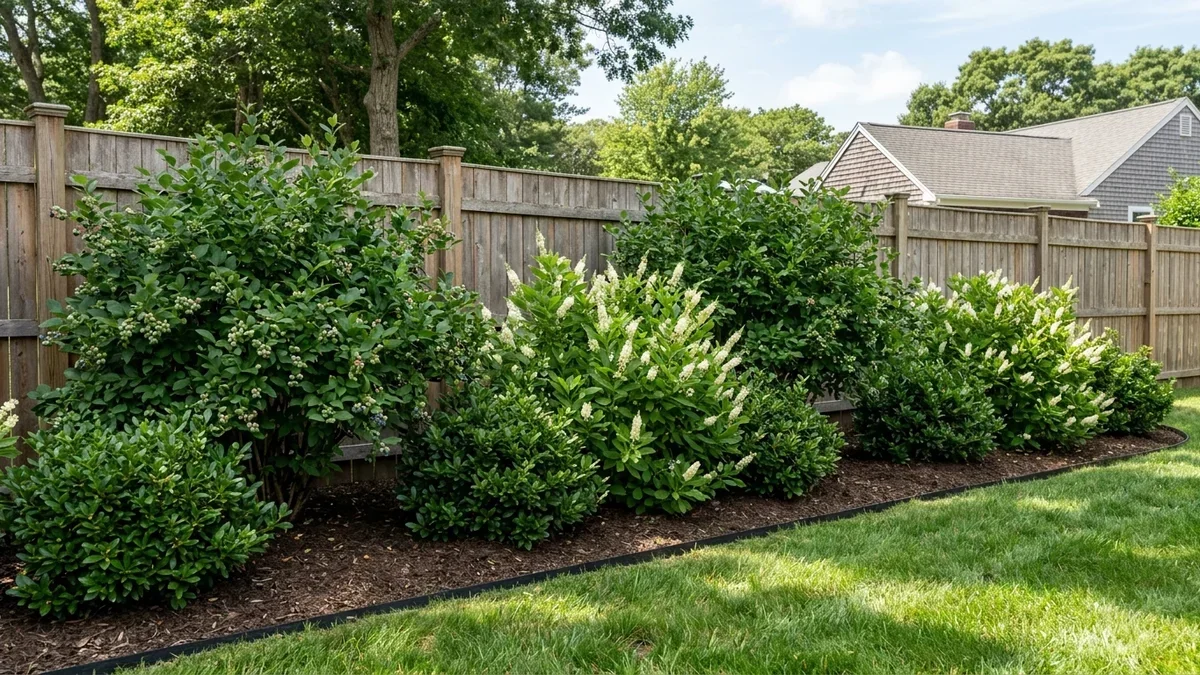
Native Woodland Edge
- Species: Exclusively US natives (H. quercifolia & H. arborescens).
- Composition: Asymmetric woodland understory drifting beneath mature canopy trees.
- Companions: Pennsylvania sedge, Christmas ferns, native azaleas, wild columbine.
What to Plant With Hydrangeas: The Companion Framework
Hydrangea Companion Layer Planner
Pair your hydrangea with four complementary plant layers to eliminate bare winter voids and create rich textural contrast.
Full Sun Panicle Hydrangea Pairing
Built for sunny borders, foundation beds, and open lawn transitions with drought-resilient companions.
1. Evergreen Backbone (Year-Round Structure)
- Inkberry Holly (Ilex glabra 'Shamrock')
- Winter Gem Boxwood
- Dwarf Mugo Pine
- Hicks Yew
2. Fine-Textured Ornamental Grasses
- Karl Foerster Feather Reed Grass
- Little Bluestem (Schizachyrium)
- Dwarf Fountain Grass (Pennisetum 'Hameln')
3. Summer & Fall Flowering Accents
- Salvia 'Caradonna' (deep purple spikes)
- Coneflowers (Echinacea purpurea)
- Russian Sage
- Sedum 'Autumn Joy'
4. Living Groundcover Mulch
- Creeping Phlox (Phlox subulata)
- Dwarf Stonecrop (Sedum rupestre)
- Creeping Thyme
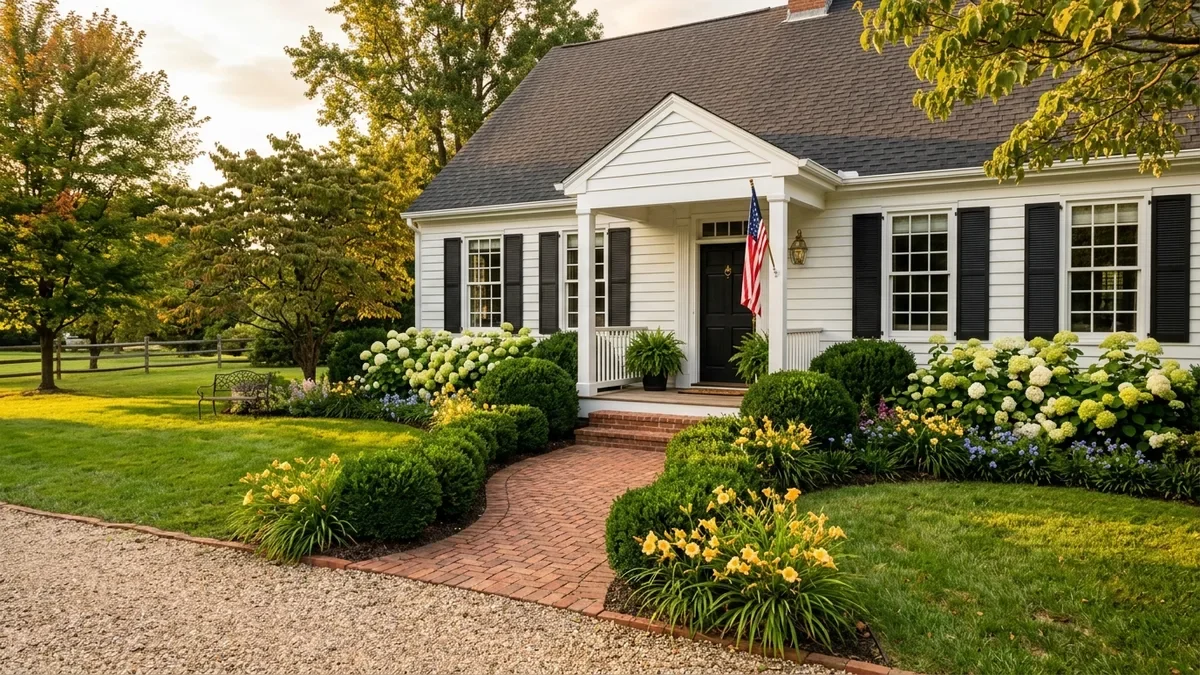
1. The Evergreen Structural Backbone
Evergreens provide high-contrast dark green foils behind pale summer blooms and hold the entire landscape together during winter dormancy. Top partners: Inkberry Holly (Ilex glabra), Winter Gem Boxwood, Japanese Plum Yew, and Hicks Yew.
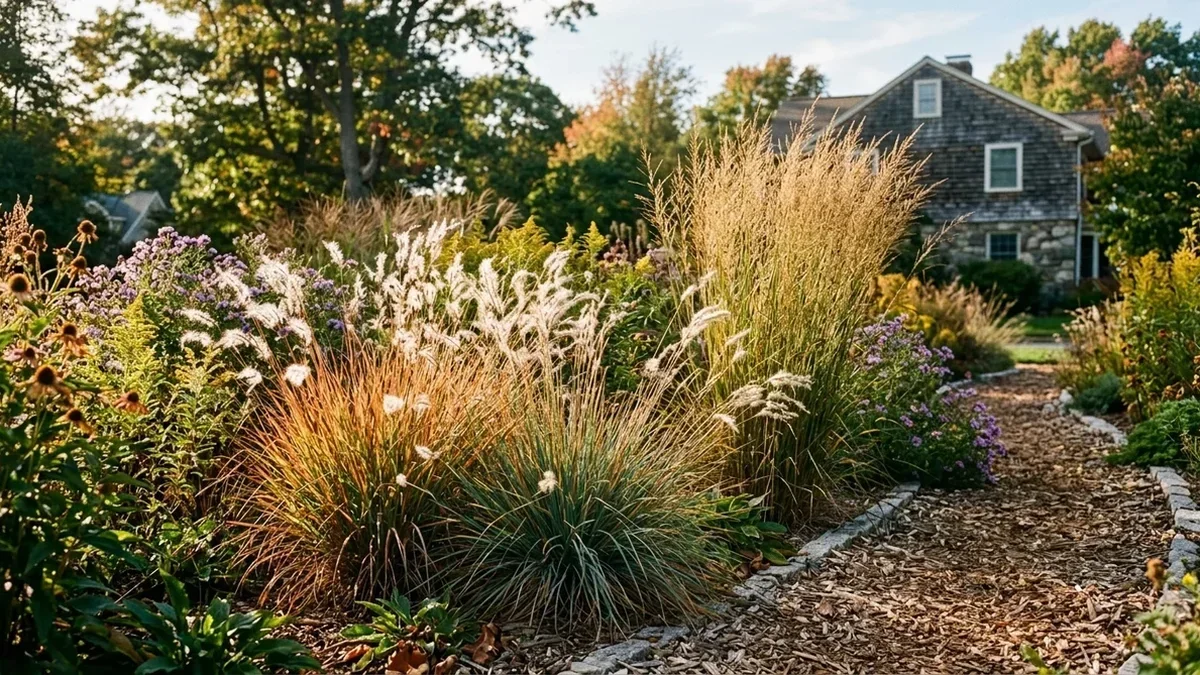
2. Fine-Textured Ornamental Grasses
Hydrangeas have massive, coarse leaves and heavy flower heads. Pairing them with linear, fine-bladed ornamental grasses creates dynamic visual energy and motion. Top partners: Feather Reed Grass ('Karl Foerster'), Japanese Forest Grass (Hakonechloa), and Little Bluestem.
Can Soil pH Change Hydrangea Color? Science vs. Myths
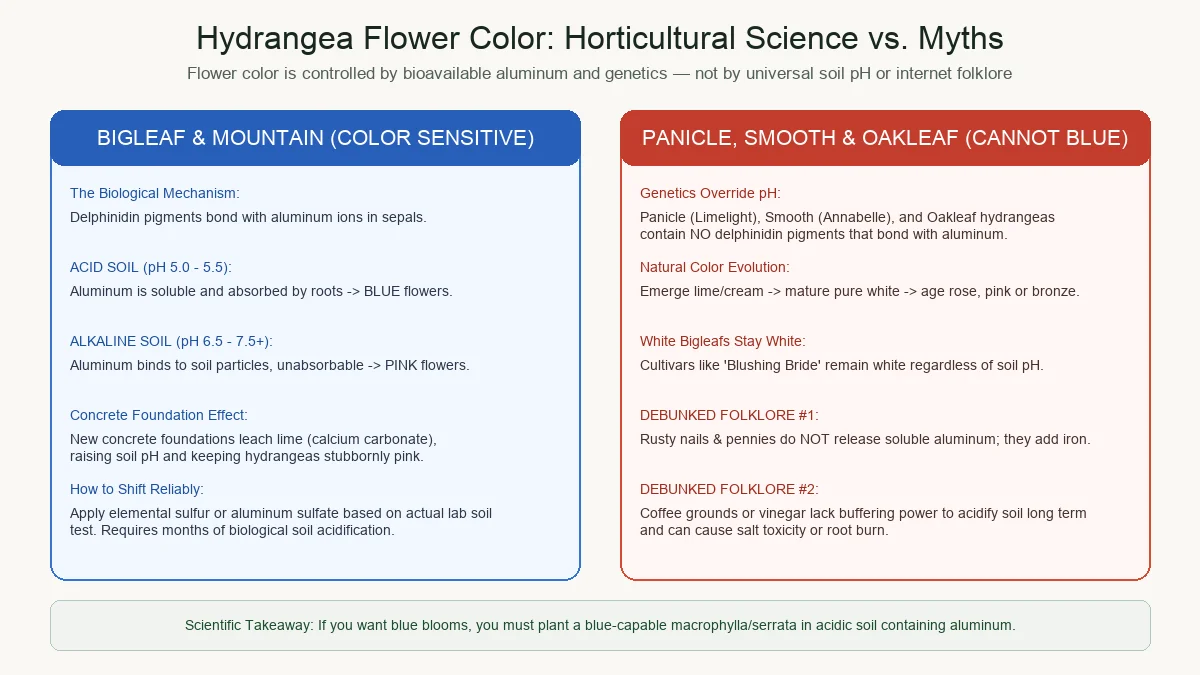
No horticultural topic is surrounded by more internet misinformation than changing hydrangea flower color. The fundamental science confirmed by university soil laboratories (such as Penn State and UMass Extension) boils down to two facts:
Hydrangea sepals turn blue ONLY when aluminum ions (Al3+) bond with delphinidin-3-glucoside pigments inside the floral cells. Soil pH merely dictates whether aluminum is chemically soluble: in acidic soils (pH 5.0–5.5), aluminum dissolves and roots absorb it (yielding blue flowers). In neutral or alkaline soils (pH 6.5+), aluminum binds tightly to soil particles and roots cannot absorb it (yielding pink flowers).
Only Hydrangea macrophylla (Bigleaf) and Hydrangea serrata (Mountain) contain delphinidin pigments that react to aluminum. Panicle hydrangeas, smooth hydrangeas, and oakleaf hydrangeas CANNOT be turned blue under any circumstances! Their white flowers age to pink or bronze through natural anthocyanin breakdown completely independent of soil chemistry.
Debunking Popular Gardening Folklore:
- The Rusty Nail & Penny Myth: Rusting iron nails release iron oxide (Fe), not aluminum (Al). Pennies are made of zinc-coated copper. Neither contains soluble aluminum, so neither will turn flowers blue.
- The Coffee Ground Myth: Fresh or brewed coffee grounds do not possess sufficient acid-buffering capacity to alter the pH of native garden soils. When applied excessively, decomposing coffee grounds can form water-repellent mats and cause root-zone fungal issues.
- The Vinegar Myth: Pouring vinegar into soil provides a temporary, erratic acid spike that quickly washes out with the next rainfall, often burning tender feeder roots in the process.
Old Wood vs New Wood: Why Pruning Timing Matters
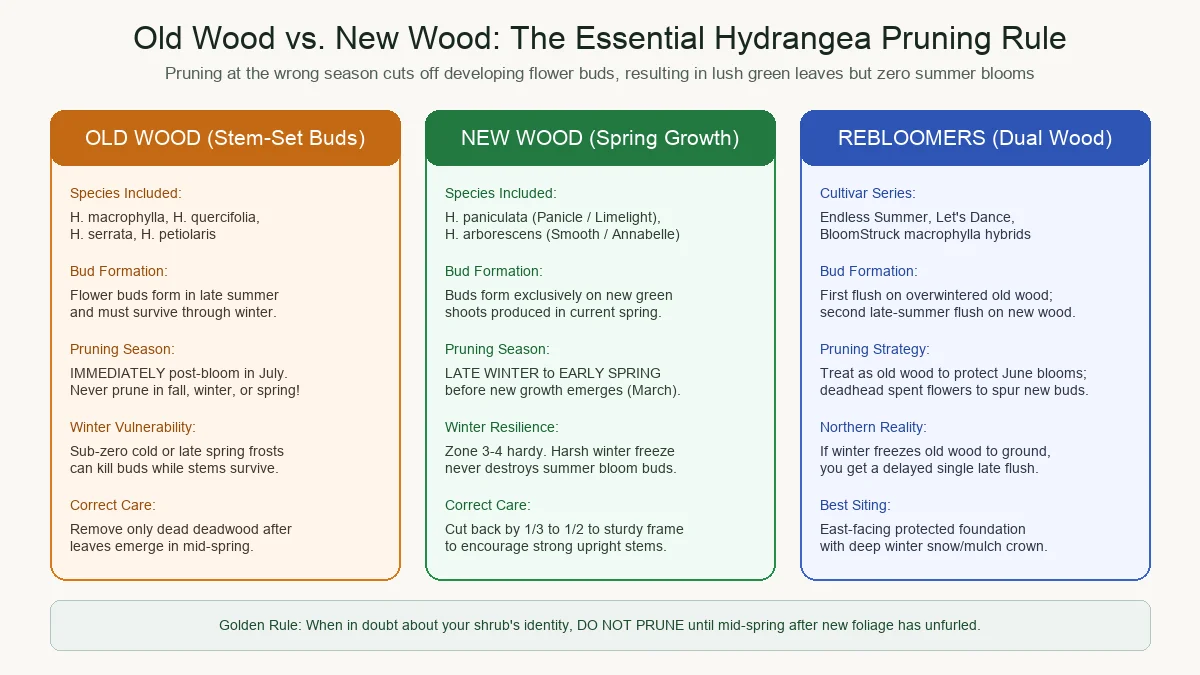
Pruning a hydrangea at the wrong time of year is the single most common reason why mature shrubs produce lush green foliage but fail to yield a single blossom. Every species falls into one of three pruning categories:
Category A: Old-Wood Bloomers (Buds Set in August)
Never Prune in SpringSpecies: H. macrophylla (standard Bigleaf), H. quercifolia (Oakleaf), H. serrata (Mountain), H. anomala subsp. petiolaris (Climbing).
These shrubs initiate embryonic flower buds inside their terminal stem nodes during late summer (August–September). Those buds must survive the entire winter intact. If you prune the shrub in autumn, winter, or early spring, you sever the buds. Pruning Rule: Prune only immediately after blooms fade in July, or wait until mid-May and cut out only dead, leafless winter twigs.
Category B: New-Wood Bloomers (Buds Form on Spring Shoots)
Prune in Late WinterSpecies: H. paniculata (Panicle / 'Limelight' / 'Bobo'), H. arborescens (Smooth / 'Annabelle' / 'Incrediball').
These species develop flower buds exclusively on fresh green growth produced in the current spring. Harsh winter sub-zero freezes can kill outer canes without affecting summer blooms. Pruning Rule: Cut back by 1/3 to 1/2 in late winter or early spring (March) before new growth appears. This encourages thick, sturdy branching that supports massive flower heads without drooping.
Category C: Reblooming Hybrids (Dual Wood Bloomers)
Selective Summer DeadheadingCultivars: Endless Summer series ('The Original', 'BloomStruck', 'Summer Crush'), Let's Dance series.
These patented hybrids produce an initial flower flush from overwintered old-wood buds in June, followed by a secondary flush on new spring stems in late summer. Pruning Rule: Treat them as old-wood plants: avoid cutting canes in spring so you protect the early flush, and snip off spent flowers in July to redirect the shrub's metabolic energy into producing the secondary late-season flush.
How to Make a Hydrangea Landscape Look Good in Winter
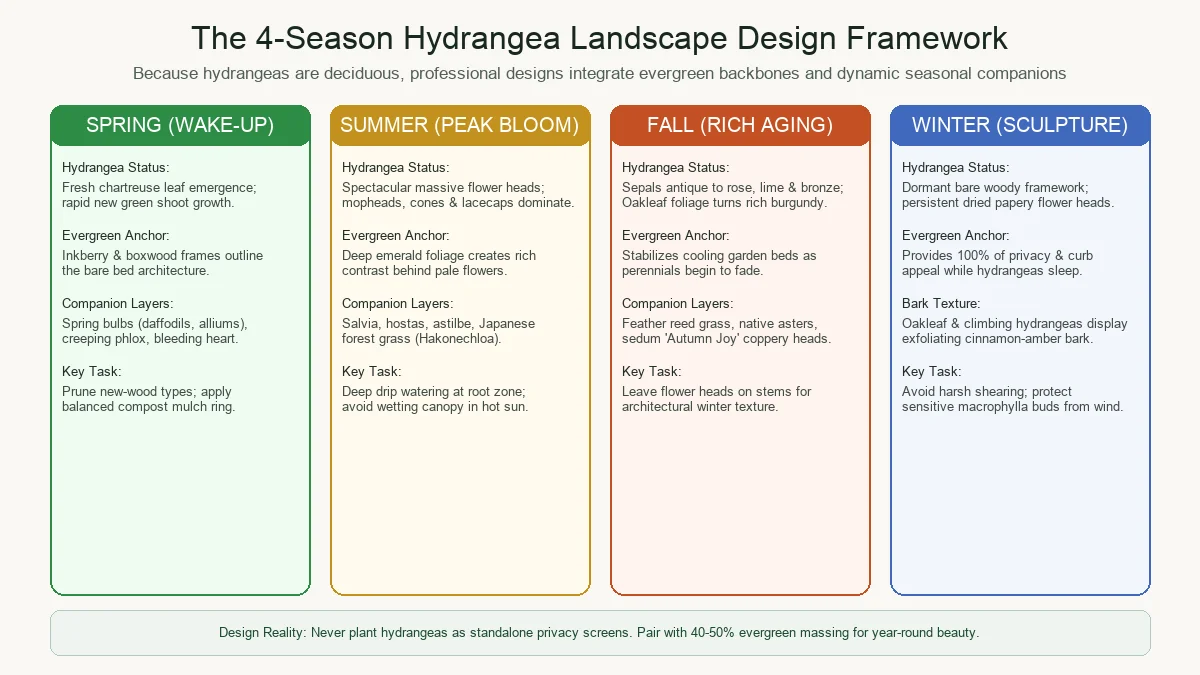
Too many homeowners make the mistake of aggressively shearing their hydrangeas back to bare ground in November, leaving their garden beds flat, barren, and visually depressing for five months.
Professional landscape designers deliberately leave faded hydrangea flower heads intact on the stems throughout late autumn and winter. The dried, papery sepals weather to warm shades of buff, amber, and russet, acting as natural sculptural snow-catchers during winter storms.
Furthermore, Oakleaf hydrangeas (Hydrangea quercifolia) and Climbing hydrangeas (Hydrangea anomala subsp. petiolaris) feature rich cinnamon-colored bark that exfoliates in shaggy, papery curls along mature woody trunks, creating extraordinary textural contrast when silhouetted against dark evergreen needles or light snowfall. Wait until late winter or early spring (just before buds swell) to remove the dried flower heads.
Common Hydrangea Landscaping Mistakes to Avoid
Purchasing a shrub based on a glamorous nursery tag without verifying its botanical species, hardiness zone, or pruning requirements.
Planting standard 8-to-10-foot cultivars (like standard 'Limelight') underneath 3-foot window sills, forcing destructive annual shearing.
Crowding root balls against exterior walls, trapping moisture against cladding, and exposing shrubs to lime-leaching concrete footings.
Failing to account for mature spread, resulting in heavy wet flower heads collapsing across walkways after summer downpours.
Siting sun-loving panicle hydrangeas in dense shade, which results in weak, spindly stems and sparse, undersized blooms.
Planting bigleaf mopheads in harsh western exposure without midday shade, causing severe foliage scorch and constant chronic wilting.
Dousing panicle, smooth, or oakleaf hydrangeas with aluminum sulfate hoping for blue flowers, ignoring that they lack delphinidin pigments.
Relying on unbuffered kitchen scraps or iron nails instead of conducting a certified soil test and applying elemental agricultural sulfur.
Shearing bigleaf or oakleaf hydrangeas in April, inadvertently lopping off all the overwintered flower buds formed the previous August.
Treating hydrangeas like formal boxwood hedges, stripping away their natural graceful arching growth habit.
Expecting a deciduous shrub to block neighbor views during the 5–6 months of winter dormancy when all foliage has dropped.
Confusing a preference for consistent soil moisture with tolerance for saturated, waterlogged soil, causing rapid pythium root rot.
Using lawn rotary sprinklers that drench large hydrangea leaves, fueling severe outbreaks of cercospora leaf spot and powdery mildew.
Locating shrubs directly below roof drip lines where torrential storm sheets and heavy winter ice loads snap main woody stems.
Mislabeling Asian species (Bigleaf, Panicle, Mountain) as native plants; only Smooth and Oakleaf hydrangeas are indigenous to the United States.
Expecting heavy mophead cultivars to feed native bees; dense mopheads consist almost entirely of sterile showy sepals with zero nectar.
Siting tender bigleaf hydrangeas in northern zones in open northwest wind corridors where winter gales freeze buds dry.
Planting one of every single cultivar in a chaotic hodgepodge rather than repeating unified drifts of 3 to 5 matching plants.
Frequently Asked Questions About Hydrangea Landscaping
Answers
Frequently asked questions
01How do I choose the right hydrangea for my landscape?
Select your hydrangea following a strict 4-step sequence: (1) Sun Exposure (panicle hydrangeas tolerate full sun, while bigleaf and oakleaf require morning sun or partial shade); (2) Available Space at Maturity (never buy based on 2-gallon nursery pot size; choose dwarf cultivars like 'Bobo' or 'Invincibelle Wee White' for 3-foot window sills); (3) Pruning Wood Class (panicle and smooth bloom on new spring wood and can be cut back in late winter, whereas bigleaf and oakleaf set flower buds on old wood the previous summer); and (4) Soil Drainage (hydrangeas require consistently moist, humus-rich soil and will quickly suffer root rot in saturated, waterlogged winter ground).
02Can all hydrangeas be turned blue with aluminum or soil acidifiers?
No. Only Bigleaf hydrangeas (Hydrangea macrophylla) and Mountain hydrangeas (Hydrangea serrata) possess the delphinidin pigments capable of binding with aluminum ions to produce blue or purple flowers. Panicle hydrangeas (H. paniculata), Smooth hydrangeas (H. arborescens), and Oakleaf hydrangeas (H. quercifolia) contain no delphinidin pigments; their blooms emerge lime, white, or cream and age to shades of rose, cranberry, or bronze regardless of soil pH or aluminum additions. Furthermore, white-flowered cultivars of bigleaf hydrangeas (such as 'Blushing Bride') remain white and cannot be turned blue.
03Why do my hydrangeas have lush green leaves but never bloom?
The two most common reasons for a lack of flowers are: (1) Pruning at the wrong time of year: cutting back old-wood hydrangeas (bigleaf, oakleaf, mountain) in autumn, winter, or early spring removes the overwintering flower buds formed the previous August; and (2) Winter bud kill: in USDA Zones 3 through 5, extreme winter temperatures below -5°F or late spring freeze-thaw cycles kill tender old-wood buds even though the woody stems survive. To guarantee flowers in cold northern climates, plant new-wood blooming species (panicles and smooth hydrangeas) or cold-hardy reblooming bigleaf cultivars.
04When should I prune my hydrangeas?
Pruning timing depends entirely on whether your species blooms on 'new wood' or 'old wood': Prune New-Wood Hydrangeas (Panicle and Smooth) in late winter or early spring (March) before new shoots emerge; you can cut them back by 1/3 to 1/2 to build a sturdy woody framework. Prune Old-Wood Hydrangeas (Bigleaf, Oakleaf, Mountain, and Climbing) immediately after their summer flowering finishes in July; never cut them back in fall, winter, or spring, as doing so removes next season's flower buds.
05How far away from the house foundation should I plant hydrangeas?
Center your hydrangea root ball at a distance equal to half the shrub's mature spread plus a 12-to-24-inch airflow buffer. For example, a cultivar with a mature width of 5 feet should be planted at least 3.5 to 4.5 feet away from the exterior wall. This buffer prevents branches from trapping moisture against exterior cladding, preserves siding ventilation, facilitates home maintenance access, and keeps roots away from alkaline concrete foundation footings that leach lime into the soil.
06Are hydrangeas good for evergreen privacy hedges?
No. All hydrangeas are completely deciduous woody shrubs. Between November and April across the United States, they drop 100% of their foliage, leaving bare woody canes and dried flower heads that provide zero visual screening or privacy. To design a functional hedge, pair hydrangeas with a permanent evergreen structural backbone (such as Inkberry Holly, Hicks Yew, or Arborvitae) so your landscape retains privacy and structural presence throughout the winter months.
07What companion plants look best with hydrangeas?
The most successful hydrangea designs combine four distinct companion layers: (1) Evergreen Anchors (Inkberry holly, boxwood, rhododendron) to provide winter structure; (2) Fine-Textured Ornamental Grasses (Japanese forest grass, feather reed grass, little bluestem) to balance coarse hydrangea foliage; (3) Woodland Perennials & Ferns (hostas, ostrich ferns, bleeding hearts, coral bells) for rich textural contrast; and (4) Vertical Flower Accents (salvia, alliums, coneflowers, asters) that introduce contrasting purple and violet spikes.
08Can hydrangeas grow in full sun?
Panicle hydrangeas (Hydrangea paniculata) thrive in full sun (6 to 8+ hours of direct sunlight) across most of the United States, provided they receive adequate soil moisture. Smooth hydrangeas (H. arborescens) can also tolerate full sun in northern zones (USDA 3–6) if mulched deeply. However, Bigleaf hydrangeas (H. macrophylla) and Oakleaf hydrangeas (H. quercifolia) suffer severe leaf scorch and midday wilting in hot afternoon sun across the Central and Southern US; they perform best with gentle morning sun and shaded afternoon shelter.
09Is there really such a thing as a 'Hydrangea Tree'?
A 'hydrangea tree' is not a naturally occurring botanical tree species; it is a standard-trained Panicle Hydrangea (Hydrangea paniculata, commonly 'Limelight', 'Grandiflora', or 'Pinky Winky') grafted or pruned into a single upright woody trunk with a rounded, weeping floral head. They typically mature at 8 to 12 feet tall and make excellent architectural focal specimens in front yards, patio corners, and lawn islands.
10Which hydrangea species are native to the United States?
Only two primary species are native to North America: Smooth Hydrangea (Hydrangea arborescens), native to the moist woods and stream banks of the Eastern United States, and Oakleaf Hydrangea (Hydrangea quercifolia), native to the Southeastern United States. Bigleaf hydrangeas (H. macrophylla), Panicle hydrangeas (H. paniculata), Mountain hydrangeas (H. serrata), and Climbing hydrangeas (H. petiolaris) are all native to East Asia (Japan, China, and Korea).
11Do coffee grounds, vinegar, or rusty nails turn hydrangeas blue?
No. These popular internet gardening folklore hacks are ineffective and potentially harmful. Rusty nails supply ferric iron (Fe), not soluble aluminum (Al), and will not alter flower color. Coffee grounds and vinegar have virtually zero buffering capacity in native garden soil and wash away before altering root-zone pH; excessive vinegar can burn delicate root hairs. To reliably turn eligible bigleaf hydrangeas blue, conduct a certified soil test and apply agricultural sulfur (to lower pH below 5.5) and aluminum sulfate according to university extension guidelines.
12How often should hydrangeas be watered in residential landscaping?
Newly installed hydrangeas require 1 to 1.5 inches of water per week through deep, infrequent soakings rather than brief daily sprinklings. Apply water directly to the soil surface using drip irrigation or a soaker hose beneath a 2-to-3-inch layer of organic bark mulch. Avoid wetting the leaves with overhead sprayers, which encourages cercospora leaf spot and powdery mildew. Mature, established panicle and oakleaf hydrangeas possess moderate drought tolerance once deep root systems develop.
Planning Hydrangea Landscaping in Peabody, MA?
The landscape design principles, spatial clearances, and companion layering rules detailed in this guide apply across the entire United States. However, actual hydrangea performance in Peabody, Danvers, Beverly, Salem, and Massachusetts North Shore communities is heavily shaped by local New England climate realities:
- USDA Hardiness Zone 6b & Winter Winds: Traditional old-wood bigleaf hydrangeas (H. macrophylla) frequently suffer terminal bud kill during sub-zero coastal Nor'easters and volatile March freeze-thaw cycles. For guaranteed annual summer blooms in Essex County, Massachusetts homeowners should prioritize ultra-hardy Panicle Hydrangeas ('Limelight', 'Bobo', 'Little Lime'), native Smooth Hydrangeas ('Incrediball'), or proven cold-hardy rebloomers ('BloomStruck').
- North Shore Soil & Glacial Till: Essex County soils range from rocky, fast-draining glacial till to dense marine clay. Incorporating well-rotted organic compost into planting beds and applying a 2-to-3-inch ring of shredded bark mulch is critical to conserving moisture during hot July spells without causing waterlogged winter roots.
- Native Planting Alternatives: Homeowners seeking ecological habitat value should explore our regional directory of native plants for Massachusetts, featuring native smooth hydrangea (Hydrangea arborescens), inkberry holly (Ilex glabra), and native New England ferns.
Peabody-area homeowners planning a comprehensive landscape renovation, foundation overhaul, or patio planting installation may request a consultation with an independent local landscaping contractor through LandscapingPeabodyMA.com.
Transform Your Property With Architectural Shrub Design
Connect with experienced local landscaping professionals for on-site design consultations, foundation bed renovations, and specimen shrub installations across the North Shore.
Get connected with an independent local landscaping professional. Calls go to (877) 537-6896.