Farmhouse Landscaping Ideas for a Welcoming, Timeless Yard
Move beyond sterile Pinterest templates and rustic flea-market clutter. Discover how authentic architecture, functional circulation, natural materials, and regionally adapted plant communities create enduring farmhouse landscapes across the United States.
Farmhouse landscaping combines practical outdoor living, natural materials, simple plant structure, and relaxed seasonal planting that honors the home's architecture. While traditional farmhouse designs feel functional and soft with shade trees and mixed borders, modern farmhouse landscapes emphasize cleaner lines, massed grasses, and restrained plant palettes. True farmhouse character comes from architectural harmony and regional plant suitability rather than decorative rustic props.
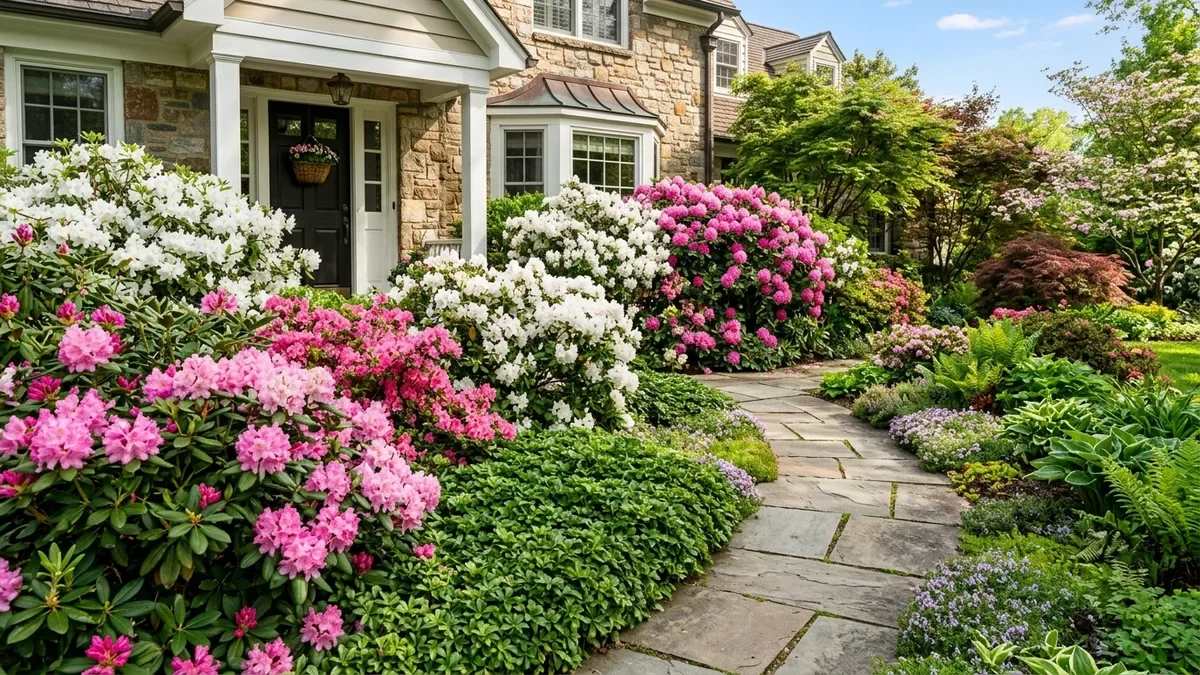
Which Farmhouse Landscape Style Fits Your Home?
Select your home's architectural style below to explore custom bed geometry, plant density, hardscape materials, and key design rules.
Traditional Farmhouse
Practical, welcoming, and grounded in working agrarian heritage.
Classic clapboard farmhouses, historic colonials, folk victorians, and gabled homesteads with broad front porches.
Gentle sweeping curves or simple straight foundation beds; minimum 5–8 ft depth to match two-story house scale.
Moderate density with grouped perennial drifts (3–5 plants) rather than tight formal clipping.
- Natural fieldstone or bluestone walkways
- Reclaimed red clay brick accents
- Simple painted wood or cedar split-rail fencing
- Undyed dark hemlock bark mulch
Large deciduous shade tree framing the roofline + evergreen corner anchors + mixed flowering shrubs and kitchen herb borders.
Sugar Maple or White Oak (Canopy), Inkberry Holly (Evergreen frame), Panicle Hydrangea ('Limelight'), Purple Coneflower, Culinary Lavender & Thyme
What Actually Makes Landscaping Feel 'Farmhouse'?
In contemporary consumer media, "farmhouse landscaping" has too often been reduced to a superficial formula: a white house with black window mullions, a row of tightly sheared boxwood spheres, a pair of oversized white hydrangeas, and an ornamental wagon wheel propped against a fence post.
This formulaic approach misinterprets the entire history of American rural architecture. Historically, farmhouse landscapes were never ornamental showpieces designed exclusively for curb-appeal photography. They were working environments governed by practical utility, climatic adaptation, and available local materials:
Direct, generous walkways connecting driveways, porches, kitchen gardens, and barnyards without confusing zig-zags.
Large deciduous canopy shade trees strategically sited to cool the roof and south-facing porches during blistering summer heat.
Locally quarried fieldstone, durable native timber, and kiln-fired brick chosen for longevity rather than trendiness.
Hardy flowering shrubs, culinary herbs, and long-lived perennials that thrive in native soil without fragile pampering.
To design a landscape that genuinely flatters your home, you must first understand which branch of the farmhouse architectural family tree your house belongs to.
Traditional vs Modern vs Country vs Cottage Farmhouse Landscaping
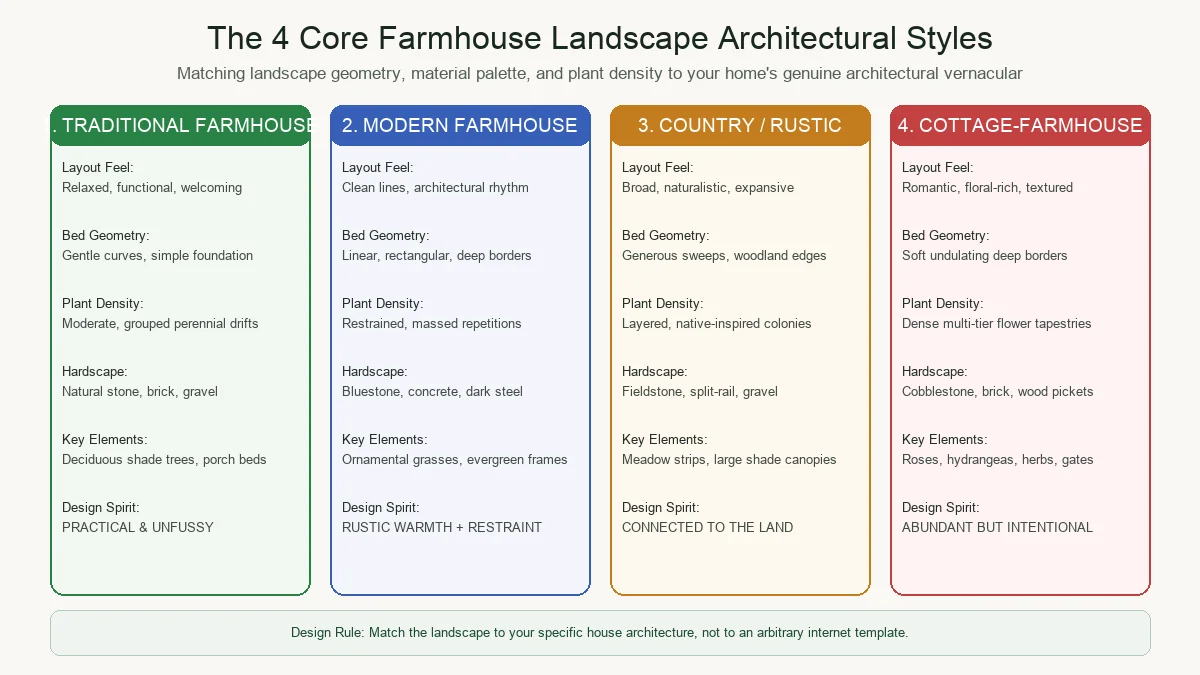
| Style Family | Bed Geometry | Plant Structure | Primary Materials | Fencing Role | Maintenance Feel | Best Architectural Fit |
|---|---|---|---|---|---|---|
| Traditional Farmhouse | Gentle sweeping curves, deep foundation beds | Shade trees + mixed flowering shrubs + perennial drifts | Fieldstone, red clay brick, gravel | Cedar split-rail or post-and-board | Moderate; seasonal mulching and pruning | Clapboard colonials, gabled homesteads |
| Modern Farmhouse | Crisp rectilinear lines, deep geometric boxes | Massed ornamental grasses + evergreen blocks | Bluestone slabs, steel edging, concrete | Horizontal cedar slat or black metal | Low to moderate; high species repetition | Board-and-batten, black trim, metal roof |
| Country / Rustic | Broad natural sweeps, meadow transitions | Heritage canopy trees + native bunchgrasses | Dry-stack stone, crushed stone, timber | Rustic locust split-rail, wire backing | Low; seasonal meadow mowing cycles | Rural acreage, bank barns, log homes |
| Cottage-Farmhouse | Soft undulating multi-tiered garden borders | Dense perennial tapestry, roses, hydrangeas | Cobblestone, reclaimed brick, cedar | White painted picket fence with arbor gate | High; continuous deadheading and dividing | Storybook cottages, saltboxes, Victorians |
Modern Farmhouse Landscaping Ideas
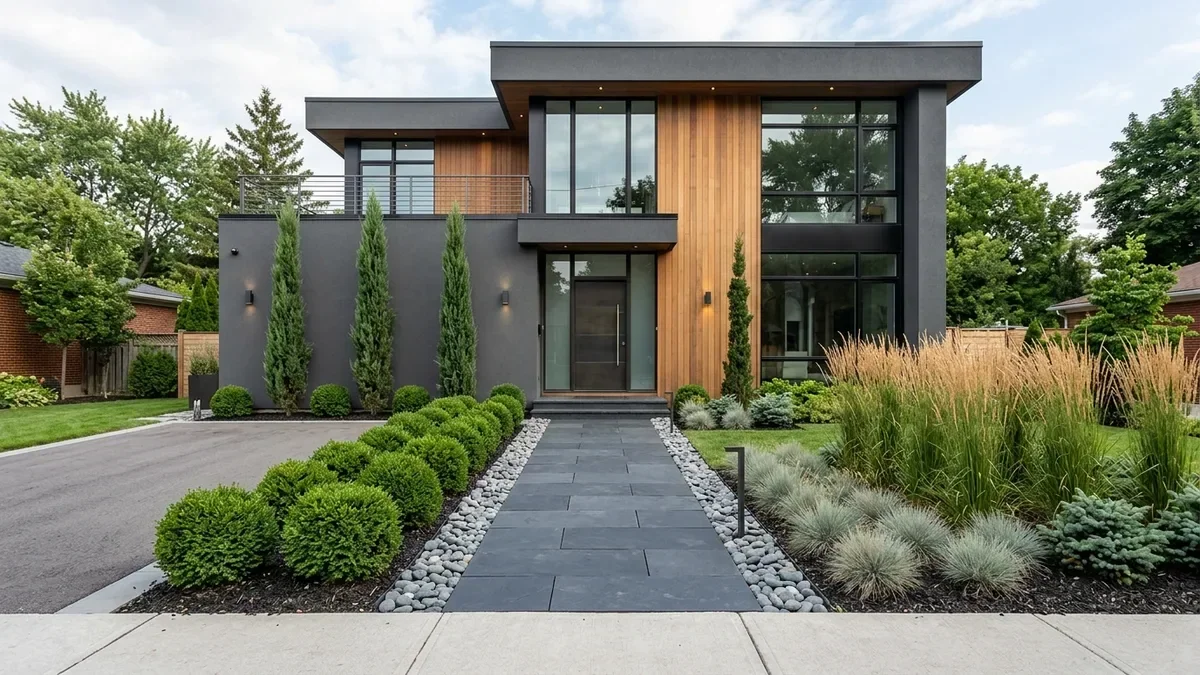
The 3 Pillars of Modern Farmhouse Restraint
Modern farmhouse architecture is characterized by strong vertical lines (board-and-batten siding), bold high-contrast trim (black window casings and standing-seam porch roofs), and expansive gable geometry. A successful modern farmhouse landscape supports these strong architectural statements through calculated restraint:
- The 3-Species Repetition Rule: Instead of dotting 15 different perennial varieties into a chaotic bed, select three core structural plants—for example, massed 'Karl Foerster' feather reed grass, dwarf 'Bobo' panicle hydrangeas, and low 'Winter Gem' boxwoods—and repeat them in bold rhythmic blocks of 5 to 9 plants.
- Crisp Hardscape Geometry: Replace wobbly, scalloped garden bed borders with razor-straight edges defined by 1/4-inch raw steel edging or deep, spade-cut English trenches. Pair with large-format bluestone or architectural concrete walkway slabs.
- Warm Grass Textures over Black Mulch Overload: Avoid dumping artificial dyed-black wood mulch everywhere. Instead, use soft, upright ornamental grasses and natural undyed hemlock mulch to inject warmth and movement that softens bold black-and-white architecture.
Traditional, Country & Cottage-Farmhouse Landscaping
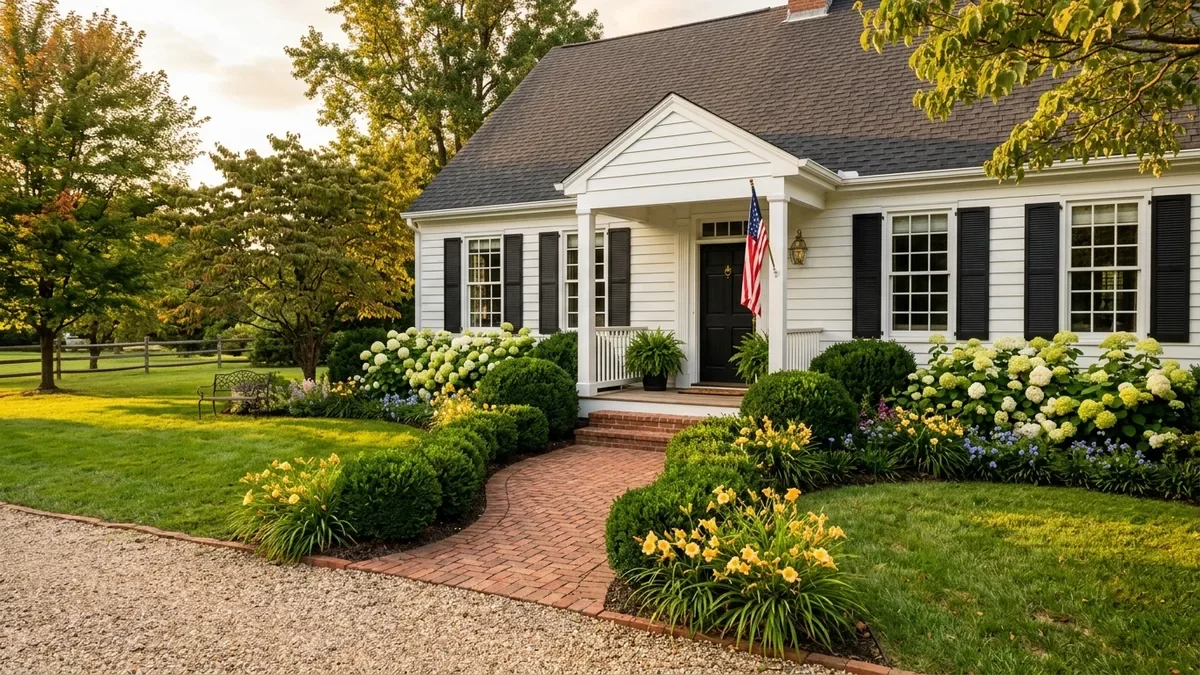
Traditional Farmhouse
Centered on family gathering and practical hospitality. Features simple stone or brick paths leading to a welcoming front porch, anchored by a majestic canopy shade tree (like sugar maple or white oak) and mixed flowering shrub borders.
Country & Rustic Farmhouse
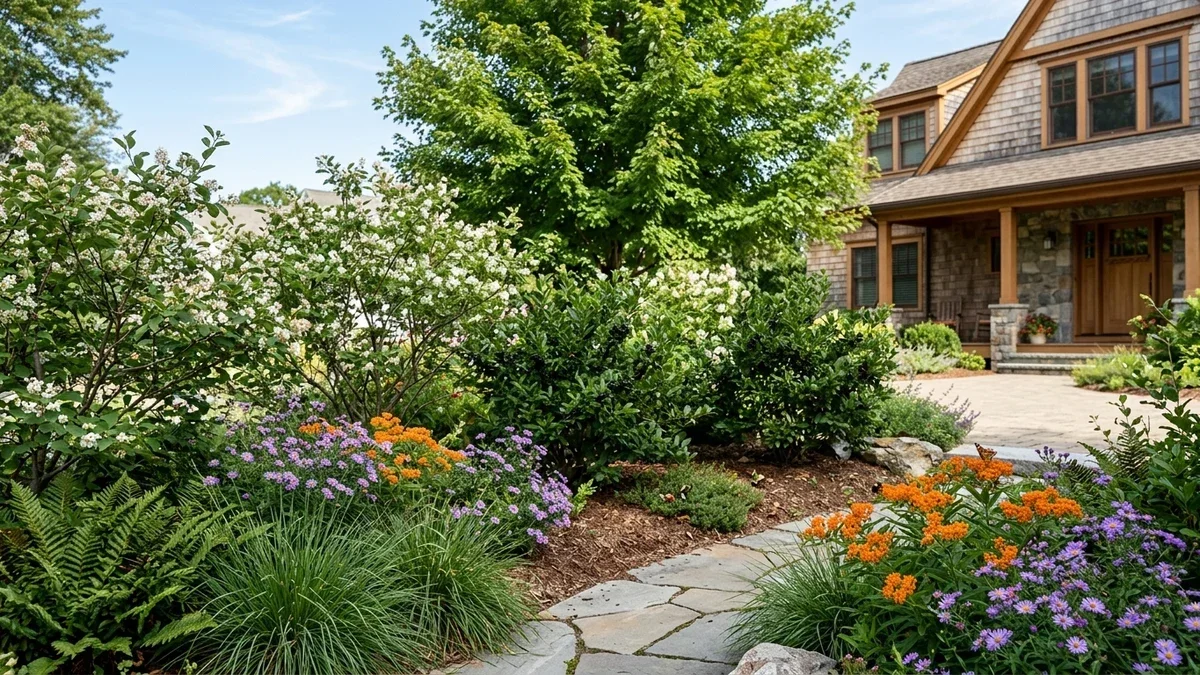
Grounded in the surrounding topography. Replaces small manicured beds with expansive borders of native shrubs, fieldstone walls, and mown pathways transitioning into natural meadows and pasture views.
Cottage-Farmhouse
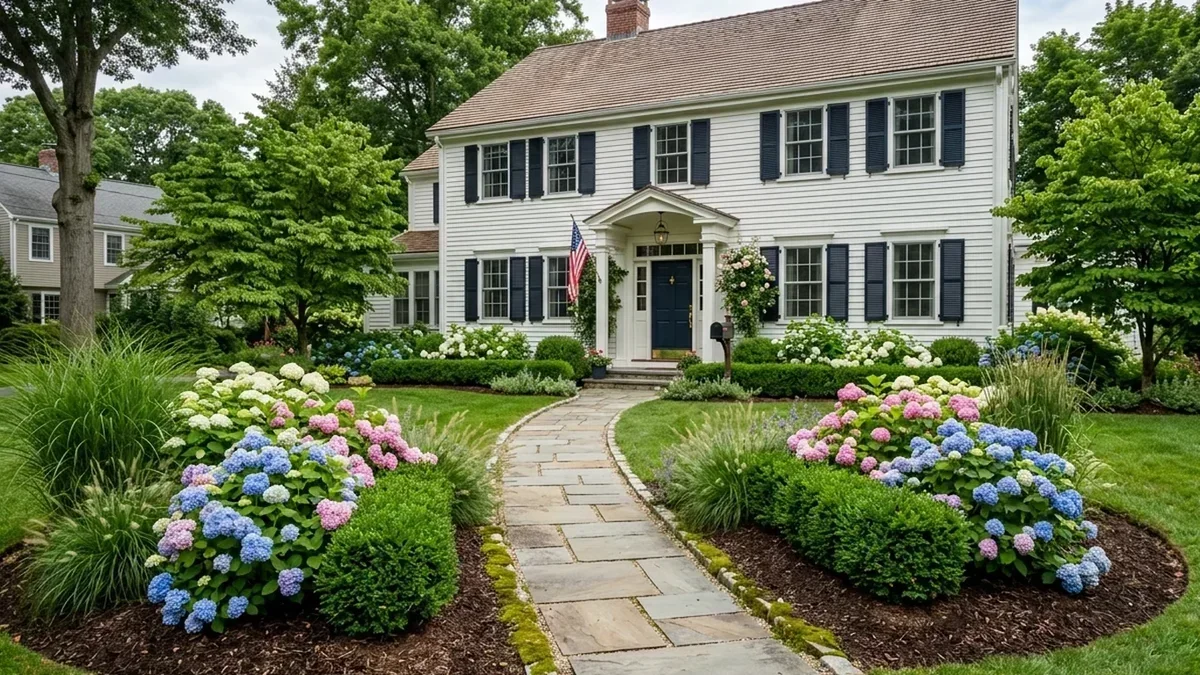
A romantic floral tapestry weaving climbing roses on porch posts, billowy hydrangeas, and soft perennial groundcovers that spill gently over bluestone borders, unified by white picket fencing and arbor gates.
Farmhouse Front Yard & Foundation Landscaping
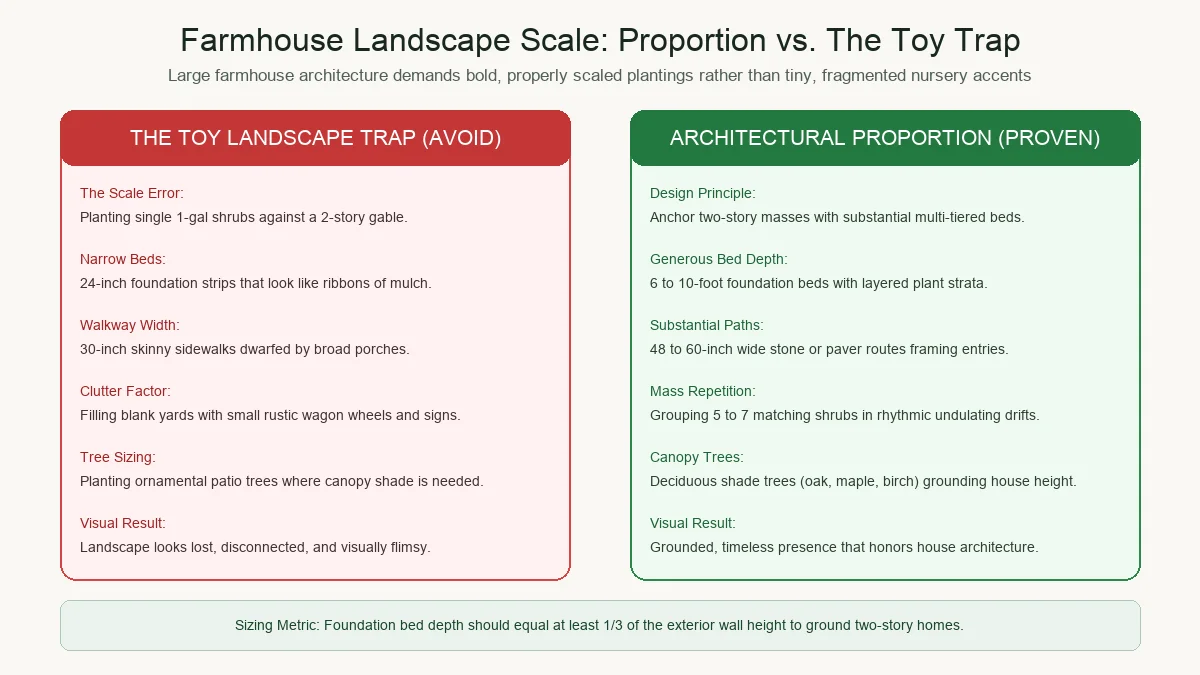
The most frequent design flaw in residential farmhouse landscaping is what landscape architects call the "Toy Landscape Trap." A farmhouse is typically a tall, commanding structure with steep roof gables, prominent chimneys, and two full stories of siding.
When a homeowner installs a timid 24-inch wide foundation bed planted with tiny, single 1-gallon shrubs spaced four feet apart, the plantings look visually ridiculous. The shrubs resemble green gumdrops lost against a towering wall.
To visually ground a two-story farmhouse, the foundation bed depth should equal approximately one-third of the exterior wall height (typically 6 to 10 feet deep). This generous depth permits a professional 3-tiered planting hierarchy:
- Back Layer (36"+ from siding): Upright structural evergreens or medium flowering shrubs anchoring blank wall sections.
- Middle Layer (24–36" height): Repeating drifts of ornamental grasses, hydrangeas, or flowering perennials.
- Front Edging Layer (6–18" height): Dense living groundcovers and creeping perennials softening the bed edge.
Framing the Front Porch & Designing Practical Walkways
Front Porch Framing Rules
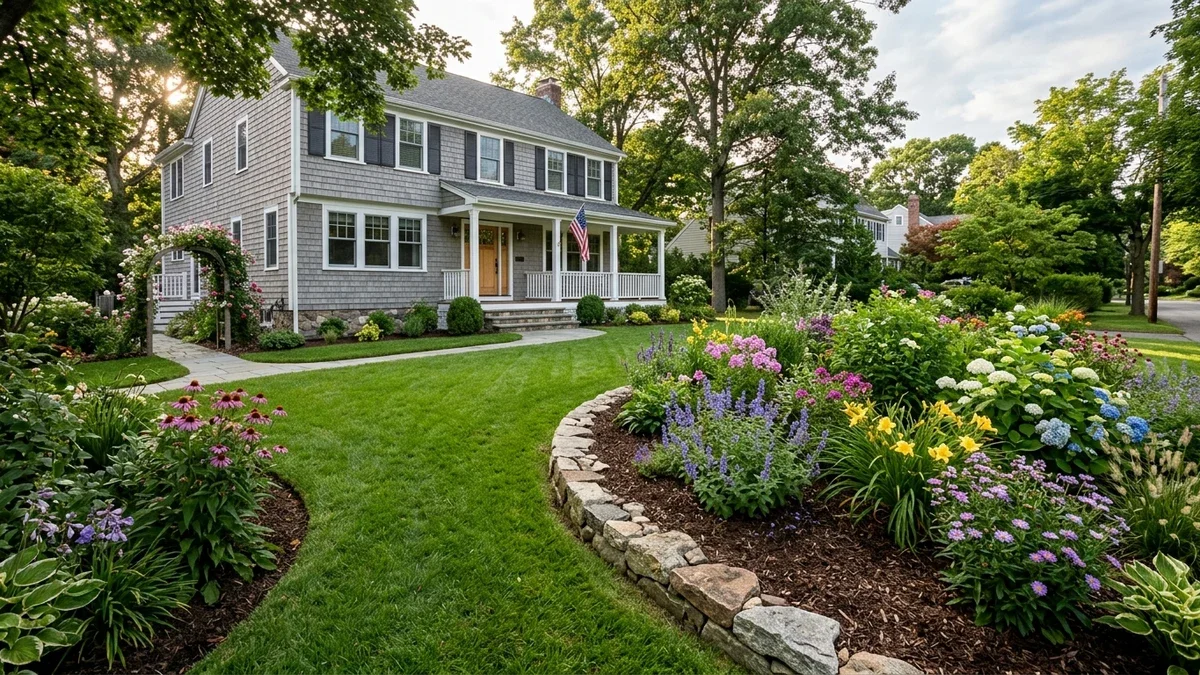
- Preserve Railing Sightlines: Keep shrubs along front porch railings under 30 to 36 inches mature height so guests seated on the porch enjoy unobstructed views of the yard.
- Anchor the Corners: Place taller, vertical evergreen anchors (like upright yew or holly) only at the outer structural porch posts.
- Siding & Lattice Airflow: Keep all plant root balls at least 24 inches away from porch skirting and lattice to prevent wood rot and termite pathways.
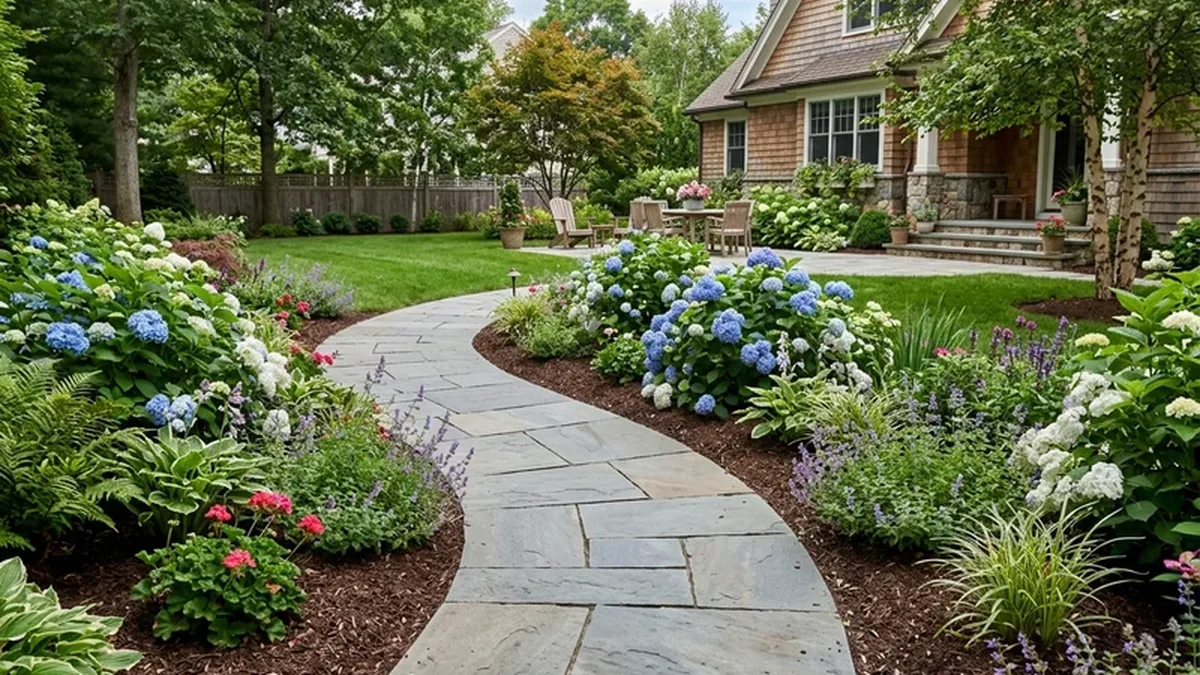
Farmhouse Walkway Geometry
- Width Standard: Primary entry walkways must be at least 48 to 60 inches wide so two adults can walk abreast comfortably.
- Setback Math: Center shrub root balls at half their mature spread plus a 12-inch buffer to avoid wet branch encroachments during rainstorms.
- The Gravel Caution: While gravel paths offer rustic charm for secondary garden strolls, they shift underfoot and are not accessible for wheelchairs or strollers.
Designing Farmhouse Beds With Hydrangeas & Ornamental Grasses
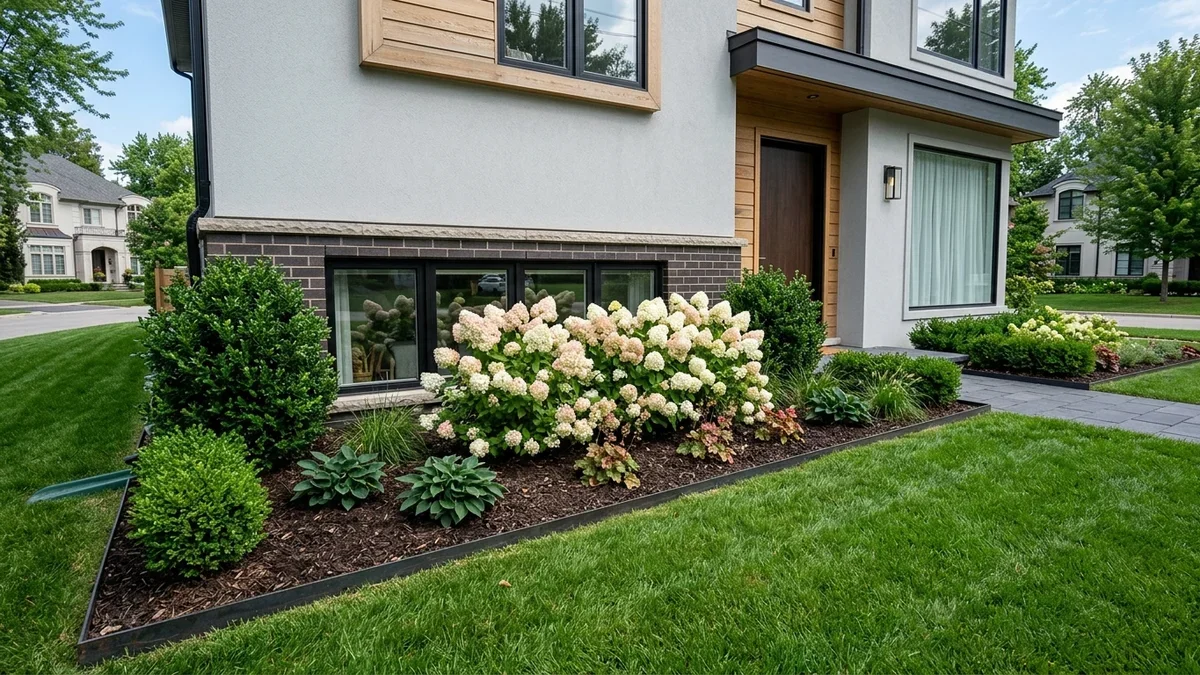
Hydrangeas in Farmhouse Design
Hydrangeas deliver unparalleled summer floral volume. However, remember that hydrangeas are 100% deciduous. If you plant hydrangeas alone along a foundation, your home will sit over bare brown sticks from November to April. Always pair hydrangeas with at least 40% permanent evergreen structure.
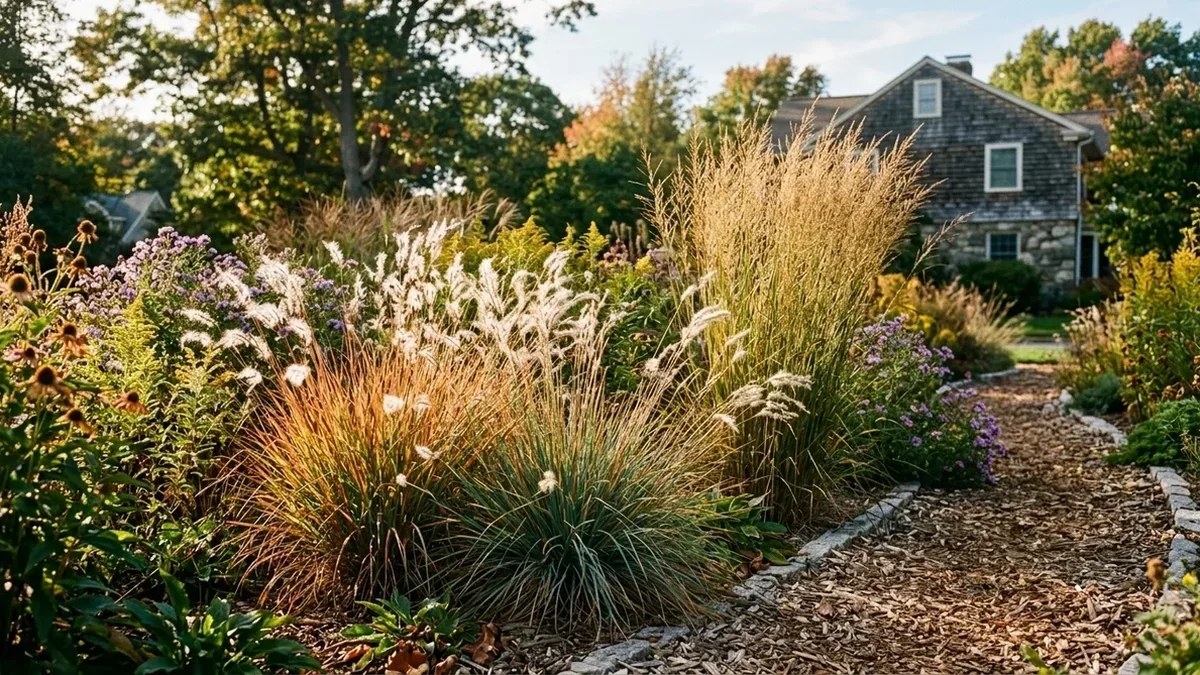
Ornamental Grasses in Farmhouse Design
Ornamental grasses inject fine-textured movement and wind whisper that softens bold vertical siding. Their coppery autumn plumes and upright winter silhouettes catch snow, providing critical four-season interest. Prioritize clump-forming native species like Little Bluestem and Switchgrass over invasive non-natives.
Native Borders, Meadow Edges & Kitchen Gardens
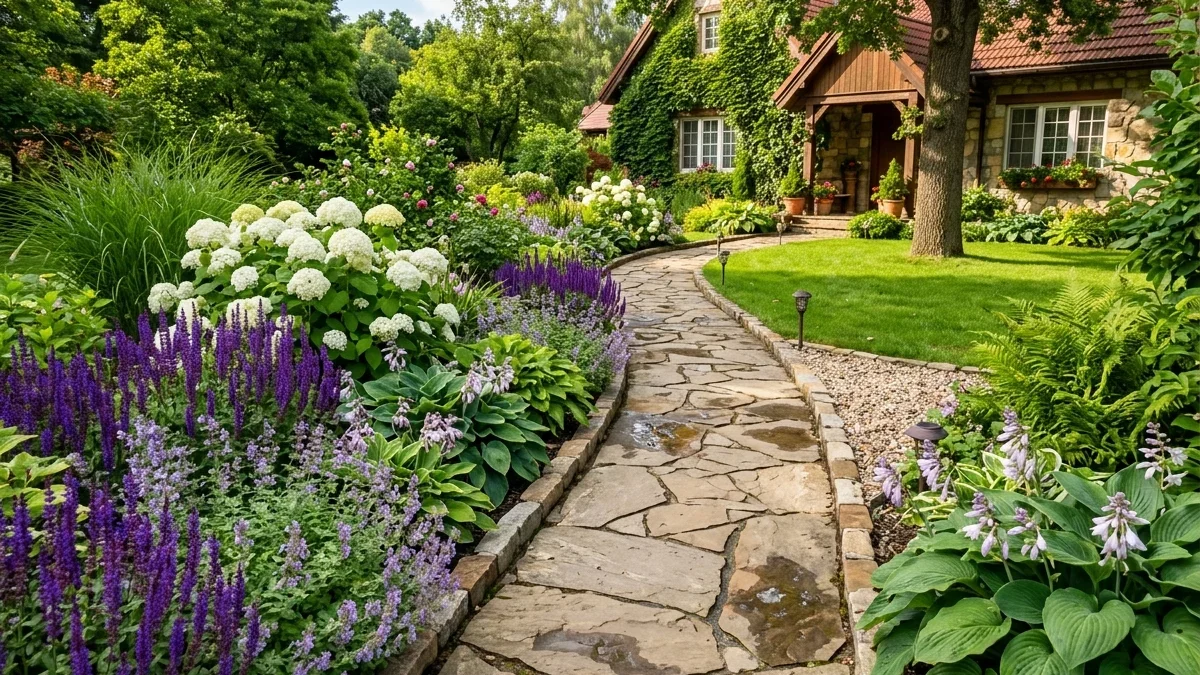
Structured Native Borders
Native plantings belong naturally on farmhouse properties. Organize native plants using structured 5-plant drifts and crisp stone edging to achieve intentional curb appeal while feeding local bees and birds.
Explore native plant landscaping →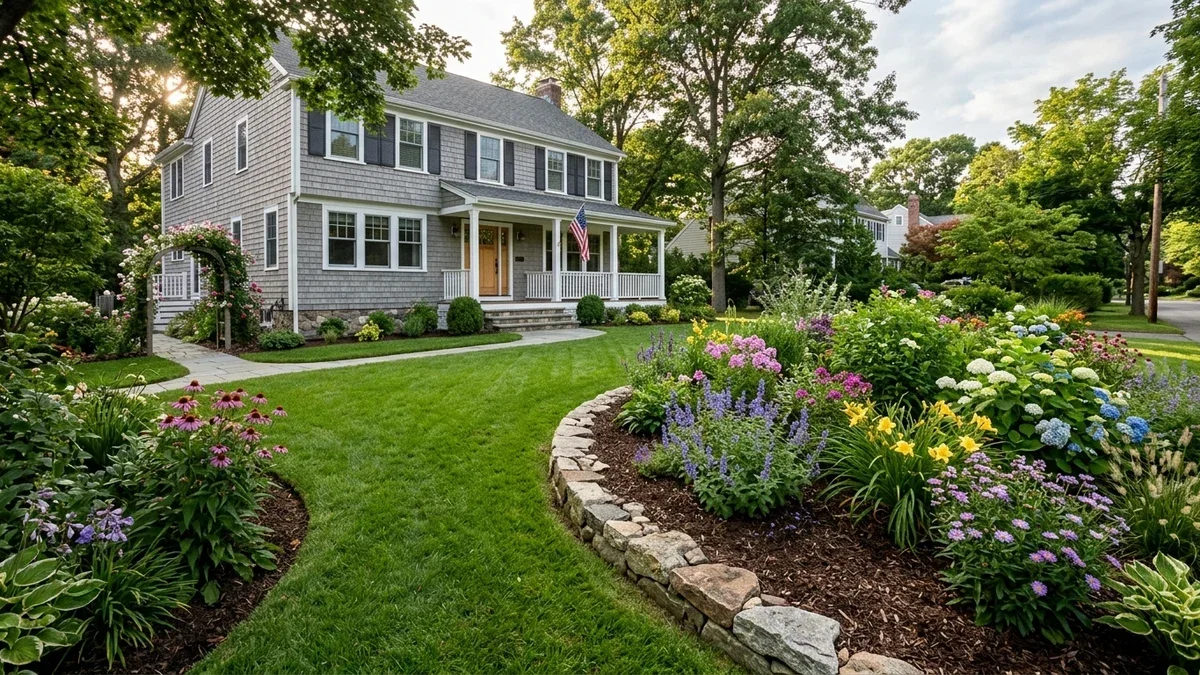
Farmhouse Meadow Transitions
For larger rural or suburban lots, convert unused outer turf into a low-mow native meadow. Maintain a clean 6-to-8-foot mown border along the road and walkways to demonstrate design intentionality.
See meadow garden ideas →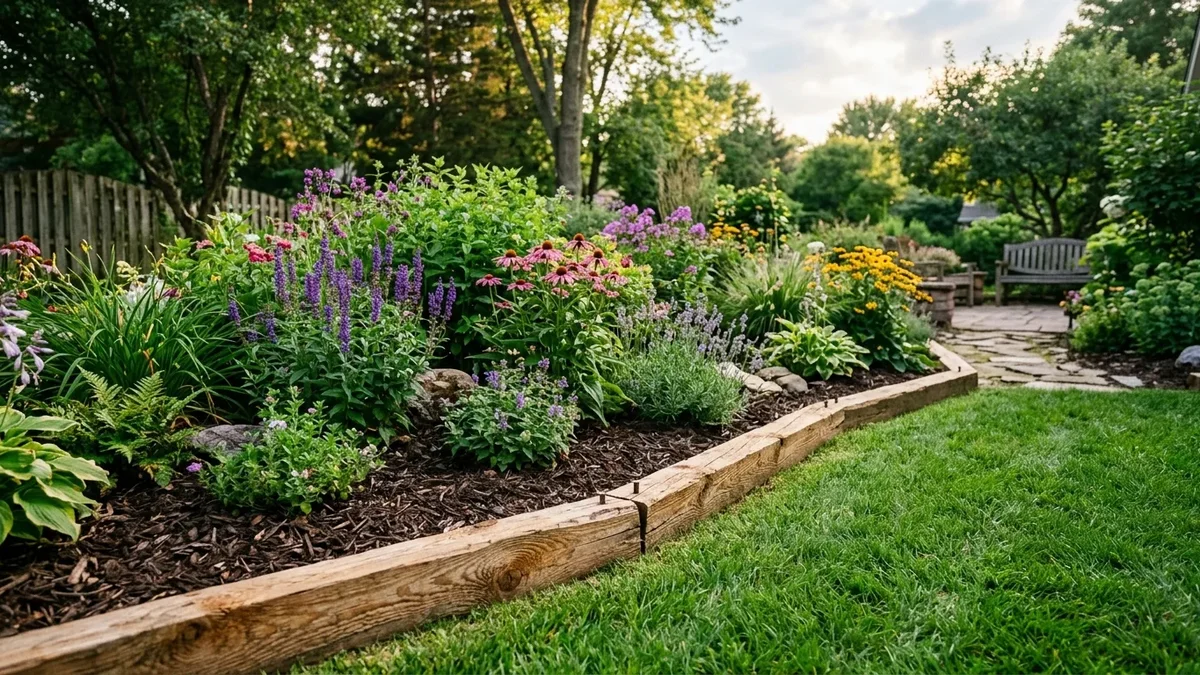
Potager & Kitchen Gardens
Historically central to farmhouse life. Elevate kitchen gardens into landscape focal points using rot-resistant cedar raised beds, wide gravel walkways, and companion borders of pollinator-friendly edible herbs.
Authentic Hardscape Materials: Restraint vs. Clutter
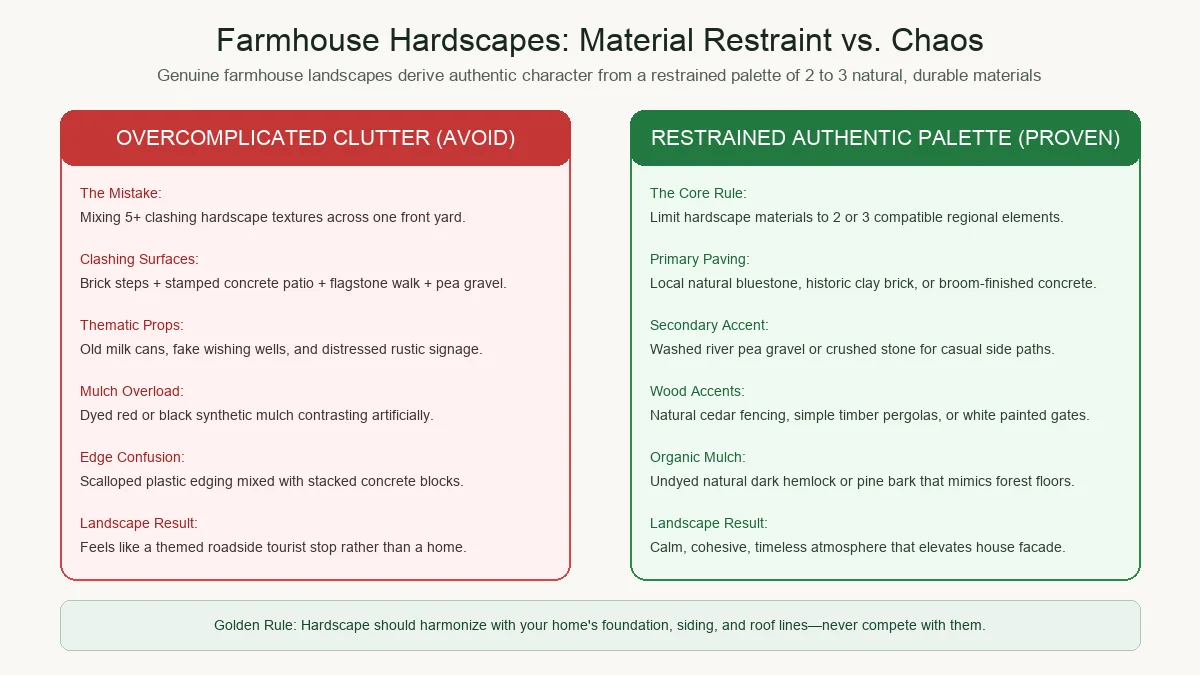
Authentic Farmhouse Material Palette Comparison
Select a material to inspect genuine architectural suitability, slip resistance, maintenance realities, and drainage truths.
Natural Bluestone & Flagstone
Primary front entry walkways, porch steps, dining patios, and courtyard flooring.
Exceptional (50+ years). Thermal-cleft surface provides natural non-slip wet traction.
Impervious surface when set on concrete base; sheds water as surface runoff. Permeable only when laid on open-graded aggregate joints.
Low. Occasional sweeping and periodic joint-sand stabilization. Tolerates winter freeze-thaw cycles without spalling.
The Four-Season Farmhouse Landscape Strategy
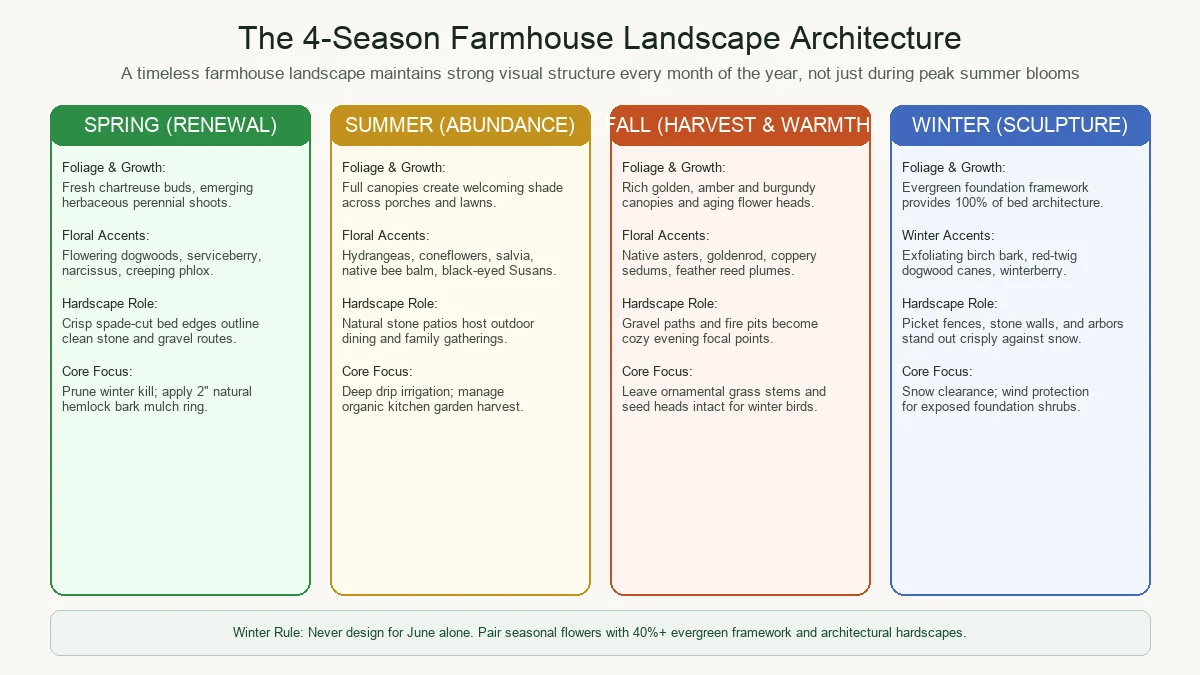
A garden that looks glorious in July but turns into a barren expanse of dead sticks from November through April fails the fundamental test of residential landscape design.
Professional farmhouse landscape plans balance ephemeral summer flowers with persistent architectural backbones: 40% cold-hardy evergreen shrub massing, the golden winter skeletons of ornamental grasses left standing until late winter, exfoliating cinnamon bark on River Birch trees, and the warm red twigs of native dogwoods silhouetted against deep winter snow.
How to Choose Farmhouse Plants for Your US Region
Regional Farmhouse Plant Palettes
Select your US geographic region to view verified native and adapted plant selections organized by architectural landscape role.
Northeast & New England
Massive stately canopy; glorious autumn orange-gold foliage.
Cold-hardy structural foundation blocks that withstand heavy snow shedding.
Blooms dependably on new wood; immune to winter bud freeze.
Upright coppery autumn blades holding snow across winter.
Long summer nectar succession transitioning into rich autumn violet.
Living green mulch carpeting bare soil beneath foundation shrubs.
Horticultural Sizing Rule: Before installing any species, verify its mature height and spread against your available bed dimensions. Never plant canopy trees beneath overhead power lines or large foundation shrubs flush against wooden house siding.
20 Common Farmhouse Landscaping Mistakes to Avoid
Replicating a Georgia or California farmhouse landscape in Minnesota or Maine without verifying cold hardiness or winter wind exposure.
Treating black trim, boxwood balls, and white hydrangeas as the only valid farmhouse aesthetic, ignoring traditional and rustic vernaculars.
Scattering old wagon wheels, milk cans, and distressed wooden signs across the yard until it looks like an antique roadside attraction.
Planting tiny 2-foot foundation beds and single 1-gallon shrubs that look dwarfed and lost against large two-story exterior facades.
Planting tall foundation shrubs that swallow porch railings, obscure front door sightlines, and block fresh air breezes.
Crowding shrubs against exterior walls, trapping moisture, promoting mildew, and creating termite and rodent bridges into the home.
Spreading pea gravel over poorly draining clay subsoils and assuming it eliminates standing water without subsurface pipes.
Installing 30-inch sidewalks that force family members and guests to walk single-file and brush against wet summer foliage.
Constantly hacking hydrangeas, spireas, and lilacs into geometric meatballs, destroying their natural graceful arching habit.
Relying 100% on hydrangeas and perennials along foundations, leaving bare woody canes for six months of the year.
Forcing a strictly monochromatic white floral palette, missing opportunities for warm native golds, ambers, and purples.
Combining brick, flagstone, stamped concrete, and river pebbles in a single small frontage, creating visual disorientation.
Planting large canopy trees (like oaks or maples) 6 feet from the house, causing future foundation and roof gutter damage.
Introducing aggressive, self-seeding species like Chinese Silvergrass (Miscanthus) that escape into native conservation woodlands.
Installing boxwood in humid, poorly ventilated shade where Volutella and Boxwood Blight rapidly defoliate entire shrub rows.
Adding tight, arbitrary S-curves that fight natural foot traffic desire lines, causing guests to cut across the lawn.
Pairing warm tan fieldstone with cool blue-grey siding, creating an unharmonized clash between hardscape and architecture.
Planting a yard and expecting it to manage itself without seasonal weeding, edging, pruning, or organic mulch top-offs.
Planting dense, resinous woody shrubs directly touching exterior walls in Western wildfire-prone mountain communities.
Placing utilitarian vegetable boxes directly in front of the main entry instead of integrating them gracefully into side or back yards.
Want to See a Farmhouse Landscape on Your Own Yard?
Upload a photo of your home into our free, real-time AI tool. Preview authentic modern, traditional, or rustic farmhouse landscape redesigns tailored to your exact property dimensions in seconds.
Frequently Asked Questions About Farmhouse Landscaping
Answers
Frequently asked questions
01What defines farmhouse landscaping?
Farmhouse landscaping is defined by practical outdoor organization, authentic natural materials (like native stone, gravel, and wood), generous porch connections, and simple, hardy plantings. Rather than rigid luxury formal gardens or prop-heavy rustic clutter, true farmhouse landscaping prioritizes useful circulation, large shade trees, structural evergreen backbones, and relaxed flowering borders that harmonize with the home's architecture.
02How does modern farmhouse landscaping differ from traditional farmhouse landscaping?
Modern farmhouse landscaping utilizes cleaner bed geometry (often straight or rectangular deep borders), a highly restrained color palette (predominantly green, white, and dark charcoal accents), and mass repetitions of fewer plant species (such as structural ornamental grasses and uniform shrub blocks). Traditional farmhouse landscaping is softer and more eclectic, featuring gentle sweeping bed curves, mixed perennial drifts, heirloom cottage flowers, and integrated kitchen herb patches.
03Are hydrangeas and boxwoods required for a farmhouse landscape?
No. While hydrangeas and boxwoods frequently appear in magazine photography, they are not universal requirements. Plant selection must be governed by your local USDA hardiness zone, sun exposure, soil drainage, and available mature space. In cold northern climates, smooth and panicle hydrangeas perform far better than tender bigleaf mopheads, while native inkberry holly (Ilex glabra) or yews provide superior disease-resistant alternatives to boxwood blight in humid regions.
04What walkway material looks best with a farmhouse?
Natural thermal bluestone, cleft flagstone, and historic kiln-fired clay brick are the most enduring and architecturally authentic walkway materials for traditional and cottage farmhouses. For modern farmhouses, large-format architectural concrete slabs or broom-finished concrete with clean saw-cut joints offer crisp complementary lines. Washed pea gravel is excellent for secondary garden stroll paths, but should not be used as an inaccessible main front entry surface.
Explore walkway landscaping ideas and material comparisons →
05Does pea gravel improve yard drainage in farmhouse landscapes?
No. This is a dangerous landscaping myth. Decorative pea gravel spread over compacted native soil is NOT an engineered drainage system. While surface stormwater trickles quickly through the gravel stones, it pools directly on the compacted subsoil beneath, creating soggy underground mud trenches. True stormwater management requires graded swales, catch basins, or engineered permeable pavement with open-graded aggregate reservoirs.
Learn how to solve standing water with our yard drainage guide →
06How do I landscape around a large farmhouse front porch?
Landscape around a front porch by framing its architectural lines rather than suffocating them. Use low-to-medium mounding shrubs and flowering perennials (under 3 feet mature height) along the front railing so sightlines from the porch to the yard remain open. Place taller structural evergreen anchors (like upright hollies or dwarf conifers) at the far outer corners of the porch, and ensure foundation plantings remain 24 to 36 inches away from wooden porch framing to allow ventilation and prevent moisture rot.
07Can I incorporate native plants into a farmhouse landscape without it looking messy?
Yes. Native plants fit farmhouse landscapes beautifully when you apply intentional design discipline: (1) Use crisp, defined 4-inch deep spade edges between planting beds and turf; (2) Group native perennials and grasses in bold, readable drifts of 3, 5, or 7 plants of the same species rather than single scattered plants; and (3) Anchor the bed with clean structural evergreens and natural stone paths that provide undeniable 'cues to care.'
08What are the best ornamental grasses for a modern farmhouse landscape?
Top architectural grasses include Karl Foerster Feather Reed Grass (Calamagrostis x acutiflora) for strong upright vertical accents; native Little Bluestem (Schizachyrium scoparium) for warm coppery-orange autumn and winter color; and Switchgrass (Panicum virgatum 'Northwind') for dense columnar habit and wind resistance. Always verify mature spread and avoid non-native invasive species like Chinese Silvergrass (Miscanthus sinensis) in vulnerable states.
09How can I landscape a farmhouse on a limited budget?
To achieve an authentic farmhouse look affordably: (1) Preserve existing mature shade trees and healthy woody shrubs rather than clear-cutting; (2) Create clean, bold bed shapes using a simple garden spade rather than expensive plastic edging; (3) Purchase smaller 1-gallon nursery stock of fast-growing perennials and mass them in rhythmic groups; (4) Focus 60% of your initial budget on the front entry walk and porch framing; and (5) Install a simple natural hemlock or pine bark mulch layer.
Review our top affordable landscaping ideas and budget strategies →
10Do I need a white picket fence for a farmhouse yard?
No. A white picket fence is an iconic feature of colonial cottage farmhouses, but it is not mandatory for all farmhouse styles. Rustic post-and-rail fences, black locust split-rail fencing, dry-stacked fieldstone field walls, or no fence at all are frequently more appropriate for country homesteads and modern farmhouses. If you install fencing, always leave a 12-to-18-inch setback buffer for maintenance mowing.
11How do I make a farmhouse landscape look good during winter?
Design for the four-season cycle by allocating at least 40% of your permanent woody shrub volume to cold-hardy evergreens (such as inkberry holly, boxwood, or yews). Leave the dried flower heads of panicle hydrangeas and ornamental grass plumes standing through winter to collect snow, and incorporate trees with exfoliating or colorful bark, like River Birch (Betula nigra) or Red-Osier Dogwood (Cornus sericea).
12How do I prevent foundation plants from outgrowing their space against a farmhouse?
Select cultivars strictly by their genetically determined mature height and spread, rather than their nursery pot size. For foundation beds beneath first-floor windows, choose dwarf cultivars that mature under 3 to 4 feet tall (such as 'Bobo' hydrangea or 'Shamrock' inkberry). Always center the root ball at a distance equal to half the shrub's mature width plus a 12-to-24-inch airflow buffer back from the house siding.
Planning a Farmhouse Landscape in Peabody, MA?
The architectural principles, proportion rules, and circulation strategies detailed in this guide apply across the United States. However, executing a farmhouse-style landscape in Peabody, Salem, Danvers, Beverly, and North Shore communities requires adapting to Massachusetts coastal realities:
- USDA Zone 6b Winter Hardiness: The North Shore experiences sub-zero Nor'easters, heavy lake-effect snows, and maritime salt spray along Route 128 corridors. Farmhouse foundation beds should emphasize hardy panicle hydrangeas ('Limelight', 'Bobo'), native inkberry hollies (Ilex glabra), and native switchgrasses that hold their structure through heavy snowfalls without splitting.
- Historic New England Granite & Fieldstone: For walkways and retaining walls, locally quarried Massachusetts granite, natural thermal bluestone, and aged New England fieldstone harmonize far more authentically with local architectural history than artificial imported pavers.
- Regional Design Assistance: Peabody-area homeowners planning a comprehensive front-yard overhaul, patio installation, or foundation redesign may request a consultation with an independent local landscaping contractor through LandscapingPeabodyMA.com.
Connect With Experienced North Shore Landscape Designers
Speak directly with independent landscaping professionals for site evaluations, foundation renovations, and custom stone walkway installations across Essex County.
Get connected with an independent local landscaping professional. Calls go to (877) 537-6896.