Landscaping Ideas With Rocks: Beautiful Ways to Use Stone in Your Yard
From natural granite boulders and smooth river cobbles to crushed stone walkways and drought-resilient gravel beds, discover 22 intentional ways to incorporate rock into residential landscapes across the United States.
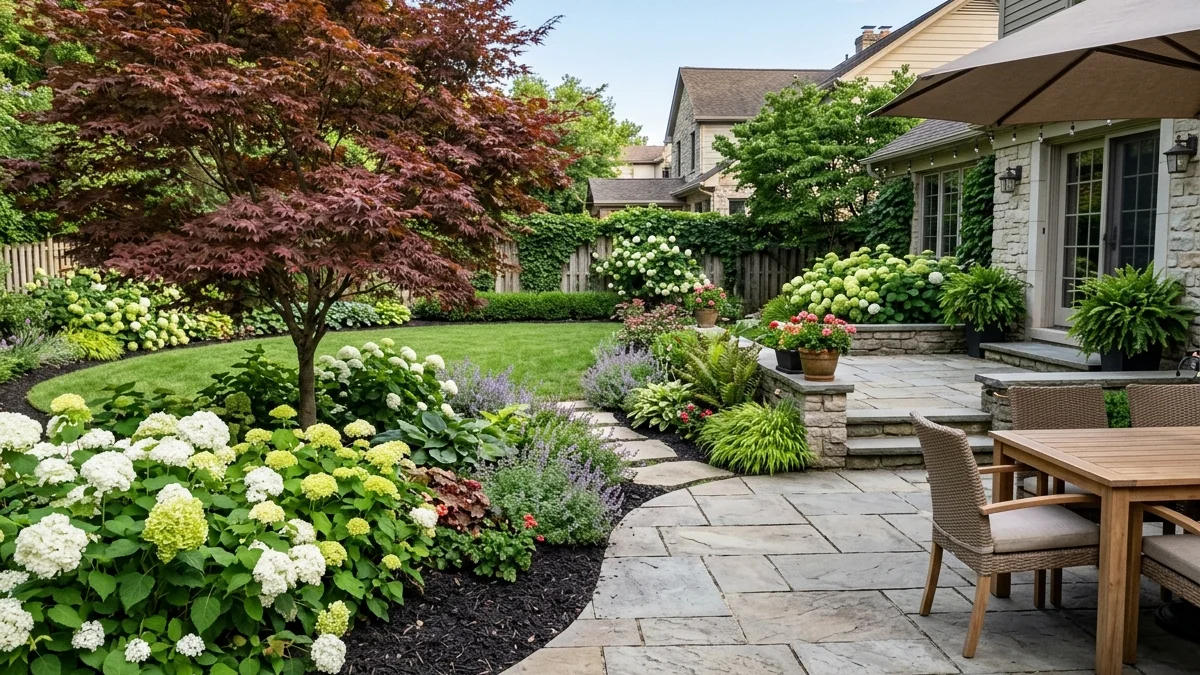
Direct Answer: How Should You Landscape With Rocks?
In residential design, rock is an enduring structural medium that brings texture, permanence, and geological character to outdoor living spaces. However, rock landscapes should never be viewed as sterile, maintenance-free desert voids. The most admired yards across the country combine stone with lush, region-appropriate plants that soften the mineral surfaces, prevent solar heat traps, and support local pollinators.
The Golden Rule: Every Stone Should Have a Job
Too often, DIY rock landscaping begins with good intentions and ends in visual disappointment: a homeowner dumps several tons of uniform white marble chips or round river rock across an open yard, only to find that it looks like an uninviting construction quarry or a scorching parking lot.
Professional landscape designers prevent this by giving stone an intentional role. Before purchasing a single ton of rock, determine what primary purpose it will serve:
Circulation & Utility
Interlocking crushed gravel provides firm, non-slip pathways, permeable dining patios, trash-bin service corridors, and mud-free dog runs.
Structure & Contrast
Partially buried boulders and crisp stacked fieldstone borders establish permanent vertical scale, frame soft perennial foliage, and anchor property edges.
Erosion & Fire Buffer
Heavy river cobbles absorb downspout impact to prevent soil scour, while a 3-foot stone perimeter provides noncombustible defensible space.
- Rock ≠ Zero Maintenance: Dust and blown-in leaves settle between stones, creating rich compost where weeds readily sprout.
- Rock ≠ Zero Water: Living plants growing in rock still require consistent irrigation, especially during initial establishment.
- Rock ≠ Automatic Drainage: Spreading gravel over impermeable clay does not fix ponding water; water simply collects under the stones.
- Rock ≠ Xeriscaping: True xeriscaping relies on sound irrigation, soil preparation, and climate-adapted plants—not barren rock fields.
Understanding Rock Scale: Ground Plane, Mid-Scale & Anchors
Landscape stones range from microscopic decomposed granite particles to multi-ton glacial monoliths. Understanding the three distinct visual tiers prevents your yard from looking like an undifferentiated gravel desert:
The Three Scales of Landscape Stone: Designing Visual Depth
One of the most common reasons DIY rock landscaping looks flat or artificial is using a single uniform rock size everywhere. Professional landscape architects create depth by combining ground plane, mid-scale, and anchor stones.
Anchor Scale (Landscape Boulders)
Establishes permanent visual weight, vertical scale, and sculptural focus. Boulders ground the entire composition, providing a timeless, weathered monumentality that anchors shrubs and trees.
Recommended Depth: Partially buried: sink the bottom 1/3 to 1/2 of the boulder below grade for naturalistic permanence
Walking Stability: Visual anchor; provides casual natural sitting perches when specified with a flat top face
Always cluster boulders in odd groupings (1, 3, or 5) of varying sizes. Pair with sweeping ornamental grasses and mounding evergreen shrubs nestled against the windward shoulder.
Filling an entire front yard with a single size of crushed stone, or perching solitary round boulders directly on top of flat grass like dinosaur eggs. It appears artificial, barren, and visually disconnected from the home.
Anchoring 1 to 3 partially buried boulders into an organic planting bed, cradling them with mid-sized river cobbles, and transitioning smoothly into a fine gravel walking surface softened by ornamental grasses and perennials.
The 11 Most Popular Landscaping Rocks & Where They Work Best
Different rock types possess wildly different properties. Angular stones lock together under foot pressure, while rounded stones roll like ball bearings. Light stones reflect sun, while dark stones absorb heat. Explore our interactive catalog below:
Types of Landscaping Rocks & Where They Work Best
Not all landscape stone performs the same. Sizing, angularity, mineral chemistry, and weight dictate whether a rock is suitable for walking, drainage, or planting beds.
Pea Gravel
Warm earth tones, tans, creams, and grays; classic smooth cottage texture
River Rock / River Cobbles
Naturally tumbled rounded stones; multi-color river blend, gray, or tan
Crushed Stone / Traprock
Sharp, clean, architectural gray, blue-gray, or charcoal; uniform modern look
Decomposed Granite (DG)
Warm golden-tan, reddish-brown, or granite gray; natural rustic earthen appearance
Mexican Beach Pebbles
Ultra-smooth, matte charcoal, deep black, or blue-gray; luxurious contemporary finish
Cobbles / Riprap
Substantial, rugged, natural river or quarried angular boulders
Landscape Boulders
Sculptural, monumental, weathered natural rock; anchors the entire property
Flagstone / Stepping Stones
Natural cleft bluestone, Pennsylvania fieldstone, sandstone, or slate slabs
Lava Rock / Volcanic Scoria
Porous, jagged, intense earthy red, burgundy, or black; high textural contrast
White Marble / Quartz Chips
Bright gleaming white, crystalline sparkles in direct sunlight; formal contrast
Regional Fieldstone
Locally quarried or glacial till stone; matches native geology and historic architecture
Front Yard Landscaping Ideas With Rocks
In the front yard, rock landscaping must prioritize curb appeal, pedestrian safety, and architectural harmony with the home's facade. Avoid covering the entire front yard in stone unless mandated by extreme water-conservation districts.
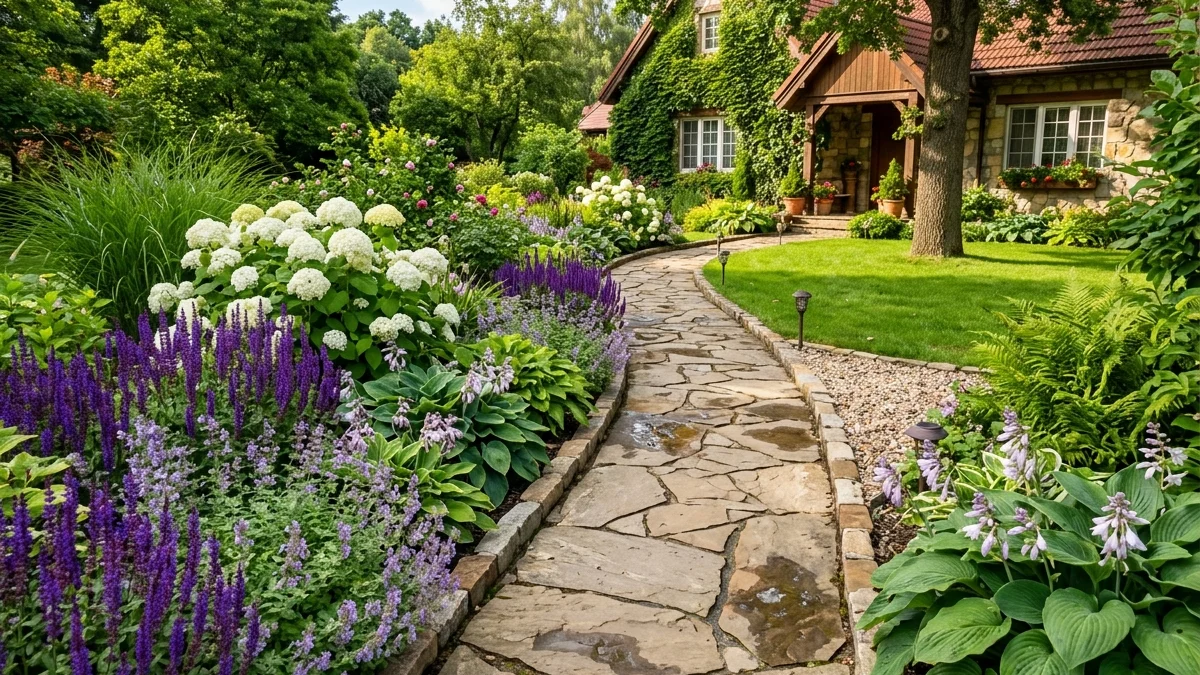
1. The Berm & Boulder Centerpiece
Construct a subtle 12-to-18-inch earthen mound (berm) in the front lawn. Sink a 300-to-500 lb character boulder into the crest of the berm, buried one-third into the soil. Group a weeping understory tree (such as a Japanese Maple or Weeping Redbud) and three clumping ornamental grasses around the boulder's shoulder to create an instant neighborhood focal point.
2. Mud-Splash Foundation Protection Band
Tired of rain splashing red mud or dark mulch onto your front siding? Excavate a 24-to-30-inch perimeter ribbon along foundation walls. Install a crisp metal or paver border and fill with 3 inches of washed 3/4" crushed river stone. Ensure subgrade slopes away from the home at a 2% minimum pitch (1/4 inch per foot).
3. The Permeable Entry Walkway
Replace cracked concrete with wide natural bluestone or granite stepping stones embedded in compacted 3/8" crushed stone. The broad flat slabs provide safe footing for guests and delivery drivers, while the stone joints drink rainwater naturally.
Backyard Landscaping Ideas With Rocks
Backyards prioritize livability, relaxation, and intimate outdoor entertaining. Here, landscape rock transitions smoothly between paved patios, green lawn play zones, and cozy fire pit lounges.
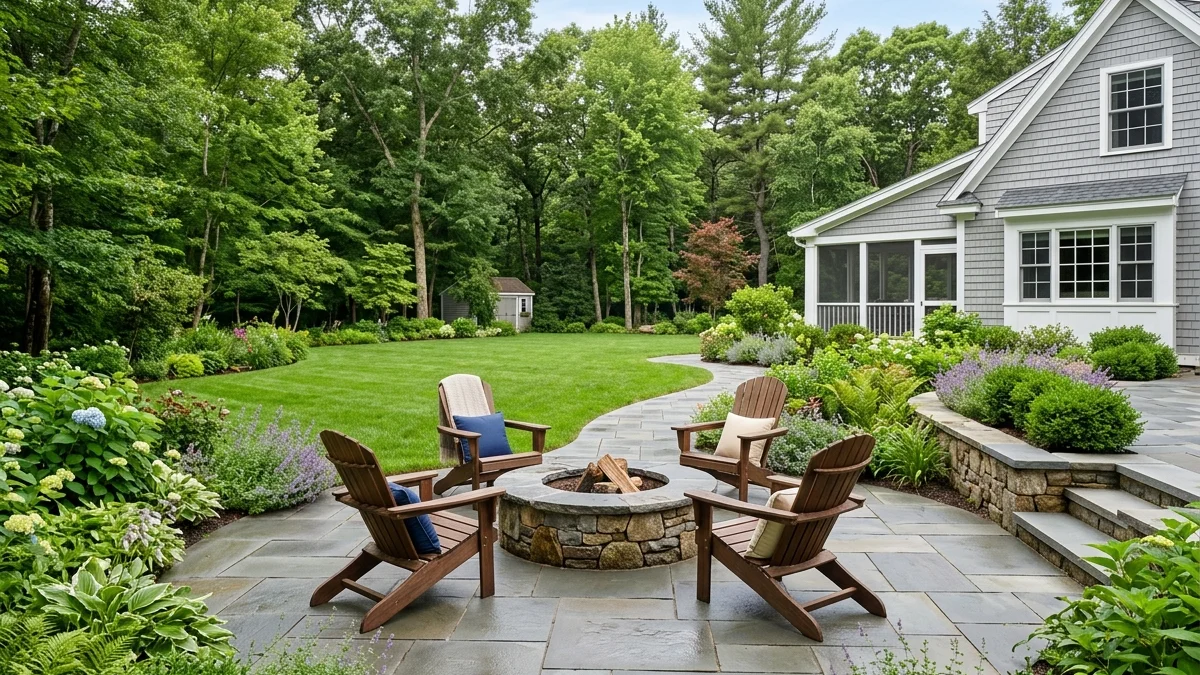
Crushed Granite Fire Pit Circle
Build a circular gravel terrace (14 to 16 ft diameter) using compacted decomposed granite with organic binder. Noncombustible stone creates the safest possible foundation for freestanding steel or masonry fire pits.
Patio-to-Lawn Infiltration Ribbon
Eliminate the soggy turf edge where concrete patios dump rainwater. Install an 18-inch river rock ribbon along the low patio perimeter to intercept sheet runoff and filter it safely into the subsoil.
Landscaping With River Rock: Getting the Details Right
River rock is one of the most widely searched materials in North America. Its smooth, water-worn curves and varied earthy color palette add warmth to garden borders. However, river rock is frequently installed incorrectly.
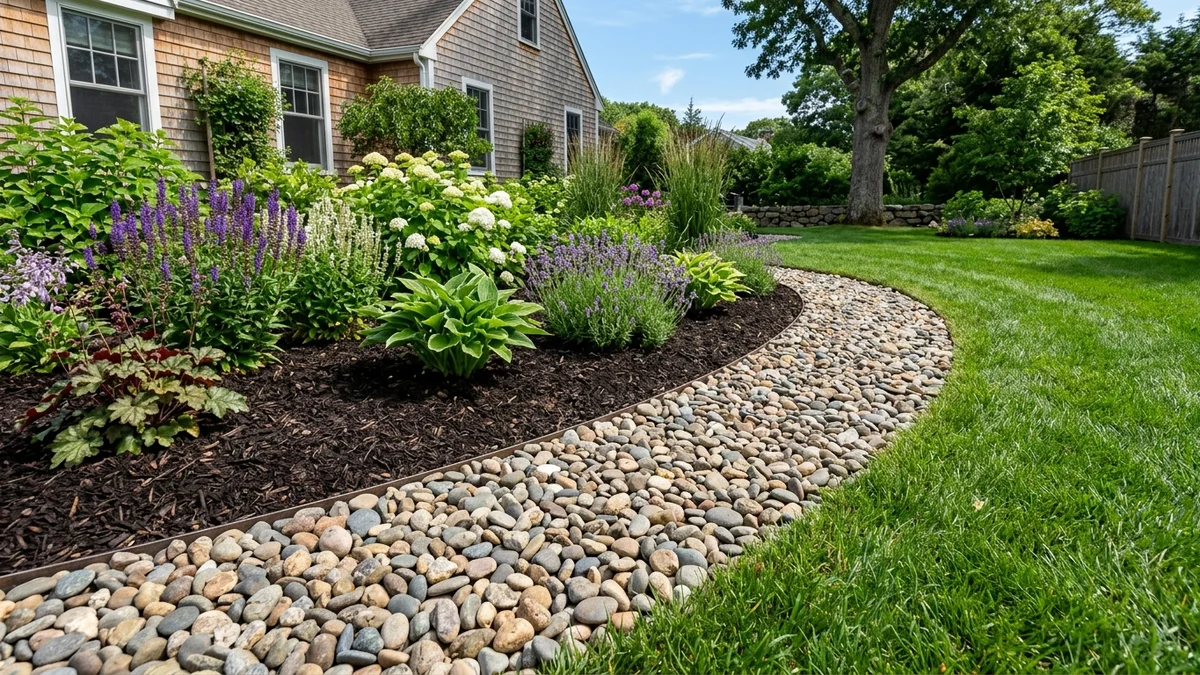
Key River Rock Design Rules:
- Never use river rock for primary walkways: Rounded stones do not lock together. Under foot pressure, they roll like marbles, creating an unstable, unsafe surface for children and seniors. Reserve river rock for non-walkable planting beds and accent margins.
- Keep river rock away from messy deciduous canopies: In autumn, fallen oak leaves and pine needles slip into the deep 2-to-3-inch gaps between stones. You cannot rake river rock without dislodging stones, and high-powered leaf blowers blast stones across the yard.
- Size matters for water velocity: In gutters and roof downspout splash zones, small 1-inch river pebbles can wash away in heavy torrential downpours. Use substantial 3-to-5-inch cobbles directly under downspout elbows to dissipate kinetic energy.
Landscaping With Boulders: Natural Integration & Safety
Boulders are the heavy anchors of landscape design. When set properly, they look as though the house was built around ancient geological outcroppings. When installed poorly, they look like artificial stone heaps dumped from a truck.
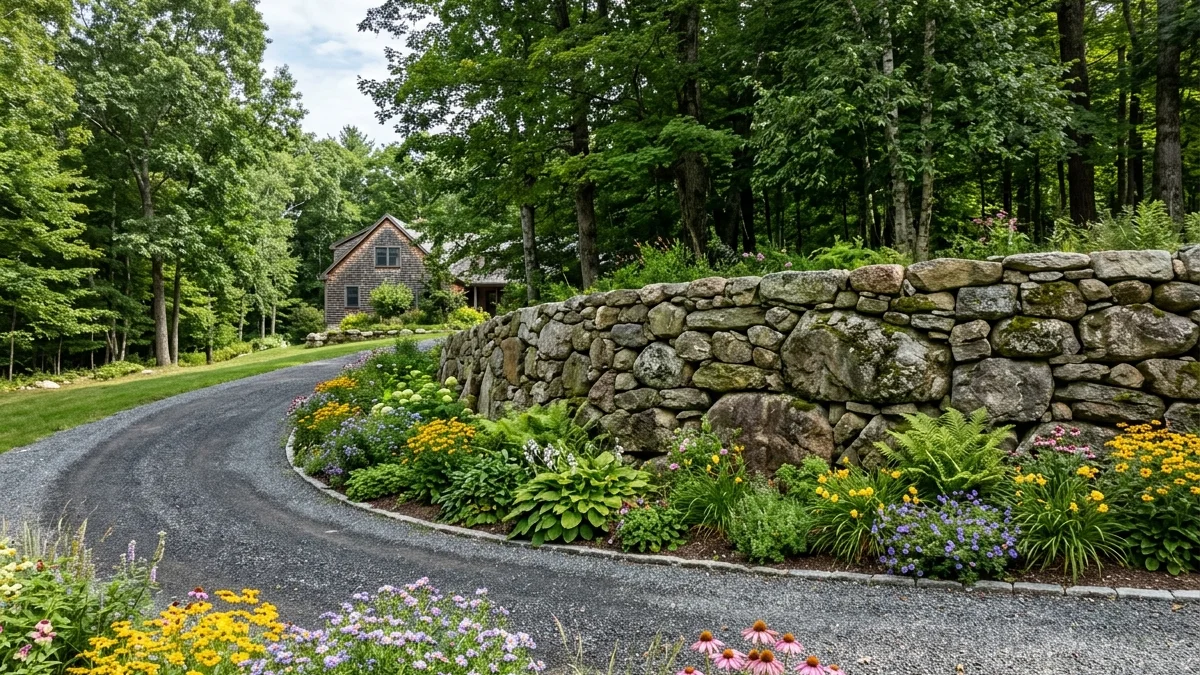
Always excavate a pocket and bury the bottom 30% to 50% of the boulder beneath the soil line. Align the natural geological strata (grain lines) horizontally so the boulder rests comfortably in the earth rather than leaning awkwardly.
A 24-inch granite boulder weighs between 400 and 700 lbs; a 36-inch boulder easily surpasses 1,500 lbs. Attempting to maneuver large stone by hand risks serious injury. Hire professionals equipped with mini-excavators and non-marking rubber tracks.
Gravel Paths & Walkways: Achieving Underfoot Stability
A gravel path offers timeless European garden charm and crisp crunch underfoot at a fraction of the cost of poured concrete or paver masonry. The key to a firm, non-shifting path is selecting angular aggregate rather than rounded pebbles.
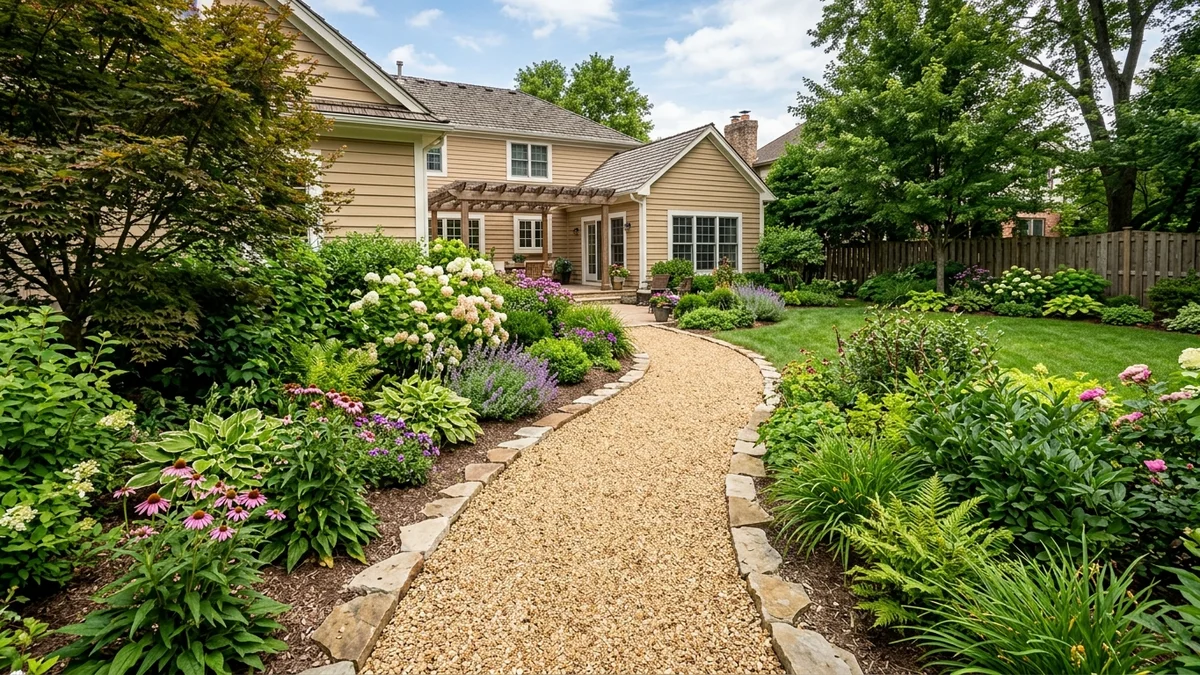
- Compacted Crushed Base: Excavate 4 inches down, lay heavy non-woven geotextile fabric, and compact 2 inches of dense-graded aggregate (#21A or road base) until rock-solid.
- Rigid Edging Restraints: Install heavy-gauge steel, aluminum, or cobblestone edging rising 1/2 inch above the finished stone grade to stop lateral gravel migration.
- Thin Surface Lift: Spread no more than 1.5 to 2 inches of angular 1/4" to 3/8" crushed stone (such as crusher run or decomposed granite). Deeper gravel causes feet to sink and bicycle wheels to bog down.
22 Standardized Rock Landscaping Idea Cards
Browse our complete collection of 22 rock landscaping concepts. Filter by yard area to examine exact rock types, scale tiers, planting styles, maintenance reality, and critical watch-outs:
22 Inspiring Landscaping Ideas with Rocks: Complete Design Cards
Every rock idea is evaluated with an architectural design card showing exact stone types, scales, plant pairings, realistic maintenance, heat behavior, and drainage realities.
Rock & Perennial Planting Bed
Best For: Modern front-yard foundation beds, dry-site planting, low-water zones
River Rock Accent Bed
Best For: Textural contrast against lawn, defining shrub clusters, downspout splash zones
Defined Meandering Gravel Path
Best For: Garden walkways, side-yard transit, connecting patios to fire pits
Stepping Stones Through Crushed Gravel
Best For: High-curb-appeal primary walkways, backyard garden strolls, modern entries
Solitary Boulder Focal Anchor
Best For: Front-yard berm centerpieces, street corner anchors, driveway entries
Boulder Triad with Plant Drift
Best For: Large front lawns, hillside plantings, sweeping transition borders
Dry-Creek-Style Landscape Feature
Best For: Visually breaking up wide yards, mimicking natural river beds, directing surface sheet flow
Stacked Fieldstone Bed Border
Best For: Separating lawn from planting beds, defining elevation steps, traditional curb appeal
Gravel Seating Courtyard
Best For: Intimate backyard fire pits, bistro dining nooks, shaded garden clearings
Modern Rock & Ornamental Grass Matrix
Best For: Contemporary architecture, minimalist front yards, high-contrast texture
Native Plants in Weathered Stone
Best For: Ecological gardens, pollinator sanctuaries, blending home into natural surroundings
Rock & Perennial Mailbox Island
Best For: High-visibility street curb appeal, replacing hard-to-mow turf strips, snowbank resilience
Foundation Rock Perimeter Band
Best For: Protecting siding from mud splash, pest deterrence, clean architectural perimeter
Zoned Rock & Wood Mulch Combination
Best For: Balancing plant health with walkway durability, saving budget, large properties
Hillside Boulder Outcropping
Best For: Sloped front or back yards, erosion transitions, naturalistic mountain aesthetic
Alpine & Crevice Rock Garden
Best For: Botanical enthusiasts, small courtyard focal points, steep rock outcroppings
Compact Front-Entry Rock Pocket
Best For: Small suburban front porches, townhouse entries, budget-conscious curb appeal
Backyard Patio Transition Border
Best For: Bridging the gap between concrete/paver patios and lawn, hiding drainage swales
Side-Yard Service Pathway
Best For: Narrow shaded side corridors, AC compressor access, trash bin rolling routes
Water-Wise Prairie & Gravel Matrix
Best For: Drought-prone climates, water-conservation rebates, south-facing baking slopes
Permeable Pavers with Gravel Joints
Best For: Eco-friendly driveways, modern patios, meeting municipal stormwater lot-coverage caps
Fire-Resilient 0-to-5 Ft Noncombustible Buffer
Best For: Homes in wildfire-prone Western & Mountain regions, defensible space compliance
Design Varieties: Modern, Traditional, Native & Water-Wise
Rock landscaping adapts effortlessly across architectural styles and regional climates. Here is how leading landscape architects execute distinct aesthetic treatments:
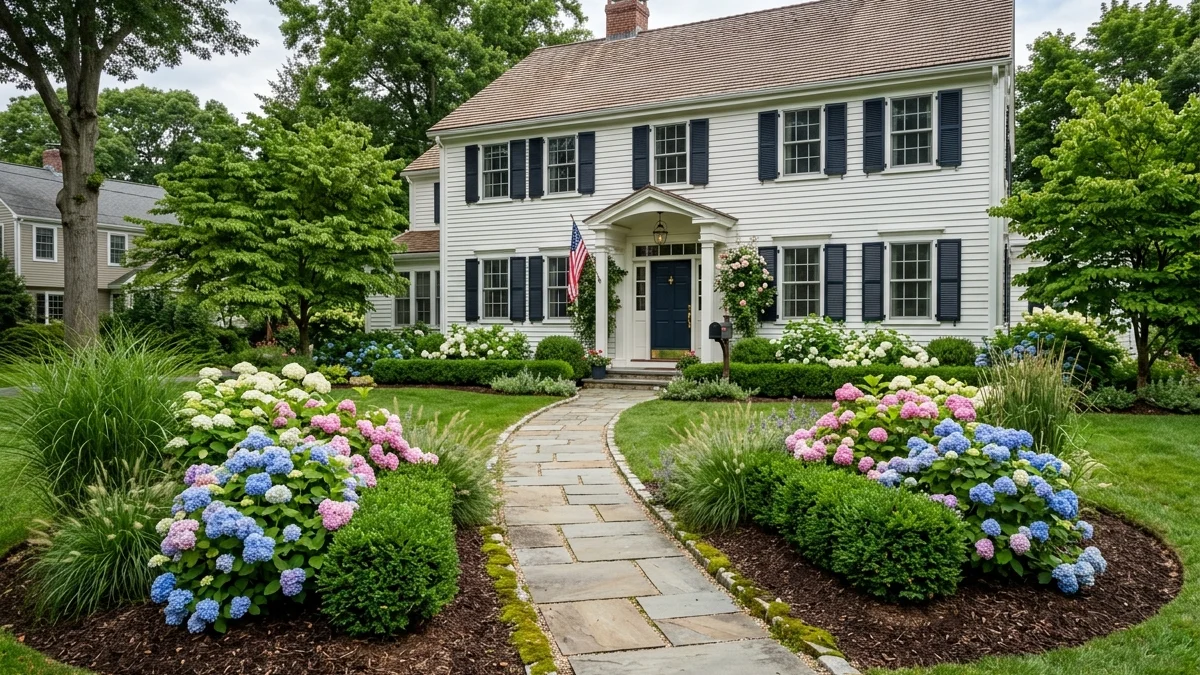
Modern & Minimalist
Clean geometric bed lines, single-color dark basalt chips, and repeating grids of architectural ornamental grasses create high-end contemporary elegance.
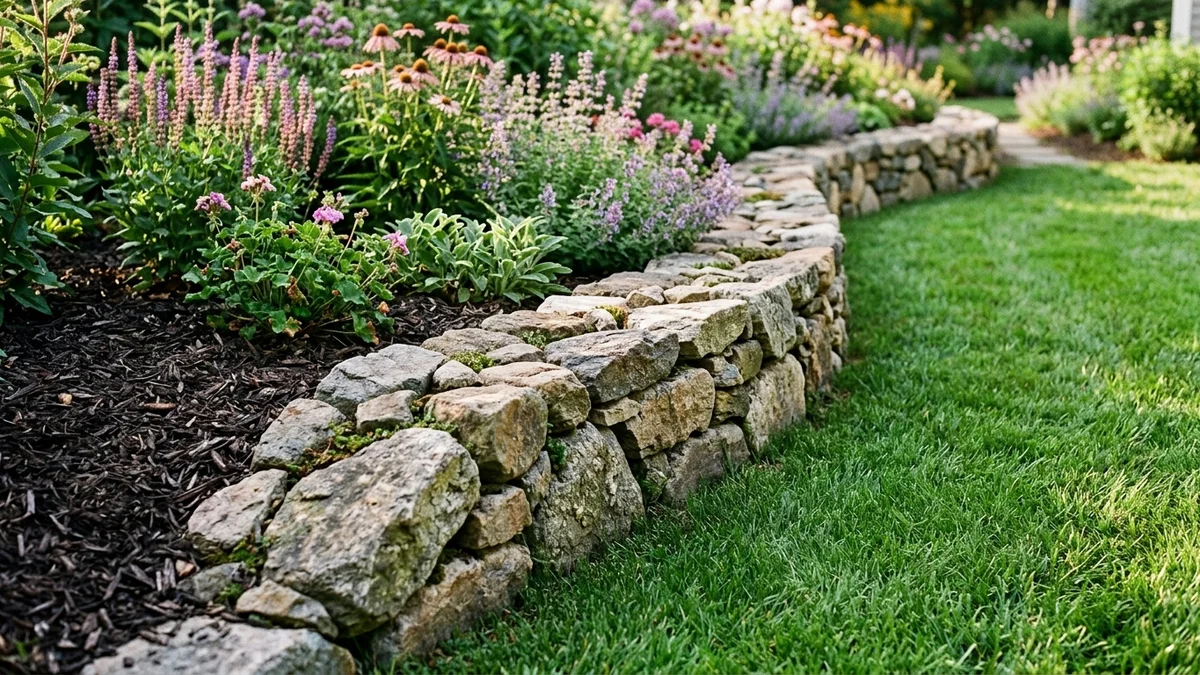
Traditional Fieldstone Border
Weathered regional fieldstone borders separate rich perennial beds from classic turf lawns, evoking historical New England and cottage estate charm.
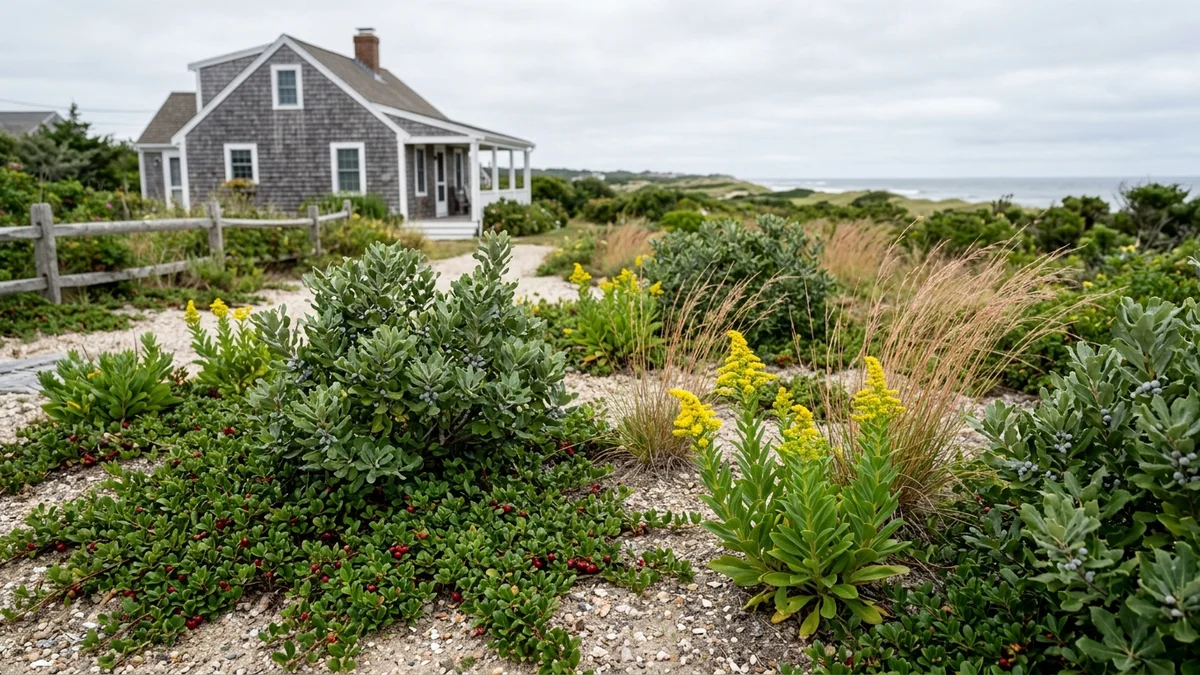
Rock + Native Plant Communities
Locally native plants soften stony beds, providing seasonal bloom progression and essential habitat for native solitary bees and songbirds.
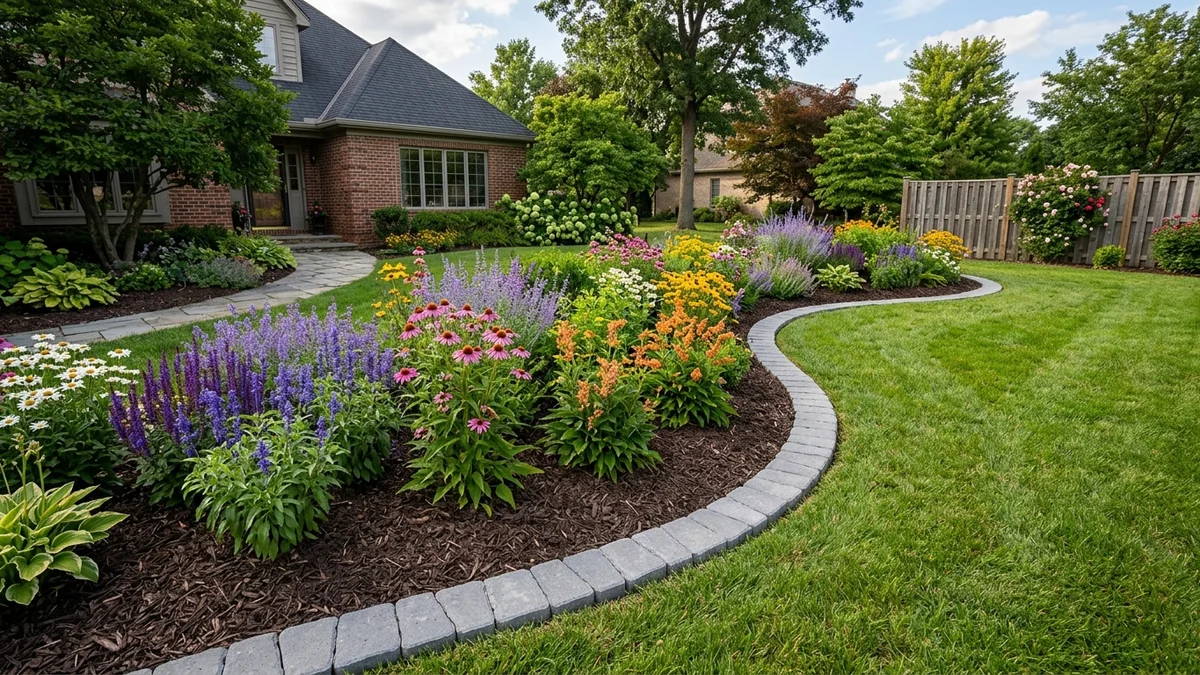
Zoned Rock & Mulch Integration
The ideal hybrid: dark organic mulch feeds shrub roots inside beds, while clean stone edging defines margins and stops lawn grass invasion.
Rock Gardens & Decorative Dry Creeks
Specialty stone features require special attention to drainage physics and horticultural reality:
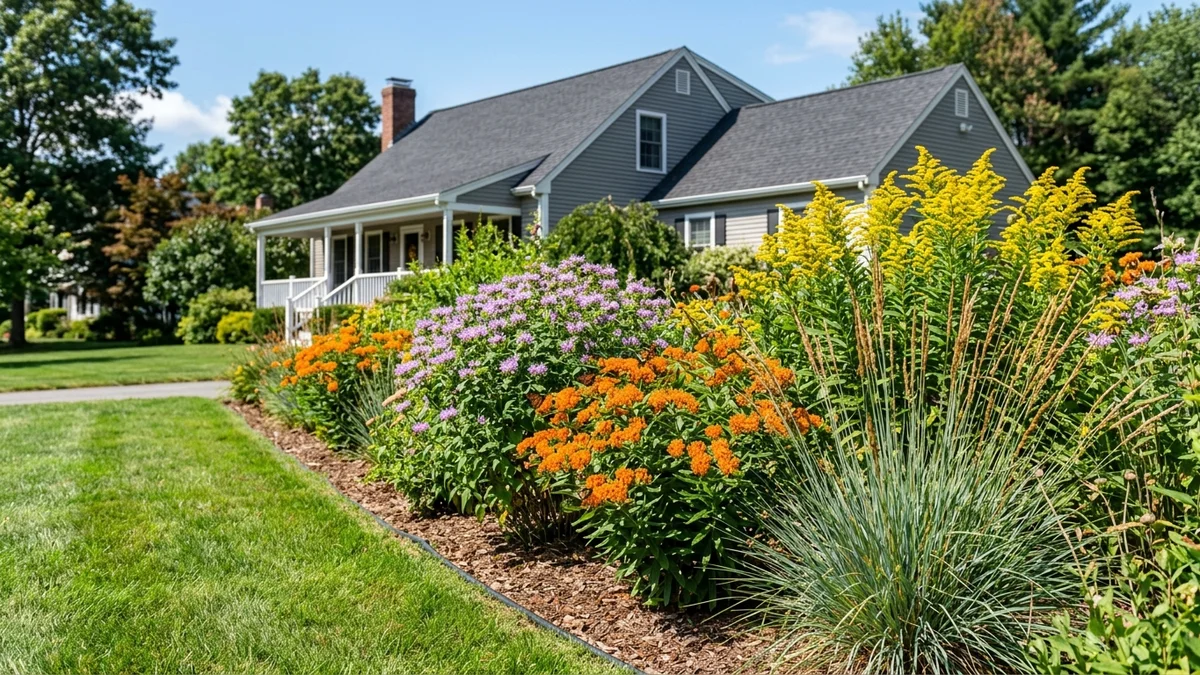
Alpine Crevice Rock Garden
A true rock garden is an intentional micro-habitat combining gritty scree, stratified rock outcroppings, and compact alpine perennials (Saxifrage, Hens & Chicks, Creeping Phlox).
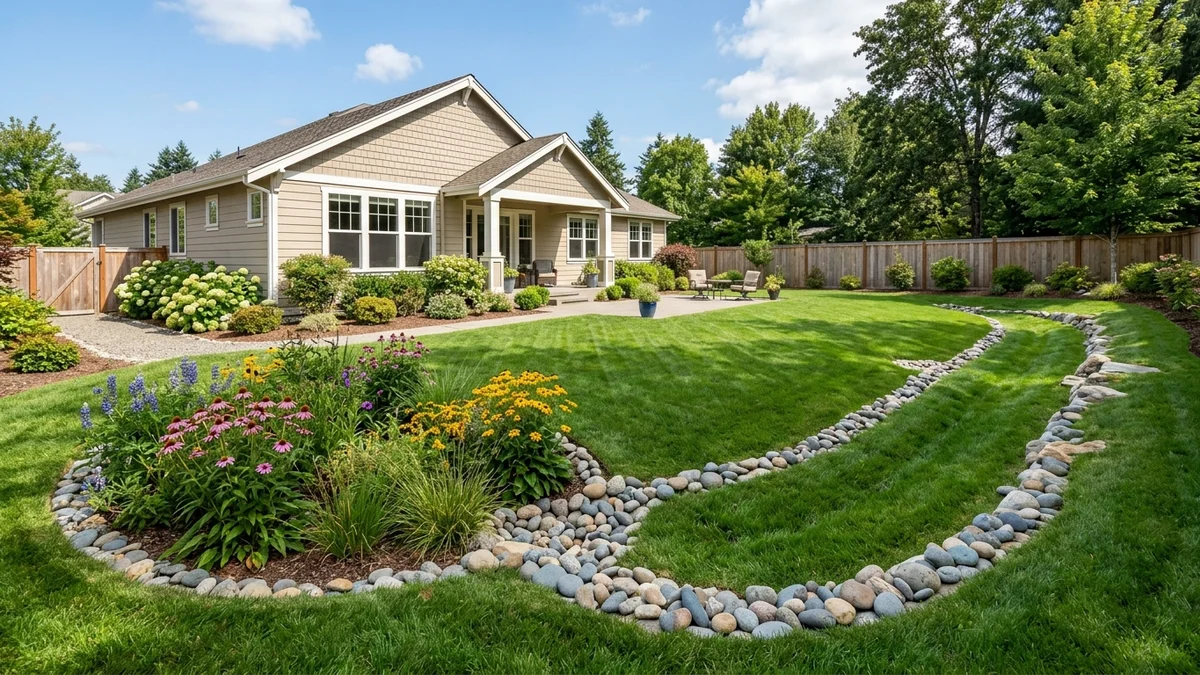
Decorative Dry Creek Feature
Graduated river rock (small pebbles in the center channel, mid-sized cobbles along the banks, and boulders at sweeping bends) mimics a dried riverbed.
Rock vs. Mulch: The Complete Comparison
Choosing between rock and organic mulch should be driven by site microclimates, plant species, and long-term maintenance capacity. Compare both materials across 11 agronomic and practical factors:
Rock vs. Mulch: Which Material Belongs in Your Yard?
Neither material is universally superior. Landscape rock and organic wood mulch fulfill completely different agronomic and design roles. Compare them across 11 key performance metrics:
Initial Installation Cost
Advantage: Wood MulchHigh upfront investment ($50 to $120+ per ton delivered, plus heavy labor, edging restraints, and equipment).
Low upfront investment ($35 to $55 per cubic yard for premium shredded hardwood or hemlock bark).
Longevity & Replacement
Advantage: RockPermanent mineral material. Never decomposes; only requires occasional top-up (every 5–10 years) if gravel settles or shifts.
Decomposes continuously. Requires an annual 1-to-2-inch top-up every spring to maintain color and depth.
Soil Biology & Health
Advantage: Wood MulchZero organic contribution. Stone does not decompose and adds no nutrients, humic acid, or microbial food to the soil profile.
Exceptional soil builder. Natural cellulose and lignin break down into rich humus, feeding earthworms and mycorrhizal networks.
Soil Moisture & Evaporation
Context DependentColorado State Extension research shows small gravel reduces surface evaporation, but unshaded large stone heats topsoil quickly.
Acts as a natural insulating sponge. Absorbs rainwater, slows runoff, and keeps root zones consistently moist and cool.
Heat & Thermal Radiation
Advantage: Wood MulchHigh thermal mass. Absorbs solar radiation and reradiates intense heat into adjacent walls and plant foliage well into the night.
Low thermal transfer. Insulates soil roots against extreme temperature swings and cools the immediate ambient microclimate.
Weed Control Reality
Context DependentDebunking the 'zero weed' myth: weed seeds blow in and easily sprout in silt and organic dust trapped between stones.
Smothers shallow weed seeds effectively for 1 season; easy to hand-pull weeds because roots slip smoothly from loose bark.
Plant Root Compatibility
Context DependentExceptional for drought-adapted species, desert natives, ornamental grasses, Mediterranean herbs, and succulent rock gardens.
Best for temperate deciduous trees, flowering shrubs, broadleaf evergreens, woodland perennials, and vegetable gardens.
Autumn Leaf & Debris Cleanup
Advantage: Wood MulchDifficult maintenance challenge. Deciduous leaves and pine needles wedged between stones cannot be raked and leaf blowers scatter gravel.
Much easier. Leaves can be lightly blown across smooth mulch surfaces, or shredded with a mower and left to enrich the mulch layer.
Ease of Future Redesign
Advantage: Wood MulchExtremely labor-intensive to modify. Shoveling out tons of embedded gravel to add new plants is backbreaking work.
Effortless to rearrange. Simply part the loose mulch with a trowel, dig a planting hole, and smooth mulch back around the new stem.
Fire-Prone Defensible Space
Advantage: Rock100% non-combustible. Recommended by fire protection agencies for the immediate 0-to-5 foot zone around homes in wildfire areas.
Combustible organic matter. Dry bark mulch can ignite from airborne embers and carry fire directly to home siding.
Visual Character & Style
Context DependentArchitectural, modern, crisp, and permanent. Excellent for contemporary, coastal, alpine, or minimalist aesthetics.
Warm, soft, traditional, and naturalistic. Harmonizes smoothly with classic suburban lawns, cottages, and woodland lots.
Horticultural analysis synthesized from Colorado State University Extension (Fact Sheet 7.214, "Mulches for Home Grounds") and University of Minnesota Extension ("Mulching the Landscape").
The Landscape Fabric Dilemma: When to Use It & When to Skip It
Perhaps no topic generates more confusion in DIY landscaping than landscape fabric. Big-box stores sell heavy rolls of woven weed barrier with the promise of "never weeding again." Agricultural extension services offer a far more nuanced reality:
Non-Planted Pathways & Courtyards
Beneath crushed gravel walkways, patio sub-bases, and foundation drip bands, a heavy non-woven geotextile fabric serves as an essential separation layer. It prevents gravel from sinking into soft subsoil under foot traffic.
Planted Shrub & Perennial Beds
Colorado State University Extension warns that over 2 to 4 years, fine silt and decomposing leaf fragments collect on top of the fabric. Weed seeds germinate directly in this silt, rooting through the fabric mesh. Meanwhile, the clogged fabric suffocates plant roots by restricting gaseous oxygen exchange.
Do Landscape Rocks Get Too Hot for Plants?
Stone acts as a dense thermal sponge. During bright summer days, dark rocks can reach surface temperatures of 130°F to 150°F. This heat reradiates into surrounding air and warms root zones well past sunset.
Horticultural Strategies to Prevent Heat Stress:
- Select Heat-Tolerant Species: Pair sunny rock beds with plants adapted to high thermal environments: Ornamental Grasses (Little Bluestem, Prairie Dropseed), Coneflowers (Echinacea), Black-Eyed Susans (Rudbeckia), Agastache, Russian Sage, and Sedums.
- Protect Shallow-Rooted Forest Plants: Never surround Hydrangeas, Japanese Maples, Rhododendrons, or Azaleas with heavy rock in full sun. Their shallow fibrous roots will cook, resulting in leaf scorch, bud drop, and chronic stress. Use organic shredded bark mulch instead.
- Choose Lighter Stone Hues: Tan, beige, and light gray gravel reflect substantially more solar radiation than charcoal basalt, dark slate, or volcanic red lava rock.
Can You Put Landscaping Rocks Around Trees?
Using stone around trees requires strict adherence to arboricultural standards. Tree trunks and root flares must remain breathable:
Just like mulch volcanoes, piling rocks against a tree trunk is fatal. Trapped moisture rots the protective bark cambium, suffocates subterranean root flares, and invites wood-boring beetle infestations.
Keep rocks at least 12 to 18 inches away from the trunk base. The root flare (where trunk meets soil) should remain completely visible and exposed to fresh air.
Regional Framework: How Rock Landscaping Varies Across the USA
A rock landscape in New England looks and functions completely differently than one in Arizona or the Pacific Northwest. Here is how geology, rainfall, and climate shape regional stone design:
How to Choose Rock Colors & Match Your Home's Architecture
Stone should look like an organic extension of your home's exterior cladding, roof shingles, and driveway masonry:
How Much Landscape Rock Do You Need?
Ordering stone by the ton or cubic yard requires calculating exact square footage and desired depth. Use our interactive planning helper below:
How Much Landscape Rock Do You Need? (Quick Formula)
Never guess rock quantities at the quarry or garden center. Calculate exact cubic yards with the industry standard geometric formula before ordering bulk delivery.
Why 324? One cubic yard is 27 cubic feet. A 1-foot-deep area requires 27 sq ft. Multiplying 27 by 12 inches yields the universal divisor: 324.
If buying bagged rock at a retail home improvement store (0.5 cu ft bags), this project requires approximately 100 bags.
Supports exact material densities (pea gravel vs #57 stone vs DG), multi-zone irregular shapes, compaction buffers, and bulk delivery pricing.
10 Common Rock Landscaping Mistakes to Avoid
Frequently Asked Questions About Landscaping With Rocks
Answers
Frequently asked questions
01How can I landscape my yard with rocks?
To landscape successfully with rocks, assign stone a specific functional or architectural job: define a crisp garden path with interlocking crushed stone, anchor a planting bed with partially buried natural boulders, or line a foundation perimeter with clean washed gravel. Always vary rock scale, edge beds with rigid borders, and combine stone with living perennials and shrubs to prevent a flat, barren appearance.
02What types of rocks are best for landscaping?
The best rock depends on your application: (1) 3/4-inch angular crushed stone or decomposed granite for stable, walkable pathways; (2) 1-to-3-inch river rock for decorative garden accents and downspout splash zones; (3) 4-to-8-inch cobbles for dry creek borders; and (4) 18-to-36-inch natural boulders to anchor planting beds and establish visual scale. Avoid smooth, round pea gravel on slopes or walkways where it rolls underfoot.
03Is rock landscaping really low maintenance?
Rock landscaping has a lower replacement frequency than organic wood mulch because stone never decomposes. However, it is low maintenance, not zero maintenance. Weed seeds blow into dust trapped between stones, autumn leaves and pine needles require regular leaf-blowing, and displaced gravel must occasionally be raked back into place. Over time, rock beds still require seasonal weed management.
04Is rock better than mulch for landscape beds?
Neither is universally superior; their suitability depends on your planting goals. Rock is permanent, non-combustible, and ideal for drought-tolerant prairie plants, ornamental grasses, and pathways. Organic wood mulch decomposes, enriching the soil with humus, insulating sensitive tree roots against peak summer heat, and keeping topsoil moist. For woodland shrubs and flowering perennials, organic mulch generally provides superior root health.
05Do landscaping rocks make a yard hotter?
Yes, unshaded landscape rocks absorb solar radiation and store thermal energy, reradiating warmth into surrounding air, plant foliage, and home foundations well into the evening. University of Minnesota Extension warns that large, dark stone fields in full sun can stress heat-sensitive plants like hydrangeas and dogwoods. To prevent heat stress, soften rock fields with living plant canopies and use light-toned stone.
06Does adding rock automatically fix yard drainage?
No. Placing decorative gravel or river rock over waterlogged, poorly graded soil does not fix standing water. True stormwater drainage requires proper surface slope, adequate soil infiltration, and an unobstructed gravity-fed outlet. While gravel is an essential component of engineered French drains and dry wells, decorative rock alone cannot compensate for high groundwater or heavy compacted clay.
07Should I put landscape fabric under landscaping rocks?
Landscape fabric is recommended beneath non-planted pathways, courtyards, and foundation drip bands to keep stone from sinking into base soil. However, Colorado State University Extension advises caution in planted garden beds: over 2 to 4 years, decaying leaves and windblown dust accumulate on top of the fabric, allowing weeds to root into the silt while the clogged fabric restricts vital oxygen and water exchange to deep plant roots.
08How deep should landscape rocks be installed?
Standard installation depths depend on stone size: small crushed gravel and pea gravel (1/4" to 3/4") should be spread 2 to 3 inches deep; medium river rock (1" to 3") should be installed 3 to 4 inches deep; and large cobbles (4" to 8") require 4 to 6 inches depth to provide complete ground coverage without exposing underlying soil. Installing gravel too deep makes walking difficult.
09Can you put landscaping rocks around trees?
You can use rocks near trees, but you must follow horticultural best practices. Never pile rocks or soil against the tree trunk flare (avoiding 'rock volcanoes'), which traps moisture against bark and induces fungal decay. Furthermore, keep stone out of the inner root zone of shallow-rooted, heat-sensitive trees like Japanese Maples and Dogwoods, which thrive far better under cool organic wood mulch.
10How do I calculate how much landscape rock I need?
Use the standard geometric formula: multiply length by width (in feet) to find square footage, multiply by depth (in inches), and divide by 324 to calculate cubic yards. To convert cubic yards to US tons for crushed stone or gravel, multiply by 1.35 (approximately 2,700 lbs per cubic yard). Always add a 5% to 10% buffer for settling, compaction, and site irregularities.
Planning a Stone, Patio, or Hardscape Project in Peabody, MA?
While the rock landscaping ideas in this guide apply to homes nationwide, executing substantial boulder placement, stone patio masonry, retaining wall construction, and engineered drainage requires specialized equipment and heavy machinery.
If you live in Peabody, Danvers, Beverly, Salem, Lynnfield, Marblehead, or surrounding North Shore Massachusetts communities, our network of independent hardscape and landscape design professionals can provide free property assessments, site grading evaluations, and competitive quotes.
Ready to Transform Your Yard with Stone & Natural Hardscaping?
Connect with experienced landscape and masonry professionals for custom patio designs, boulder outcroppings, decorative gravel borders, and complete property transformations.
Get connected with an independent local landscaping professional. Calls go to (877) 537-6896.