20 Backyard Privacy Ideas With Plants
Living design strategies to screen neighbor windows, adjacent patios, driveways, and exposed seating areas using layered shrubs, small trees, ornamental grasses, and climbers.
The Core Principle of Plant-Based Backyard Privacy
Plants create effective backyard privacy when you screen the exact sightline rather than automatically planting a solid wall along the entire property boundary. By determining where you sit, what view you need to block, and whether privacy must be year-round or seasonal, you can combine evergreen anchors, flowering shrubs, small trees, and ornamental grasses. A multi-species mixed screen delivers superior disease resilience, visual depth, and natural beauty compared to a single-species hedge.
Interactive Tool
Calculate the Exact Screen Height for Your Sightline
Backyard Sightline & Screen Calculator
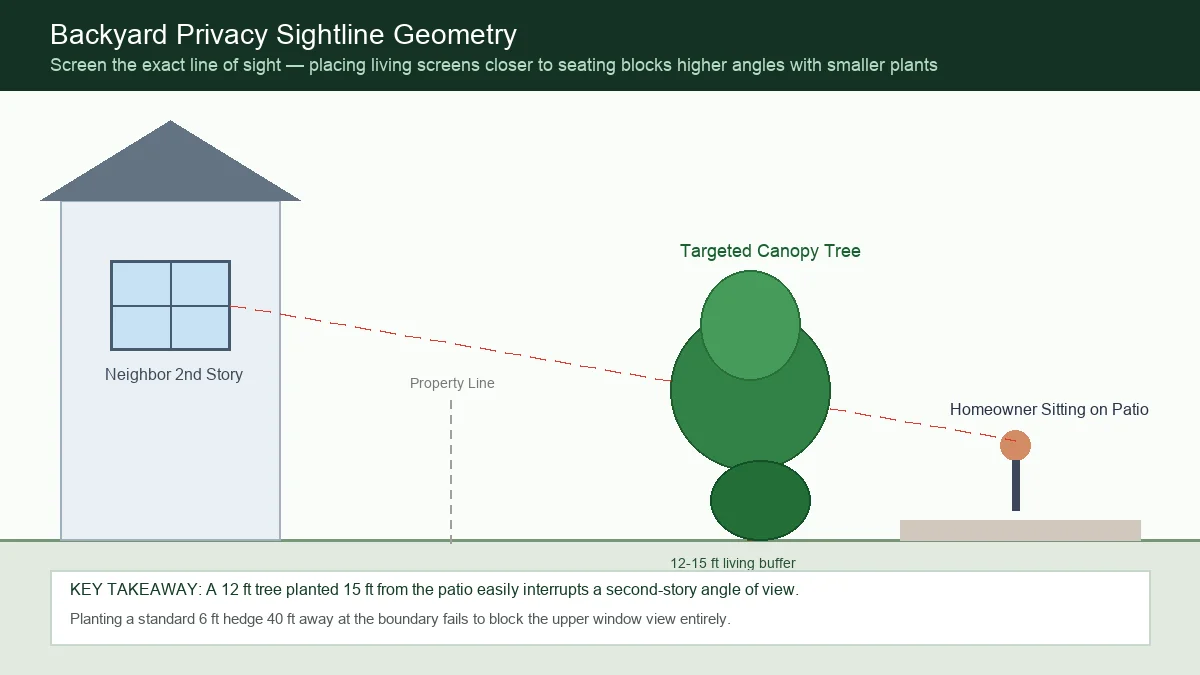
Before choosing plants, calculate the precise sightline angle. Placing a living screen closer to where you sit lets you block high upper-story angles with a modest 10–12 ft plant, whereas planting at the far property fence requires a 20+ ft giant.
High downward sightline into your yard from an upper floor.
Includes a 1.2 ft comfort cushion above direct line of sight.
Bed Width Needed: 3 to 5 ft
Season: Seasonal to Year-Round depending on winter yard use
At a Glance
Quick Comparison: 20 Privacy Ideas at a Glance
| Idea # & Name | Best For | Season | Bed Width | Upper Screening? | Maintenance | Time to Fill |
|---|---|---|---|---|---|---|
| #1 Layered Mixed Privacy Screen | Medium to large property boundaries needing natural aesthetic depth | Mixed | Wide (>8 ft) | Yes (Canopy/Tall) | Medium | Medium-Term |
| #2 Evergreen Backbone + Flowering Shrubs | Homeowners needing winter privacy without a monotonous green wall | Year-Round | Moderate (4–8 ft) | Yes (Canopy/Tall) | Low | Medium-Term |
| #3 Narrow Columnar Evergreen Screen | Tight side yards, narrow suburban setbacks, and property line ribbons | Year-Round | Narrow (<4 ft) | Yes (Canopy/Tall) | Low | Medium-Term |
| #4 Staggered Small Trees | Breaking distant views and upper-story neighbor windows without a rigid hedge | Mixed | Wide (>8 ft) | Yes (Canopy/Tall) | Low | Long-Term |
| #5 Small Tree + Shrub Layers | Two-story neighboring houses requiring upper canopy and lower eye-level screening | Mixed | Wide (>8 ft) | Yes (Canopy/Tall) | Medium | Medium-Term |
| #6 Mixed Native Shrub Screen | Ecological landscapes, local wildlife habitat, and resilient native boundaries | Mixed | Moderate (4–8 ft) | Eye-level only | Low | Short-Term |
| #7 Flowering Privacy Hedge | Warm-season patio boundaries with continuous summer color and pollinator activity | Seasonal | Moderate (4–8 ft) | Eye-level only | Medium | Short-Term |
| #8 Ornamental Grass Privacy Border | Fast seasonal fill, gentle wind sound, and modern linear patio screens | Seasonal | Narrow (<4 ft) | Eye-level only | Low | Short-Term |
| #9 Privacy Around a Patio | Secluded outdoor dining and conversation spaces without enclosing the whole lawn | Mixed | Moderate (4–8 ft) | Eye-level only | Low | Short-Term |
| #10 Privacy Around a Raised Deck | Elevated outdoor living where ground-level fences fall below sightlines | Mixed | Moderate (4–8 ft) | Yes (Canopy/Tall) | Medium | Medium-Term |
| #11 Large Planters with Screening Plants | Paved courtyards, concrete patios, rental homes, and flexible movable privacy | Mixed | Narrow (<4 ft) | Eye-level only | High | Short-Term |
| #12 Climbing Plants on an Existing Support | Maximum vertical privacy with minimum ground footprint along trellises and pergolas | Seasonal | Narrow (<4 ft) | Yes (Canopy/Tall) | Medium | Short-Term |
| #13 Plant-Covered Fence Softening | Transforming stark wooden or vinyl boundary fences into lush living borders | Mixed | Narrow (<4 ft) | Eye-level only | Medium | Short-Term |
| #14 Privacy Pocket Around One Seating Area | Creating an intimate 'outdoor garden room' around a bench or reading nook | Mixed | Moderate (4–8 ft) | Eye-level only | Low | Short-Term |
| #15 Corner Privacy Planting | Angled neighbor sightlines where only one diagonal viewpoint requires screening | Year-Round | Moderate (4–8 ft) | Yes (Canopy/Tall) | Low | Medium-Term |
| #16 Shade-Tolerant Privacy Screen | North-facing yards and borders under mature forest canopies | Year-Round | Moderate (4–8 ft) | Eye-level only | Low | Long-Term |
| #17 Sunny Flowering Privacy Border | Full-sun backyards wanting vibrant summer flower power and butterfly attraction | Seasonal | Wide (>8 ft) | Eye-level only | Low | Short-Term |
| #18 Edible Privacy Planting | Urban and suburban homesteaders combining delicious harvests with living boundaries | Seasonal | Moderate (4–8 ft) | Eye-level only | High | Medium-Term |
| #19 Seasonal Privacy with Deciduous Plants | Homeowners using their backyard primarily May through October, wanting winter light | Seasonal | Moderate (4–8 ft) | Yes (Canopy/Tall) | Low | Short-Term |
| #20 Evergreen + Deciduous + Grass Privacy Garden | The definitive master-planned living sanctuary with zero monoculture risk | Mixed | Wide (>8 ft) | Yes (Canopy/Tall) | Medium | Medium-Term |
Filter 20 Backyard Privacy Concepts by Site Need
Layered Mixed Privacy Screen
Medium to large property boundaries needing natural aesthetic depth
Evergreen Backbone + Flowering Shrubs
Homeowners needing winter privacy without a monotonous green wall
Narrow Columnar Evergreen Screen
Tight side yards, narrow suburban setbacks, and property line ribbons
Staggered Small Trees
Breaking distant views and upper-story neighbor windows without a rigid hedge
Small Tree + Shrub Layers
Two-story neighboring houses requiring upper canopy and lower eye-level screening
Mixed Native Shrub Screen
Ecological landscapes, local wildlife habitat, and resilient native boundaries
Flowering Privacy Hedge
Warm-season patio boundaries with continuous summer color and pollinator activity
Ornamental Grass Privacy Border
Fast seasonal fill, gentle wind sound, and modern linear patio screens
Privacy Around a Patio
Secluded outdoor dining and conversation spaces without enclosing the whole lawn
Privacy Around a Raised Deck
Elevated outdoor living where ground-level fences fall below sightlines
Large Planters with Screening Plants
Paved courtyards, concrete patios, rental homes, and flexible movable privacy
Climbing Plants on an Existing Support
Maximum vertical privacy with minimum ground footprint along trellises and pergolas
Plant-Covered Fence Softening
Transforming stark wooden or vinyl boundary fences into lush living borders
Privacy Pocket Around One Seating Area
Creating an intimate 'outdoor garden room' around a bench or reading nook
Corner Privacy Planting
Angled neighbor sightlines where only one diagonal viewpoint requires screening
Shade-Tolerant Privacy Screen
North-facing yards and borders under mature forest canopies
Sunny Flowering Privacy Border
Full-sun backyards wanting vibrant summer flower power and butterfly attraction
Edible Privacy Planting
Urban and suburban homesteaders combining delicious harvests with living boundaries
Seasonal Privacy with Deciduous Plants
Homeowners using their backyard primarily May through October, wanting winter light
Evergreen + Deciduous + Grass Privacy Garden
The definitive master-planned living sanctuary with zero monoculture risk
Sightline Architecture
Start With the View You Actually Want to Block
In professional residential landscape design, every privacy problem consists of six distinct variables:
- The Viewer: Where you and your family actually sit, stand, or cook (e.g. lounge chair, dining table, grill, or hot tub).
- The Target View: The specific intrusion you wish to screen (neighbor's second-story bedroom window, ground-floor sliding glass door, driveway, or street traffic).
- The Screen Location: The point along that ray where planting can physically occur (patio perimeter, mid-lawn garden island, or property boundary).
- The Screen Height: The eventual mature height required to interrupt the line of sight based on distance and angle.
- The Seasonality: Whether you require privacy 365 days a year or predominantly during the warm-season outdoor months (May through October).
- The Available Bed Width: Whether your site accommodates a slender 3-foot columnar ribbon or a deep 10-foot multi-tier mixed planting border.
When you identify the exact sightline first, you immediately realize that you do not need a solid 20-foot wall of arborvitae enclosing your entire lot. Often, two well-placed small trees and three structural shrubs near your patio solve 90% of the privacy problem while keeping your yard feeling spacious, airy, and full of natural sunlight.
Seasonality
Do You Need Year-Round or Seasonal Privacy?
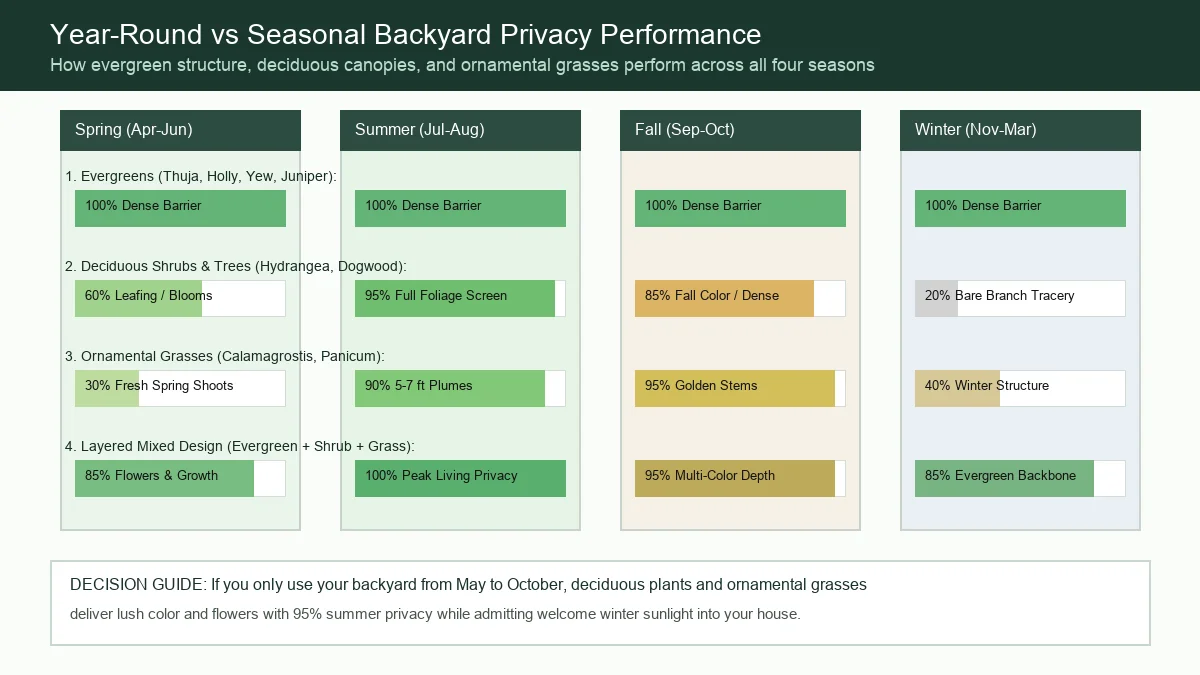
Essential if your living room, kitchen window, or hot tub looks directly into a neighbor’s living space every day of the year. Requires conifer needles or broadleaf evergreen foliage that persists through freezing winters.
Ideal if you primarily use your patio or deck from late spring through early autumn. Deciduous shrubs and ornamental grasses leaf out quickly, produce spectacular blooms and fall colors, and admit warm winter sunlight into your home when leaves drop.
20 Distinct Backyard Privacy Ideas With Plants
Each numbered concept below represents a genuinely distinct design method for living privacy, featuring verified cultivars, dimensions, and maintenance considerations.
1. Create a Layered Mixed Privacy Screen
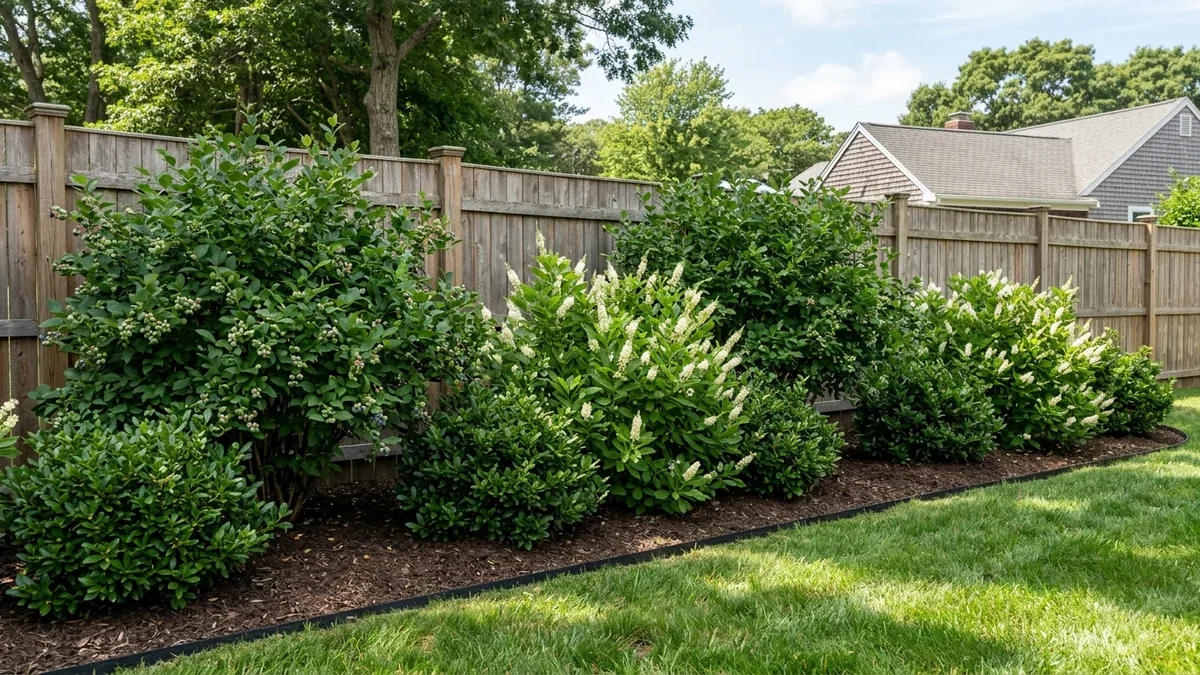
Best For: Medium to large backyard boundaries where you have at least 8 to 12 feet of planting depth and want natural depth instead of a flat hedge.
Why It Works: By arranging plants in three graduated height tiers—tall evergreens at the rear, medium flowering shrubs in the center, and lower grasses or perennials in the foreground—you create visual depth that makes the yard feel larger while blocking sightlines completely.
Plant Types: Back tier: American Holly (Ilex opaca, 15–25 ft) or Eastern Redcedar. Middle tier: Arrowwood Viburnum (Viburnum dentatum, 6–8 ft) or Panicle Hydrangea. Front tier: Switchgrass (Panicum virgatum, 4–5 ft).
Design Tip: Stagger plants in interlocking zig-zag triangles rather than straight parallel soldier lines. This allows plants to interlock naturally without competing for light.
Maintenance: Low to moderate. Selective renewal pruning every 2 to 3 years; annual late-winter cutback of foreground ornamental grasses.
Main Watch-Out: Do not crowd plants when installing small 3-gallon nursery pots. Space according to mature width (8–10 ft apart for trees; 5–6 ft for mid shrubs).
Regional Note: In the Northeast and Midwest, use native Viburnums and Conifers; in the Southeast, substitute Wax Myrtle and Illicium.
2. Combine Evergreens With Flowering Shrubs
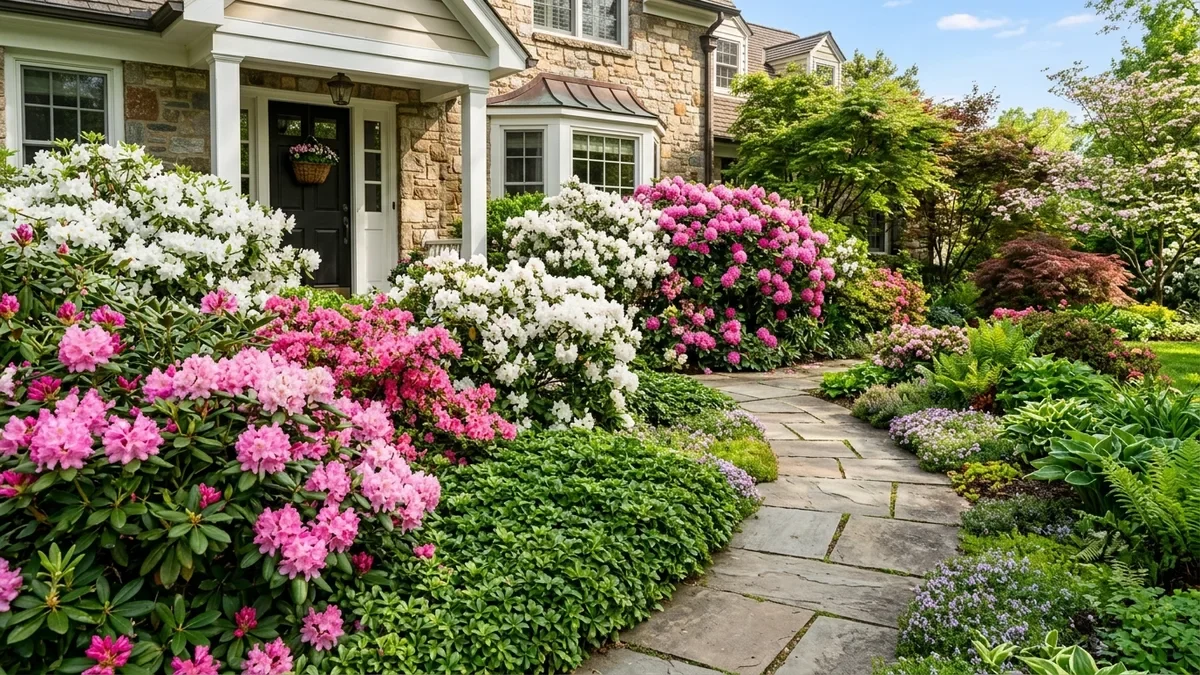
Best For: Homeowners who need guaranteed winter sightline blocking but dislike the look of an austere, uninterrupted wall of identical arborvitae.
Why It Works: An evergreen backbone guarantees winter sightline opacity. Planting deciduous flowering shrubs directly in front of or alternating with the evergreens adds seasonal perfume, pollinator nectar, and shifting color.
Plant Types: Evergreen backbone: Thuja occidentalis 'Emerald Green' (12–15 ft tall, 3–4 ft wide) or Hicks Yew. Flowering foreground: Panicle Hydrangea 'Limelight' or Korean Spice Viburnum (Viburnum carlesii).
Design Tip: Use a 60/40 ratio: 60% evergreen mass ensures privacy never drops below functional levels in January, while 40% flowering mass provides summer vibrancy.
Maintenance: Minimal. Hand-prune flowering shrubs in early spring before bud break; leave evergreens unpruned to maintain natural columnar form.
Main Watch-Out: Keep flowering shrubs at least 4 feet in front of the evergreens so the deciduous branches do not shade out lower evergreen needles.
Regional Note: In deer-heavy suburban zones, substitute Hicks Yew and Arborvitae with deer-resistant Inkberry Holly (Ilex glabra) or Western Redcedar (Thuja plicata).
3. Use Narrow Columnar Evergreens in Tight Spaces
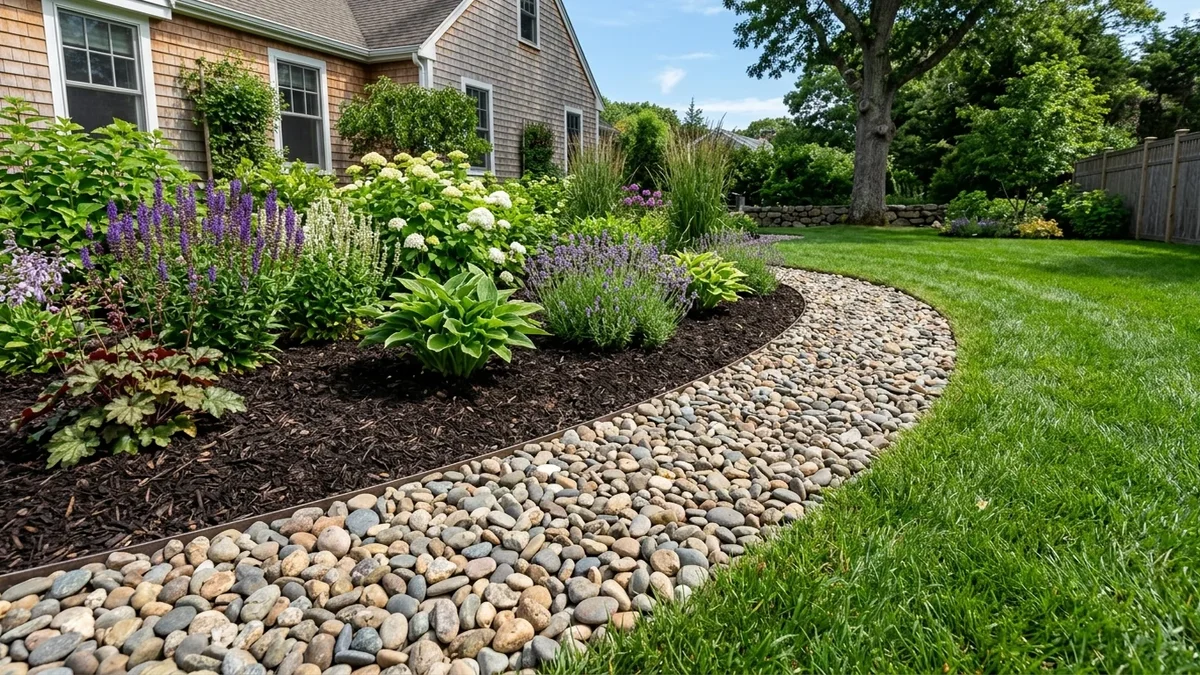
Best For: Narrow suburban side yards, tight boundary setbacks between adjacent homes, and linear ribbons between driveways and patios.
Why It Works: Genetically fastigiate (upright columnar) cultivars grow tall (10–18 ft) while maintaining a strict 2-to-3.5-foot mature width, delivering full vertical occlusion without stealing lawn space.
Plant Types: Thuja occidentalis 'DeGroot's Spire' (12–18 ft tall, 3–4 ft wide), Sky Pencil Holly (Ilex crenata 'Sky Pencil', 6–8 ft tall, 1.5–2 ft wide), or Taylor Juniper (Juniperus virginiana 'Taylor', 15–20 ft tall, 3–4 ft wide).
Design Tip: Space cultivars on-center according to their mature width: plant 'DeGroot's Spire' at 3 feet on-center for a tight hedge; plant Sky Pencil Holly at 2 feet on-center.
Maintenance: Very low. No shearing required; occasional removal of multi-leader branch forks in early spring.
Main Watch-Out: Never plant standard species arborvitae or Leyland cypress in a narrow bed. Only genetically selected columnar cultivars stay narrow without lifelong shearing.
Regional Note: Taylor Juniper tolerates cold winds and drought in Zones 4–9; Sky Pencil Holly requires acid, moist soil in Zones 5–9.
4. Stagger Small Trees Instead of Planting a Straight Row
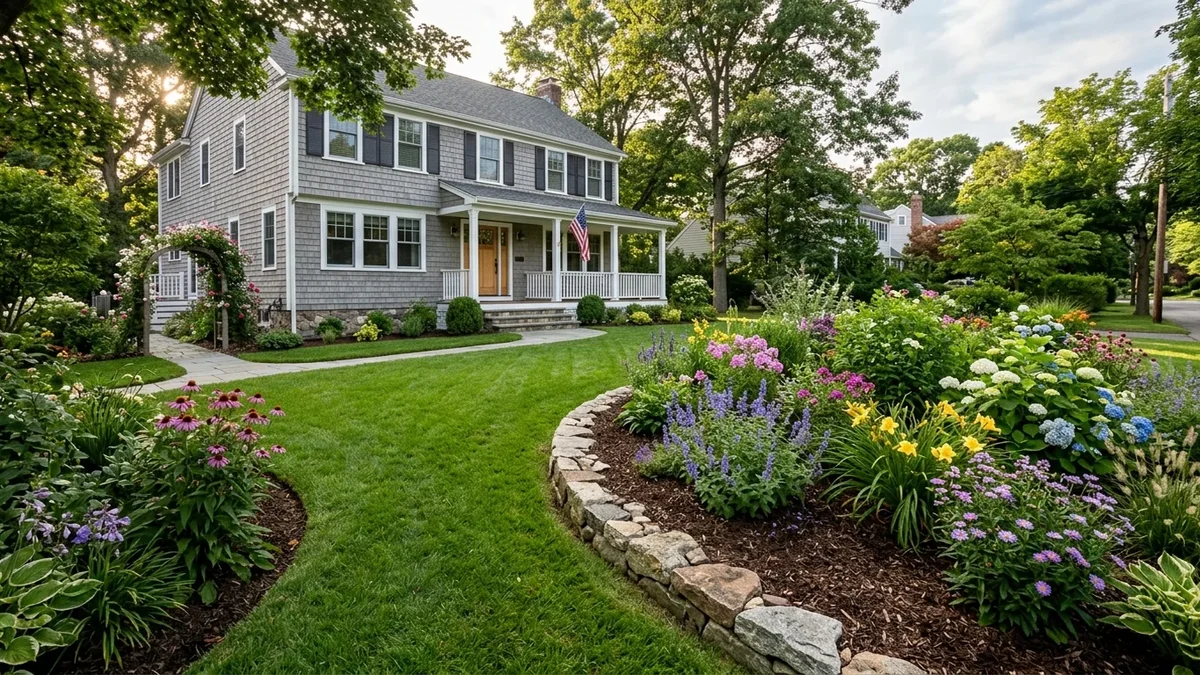
Best For: Homeowners with open backyards who want to screen distant houses or diagonal neighbor sightlines without turning their yard into a fortress.
Why It Works: Two or three small trees planted in a staggered, diagonal relationship create an optical overlap that blocks views from specific sitting angles while preserving openness from other directions.
Plant Types: Serviceberry (Amelanchier grandiflora 'Autumn Brilliance', 15–20 ft), American Hornbeam (Carpinus caroliniana, 20–25 ft), or Kousa Dogwood (Cornus kousa, 15–20 ft). See our guide on small trees for residential yards for canopy shapes.
Design Tip: Multi-stem (clump-form) specimens provide twice the horizontal visual density of single-stem standards at eye level.
Maintenance: Very low. Occasional corrective pruning of dead or crossing branches in late winter.
Main Watch-Out: Check for overhead utility wires. Small trees maturing at 18–25 feet are utility-compatible under standard residential transmission lines.
Regional Note: Serviceberry thrives in Zones 4–8; Eastern Redbud thrives in Zones 4–9; Texas Whitebud in Zones 6–9.
5. Layer Small Trees Over Privacy Shrubs
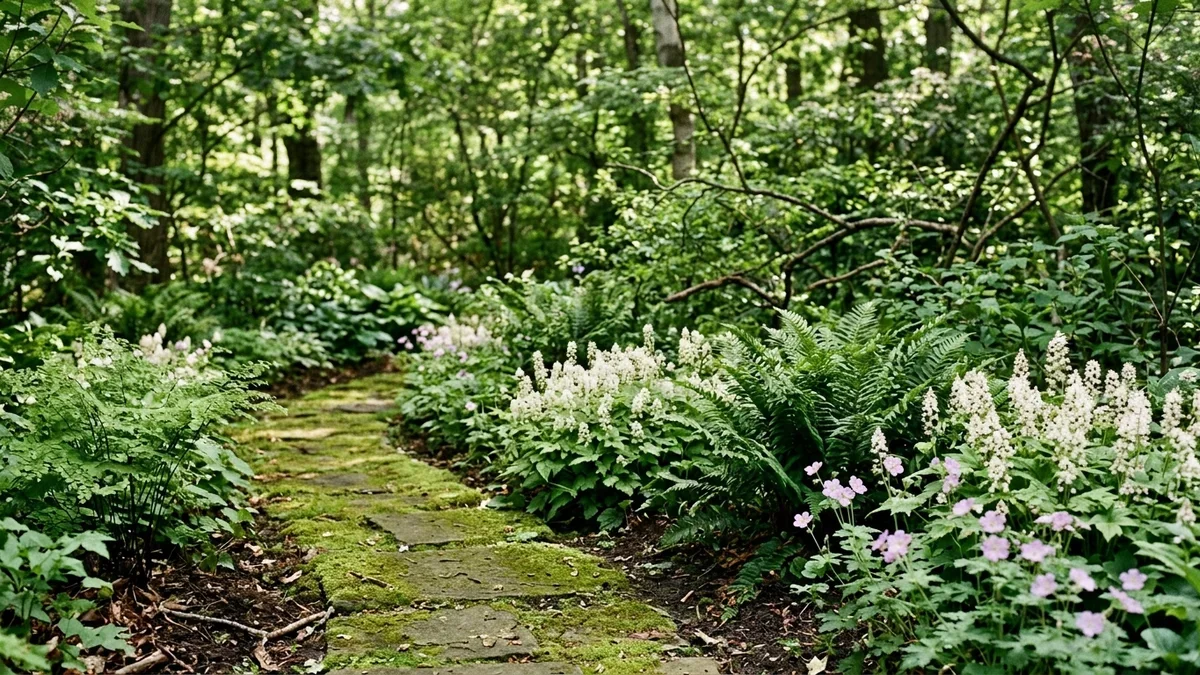
Best For: Backyards adjacent to tall two-story neighboring homes where sightlines intrude simultaneously from second-story bedrooms and ground-floor decks.
Why It Works: Single-layer hedges leave the upper elevation exposed. Placing an umbrella-like deciduous small tree directly above dense understory shrubs blocks both sightline angles without building an artificial wall.
Plant Types: Upper layer: River Birch (Betula nigra 'Dura Heat', multi-stem) or Paperbark Maple (18–22 ft). Lower understory: Inkberry Holly 'Shamrock' or Cherry Laurel 'Otto Luyken' (3–5 ft).
Design Tip: Limber up the lower branches of the canopy tree to a height of 5 to 6 feet, allowing the shrub layer to nestle underneath without root strangulation.
Maintenance: Moderate. Mulch root zones well to prevent moisture competition between tree and shrub root systems.
Main Watch-Out: Choose shade-tolerant shrubs for the lower layer that tolerate partial canopy shade as the tree matures.
Regional Note: In Southern states (Zones 7–9), use Crape Myrtle (Lagerstroemia) over Dwarf Yaupon Holly (Ilex vomitoria 'Nana').
6. Create a Mixed Native Shrub Screen
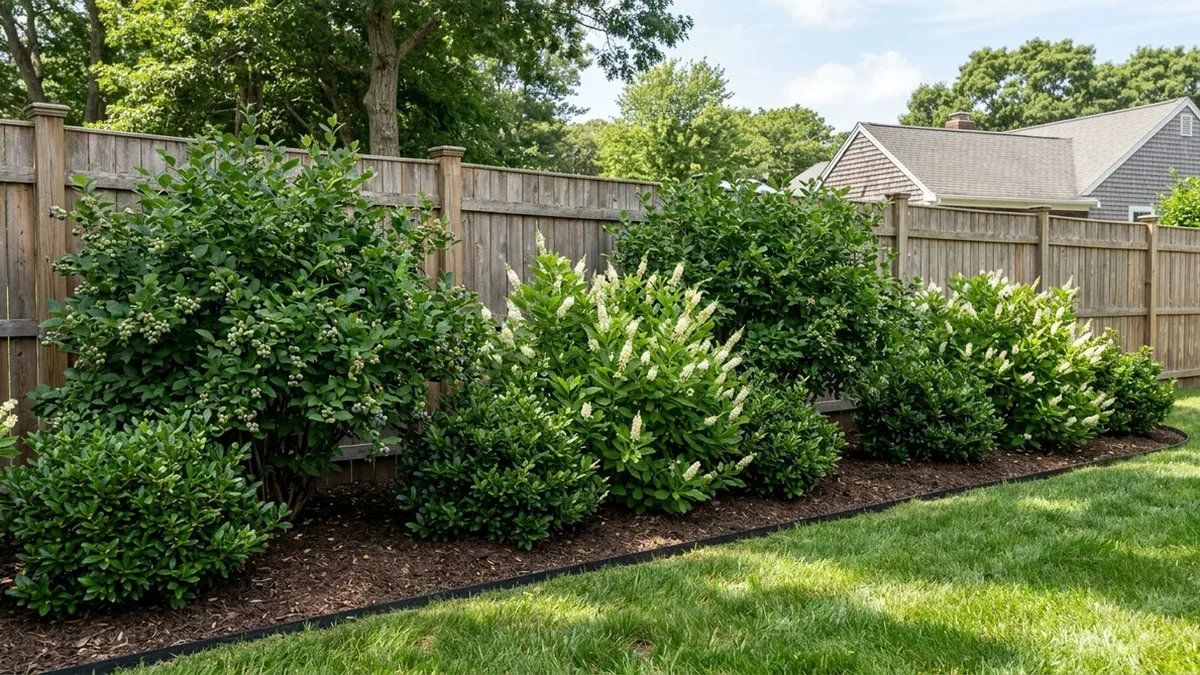
Best For: Environmentally conscious homeowners seeking low-maintenance living borders that feed native pollinators, songbirds, and beneficial insects.
Why It Works: Locally native shrubs have evolved to withstand regional rainfall patterns and pests without supplemental fertilizer or fungicides. Consult our guide on native plant landscaping principles for bed composition.
Plant Types: Arrowwood Viburnum (Viburnum dentatum, 6–10 ft), Northern Bayberry (Morella pensylvanica, 6–8 ft), American Elderberry (Sambucus canadensis, 8–10 ft), and Inkberry Holly (Ilex glabra, 4–6 ft).
Design Tip: Group in clusters of 3 of each species to avoid a chaotic look. The repetition of foliage textures creates cohesive rhythm.
Maintenance: Very low once established. No formal shearing; occasional thinning of older stems every 3 to 4 years.
Main Watch-Out: Never use a single generic national native list. Always verify the native status for your specific US state and ecoregion.
Regional Note: In California, use Coffeeberry (Frangula californica) and Toyon (Heteromeles arbutifolia); in the Pacific Northwest, use Pacific Ninebark and Wax Myrtle.
7. Use a Flowering Privacy Hedge
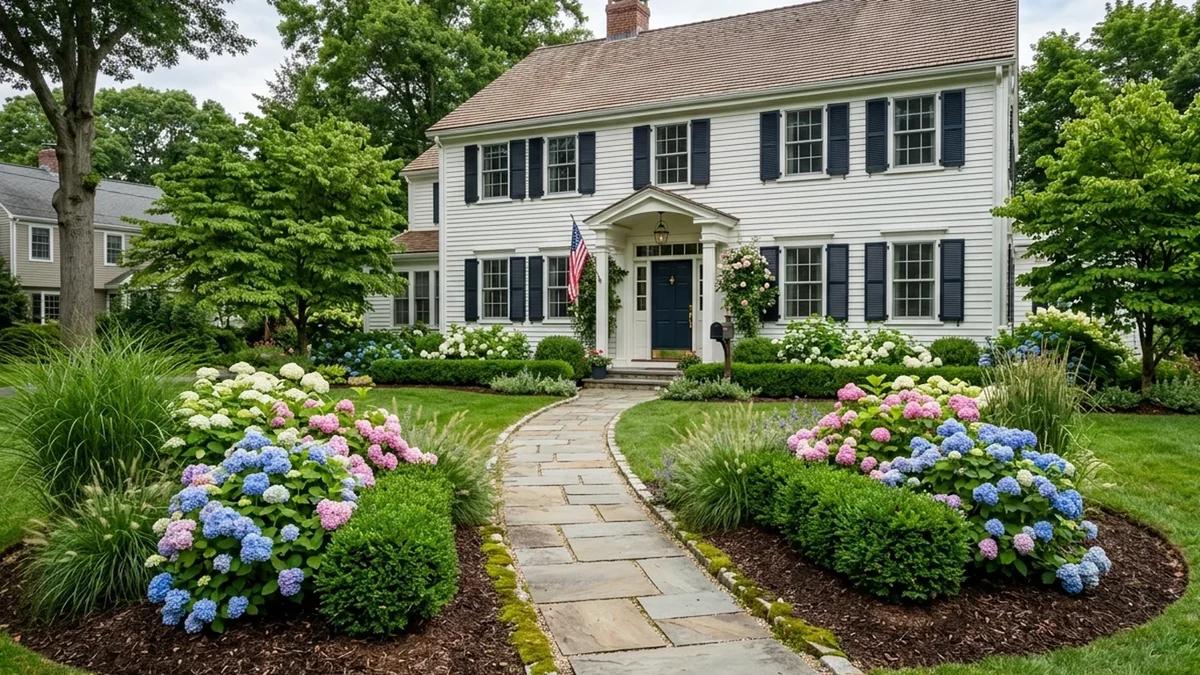
Best For: Backyard living areas where the primary goal is lush summer and early autumn seclusion accompanied by showstopping floral displays.
Why It Works: Vigorous flowering shrubs produce massive leaf volume and voluminous flower panicles that interlace tightly, providing 95% opacity from late June through October.
Plant Types: Panicle Hydrangea (Hydrangea paniculata 'Limelight' or 'Quick Fire', 6–8 ft tall & wide), Rose of Sharon (Hibiscus syriacus, 8–10 ft tall, upright), or Common Lilac (Syringa vulgaris, 8–12 ft).
Design Tip: Hydrangea paniculata blooms on new wood, so it can be pruned hard in late winter without sacrificing summer blooms or screening density.
Maintenance: Moderate. Annual late-winter pruning to cut back previous season stems by one-third maintains a bushy, dense habit.
Main Watch-Out: Remember that deciduous flowering shrubs drop their leaves in November. Do not rely on them for winter hot tub or bedroom window screening.
Regional Note: Panicle hydrangeas perform flawlessly from Zones 3–8; in hot Southern Zones 8–9, provide afternoon shade or substitute Vitex (Chaste Tree).
8. Add Tall Ornamental Grasses for Seasonal Privacy
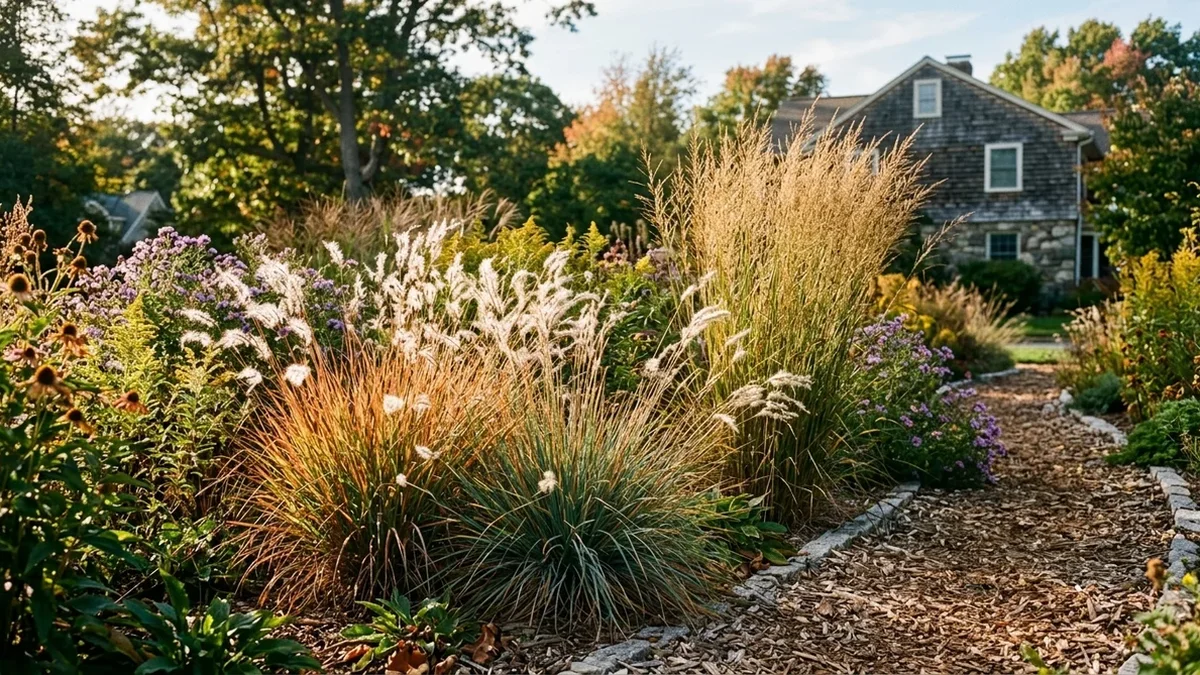
Best For: Modern patio borders, narrow garden strips, pool enclosures, and budget-conscious homeowners wanting rapid height in the first growing season.
Why It Works: Upright ornamental grasses rocket from ground level to 5–6 feet tall by early July. Their rigid vertical stems and feathery plumes create an effective translucent visual screen and acoustic white noise.
Plant Types: Feather Reed Grass (Calamagrostis × acutiflora 'Karl Foerster', 5–6 ft tall, 2 ft wide) or Native Switchgrass (Panicum virgatum 'Northwind', 5–6 ft tall, 2.5 ft wide).
Design Tip: Plant in a staggered double row with 18-to-24-inch spacing on-center to create an impenetrable summer visual ribbon.
Maintenance: Extremely low. Cut stems down to 3 inches above the ground once a year in late winter (February/March) before new green shoots emerge.
Main Watch-Out: Avoid invasive Miscanthus sinensis (Maiden Grass), which escapes into natural ecosystems and is restricted in many states. Use non-invasive native grasses.
Regional Note: 'Karl Foerster' excels in Zones 4–8; Native Switchgrass 'Northwind' thrives in Zones 4–9 across cold winters and hot humid summers.
9. Screen Only the Patio With Plants
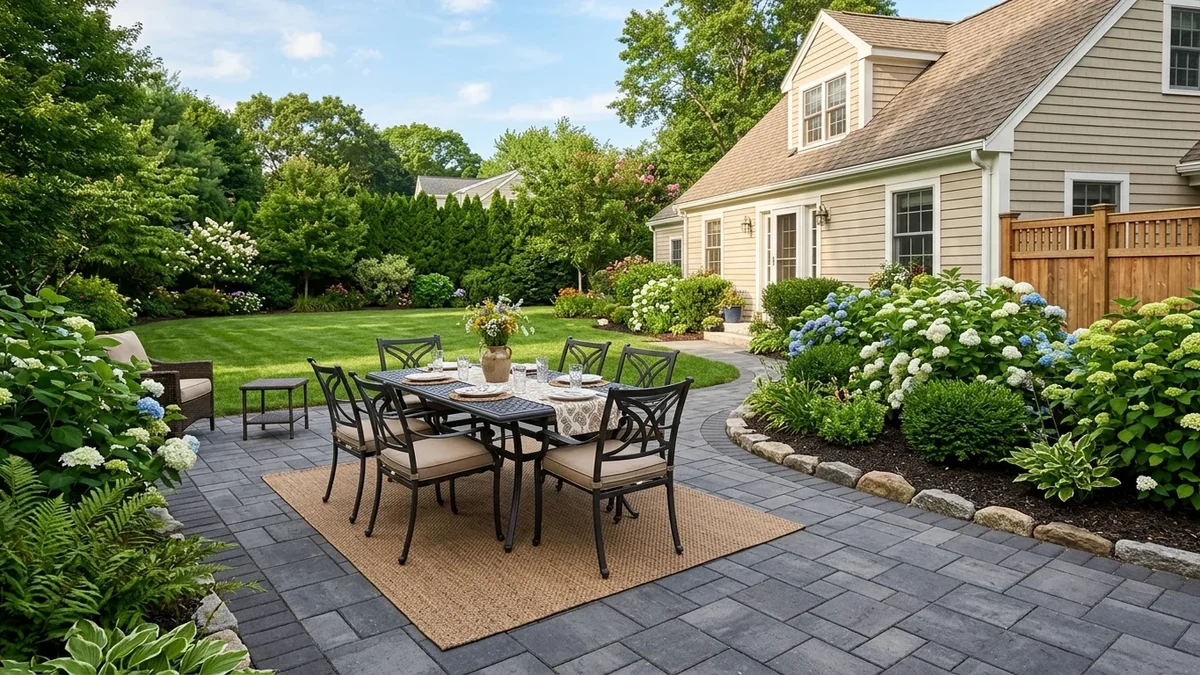
Best For: Large backyards where enclosing the entire property fence is cost-prohibitive, and small suburban yards where open lawn must be preserved.
Why It Works: Planting directly along the 2 or 3 exposed edges of your patio creates an intimate courtyard feel. Because you are sitting within feet of the foliage, 6-foot plants block views that would require 15-foot trees at the boundary.
Plant Types: Inkberry Holly (Ilex glabra 'Gem Box', 3 ft), Feather Reed Grass (5 ft), Dwarf Korean Lilac (4–5 ft), and sweetbox or lavender for scent.
Design Tip: Leave one or two open viewing corridors toward lawn, flower gardens, or distant trees to avoid feeling trapped in a claustrophobic box.
Maintenance: Low. Keep plant canopies pruned 12 inches back from patio pavers so walking paths remain unobstructed.
Main Watch-Out: Avoid shrubs with aggressive surface root systems (like weeping willows or silver maples) that can buckle patio paving sand beds.
Regional Note: In arid regions, pair water-wise shrubs with flagstone paving (see our drought tolerant landscaping guide).
10. Create Plant Privacy Around a Raised Deck
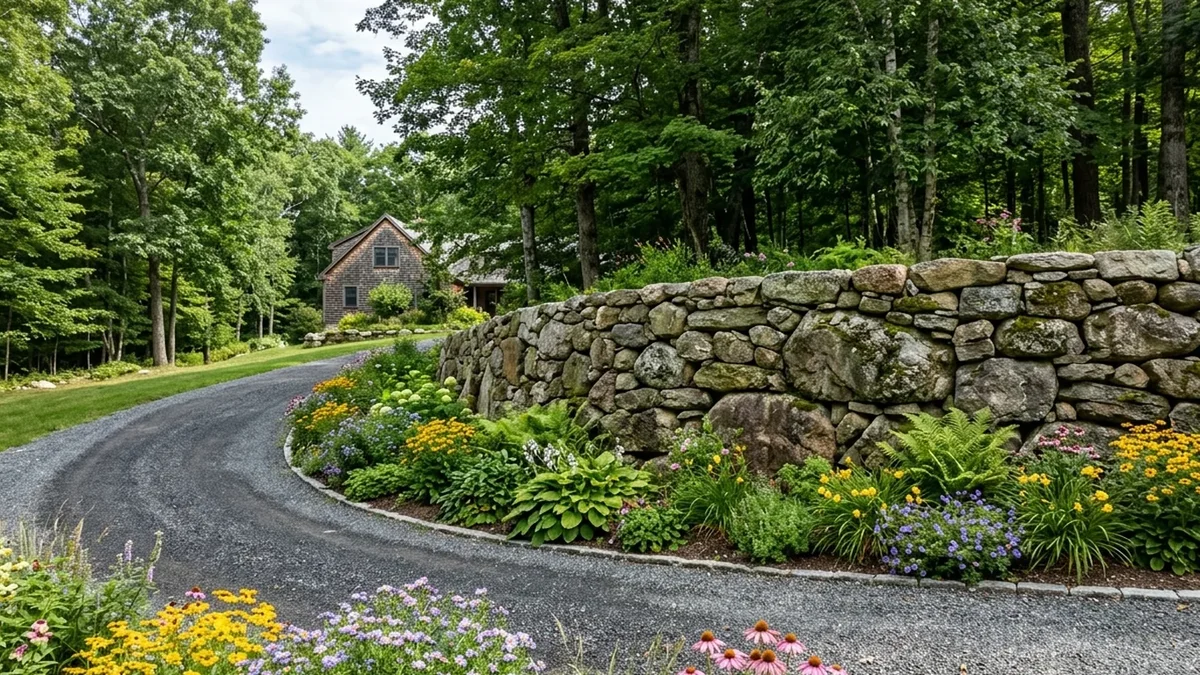
Best For: Second-story walkout decks, hillside homes, and elevated outdoor dining areas where sitting puts you 6 to 10 feet above surrounding ground level.
Why It Works: Ground-level shrubs cannot screen an elevated deck. A two-pronged strategy combines in-ground narrow trees (whose canopies reach 12–16 ft) with deck-mounted railing planter boxes for immediate eye-level coverage.
Plant Types: In-ground: Thuja occidentalis 'Emerald Green' or Hicks Yew. Railing planters: Upright ornamental grasses, trailing calibrachoa, and dwarf conifers.
Design Tip: Plant in-ground trees 4 to 6 feet away from the deck foundation footings to prevent tree root interference with structural posts.
Maintenance: Moderate. Railing planters require frequent drip irrigation and winter protection in freeze-thaw zones.
Main Watch-Out: Never plant large timber trees (like Norway spruce or oak) directly next to elevated deck joists where heavy branches could drop during storms.
Regional Note: In windy prairie regions, choose flexible trees like Fastigiate Hornbeam that handle wind shear at elevated deck levels without snapping.
11. Use Large Planters as Movable Living Screens
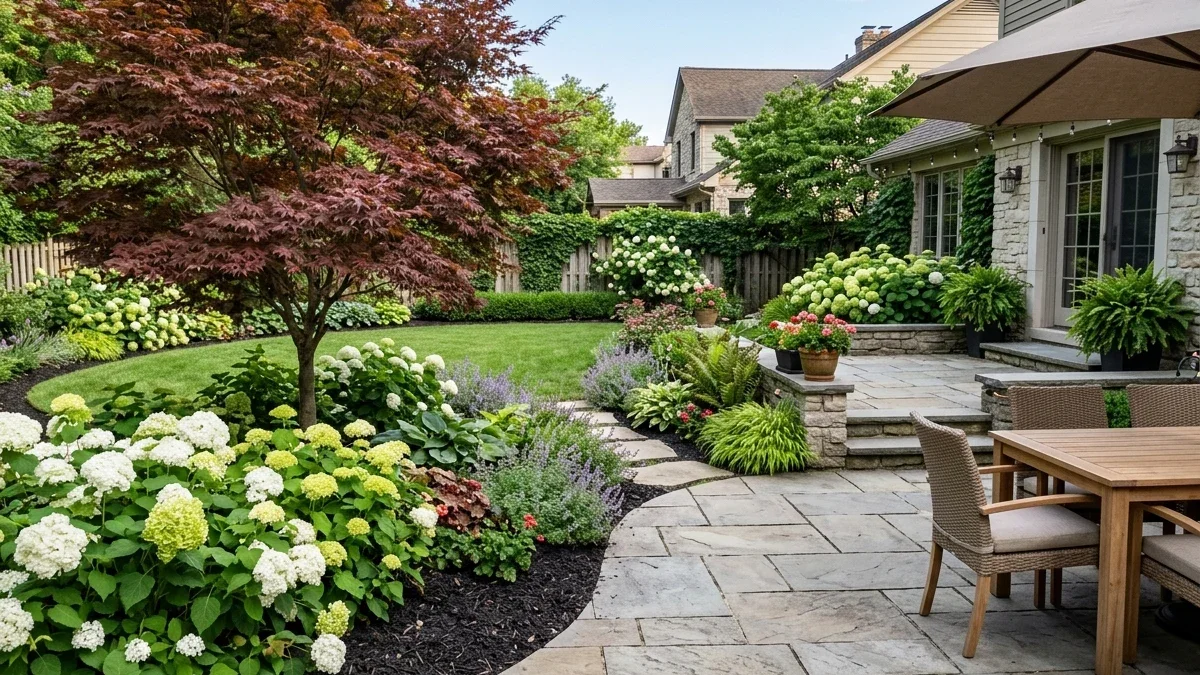
Best For: Paved urban courtyards, concrete pool decks, rental properties, and homeowners who want movable privacy that adapts to outdoor gatherings.
Why It Works: Large trough planters (at least 20–24 inches deep and 36–48 inches wide) elevate plants by 2 feet off the ground, turning a 4-foot shrub into an instant 6-foot eye-level privacy shield.
Plant Types: Dwarf Hinoki Cypress (Chamaecyparis obtusa 'Nana Gracilis'), Inkberry Holly 'Gem Box', or Japanese Forest Grass (Hakonechloa macra) combined with upright grasses.
Design Tip: Equip heavy fiberglass or composite trough planters with heavy-duty hidden caster wheels so you can reconfigure your privacy screen on demand.
Maintenance: High. Container plants dry out rapidly in summer heat and require dedicated drip irrigation lines and seasonal organic fertilizer.
Main Watch-Out: Winter root freeze rule: Choose plants rated for two USDA hardiness zones colder than your local zone to survive pot freeze-thaw cycles without root death.
Regional Note: In freeze-prone northern zones, insulate container interiors with 1-inch foam board; in hot desert climates, use light-colored pots to prevent root overheating.
12. Grow Climbers on an Existing Vertical Support
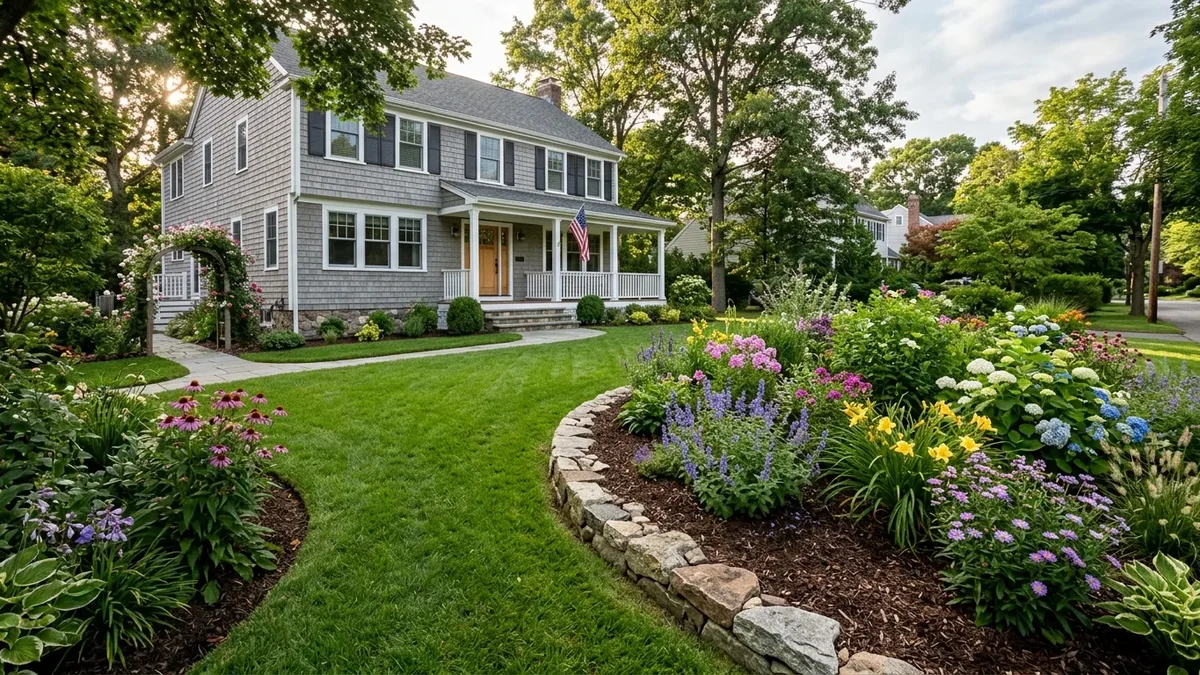
Best For: Extremely narrow lot lines, patio sides, pergolas, and outdoor dining nooks where there is zero room for an 8-foot-wide shrub bed.
Why It Works: Climbing plants channel their entire biological energy into vertical height and horizontal leafy twining, achieving complete visual opacity on an in-ground soil footprint of less than 1.5 feet.
Plant Types: Native Coral Honeysuckle (Lonicera sempervirens, non-invasive), Virgin's Bower (Clematis virginiana), or American Wisteria (Wisteria frutescens 'Amethyst Falls').
Design Tip: Use sturdy cedar, powder-coated steel, or stainless wire trellises. Do not allow vines to climb directly on vinyl home siding or wood shingles where moisture can get trapped. For perimeter boundaries, review our specialized guide on landscaping along a fence for safe climbing mechanisms and the 50% setback rule.
Maintenance: Moderate. Pruning once or twice per summer keeps shoots from wandering beyond the support structure.
Main Watch-Out: Never plant invasive climbers like English Ivy (Hedera helix), Japanese Honeysuckle (Lonicera japonica), or Asian Wisteria, which damage structures and natural woodlands.
Regional Note: Coral Honeysuckle is native across the Eastern US (Zones 4–9); in the South, Evergreen Clematis (Clematis armandii) provides year-round foliage.
13. Soften an Existing Fence With Plants
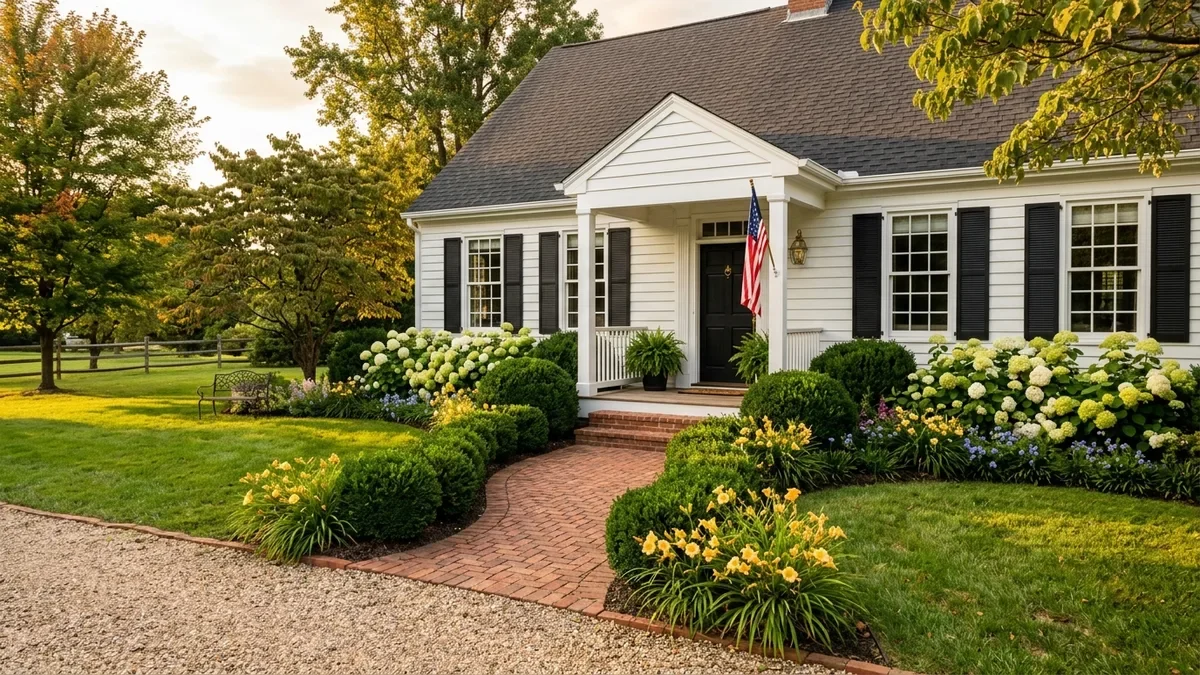
Best For: Yards with existing 6-foot wood, vinyl, or chain-link fences where the barrier feels harsh, institutional, or insufficiently tall for upper-level sightlines.
Why It Works: The fence provides baseline eye-level privacy, freeing your plants from the burden of creating a solid wall. Layered shrubs soften the hard boundary, absorb reflected fence heat, and can extend privacy 2 to 4 feet above fence height.
Plant Types: Espaliered Apple or Pear trees, Upright Holly 'Sky Pencil', Rose of Sharon, and billowing drifts of Salvia and Catmint along the bed edge.
Design Tip: Leave a 12-to-18-inch maintenance gap between the rear shrub branches and the fence so you can stain, paint, or inspect fence panels without damaging plants.
Maintenance: Moderate. Selective pruning to guide branches horizontally along fence rails and remove deadwood.
Main Watch-Out: In damp climates, avoid planting dense evergreens flush against wood fences where lack of airflow promotes mold, rot, and fastener failure.
Regional Note: In areas with municipal 6-foot fence height limits, living shrubs trained along the fence top legally add essential privacy height above the fence line.
14. Create a Private Garden Seating Pocket
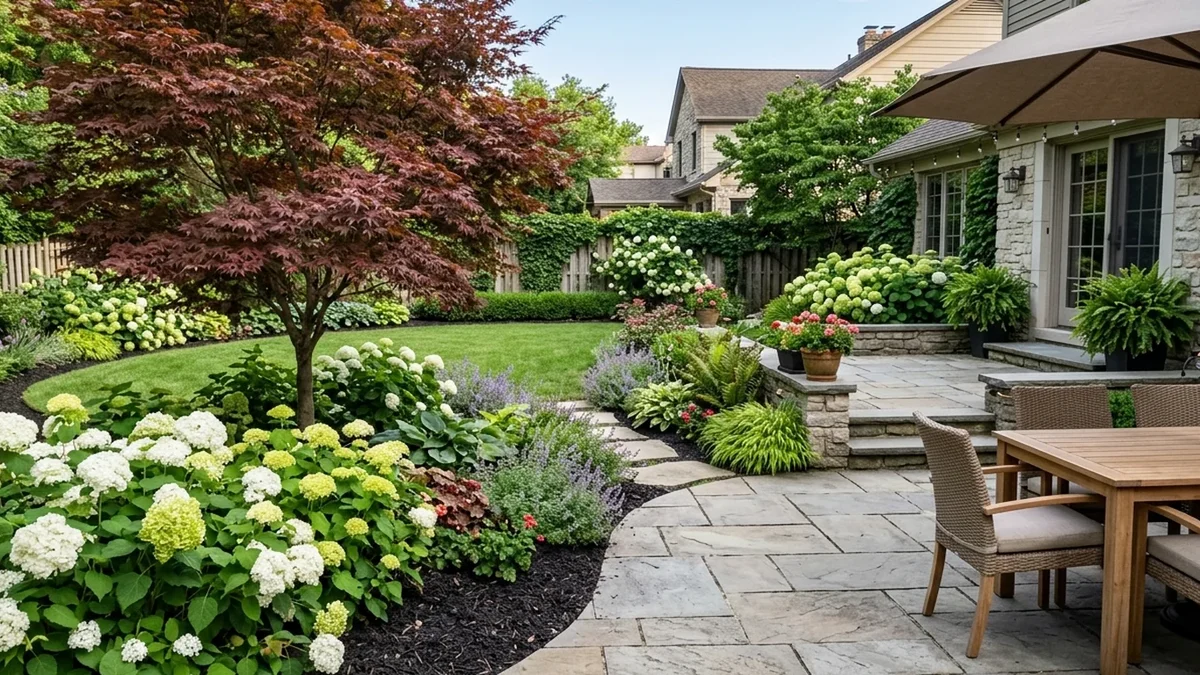
Best For: Homeowners who want a quiet reading corner, meditation space, or small two-person conversation nook without spending thousands on boundary planting.
Why It Works: Embodying the core principle of screening where you actually sit, this concept builds a U-shaped living alcove that encloses the back and sides of a bench while keeping the front view open to your own yard.
Plant Types: Japanese Maple (Acer palmatum, 8–10 ft canopy), Fragrant Sweetbox (Sarcococca, 3–4 ft), Inkberry Holly 'Shamrock', and Oakleaf Hydrangea.
Design Tip: Prioritize sensory plants: incorporate fragrant flowers (like Sweetbox or Korean Spice Viburnum) and tactile foliage (like Lamb's Ear) within arm's reach of the bench.
Maintenance: Very low. Occasional hand pruning to keep the seating pathway clear.
Main Watch-Out: Avoid shrubs with heavy bee attraction (like sweet clover or borage) directly overhanging the seating surface if stinging insect allergies are a concern.
Regional Note: In the Pacific Northwest and Mid-Atlantic, Japanese Maple and Rhododendrons create fairy-tale pockets; in dry climates, use Mexican Bush Sage and Manzanita.
15. Screen One Exposed Backyard Corner
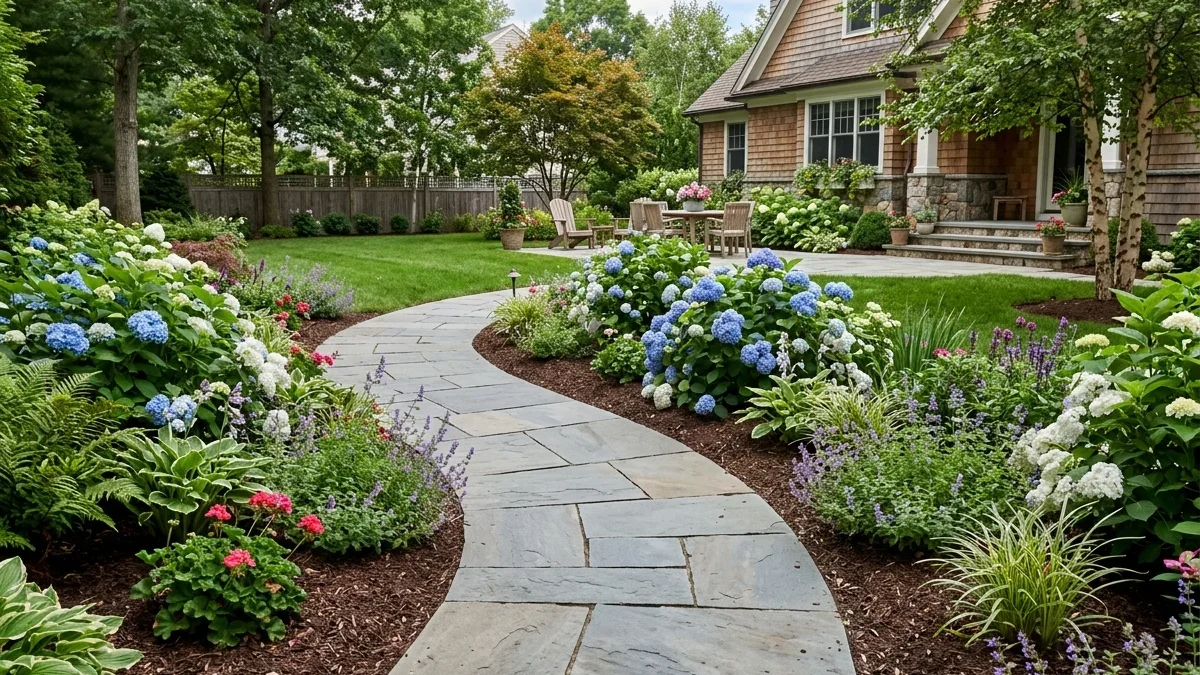
Best For: Angled suburban lots, cul-de-sacs, and properties where only one diagonal viewpoint into a neighbor’s driveway or raised deck feels exposed.
Why It Works: Diagonal lot corners often channel the most intrusive sightlines between three adjacent yards. Placing a single specimen pyramidal evergreen right at the convergence point blocks all three views with one anchor.
Plant Types: Single specimen: Eastern White Pine 'Fastigiata', Soft Serve False Cypress (Chamaecyparis pisifera 'Soft Serve', 8–10 ft), or Dragon Lady Holly (12–15 ft). Flank with Panicle Hydrangea and boulders.
Design Tip: Layer smaller shrubs and perennials down from the corner anchor toward the lawn to turn a utility privacy solution into a major garden focal point.
Maintenance: Very low. Mulch corner beds with natural dark bark to suppress weeds and retain soil moisture.
Main Watch-Out: Confirm exact property pins before planting large corner evergreens to ensure roots and canopy do not cross legal lot lines.
Regional Note: Pair corner evergreens with decorative stone and landscape rock for a low-water foundation (see our landscaping ideas with rocks).
16. Build a Shade-Tolerant Privacy Border
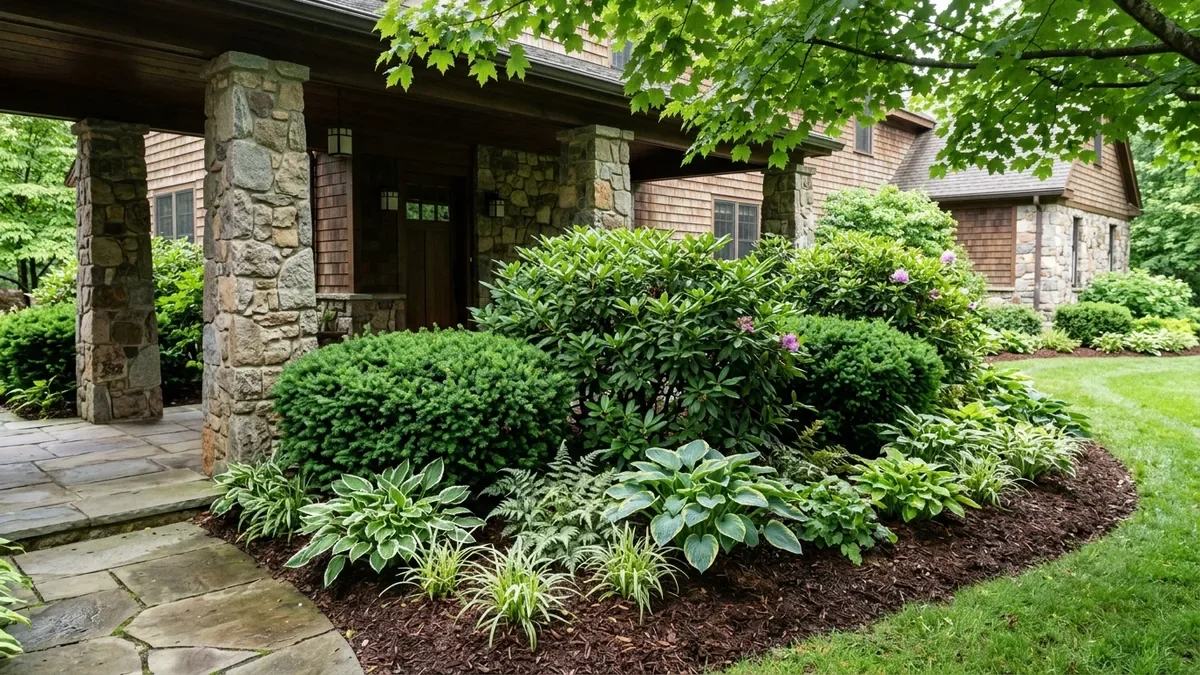
Best For: North-facing property boundaries, yards beneath towering mature oak or maple canopies, and shaded spaces between tall multi-story houses.
Why It Works: Sun-loving privacy plants (like Thuja and Juniper) become leggy, thin, and diseased in deep shade. Selecting true shade-tolerant understory evergreens ensures thick foliage density even under heavy canopy cover.
Plant Types: Hicks Yew (Taxus × media 'Hicksii', 8–12 ft tall, 3–4 ft wide), Japanese Plum Yew (Cephalotaxus harringtonia 'Fastigiata', 6–8 ft tall, 2–3 ft wide), or Mountain Laurel (Kalmia latifolia).
Design Tip: Incorporate white-flowering or variegated understory perennials (like Brunnera, Hostas, and Ferns) along the base to reflect ambient light into shaded corners.
Maintenance: Very low. Slow growth rates mean minimal pruning; supplemental water during summer dry spells when competing with tree roots.
Main Watch-Out: Yew foliage is toxic to horses and pets if ingested in quantity. Plum Yew (Cephalotaxus) is deer resistant and non-toxic.
Regional Note: Hicks Yew thrives in cold Zones 4–7; Japanese Plum Yew thrives in humid Southern shade in Zones 6–9 where traditional yews melt in heat.
17. Create a Sunny Flowering Privacy Border
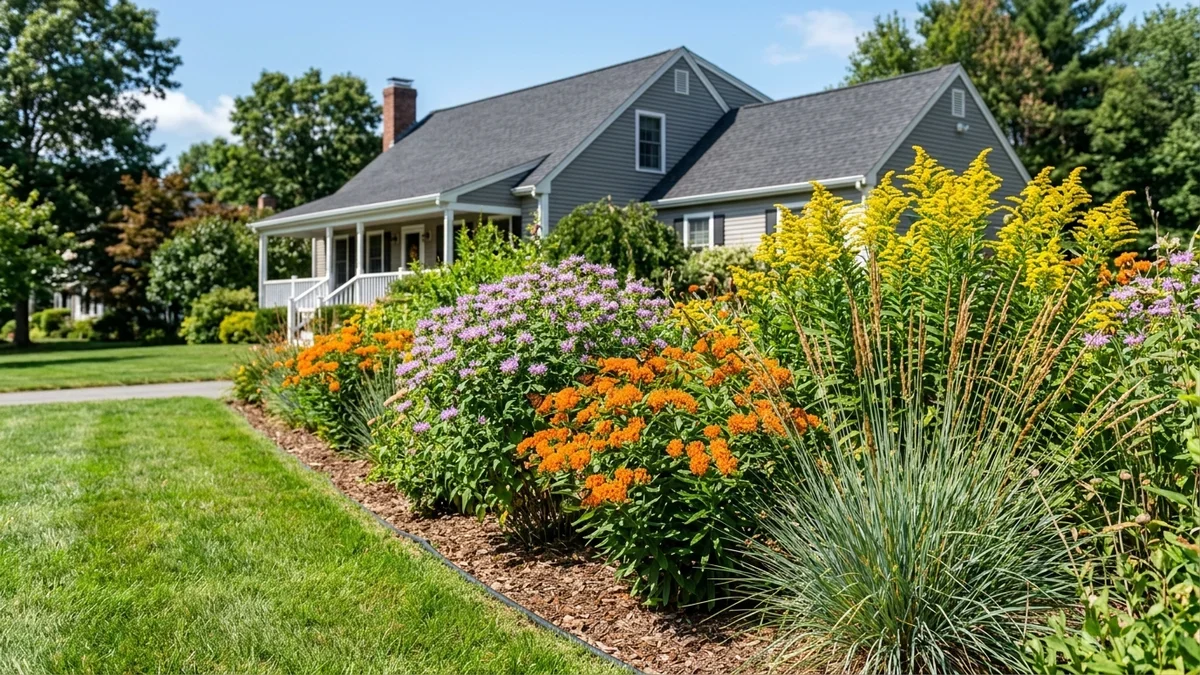
Best For: Wide, south- and west-facing backyards baking in intense midday sun where homeowners desire maximum butterfly and humming bird attraction.
Why It Works: Full sun fuels explosive foliage and flower growth. A diverse border of heat-adapted blooming shrubs creates an impenetrable living thicket during peak outdoor barbecue months.
Plant Types: Chaste Tree (Vitex agnus-castus, 8–10 ft), Diervilla (Bush Honeysuckle, 4–5 ft), Panicle Hydrangea, and Joe Pye Weed (Eutrochium, 5–7 ft). Explore our pollinator garden design ideas for bloom sequences.
Design Tip: Layer tall summer-blooming perennials (like Joe Pye Weed and Tall Ironweed) directly between woody shrubs to fill horizontal light gaps seamlessly.
Maintenance: Low. Prune late-winter; apply a 2-to-3-inch organic bark mulch blanket to conserve soil moisture under harsh summer sun.
Main Watch-Out: Avoid invasive non-sterile Butterfly Bush (Buddleja davidii) cultivars; select only certified seedless cultivars like 'Blue Chip' or 'Miss Molly'.
Regional Note: Vitex performs brilliantly in heat from Zones 6–9; in Northern Zones 4–6, rely on Ninebark and Panicle Hydrangea.
18. Combine Privacy With Edible Landscaping
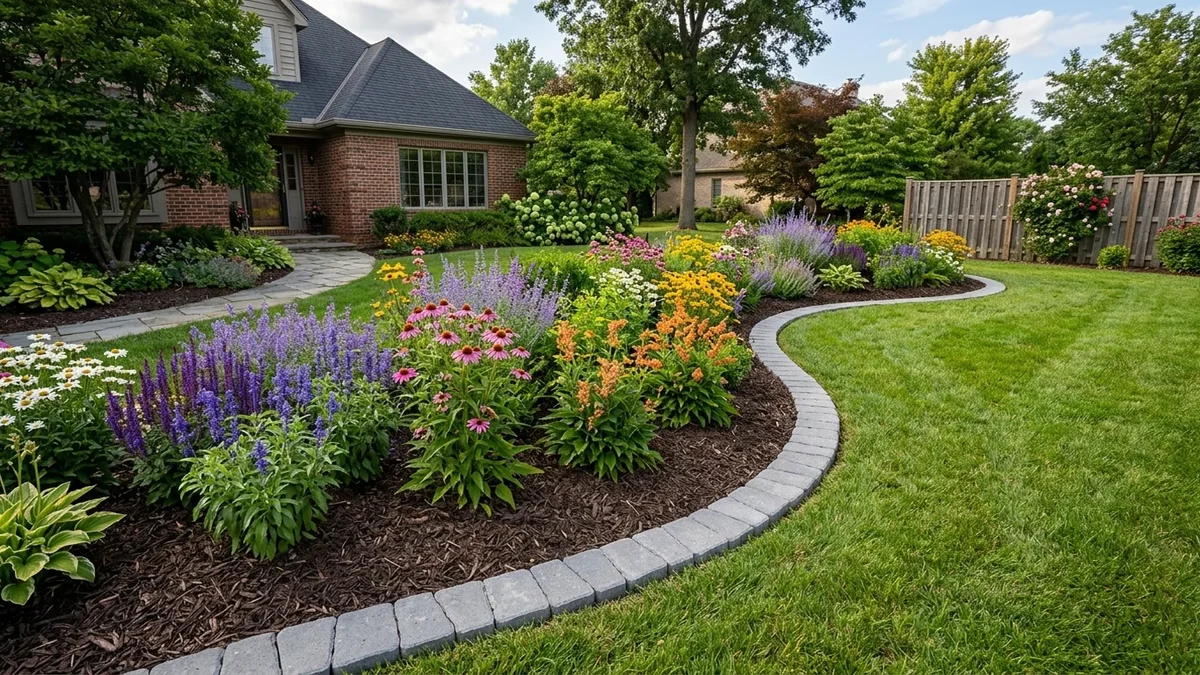
Best For: Suburban homesteaders, gardeners with limited yard area, and families who want their privacy screening to produce fresh organic fruit for the kitchen.
Why It Works: Many fruiting shrubs grow to 6–10 feet with dense foliage canopies. Instead of an ornamental-only shrub, an edible hedge provides privacy, spring flowers, autumn foliage, and gallons of fresh berries.
Plant Types: Highbush Blueberry (Vaccinium corymbosum, 5–7 ft tall & wide), American Elderberry (Sambucus canadensis, 8–10 ft), or Espaliered European Pear trees trained on a wire horizontal support.
Design Tip: Plant at least two different compatible blueberry cultivars (e.g. 'Bluecrop' and 'Elliot') to ensure cross-pollination and maximize fruit set.
Maintenance: Moderate to high. Blueberries strictly require acidic soil (pH 4.5–5.2) and consistent drip irrigation during fruit formation.
Main Watch-Out: Never consume wild or ornamental berries without authoritative botanical verification. Highbush Blueberries and properly cooked Elderberries are edible; many landscape berries (like Yew) are toxic.
Regional Note: Blueberries thrive in acid soils from Zones 4–8; in alkaline soil regions, grow them in peat-filled raised berms or substitute Fig trees (Zones 7–10).
19. Use Deciduous Plants for Seasonal Privacy
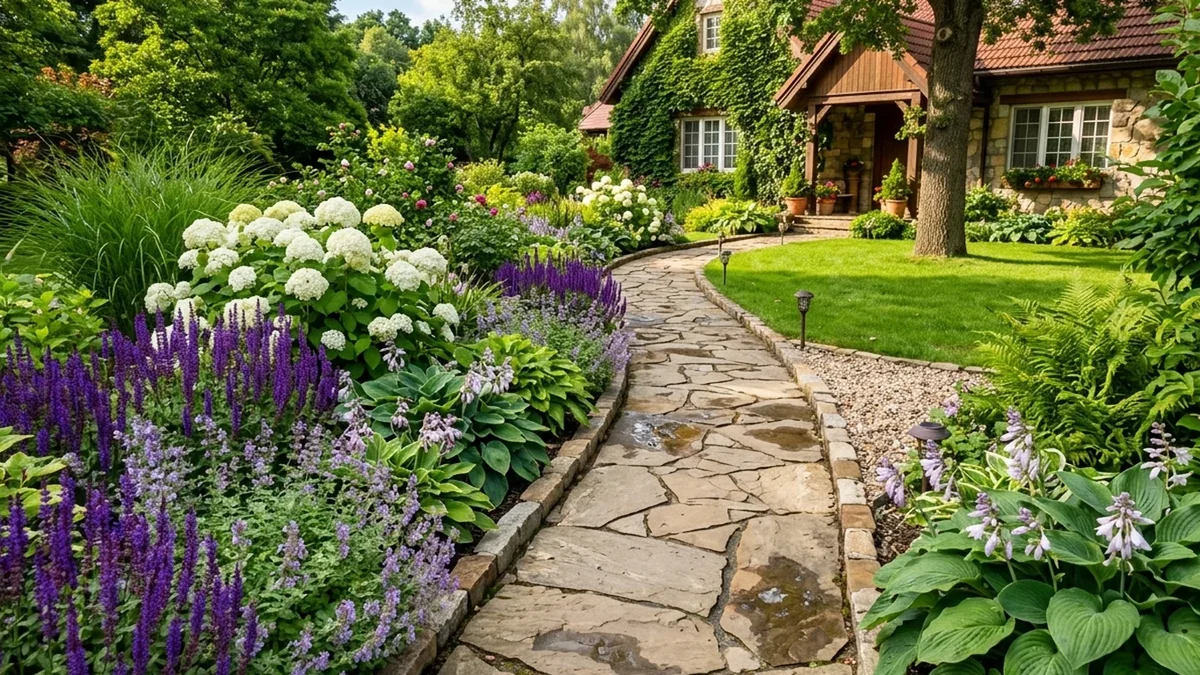
Best For: South- and east-facing house windows where a tall evergreen wall would plunge interior rooms into dark winter gloom when passive solar heat is most welcome.
Why It Works: Deciduous living screens provide dense foliage when you need it (during outdoor barbecue and patio weather from May to October), then gracefully drop leaves in winter, letting 80% of low-angle winter sunlight warm your home.
Plant Types: Seven-Son Flower (Heptacodium miconioides, 12–15 ft), Japanese Tree Lilac (Syringa reticulata, 15–20 ft), or Smokebush (Cotinus coggygria, 8–12 ft).
Design Tip: Select multi-stem deciduous trees with handsome peeling bark (like Seven-Son Flower or Paperbark Maple) so the winter silhouette looks sculptural and intentional rather than empty.
Maintenance: Low. Autumn leaf raking or mulching into garden beds; occasional branch shaping in late winter.
Main Watch-Out: Ensure you and your family genuinely do not use the backyard during cold months. If you have an outdoor hot tub used all winter, you must add an evergreen backbone.
Regional Note: Seven-Son Flower thrives from Zones 5–9, providing late-summer white flowers followed by striking cherry-red autumn calyces.
20. Combine Trees, Evergreens, Shrubs and Grasses
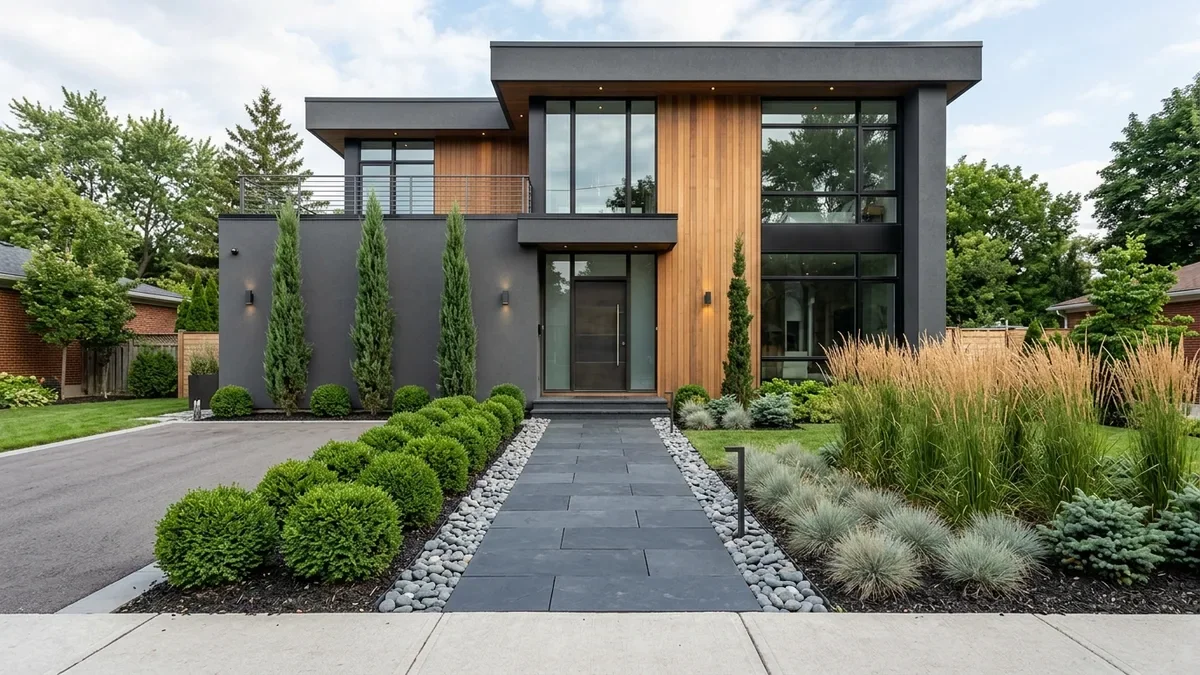
Best For: Homeowners wanting the gold standard in residential landscape design: total multi-story privacy that looks like a lush botanical garden rather than a green barricade.
Why It Works: Combining all four functional plant types—a canopy tree for high sightlines, evergreen pillars for permanent opacity, flowering shrubs for seasonal volume, and ornamental grasses for ground texture—creates a self-sustaining ecosystem that shrugs off disease and weather extremes.
Plant Types: Complete matrix: (1) Serviceberry canopy (18 ft), (2) Thuja 'DeGroot's Spire' pillars (14 ft), (3) Panicle Hydrangea 'Limelight' (7 ft), and (4) Switchgrass 'Northwind' (5 ft).
Design Tip: Use repetition: repeat the same ornamental grass drift and evergreen pillar twice along the boundary to create architectural rhythm that ties the border together.
Maintenance: Moderate. Establish an organic mulch blanket and automated drip irrigation during the first two seasons; thereafter requires only light seasonal pruning.
Main Watch-Out: Ensure you have at least 10 to 14 feet of bed depth to allow all four functional layers to mature without severe root and crown crowding.
Regional Note: Adapt the 4-tier matrix to regional native species for maximum drought resilience and zero chemical pesticide needs.
Interactive Builder
Design Your Custom 3-Tier Living Screen
Build a Resilient 3-Tier Mixed Living Screen
Planting a single-species hedge (like 30 identical arborvitae) invites catastrophic loss if bagworms, spider mites, or root rot strike. A 3-tier mixed screen spreads risk, looks natural, and delivers continuous seasonal color.
Dense native evergreen pyramid, red winter berries
Enormous lime-to-rose conical flower panicles all summer
Strict vertical wheat-colored plumes, rustling movement
3 distinct botanical families prevent catastrophic single-pest failure.
Evergreen backbone maintains sightline barrier when deciduous layers drop leaves.
Provides ample root space and prevents overcrowding at maturity.
Plant Performance
Evergreen vs Deciduous Privacy Plants: The Complete Tradeoff
| Comparison Factor | Evergreen Plants | Deciduous Plants | Mixed Combination |
|---|---|---|---|
| Winter Privacy | 100% Full density | 15–25% Bare twig matrix | 75–85% Maintained backbone |
| Showy Flowers | Rare (mostly subtle cones/berries) | Abundant (Hydrangeas, Lilacs, Viburnum) | Abundant seasonal blooms |
| Fall Foliage Color | None (remains green) | Spectacular scarlet, gold, orange | Striking color against dark green |
| Winter Sunlight | Blocks low winter sun permanently | Admits 80% passive solar warmth | Balanced directional light |
| Pest/Disease Risk | High if planted in single-species rows | Moderate (defoliation rarely fatal) | Lowest risk (high diversity) |
| Wildlife & Pollinators | Winter thermal bird shelter | Nectar, pollen, host leaves, fruit | Year-round habitat & food |
Horticultural Science
Hedge vs Mixed Privacy Screen: Why Monocultures Fail
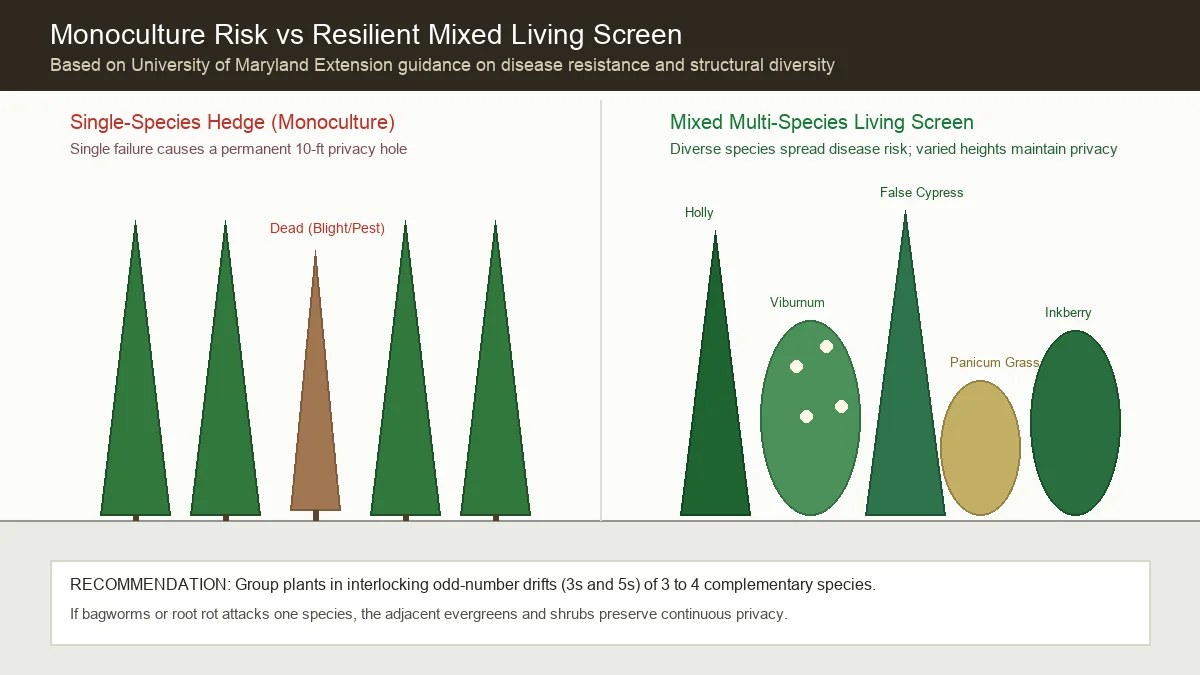
The Reality of Single-Species Privacy Hedges
When a suburban homeowner decides they need privacy, the default impulse is to purchase 25 identical 'Emerald Green' arborvitae or Leyland cypresses and plant them in a rigid military row. While uniform on day one, monocultures carry immense biological risks:
- Pest Outbreak Fast Lanes: Pests like bagworms (Thyridopteryx ephemeraeformis) and spider mites multiply exponentially along an identical row of host plants, stripping foliage from end to end in weeks.
- Lethal Root Pathogens: Soil-borne fungi like Phytophthora root rot spread through connected root zones in heavy or poorly drained soils, causing entire hedge sections to turn rust-brown and collapse.
- Irreparable Gaps: If tree #7 dies in a 10-year-old uniform row, removing it and shoehorning a new small tree in its place looks unsightly. The replacement tree is shaded out by its mature neighbors, taking 8 to 12 years to catch up.
By contrast, University of Maryland Extension guidance emphasizes that combining three to five complementary species spreads biological risk. If an insect infests one shrub, the adjacent species are immune, preserving continuous privacy and protecting your landscape investment.
Vertical Geometry
How to Block a Second-Story Neighbor's View With Plants
Second-Story Sightline Simulator: Why Canopy Placement Trumps Fence Height
A standard 6-foot property fence cannot stop a neighbor looking down from a second-story window into your patio. Drag the sliders below to see why placing a modest 14-foot small tree closer to your patio creates complete privacy, whereas placing that same tree at the rear boundary leaves you in plain view.
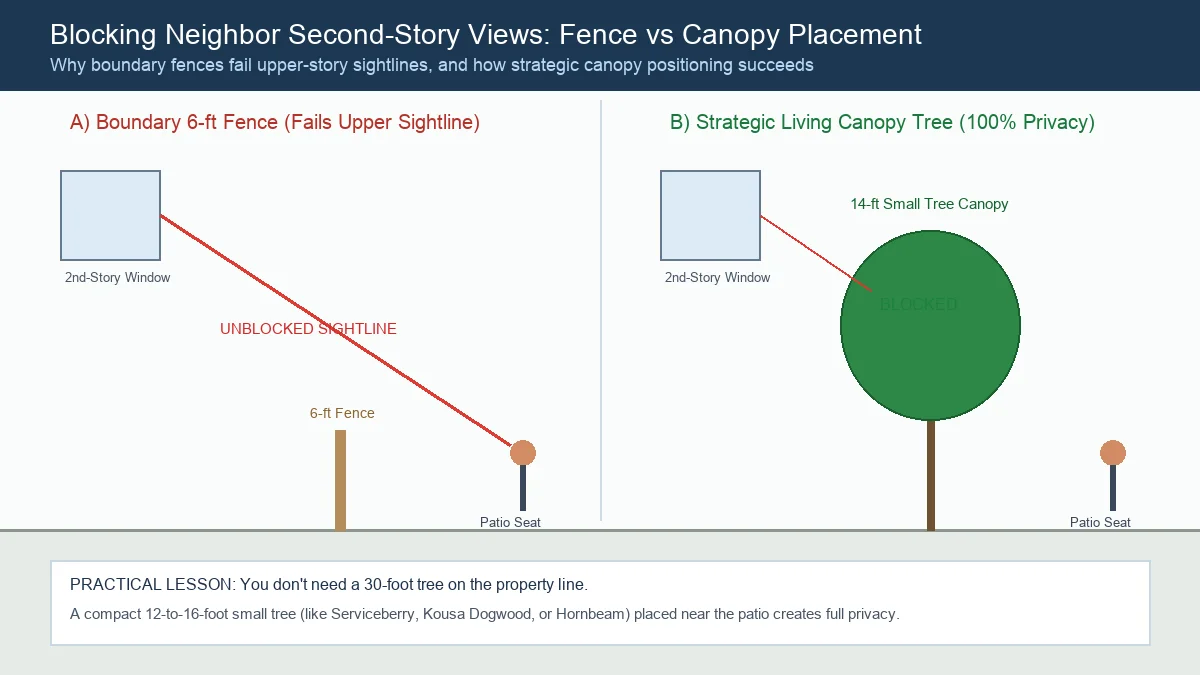
Three Rules for Second-Story Living Screening:
- Prioritize Tree Canopy Over Shrub Density: Shrub height maxes out around 8 to 10 feet. Upper sightlines require an umbrella canopy elevated 12 to 18 feet above the ground.
- Move the Tree Toward Your Patio: The closer the canopy tree sits to your lounge chair or patio dining table, the more of the sky and upper horizon it occludes with a smaller physical crown.
- Choose Multi-Stem Architectural Specimens: Multi-stem clump trees (like Serviceberry, Kousa Dogwood, or River Birch) fan outward into broad, dense branching fans that block wider viewing angles than single-trunk standards.
National Scope
How to Choose Privacy Plants for Your US Region
1. Northeast & New England (Zones 4–7)
Climate Factors: Heavy winter snow loads, ice storms, short growing seasons, acidic rocky soils.
Top Selections: Eastern Redcedar, American Holly, Inkberry Holly 'Shamrock', Serviceberry, Hicks Yew, Arrowwood Viburnum.
2. Mid-Atlantic (Zones 6–8)
Climate Factors: Humid summers, variable winter freezes, clay soils, high deer browsing pressure.
Top Selections: American Holly, Foster's Holly, Skip Laurel (Prunus laurocerasus), Native Switchgrass, Seven-Son Flower.
3. Southeast & Piedmont (Zones 7–9)
Climate Factors: Intense summer heat, high humidity, red clay, long growing season.
Top Selections: Wax Myrtle (Morella cerifera), Yaupon Holly, Illicium (Florida Anise), Japanese Plum Yew, Vitex.
4. Florida & Gulf Coast (Zones 9–11)
Climate Factors: Subtropical humidity, tropical storms, sandy well-drained soils, zero winter chill.
Top Selections: Simpson's Stopper (Myricanthes fragrans), Walter's Viburnum, Podocarpus, Firebush, Clusia.
5. Midwest & Great Lakes (Zones 4–6)
Climate Factors: Polar vortex cold snaps, drying winter winds, heavy clay soils, hot humid summers.
Top Selections: Techny Arborvitae, American Hornbeam, Diabolo Ninebark, Panicle Hydrangea, Prairie Switchgrass.
6. Northern & Central Plains (Zones 3–5)
Climate Factors: Extreme winter lows (-30°F), high sustained prairie winds, summer drought.
Top Selections: Rocky Mountain Juniper, Black Hills Spruce, Tatarian Maple, Big Bluestem, Silver Buffaloberry.
7. Texas & South-Central (Zones 7–9)
Climate Factors: Extreme summer heat (100°F+), flash droughts, caliche and alkaline limestone soils.
Top Selections: Texas Mountain Laurel (Sophora secundiflora), Wax Myrtle, Cenizo (Texas Sage), Desert Willow.
8. Mountain West (Zones 3–6)
Climate Factors: High altitude UV, low humidity, dry winters, sudden freeze-thaw cycles.
Top Selections: Bristlecone Pine, Mountain Mahogany, Chokecherry, Blue Spruce, Serviceberry (Amelanchier alnifolia).
9. Desert Southwest (Zones 8–10)
Climate Factors: Extreme arid heat, alkaline soil, strict water restrictions.
Top Selections: Hopbush (Dodonaea viscosa), Arizona Rosewood, Texas Mountain Laurel, Jojoba.
10. California & Coastal West (Zones 8–10)
Climate Factors: Mediterranean wet winter/dry summer, wildfire defensible space regulations.
Top Selections: Pacific Wax Myrtle, Toyon (Heteromeles arbutifolia), Island Bush Poppy, Coffeeberry.
11. Pacific Northwest (Zones 7–9)
Climate Factors: Wet mild winters, dry summers, acidic woodland soils.
Top Selections: Pacific Wax Myrtle, Western Hemlock, Strawberry Tree (Arbutus unedo), Vine Maple, Camellia.
Realistic Expectations
How Long Does a Living Privacy Screen Take to Grow?
Trellised climbers, railing planter troughs, and 15-gallon container specimens provide immediate functional micro-screening around seating.
Ornamental grasses reach full 5–6 ft height; vigorous flowering shrubs (Panicle Hydrangeas, Ninebark) interlock horizontally into solid summer screens.
Upright columnar evergreens ('DeGroot's Spire', Sky Pencil) and 3-tier mixed borders close canopy gaps, establishing 85–100% year-round density.
Staggered canopy trees (Serviceberry, Hornbeam, Birch) attain 18–25 ft mature heights, delivering permanent architectural shade and upper-window screening.
Container Size vs Establishment Speed Tradeoff
Homeowners often assume buying huge ball-and-burlap (B&B) trees yields faster screening than buying smaller 3-to-7-gallon containers. In reality, large transplanted trees lose up to 80% of their root mass during harvest and suffer 2 to 3 years of severe transplant shock. Vigorous, smaller containerized stock establishes rapid root contact and frequently catches up to and surpasses large B&B trees within 4 to 5 growing seasons at a fraction of the installation cost.
Critical Pitfalls
15 Common Backyard Privacy Planting Mistakes
Spending thousands to line every inch of property fence when only one specific neighbor window or patio is the true sightline problem.
Choosing Leyland Cypress or hybrid willows that shoot up 5 ft a year, only to quickly outgrow the yard, snap in ice storms, and die from Seiridium canker.
Designing with nursery pot dimensions instead of mature 10-foot widths, causing plants to overcrowd, lose lower needles, and choke walkways.
Cramming shrubs 18 inches apart for immediate fill. Within 3 years, lack of interior airflow causes fungal mildew and irreversible lower stem dieback.
Planting 30 identical trees. A single bagworm, borer, or blight infestation wipes out the entire screen simultaneously.
Planting running bamboo (Phyllostachys). Rhizomes break plastic barriers, puncture foundations, invade neighbor yards, and violate state laws.
Using English Ivy, Japanese Honeysuckle, or Kudzu. They escape into natural woods, strangle trees, and rot wooden fence panels. Consult our fence line landscaping guide for safe native alternatives and maintenance clearance buffers.
Digging into shallow buried gas, electric, or fiber-optic lines, or planting trees directly beneath overhead high-voltage transmission wires.
Growing tall dense hedges within 15–20 feet of road intersections or driveway curbs, creating dangerous blind spots for reversing vehicles.
Planting directly on an assumed fence line without confirming boundary pins, risking neighbor complaints or court-ordered removal.
Assuming that a summer hydrangea or lilac hedge will maintain privacy for a winter hot tub after autumn leaf drop.
Forgetting that ornamental grasses must be cut down to the ground in late winter, leaving an open 6-to-8-week sightline window in early spring.
Assuming plants will block 80% of highway noise. Plants diffuse sound and provide rustling white noise, but cannot replace masonry acoustic walls.
In fire-prone western regions, planting resinous dwarf conifers (like junipers or pines) within Zone 0 (0–5 ft) directly under wood eaves.
Installing privacy evergreens directly into standing yard water or heavy compacted construction soil, causing root suffocation. Review our yard drainage solutions before planting.
Questions & Answers
Frequently Asked Questions About Living Privacy
Answers
Frequently asked questions
01What plants are best for backyard privacy?
The best plants for backyard privacy depend on whether you need year-round or seasonal screening, your available bed width, and the height of the view you need to block. For year-round dense screening in narrow spaces, upright cultivars like Thuja occidentalis 'DeGroot's Spire', Sky Pencil Holly, and Hicks Yew excel. For wider borders, a multi-species mixed screen combining evergreen conifers with flowering shrubs (like Panicle Hydrangeas and Viburnums) and ornamental grasses provides greater disease resilience and seasonal beauty than a single-species hedge.
02How can I get privacy from my neighbors without a fence?
You can create living privacy without a fence by identifying the specific sightlines between your seating area and neighboring viewpoints, then placing plants to interrupt those lines of sight. Common non-fence strategies include planting a staggered line of small trees (such as Serviceberry or Kousa Dogwood) to block upper-story windows, using large planted containers around a patio perimeter, installing trellises with native climbing vines, or planting a layered mixed shrub and grass border along property edges.
03How do I block my neighbor's second-story view into my yard?
Blocking a neighbor's second-story window requires strategic canopy placement rather than a tall property-line hedge. Because the downward viewing angle is steep, a standard 6-foot fence or hedge fails to block the view. Placing a 12-to-16-foot small ornamental tree (such as Serviceberry, American Hornbeam, or Kousa Dogwood) 10 to 15 feet from your patio seating creates 100% occlusion along the sightline ray with a modest plant, whereas planting at the far property line would require an oversized 25+ foot tree.
04What is the fastest-growing plant for backyard privacy?
Fast-growing privacy plants include Thuja 'Green Giant' (up to 3–5 ft per year in optimal conditions), Skip Laurel (2 ft per year), and ornamental feather reed grasses (reach 5–6 ft in a single growing season). However, University Extension specialists warn against choosing plants solely for speed. Extremely fast growers often become oversized for residential lots, develop weak wood susceptible to storm breakage, require constant shearing, and can suffer premature dieback compared to moderate-growing, well-matched species.
05Why does University of Maryland Extension recommend mixed living screens over single-species hedges?
University of Maryland Extension recommends mixed privacy screens because planting 20 to 30 identical trees (a monoculture) creates high vulnerability to pests, diseases, and climate stress. If bagworms, spider mites, or root rot strike that single species, the entire screen can die, leaving a massive privacy gap that costs thousands to replace. A mixed screen with three or more botanical families spreads risk: if one plant experiences stress, adjacent healthy species maintain privacy and visual continuity.
06How wide does a backyard privacy planting bed need to be?
Bed width depends entirely on the mature spread of your chosen plants and your design approach. A narrow columnar screen (such as 'DeGroot's Spire' Arborvitae or Sky Pencil Holly) can fit in a 3-to-4-foot bed. A two-tier screen of medium shrubs requires 6 to 8 feet. A resilient three-tier mixed border combining a canopy tree or large conifer, mid-layer flowering shrubs, and a foreground grass drift requires 8 to 14 feet of bed depth to allow healthy root expansion and maintenance clearance.
07Are ornamental grasses effective for backyard privacy?
Ornamental grasses provide rapid, highly effective privacy during the outdoor-living season from late spring through late autumn. Tall upright varieties like Calamagrostis × acutiflora 'Karl Foerster' (5–6 ft) and Panicum virgatum 'Northwind' (5–6 ft) form dense vertical screens with gentle rustling sound and beautiful movement. However, they are seasonal: they must be cut back to the ground in late winter, leaving sightlines open for roughly 6 to 8 weeks in early spring before fresh shoots emerge.
08Should I plant bamboo for fast backyard privacy?
No. Horticultural Extension services strongly advise against planting running bamboo (Phyllostachys species) for residential privacy. Running bamboo spreads aggressively via underground rhizomes, breaking through plastic barriers, invading neighboring properties, cracking hardscape, and violating municipal ordinances in many states. If you desire a grass-like appearance, use tall native switchgrass, big bluestem, or non-invasive clumping species strictly inside heavy-duty, above-ground planters.
09How far from the property line should I plant privacy trees and shrubs?
Set privacy plants back by at least half their mature spread plus a 1.5-to-2-foot buffer from the boundary line. For example, a shrub with an 8-foot mature spread should be planted at least 5.5 to 6 feet inside your property boundary. This prevents branches from overhanging neighboring yards, allows you to maintain and prune the back of the hedge without trespassing, and avoids boundary disputes.
10Can plants block street and neighbor noise?
Plants soften the acoustic environment by absorbing and diffusing high-frequency sound, and rustling foliage (from ornamental grasses and trembling leaves) creates pleasant natural masking sound. However, a living plant screen cannot soundproof a yard or block low-frequency noise from heavy traffic or loud music. University research confirms that living vegetation primarily delivers visual privacy, which reduces perceived noise by removing the visual trigger.
Planning a More Private Backyard in Peabody, MA?
While the 20 privacy concepts detailed above apply to residential landscapes nationwide, plant selection in Peabody and the Massachusetts North Shore requires careful adaptation to USDA Hardiness Zone 6b, coastal winter winds, heavy glacial till soil, and local municipal property setback ordinances.
Whether you are looking to install a resilient native mixed living screen, screen an exposed deck, or redesign your entire backyard grading and planting beds, LandscapingPeabodyMA.com connects you with independent, experienced landscape professionals across Essex County.
Ready to Transform Your Landscape?
Connect with independent local landscaping professionals for on-site property evaluations and detailed project estimates.
Get connected with an independent local landscaping professional. Calls go to (877) 537-6896.