Homeowner Guide · Practical Landscape Design
Easy Landscaping Ideas for Beginners: 14 High-Impact, Low-Maintenance Upgrades
The easiest landscaping improvements do not require bulldozing your lawn or buying dozens of random nursery plants. High-impact beginner landscaping focuses on four foundational actions: cutting clean 3-to-4-inch trench edges along existing beds, laying 2 inches of natural dark bark mulch, massing hardy site-adapted perennials in drifts of three to five, and creating one defined focal point like a container pair or compact ornamental tree. By editing what already exists rather than starting from scratch, homeowners can achieve 80% of a professional aesthetic in a single weekend without triggering heavy ongoing maintenance.
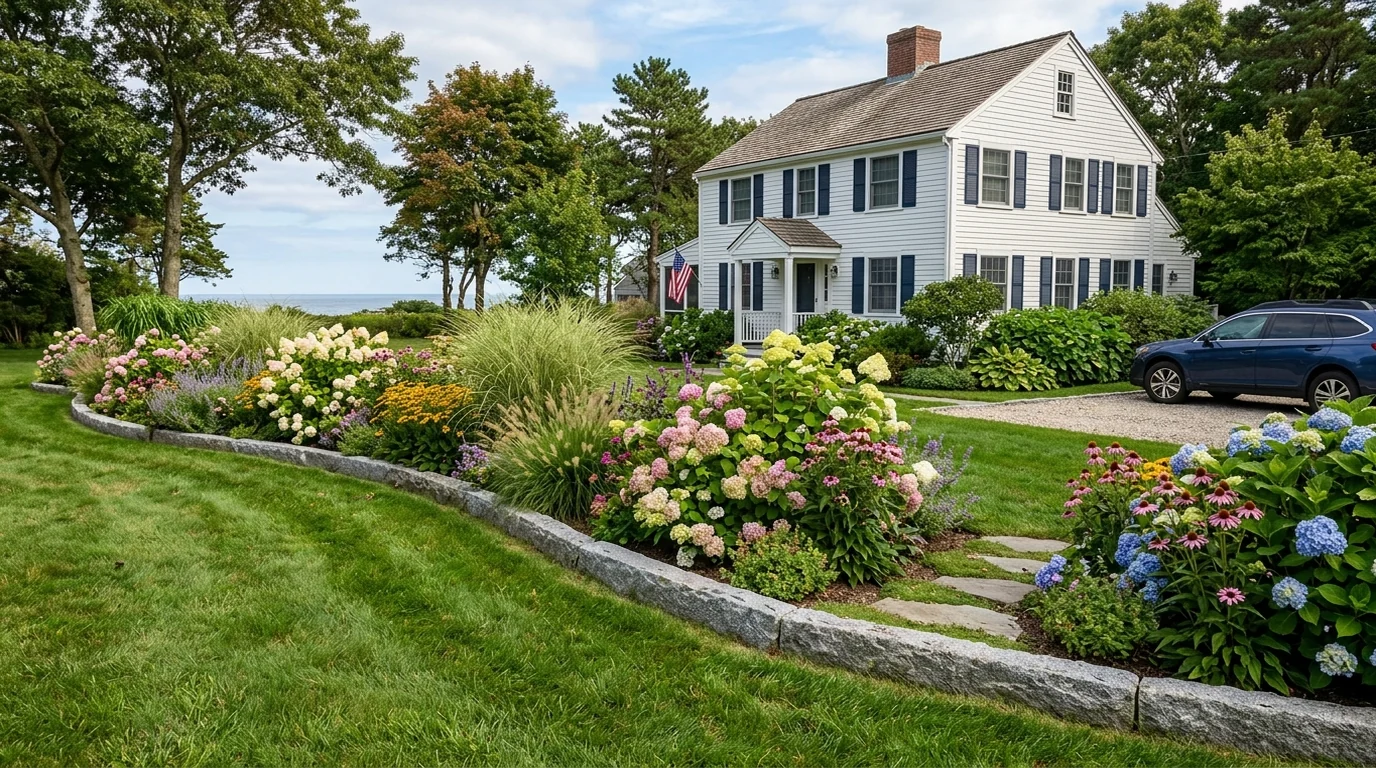
When homeowners search for easy landscaping ideas, they are typically met with overwhelming listicles showing 50 luxury estates with sweeping stone terraces, retaining walls, and custom water features. In reality, true beginner landscaping is about high leverage: choosing projects where modest physical effort and a sensible budget yield immediate visual structure that stays manageable for years to come.
Before picking up a shovel or heading to a garden center, it is essential to establish what actually qualifies as an "easy" landscaping project—and just as importantly, which projects appear deceptively simple but belong in professional hands.
Decision Support
What Does 'Easy' Actually Mean in Residential Landscaping?
Uses everyday household garden tools (flat spade, wheelbarrow, bow rake, hand pruners) rather than plate compactors, laser levels, or mini-excavators.
Can be comfortably tackled in a half-day or a single weekend without leaving the yard a torn-up construction zone for weeks on end.
Delivers noticeable aesthetic transformation for under $100 to $400, avoiding open-ended supply purchases or hidden mobilization charges.
Low-maintenance plants and physical borders that reduce weeding and mowing time rather than adding hours of pruning, deadheading, and edging.
If a plant dies or an edge wobbles, it is cheap and simple to adjust. Zero risk of structural collapse, water entering the basement, or utility strikes.
Works harmoniously with the yard's natural contours and light conditions rather than trying to fight gravity, poor subsoils, or severe shade.
| Project Scope | Why It Qualifies as Easy DIY | When It Requires Professional Planning |
|---|---|---|
| Planting Bed Edging | Spading a 3-inch trench edge along an existing lawn perimeter with hand tools. | Installing extensive mortared granite curbing or tiered retaining borders on a slope. |
| Mulch & Ground Cover | Top-dressing 2 inches of natural dark bark mulch over existing cleared beds. | Re-grading an entire yard slope or removing 6 inches of contaminated clay subgrade. |
| Garden Walkways | Laying dry-set bluestone or flagstone stepping stones embedded directly into lawn/mulch. | Excavating and compacting an 8-inch aggregate base for an interlocking paver walkway or patio. |
| Water Management | Arranging a shallow river stone splash pad beneath a downspout elbow. | Installing underground perforated French drains, catch basins, or dry wells for chronic pooling. |
| Tree & Shrub Planting | Planting 1–3 gallon container perennials, compact shrubs, or a small specimen tree. | Planting large ball-and-burlap canopy trees (150+ lbs) near overhead or buried utility lines. |
Quick Comparison
14 Easy Landscaping Ideas at a Glance
| Idea | Difficulty | Time / Effort | Budget | Ongoing Maint. | Best Application |
|---|---|---|---|---|---|
Spaded Trench Edging (English Edge) Curb Appeal Wins | Very Easy | Half-Day | $ | Low/Moderate | Clean separation between lawn & planting beds |
2-Inch Dark Hemlock Bark Mulch Curb Appeal Wins | Very Easy | Half-Day | $ | Low | Moisture retention, weed suppression, uniform color |
Symmetrical Entryway Planters Curb Appeal Wins | Very Easy | Quick Refresh | $$ | Moderate | Front door welcoming accent & vertical curb appeal |
Mailbox Island Planting Curb Appeal Wins | Easy | Half-Day | $ | Low/Moderate | Street-view curb appeal with drought-hardy blooms |
Odd-Numbered Perennial Drifts (3-5-7) Planting & Beds | Easy | Half-Day | $$ | Low/Moderate | Cohesive visual rhythm without polka-dot clutter |
Native Pollinator Pocket Border Planting & Beds | Easy | Weekend | $$ | Low | Supporting bees & birds with drought-hardy natives |
Three-Tier Bed Architecture Planting & Beds | Moderate | Weekend | $$ | Moderate | Foundation beds with groundcover, perennials & shrubs |
Mulched Island in Awkward Corner Planting & Beds | Easy | Weekend | $ | Low | Eliminating steep or narrow lawn mower traps |
Dry-Set Stepping-Stone Garden Path Hardscape & Paths | Moderate | Weekend | $$ | Low | Informal, mud-free garden & side-yard circulation |
Mulch & Stone Walkway Flanking Hardscape & Paths | Easy | Half-Day | $ | Low | Preventing mud splash & defining walkway edges |
Single Compact Specimen Tree Hardscape & Paths | Moderate | Half-Day | $$$ | Low/Moderate | Front lawn anchor with 4-season flowers & branch structure |
Low-Voltage / Solar Path Lighting Hardscape & Paths | Very Easy | Quick Refresh | $ | Low | Evening walkway safety & gentle landscape illumination |
Rejuvenation Pruning & De-Cluttering Simplification | Easy | Half-Day | $ | Low | Opening up blocked windows & airing out leggy shrubs |
River Stone Downspout Splash Pad Simplification | Easy | Half-Day | $ | Low | Preventing mulch washout & directing roof runoff |
Category 1
Quick Curb-Appeal Wins: High Visual Return in Under a Day
Spaded Trench Edging (The Classic English Edge)
What It Is & Why It Works
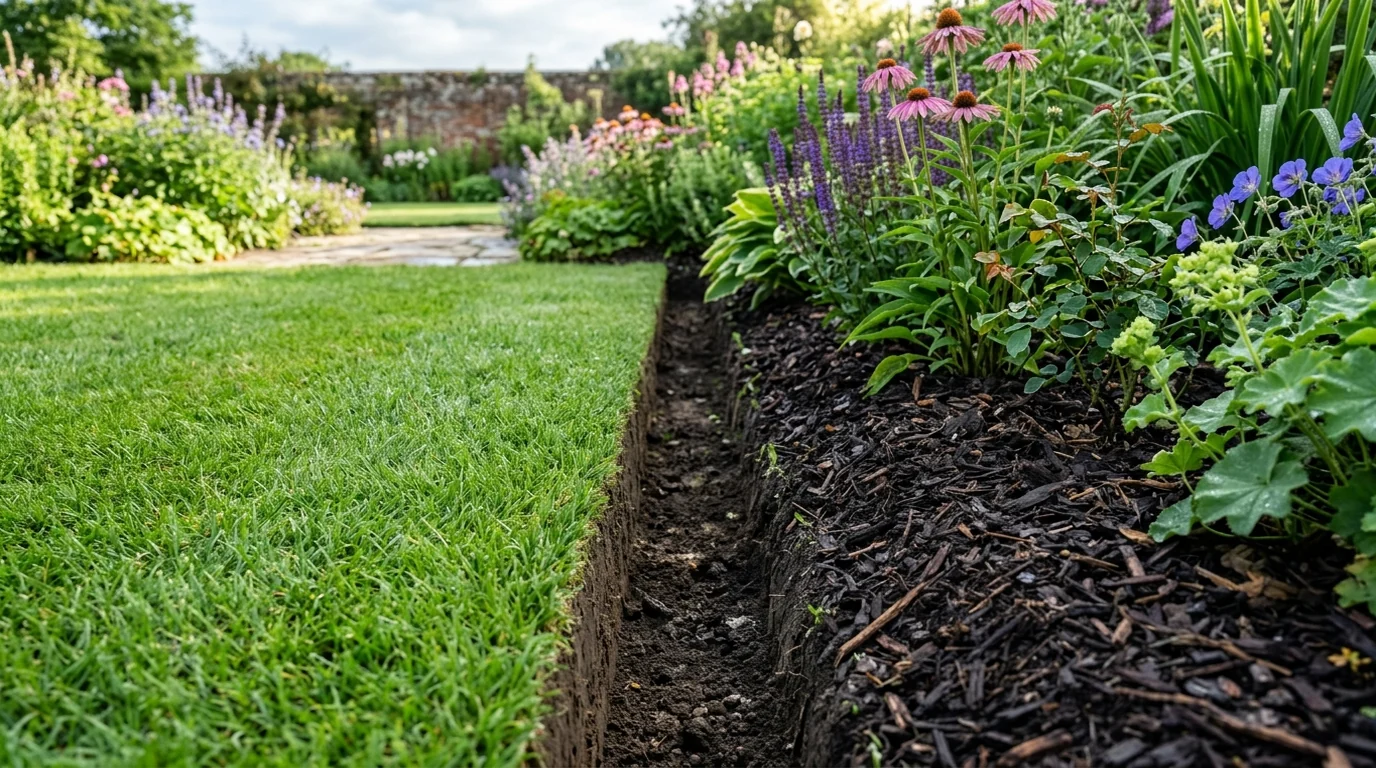
Instead of buying flimsy plastic edging that heaves out of the ground after a single winter, professional landscapers use a sharp spade to slice a crisp, 3-to-4-inch vertical trench along the lawn perimeter, sloping back at 45 degrees into the garden bed.
This physical air gap stops turf stolons (especially Kentucky bluegrass and fine fescues) from creeping into the mulch, while casting a deep shadow line that makes the entire front yard look professionally manicured. For a full comparison of edging styles, see our guide on flower bed edging ideas.
Watch-Out & Execution
How to do it: Lay down a garden hose or rope to create smooth, sweeping curves. Step firmly on a flat-edged garden spade perpendicular to the turf, rocking it back slightly. Scoop away the loose sod clumps.
Beginner Mistake: Cutting tiny zigzag waves. Human eyes prefer long, gentle, sweeping arcs. Sharp wobbles look accidental and make weekly lawn mowing frustrating.
2-Inch Natural Dark Bark Mulch Refresh
What It Is & Why It Works
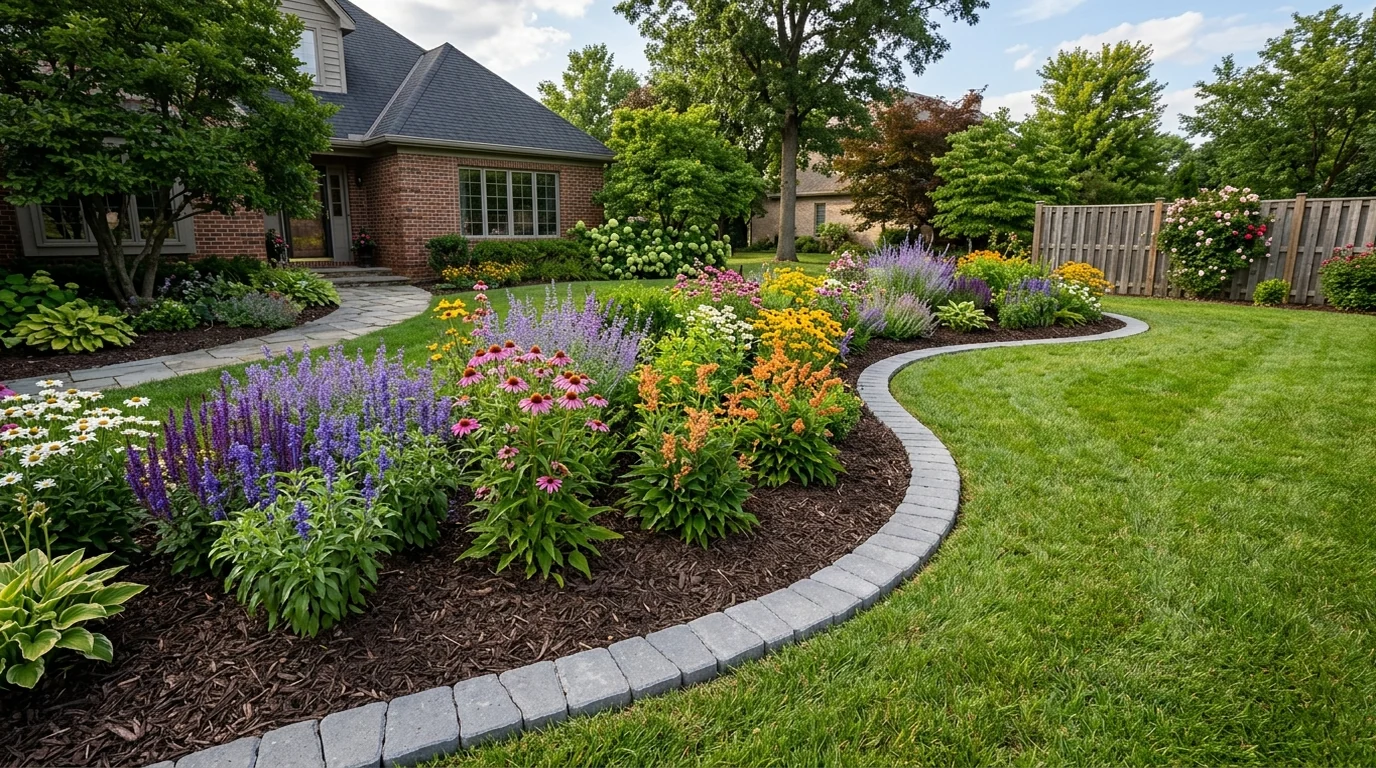
Natural shredded bark mulch (hemlock, cedar, or pine) provides three simultaneous benefits: it cools root zones during summer droughts, smothers germinating weed seeds, and creates a unified dark backdrop that makes green foliage and flower colors visually pop.
Unlike artificial rubber pellets or dyed red mulches that bleed chemical dyes, natural bark breaks down slowly into rich organic humus that feeds beneficial soil microbes across your garden beds.
Watch-Out & Execution
How to do it: Spread with a bow rake to an even depth of 2 to 3 inches. If your beds already have 2 inches of mulch from last year, merely scuffle the top layer with a rake and add a light 1-inch dusting to restore color.
The "Volcano Mulch" Trap: Never pile mulch against the bark of trees or wooden home siding. Mulch touching trunks traps moisture, rots the cambium layer, and invites destructive burrowing rodents and wood-decay fungus.
Symmetrical Architectural Entryway Planters
What It Is & Why It Works
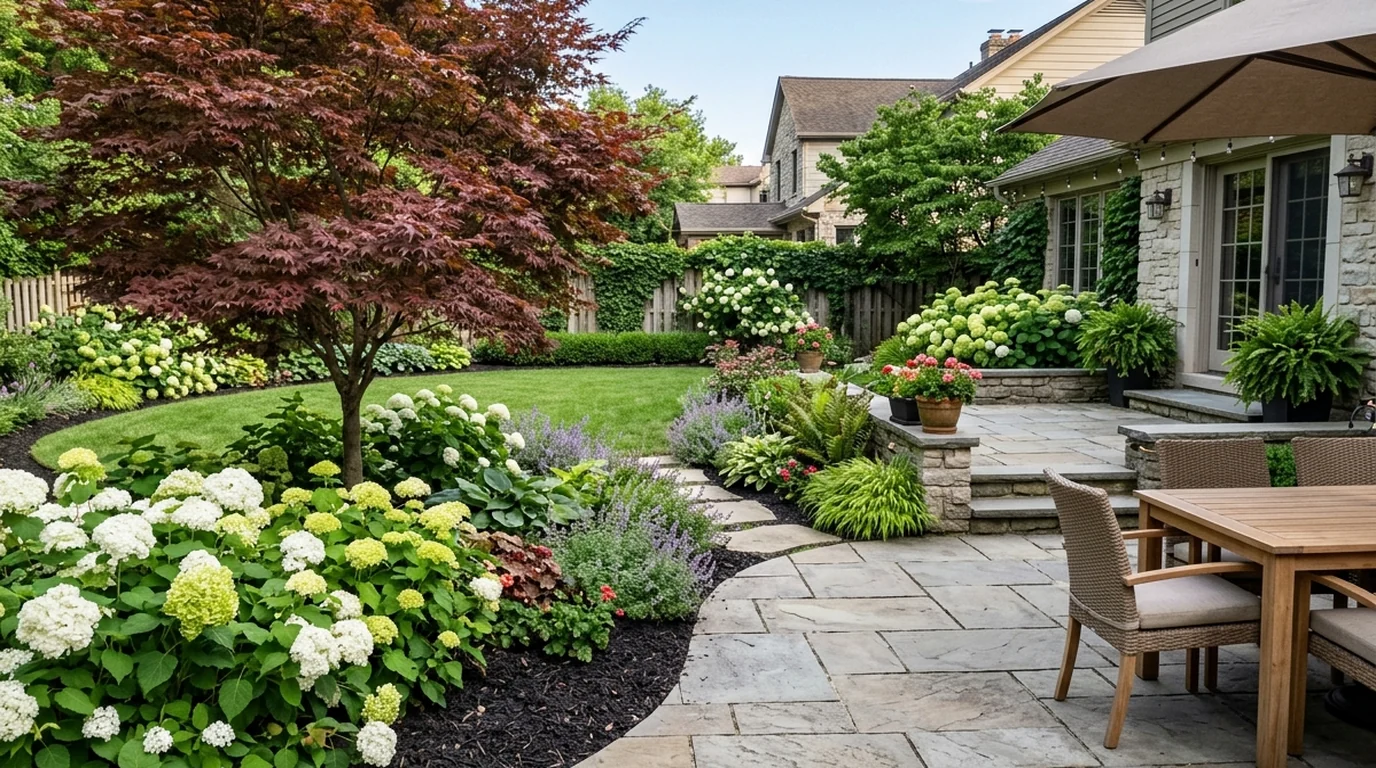
A matching pair of substantial containers (minimum 16 to 20 inches in diameter) flanking your front door or front porch steps immediately establishes architectural symmetry.
Because pots sit above ground, they allow you to display lush flowers and evergreen textures right beside your entryway even if your front porch is surrounded by concrete, paving, or compacted foundation soil.
Watch-Out & Execution
The Designer Thriller-Filler-Spiller Rule: Place one vertical centerpiece (like an upright dwarf Alberta spruce, spiral boxwood, or ornamental grass), surrounded by compact mounding foliage (coral bells or begonia), and a cascading edge plant (creeping Jenny or ivy).
Tiny Pot Syndrome: Buying 8-inch plastic pots looks cluttery from the street and dries out within hours during July heat waves. Invest in heavy, weatherproof composite or glazed ceramic pots that hold enough potting mix to retain moisture.
Mailbox Garden Island with Drought-Tolerant Perennials
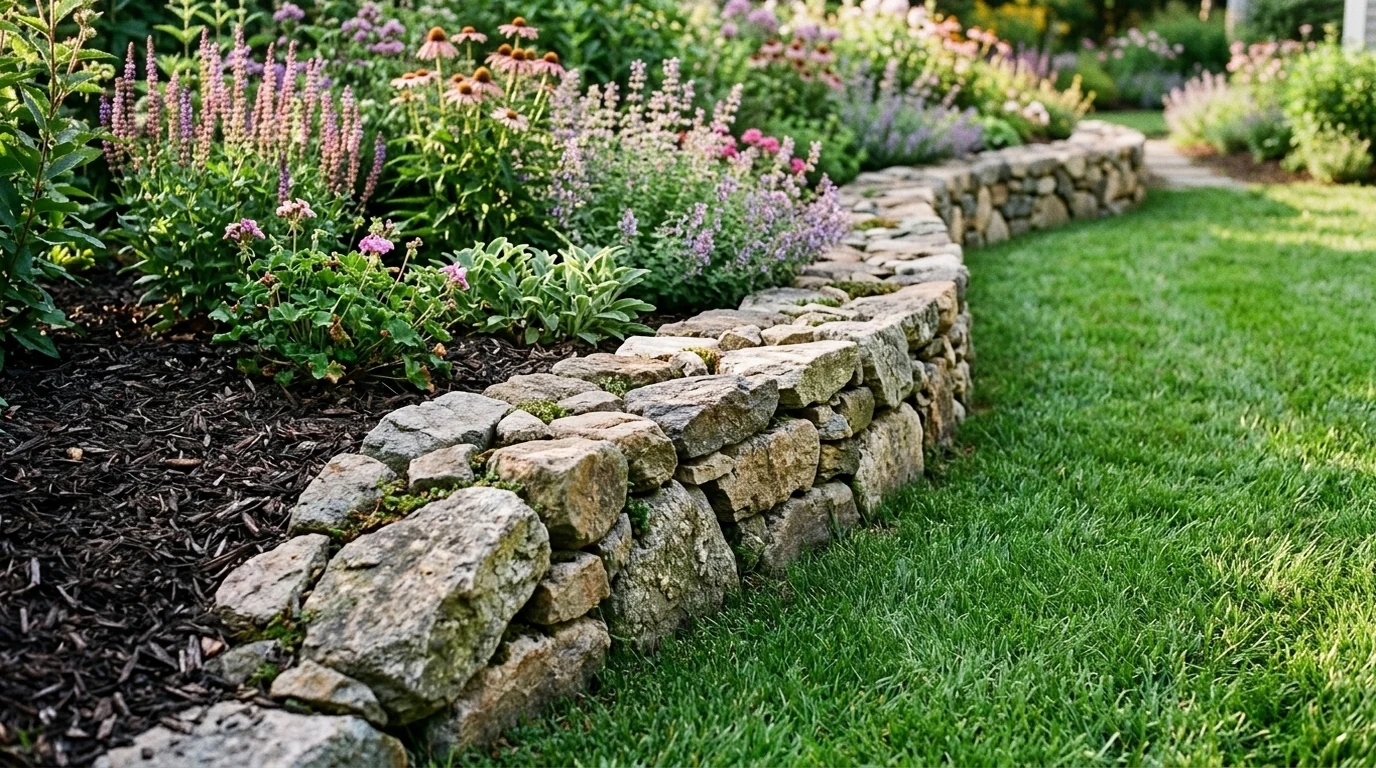
What It Is & Why It Works
A standalone wooden or granite mailbox post surrounded by scraggly turf is an eyesore and a maintenance nuisance that requires awkward weed-whacking every time you mow.
Carving out a small kidney-shaped or rectangular bed (typically 3 to 4 feet deep by 5 to 6 feet wide) around the post completely eliminates trimmer damage while delivering street-level seasonal color.
Watch-Out & Execution
Street-Hardy Plants: Because street verges absorb road heat, winter road de-icing salt, and snowplow spray, choose tough perennials like catmint (Nepeta 'Walker's Low'), daylilies, Russian sage, or coneflowers.
Access & Utility Warning: Never plant tall bushy shrubs or thorny roses that obstruct the mail carrier's reach or block line-of-sight for cars backing out of the driveway. In Massachusetts, always call Dig Safe (811) before digging near the road curb where gas and cable lines often run shallow.
Category 2
Low-Maintenance Planting: Stopping the Weed & Water Battle
The Odd-Numbered Perennial Drift Rule (3-5-7)
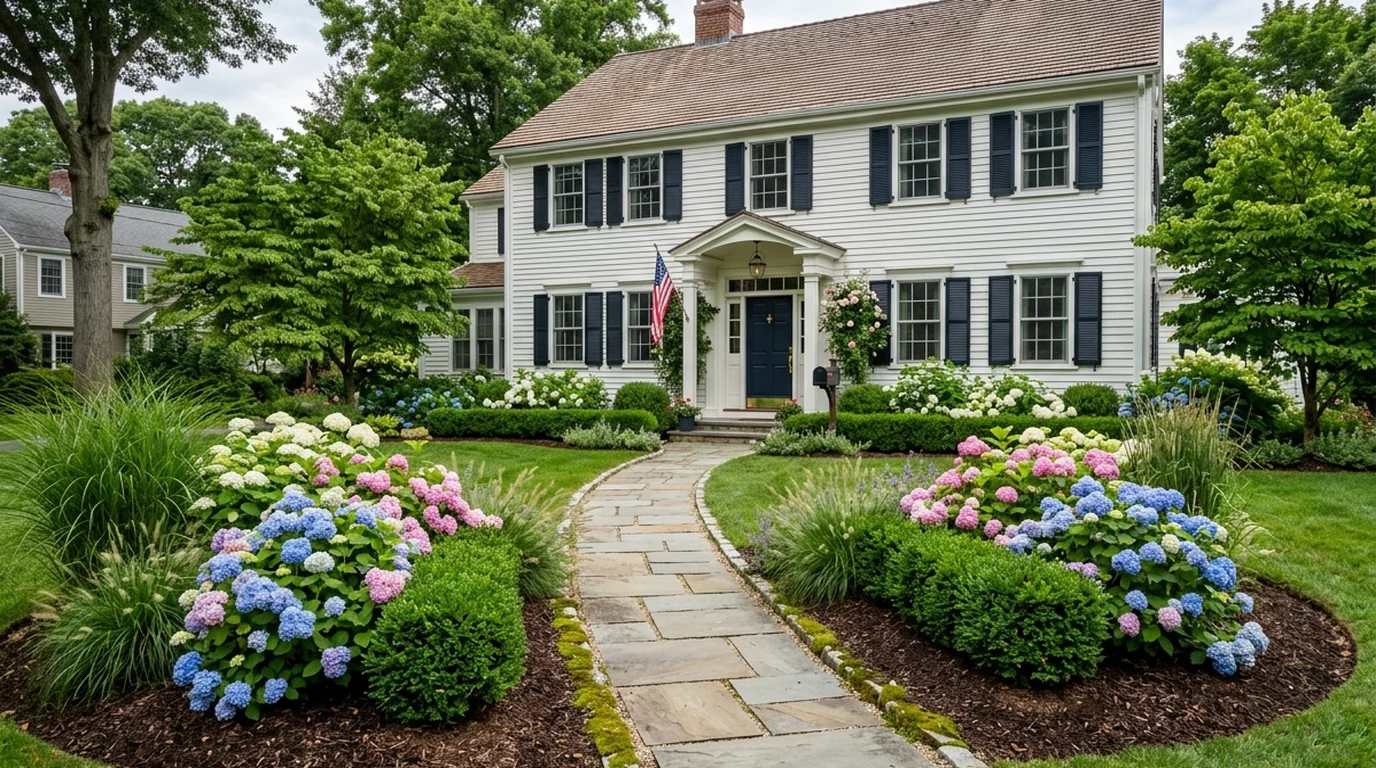
What It Is & Why It Works
The biggest trap for beginners at the garden nursery is "plant collector syndrome"—buying one hosta, one coneflower, one black-eyed Susan, and one daylily. When planted individually, the bed looks like an accidental polka-dot salad.
Professional designers select only 3 or 4 plant species and buy 3, 5, or 7 of each. Odd numbers prevent our brains from forming artificial geometric pairs, creating naturalistic "drifts" of color that mimic native plant colonies.
Watch-Out & Execution
Maintenance Payoff: When five coneflowers grow together, their leaves knit into a solid canopy within two seasons. This living green mulch blocks sunlight from hitting the soil, cutting annual bed weeding by over 60%.
Overcrowding Mistake: Read the plant tag's mature spread! If a salvia grows 24 inches wide, space them 18 to 20 inches apart on center. Jamming them 8 inches apart causes mildew and fungal decline in humid summers.
Low-Maintenance Native Pollinator Pocket
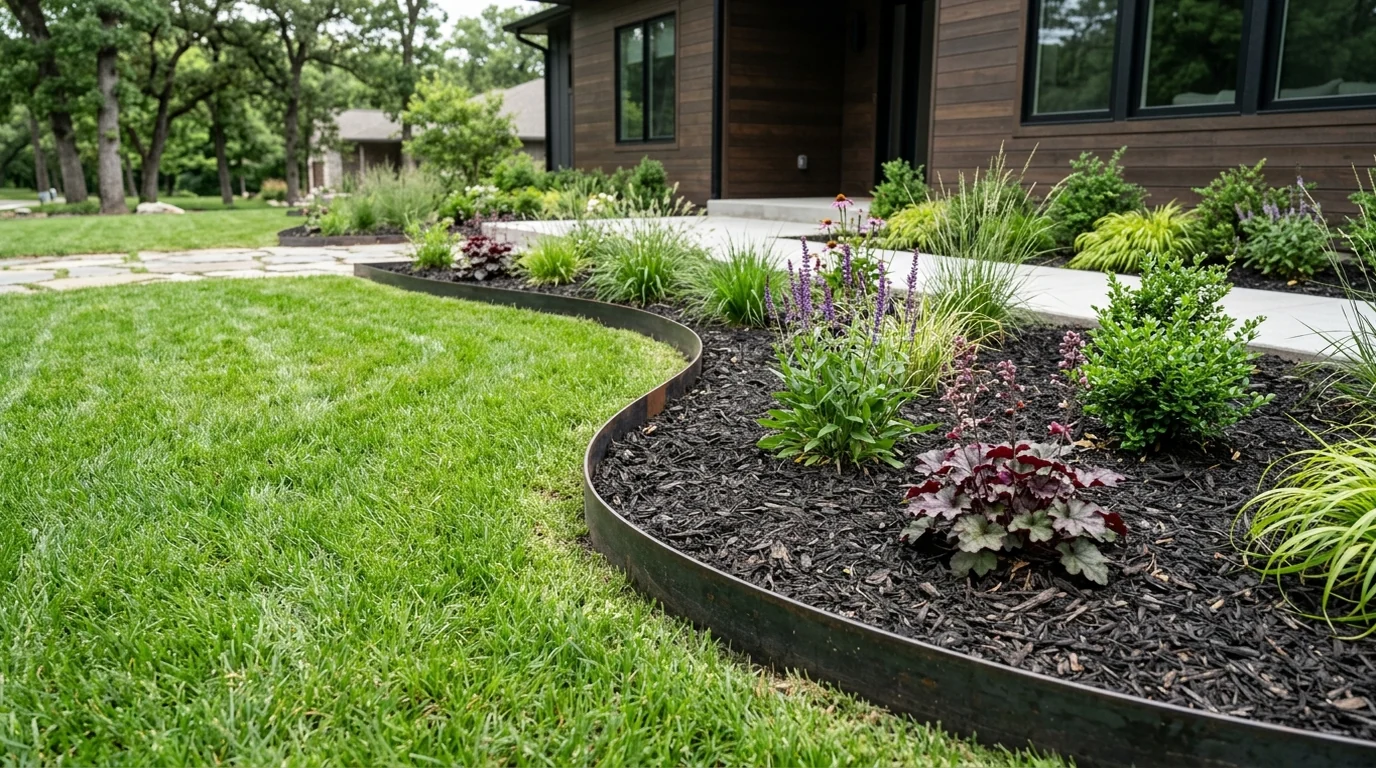
What It Is & Why It Works
Perennials native to Massachusetts and the Northeast evolved in our glacial soils, freezing winters, and humid summers. Once their root systems establish after the first season, they need zero chemical fertilizers and survive regional dry spells with ease.
Proven Native Workhorses: Purple Coneflower (Echinacea), Black-Eyed Susan (Rudbeckia fulgida 'Goldsturm'), Butterfly Weed (Asclepias tuberosa), Foamflower (Tiarella cordifolia for shade), and Wild Blue Phlox.
Watch-Out & Execution
Native ≠ Neglected: A native pocket border is not an unmanaged weedy meadow. Keep it tidy by maintaining a crisp, spaded edge and cutting back dead stems in late winter/early spring rather than autumn to protect overwintering beneficial insects.
Invasive Screening: Never plant invasive species like Japanese barberry (Berberis thunbergii) or burning bush (Euonymus alatus), which are prohibited by the Massachusetts Department of Agricultural Resources (MDAR).
Three-Tier Planting Bed Architecture (Groundcover + Perennial + Shrub)
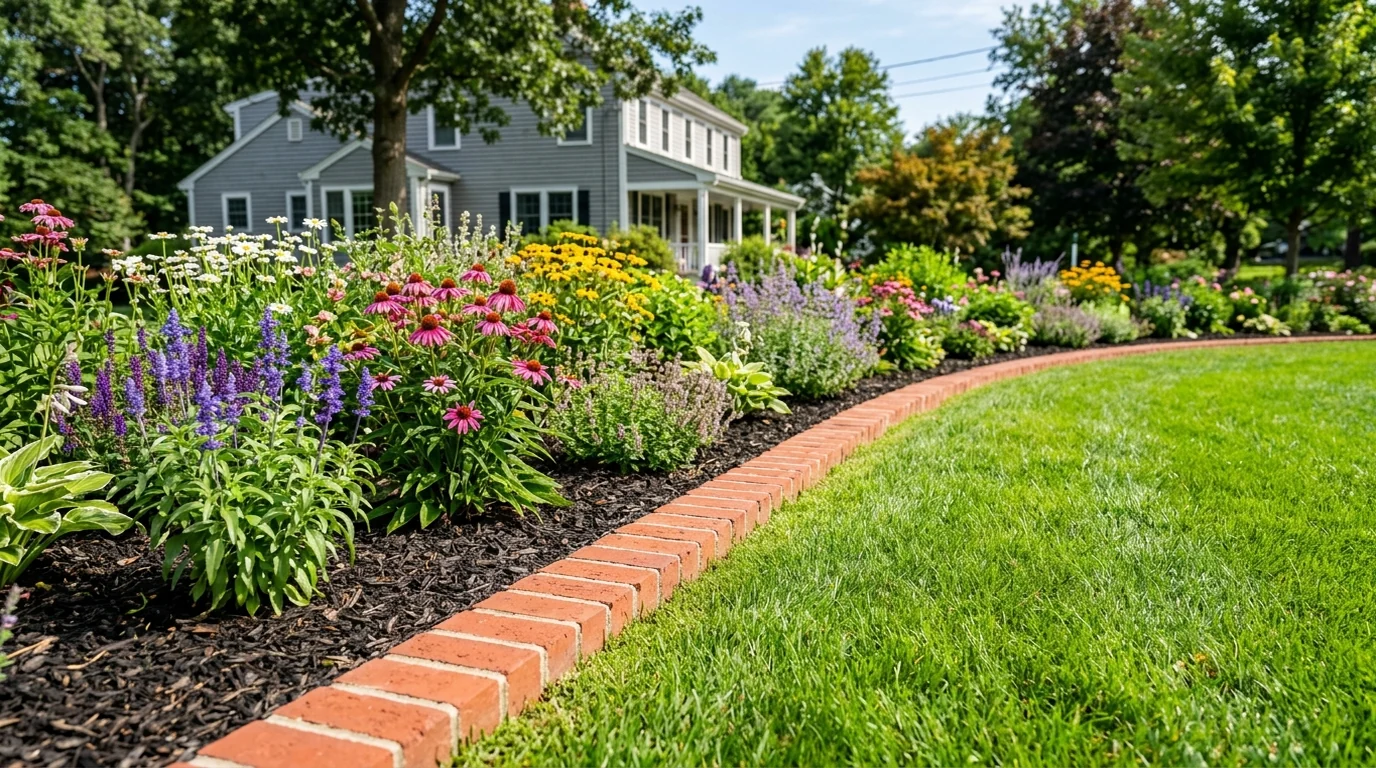
The 3-Tier Layering System
When foundation beds look flat, it is usually because all the plants are the exact same 3-foot height. Professional landscape designers organize planting depth in three distinct vertical layers:
- Back Tier (3–5 ft): Compact evergreen structural shrubs (e.g., inkberry holly, dwarf rhododendron, or boxwood) to anchor the foundation.
- Middle Tier (1.5–3 ft): Seasonal blooming perennials (coneflower, salvia, black-eyed Susan, or daylilies).
- Front Tier (6–12 in): Low mounding groundcover (creeping thyme, pachysandra, or coral bells) spilling gently over the edge.
Watch-Out & Execution
Bed Depth Requirement: To fit three vertical layers comfortably, a foundation bed must be at least 5 to 6 feet deep from house siding to the lawn edge. Cramming three layers into a narrow 2-foot trench causes chronic crowding and plants rubbing against siding.
Foundation Clearance: Keep back-tier shrubs at least 18 to 24 inches away from your home's siding to allow air circulation and pest inspection.
Converting an Awkward Mower-Trap Lawn Corner into a Mulched Island
What It Is & Why It Works
Nearly every residential property has an awkward, high-maintenance corner: a steep slope where the mower slips, a narrow strip between a fence and a shed where grass grows patchy, or a shaded spot under a mature tree where turf constantly dies.
Stop trying to force grass to grow where it does not want to. Smother the struggling turf with cardboard, top with 3 inches of dark bark mulch, cut a smooth curved outer edge, and plant shade-tolerant groundcovers like hostas, ferns, or foamflower.
Watch-Out & Execution
The Cardboard Smother Method: Do not break your back digging out patchy turf and rocks. Lay overlapping sheets of plain brown corrugated cardboard directly over the grass, soak thoroughly with water, and dump mulch directly on top. The cardboard smothers the grass and naturally decomposes into rich soil within a few months.
Avoid Surface Tree Root Damage: If this corner is beneath a mature tree, never use a rototiller or dig deep trenches into the root zone. Shallow hand-planting between major root flares protects tree health.
Category 3
Simple Hardscape & Walkways: Adding Structure Without Heavy Masonry
Dry-Set Stepping-Stone Garden Path
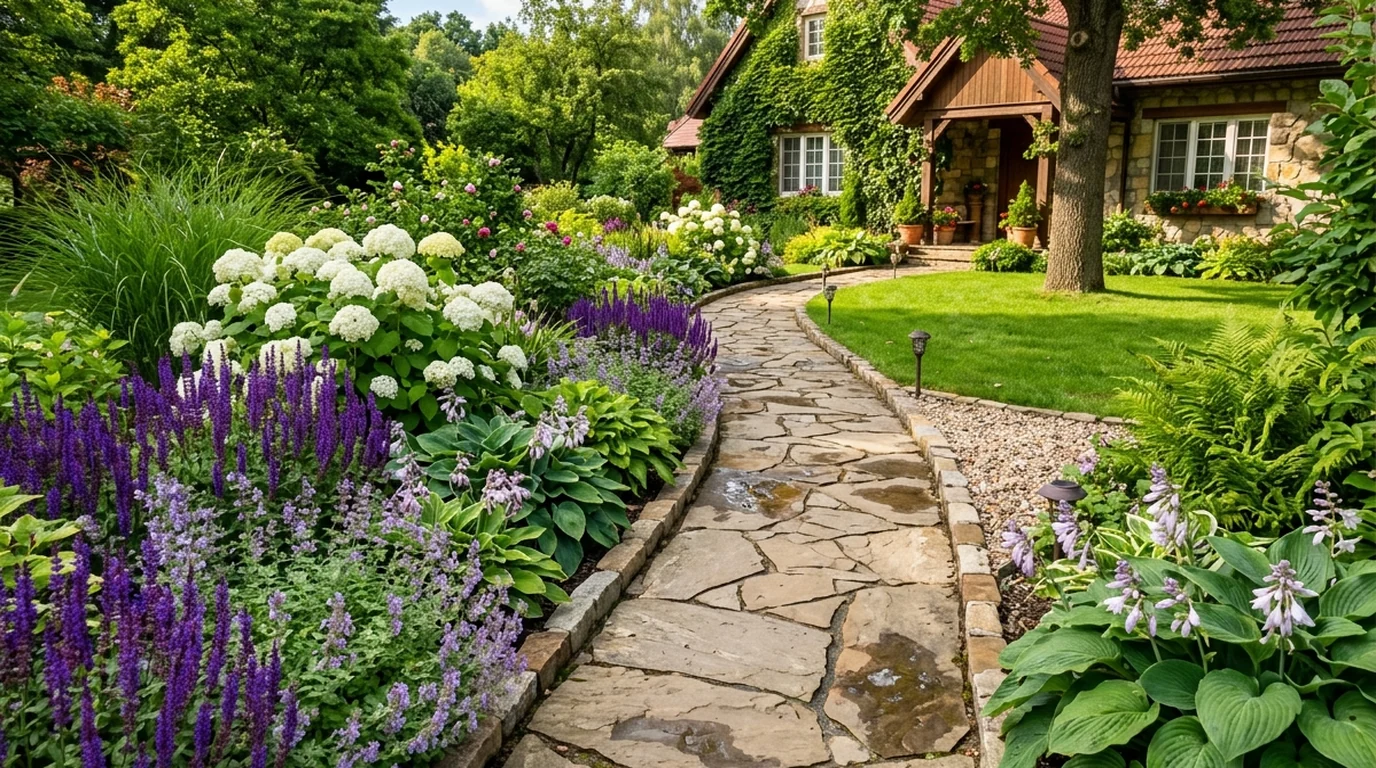
What It Is & Why It Works
Frequent foot traffic between the driveway and the backyard gate, hose spigot, or trash bins inevitably turns lawn into a packed, muddy dirt track.
Laying 6 to 10 natural bluestone or thermal granite flagstone stepping stones (18 to 24 inches wide) provides immediate, mud-free pedestrian access while lending an organic cottage charm to side yards. For formal driveway or patio paving, review our guide to concrete pavers vs. stone.
Watch-Out & Stride Spacing
Human Stride Geometry: Set stones so their centers are approximately 24 inches apart. This matches the natural adult walking stride, preventing people from doing awkward half-steps or giant leaps.
Lawn Mower Clearance: If setting stones directly into turf, cut out the sod and dig down 2 inches so the stone sits roughly 1/2 inch below the top of the turf soil. This lets your lawnmower blade glide directly over them without chipping blades.
Mulch & Stone Walkway Flanking Border
What It Is & Why It Works
Concrete or paver front walkways that run directly against turf grass often suffer from grass overgrowth, soil compaction, and muddy splash-back during rainstorms.
Carving a clean 12-to-18-inch border along the walkway edges and filling it with dark hemlock mulch or rounded 3/4-inch New England river stone creates a crisp frame that visually widens the arrival path and protects shoes from wet grass.
Watch-Out & Execution
Plant Low or Upright: If adding plants into this flanking strip, choose tight, vertical varieties like 'Little Spire' Russian sage, creeping phlox, or dwarf mondo grass that will not flop onto the paved walkway or trip visitors.
Snow Clearance Consideration: In Massachusetts winters, this border sits right where snow shovels push snow. Avoid brittle or delicate woody shrubs that snap under heavy snow banks.
Single Compact Specimen Tree as an Architectural Anchor
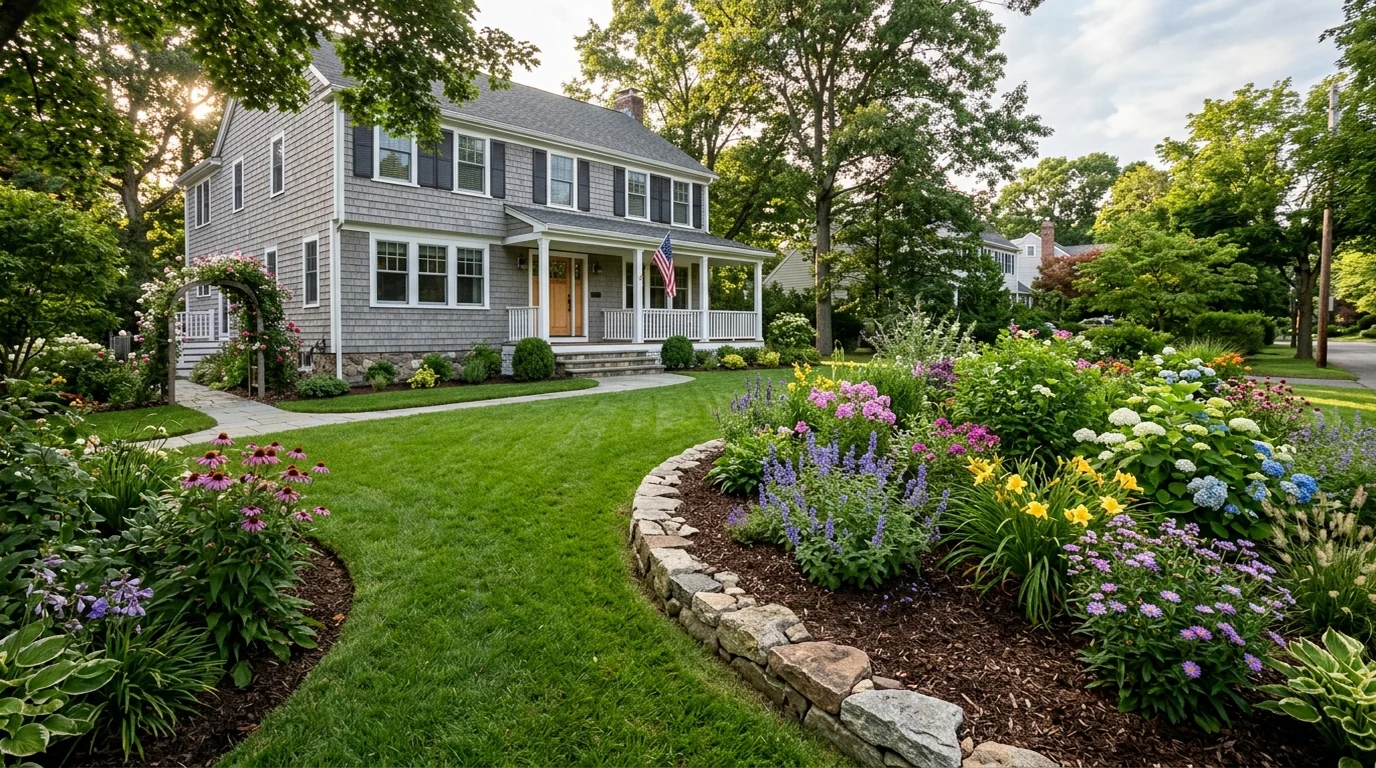
What It Is & Why It Works
A flat front lawn often lacks vertical presence. Planting a single, appropriately scaled ornamental tree creates an architectural focal point that softens rigid house corners and provides multi-season beauty (spring flowers, summer shade, autumn foliage, and winter branch structure).
Top Compact New England Picks (stays under 20–25 ft):
- Eastern Redbud (Cercis canadensis): Magenta spring blooms and heart-shaped leaves.
- Serviceberry (Amelanchier 'Autumn Brilliance'):Delicate white blooms, edible June berries, and fiery orange fall color.
- Kousa Dogwood (Cornus kousa): Disease-resistant June white star bracts and exfoliating bark.
Watch-Out & Execution
Mature Spread Planning: A tree that is 6 feet tall at the nursery will eventually grow 15 to 25 feet wide. Plant at least 10 to 15 feet away from your foundation, driveway, and overhead utility lines.
Dig Safe Law: In Massachusetts (M.G.L. c. 82 § 40), you must call Dig Safe (811) at least 72 hours before digging a tree pit. Gas, electric, or cable lines may run through your front lawn right where you plan to dig.
Low-Voltage / Solar Path Lighting Accents
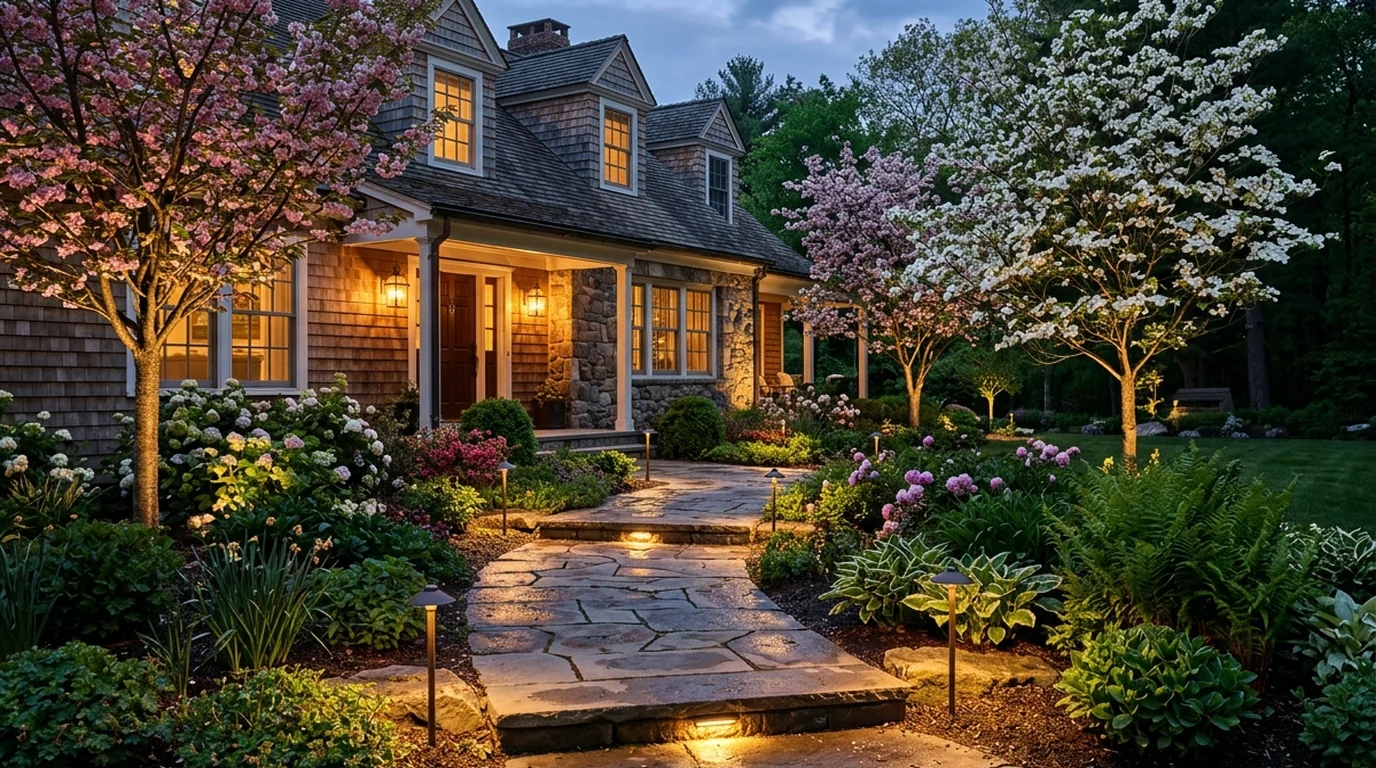
What It Is & Why It Works
Landscape lighting transforms your home after sunset, providing safety for guests navigating steps and accentuating the sculptural silhouettes of trees and shrubs.
Modern plug-and-play low-voltage LED kits (12V) plug directly into an exterior GFCI outlet. The thin wire is simply tucked 2 inches beneath mulch or slit into turf, making it 100% safe for beginners with zero licensed electrical work required.
Watch-Out & Execution
Avoid the Runway Effect: Do not install lights in perfectly straight, opposing pairs like an airport runway. Stagger lights along alternating sides of the path (8 to 10 feet apart) and aim warm uplights (2700K color temperature) into tree canopies.
Avoid Cheap Blue Solars: Ultra-cheap solar stakes produce cold, harsh blue-white light (5000K+) and fail after two months of cloudy New England weather. Opt for quality warm-white solar or plug-in 12V LED fixtures.
Category 4
Landscape Simplification: Editing Out Problems Before Adding New Plants
Selective Rejuvenation Pruning & Shrub De-Cluttering
What It Is & Why It Works
Before spending hundreds of dollars ripping out overgrown foundation beds, look closely at what you already own. Often, an "ugly" yard simply suffers from years of neglected pruning that has blocked lower windows and turned shrubs into leggy, congested tangles.
Using a clean pair of bypass loppers and a hand pruning saw to remove deadwood, crossing branches, and suckers restores natural branching form, lets light into interior foliage, and lifts sightlines back to your front windows.
Watch-Out & Execution
The One-Third Pruning Rule: Never remove more than one-third of a shrub's total canopy in a single growing season. Pruning too heavily triggers panic growth of weak water-sprout suckers.
Avoid "Meatball" Shearing: Do not take electric hedge shears and buzz every shrub into artificial round spheres or green meatballs. Shearing forces dense growth at the exterior shell, starving interior leaves of sun and turning the center into dead brown twigs. Hand-thin branches at their base instead.
River Stone & Gravel Downspout Splash Pad
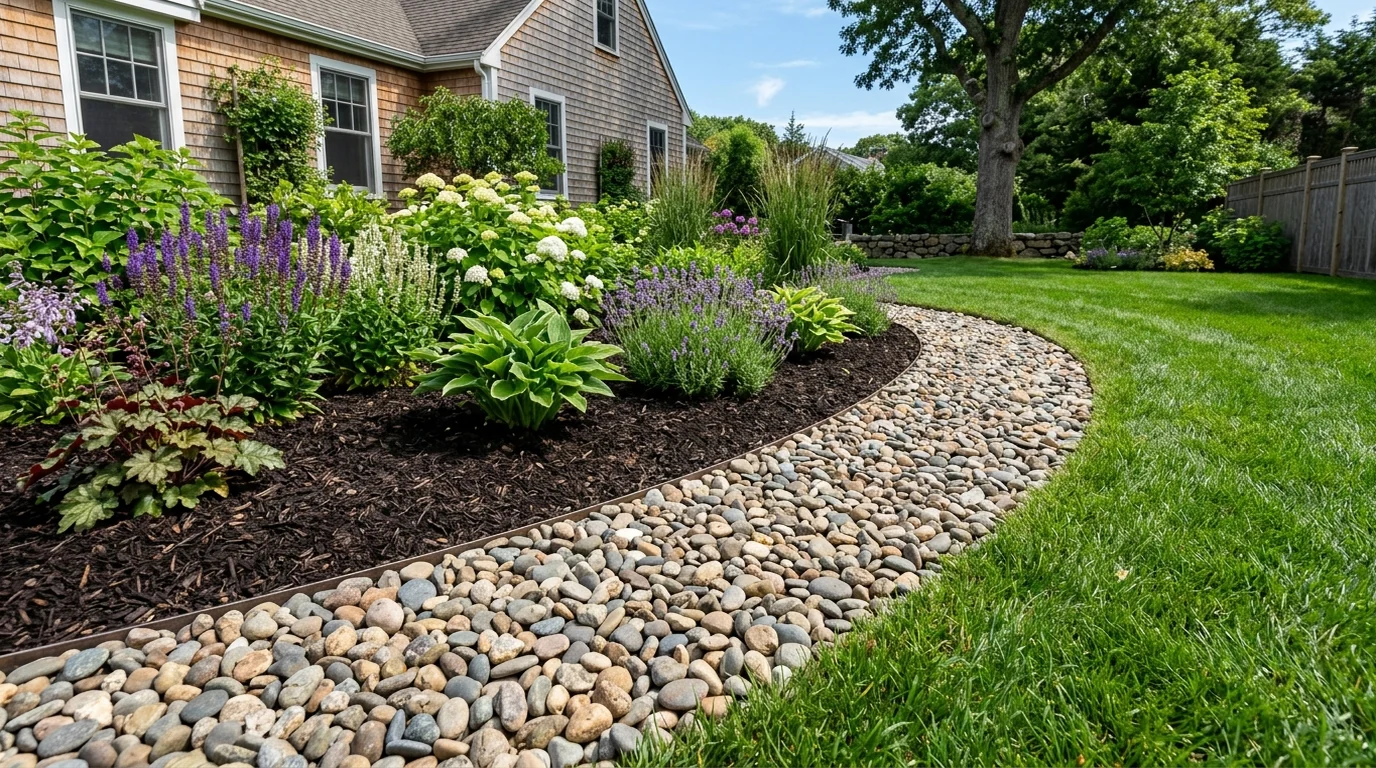
What It Is & Why It Works
During heavy New England downpours, roof gutters discharge hundreds of gallons of water at high velocity through downspout elbows. If the downspout empties directly onto bark mulch, it gouges ugly trenches and washes mulch across your lawn.
Excavating a shallow 2x3 foot depression, lining it with permeable non-woven geotextile fabric, and filling it with rounded 1-to-3-inch river stones creates a functional, rustic "dry creek splash pad" that dissipates water energy and keeps mulch in place.
Watch-Out & Foundation Slope
Slope Away From House: Ensure the soil beneath the splash pad pit slopes downward away from your foundation wall at a minimum grade of 1 inch per foot. Never allow roof water to pool against basement walls.
Chronic Pooling Warning: If water pools in your yard for more than 24 hours after a storm, a simple gravel splash pad is insufficient. The issue is subgrade compaction or poor grading requiring dedicated yard drainage solutions.
Material Comparison
The Great Debate: Mulch vs. Rocks (And the Weed Fabric Myth)
Natural Shredded Bark Mulch
Pros: Organic bark decomposes over time, feeding soil microbiology and improving moisture retention. It buffers soil temperatures during harsh winters and summer heat waves. It is easy to weed with a hand-claw, inexpensive ($35–$45 per cubic yard bulk), and simple to re-edge or modify when adding new perennials.
Cons: Requires a light 1-to-2-inch top-dress refresh every spring as it decomposes and color fades.
Decorative River Stone / Gravel
Pros: Inorganic material that never decomposes, blows away, or needs annual replacement. Excellent for dissipating high-velocity water around gutter downspouts, French drain outlets, and foundation drip-lines.
Cons: High upfront cost ($80–$120+ per yard). Absorbs intense solar radiation, heating the soil and stressing plant roots. Traps windblown dirt and organic matter over weed fabric, turning into an entrenched weed nursery within two years that cannot easily be pulled or hoed.
Why Landscape Fabric Under Organic Bark Mulch is a Huge Mistake
Beginners often believe laying woven weed barrier fabric underneath bark mulch permanently stops weeds. In reality, wind and trees blow dust, pollen, and leaves on TOP of the fabric. Within 12 to 18 months, that debris breaks down into a fresh 1-inch layer of rich compost right above the plastic weave.
Weed seeds land from the air, sprout in the top mulch, and send roots directly through the tiny pores of the weed barrier. When you try to pull the weeds, they are firmly knitted into the plastic mesh and tear off at the crown. Skip fabric under mulch; use a clean 3-inch layer of bark mulch directly over bare soil, and pull occasional weeds effortlessly by hand.
Implementation Roadmap
The Beginner 10-Step Framework: Where to Start Without Overwhelm
Observe Sunlight Patterns Across the Day
Check your yard at 9:00 AM, 1:00 PM, and 5:00 PM. Knowing whether a bed receives full sun (6+ hours), partial shade (3–6 hours), or deep shade dictates plant survival.
Map Water Runoff During a Heavy Downpour
Go outside in the rain with an umbrella. Identify where water sheets off the roof, puddles against siding, or ponds in the lawn. Never build planting beds in spots that trap standing water.
Perform a 'Keeper Audit' Before Demolition
Do not bulldoze your existing landscape. Identify healthy mature shrubs, perennial roots, and shade trees. Pruning existing assets saves thousands compared to buying young replacements.
Call Dig Safe (811) Before Shovel Work
In Massachusetts, M.G.L. c. 82 § 40 requires notifying utility locators at least 72 hours before excavation. It is free and prevents striking gas lines, electrical conduits, or fiber optic cables.
Pick ONE High-Impact Focus Zone
Do not attempt the entire yard at once. Focus 100% of your energy on one 15-foot zone—such as the front entryway walkway or the mailbox island—until it is completely finished.
Establish Clean Bed Boundaries
Lay out a garden hose in smooth, sweeping curves. Use a flat-edge spade to cut a crisp 3-to-4-inch trench edge that physically separates lawn roots from the garden bed.
Select Plants Using the 3-5-7 Drift Rule
Pick 3 reliable plant varieties adapted to your sun conditions. Buy 3, 5, or 7 of each and space them in staggered groupings rather than scattering single plants.
Spread 2 to 3 Inches of Natural Bark Mulch
Evenly distribute shredded hemlock or pine bark mulch across the bed. Keep mulch 2 inches away from plant stems and 3 inches away from tree root flares.
Deep Soaking & Root Establishment
Water newly planted perennials and shrubs deeply twice a week for the first month to encourage roots to dig deep into the subsoil, rather than shallow daily sprinkles.
Evaluate & Enjoy Before Expanding
Live with your new completed zone for a full season. See how plants grow into their mature spread and enjoy the curb appeal boost before moving to the next area of your yard.
Local Reality
Easy Landscaping Ideas That Make Sense in Peabody, MA
USDA Hardiness Zone 6b & Freeze-Thaw Cycling
Per the updated USDA Plant Hardiness Zone Map, Peabody, MA (ZIP 01960) sits in Zone 6b, with extreme winter minimum temperatures reaching -5°F to 0°F. While coastal maritime breezes soften winter lows slightly compared to interior Massachusetts, the North Shore experiences severe repeated freeze-thaw cycles from December through March.
Any plastic edging or shallow-set pavers will pop out of the ground if not installed properly. Stick to spaded trench edging for beds and ensure stepping stones sit flat on a compacted base.
Snow Storage & Road Salt Protection
When planning front walkway and driveway landscaping, design for winter snowplows. Town plows throw heavy, salt-laden slush 6 to 10 feet into front yards along Peabody streets like Lowell Street and Lynnfield Street.
Avoid brittle evergreen shrubs (like dwarf arborvitae or boxwood) directly along the curb where heavy snow will crush them or road salt will burn their foliage. Use resilient salt-tolerant deciduous perennials like daylilies, rugosa rose, or switchgrass that die back to the ground before winter plowing begins.
Massachusetts Prohibited & Invasive Plants to Avoid
Before buying plants, check the current Massachusetts Prohibited Plant List managed by the Department of Agricultural Resources (MDAR). Popular older landscape plants are now legally banned from sale, propagation, or distribution in Massachusetts due to severe environmental damage to local forests and wetlands:
- ✗ Burning Bush (Euonymus alatus)
- ✗ Japanese Barberry (Berberis thunbergii)
- ✗ Callery / Bradford Pear (Pyrus calleryana - Banned Sept 2024)
- ✗ Norway Maple (Acer platanoides)
Instead, choose safe Massachusetts native alternatives like Highbush Blueberry (Vaccinium corymbosum) for fiery scarlet fall color, or Fothergilla for fragrant spring bottlebrush blooms.
Knowing Your Limits
When Does a Project Exceed 'Easy DIY'?
While laying mulch, cutting bed edges, and planting perennials are ideal weekend projects, certain conditions require commercial equipment, structural engineering, and specialized crews:
- Slope Retention & Soil Failure:Hillside terracing or retaining walls over 3 feet tall require structural footings, geogrid reinforcement, and municipal permits under Massachusetts building codes. Read our guide to cinder block retaining walls for engineering details.
- Severe Grading & Water Intrusion:Water pooling within 10 feet of your foundation wall cannot be cured by mulch or rock. It demands proper slope grading, French drains, or swales.
- Large Patios & Driveway Hardscapes:Excavating 8 to 12 inches of dense glacial till subsoil and mechanically compacting tonnage of crushed gravel requires heavy machinery.
- Large Tree Removal & Root Clearing:Felling dead trees or grinding extensive root systems near buried utilities demands licensed, insured arborists.
If your yard goals involve integrating multiple areas—combining planting beds with walkways, lawn grading, and drainage—explore our comprehensive Peabody landscape design planning guide or check current project investment ranges in our Peabody landscaping cost guide.
Answers
Frequently Asked Questions About Easy Landscaping
01Where should a beginner start with landscaping?
Start by observing before buying anything. Spend a weekend noting sun and shade patterns across the day, identifying downspout runoff paths during rain, and cataloging healthy existing shrubs you want to keep. Choose one single high-impact zone—such as the front entryway walkway—and focus exclusively on cleaning edges, laying fresh natural bark mulch, and planting a simple drift of three to five identical site-adapted perennials.
02What is the easiest, lowest-maintenance landscaping option?
The lowest ongoing maintenance setup combines deep spaded trench edging, a 2- to 3-inch layer of shredded hardwood or hemlock bark mulch, and massed groupings of hardy native perennials (such as purple coneflower, black-eyed Susan, or catmint) matched to your yard's natural sun exposure. Grouped perennials canopy over the soil within two seasons, naturally shading out weeds while the spaded trench blocks turfgrass stolons without plastic edging.
03Is mulch or river rock easier to maintain?
While homeowners assume river rock is 'permanent zero maintenance,' organic bark mulch is generally much easier over 3 to 5 years. Rock beds trap windblown dust, fallen leaves, and seeds that turn the landscape fabric beneath them into a weed nursery that cannot easily be hoed or weeded. Bark mulch naturally decomposes, enriches soil, keeps roots cool, and only requires a shallow 1-inch top-dress refresh every spring.
04How can I improve my front yard landscaping on a small budget?
Focus on editing and defining what already exists rather than purchasing expensive new materials. Re-cutting a crisp 3-inch trench edge around existing beds costs $0 if you own a flat garden spade. Adding two yards of bulk dark bark mulch ($80–$120) and two matching container planters at the front door ($60–$100) delivers immediate curb-appeal transformation for under $250.
05What can I do to landscape my yard in just one weekend?
In a single weekend, you can execute a three-step refresh: (1) selective rejuvenation pruning to remove deadwood and lift overgrown branches away from front windows, (2) spading crisp curved trench edges along your lawn perimeter, and (3) spreading 2 inches of natural dark bark mulch while keeping it 2 inches away from tree trunks and foundation siding.
06Why do so many beginner flower beds fail or become overrun with weeds?
The most common beginner mistakes are buying one individual plant of 10 different species (creating a fragmented garden with different watering and pruning needs), skipping physical bed edging so lawn grass creeps in, and relying on cheap weed barrier fabric under organic mulch. Decomposing organic matter on top of fabric creates a fertile seedbed for windblown weeds whose roots entangle in the fabric weave.
07When does an 'easy' landscaping project require professional help?
A project exceeds DIY scope when it involves significant soil grading, standing water near the foundation requiring deep French drains, structural retaining walls holding back sloped earth, or tree planting near buried gas and electric lines. While bed edging and perennial planting are beginner-friendly, structural and water management work carries expensive structural risks if installed improperly.
Horticultural guidance synthesized from UMass Amherst Center for Agriculture, Food, and the Environment (CAFE), the Massachusetts Department of Agricultural Resources (MDAR) Prohibited Plant List, USDA Plant Hardiness Zone 6b data, and New England ecological landscape standards.
Updated:Planning a broader yard transformation in Peabody?
Whether you need help reshaping overgrown foundation beds, installing proper yard drainage, or connecting a walkway with new planting beds, we can connect you with an independent local landscape professional.
Get connected with an independent local landscaping professional. Calls go to (877) 537-6896.